


Key Takeaways
- Benzodiazepines like diazepam, chlordiazepoxide, and lorazepam remain the first-line choice for alcohol withdrawal because they ease acute symptoms and lower seizure and delirium tremens risk 3, 1.
- Medication choice depends on drinking history, prior withdrawal severity, liver function, other substances in your system, age, and how closely you can be monitored by a trained team 2.
- Thiamine, folate, and a multivitamin are given at the start of treatment to help prevent Wernicke encephalopathy, while phenobarbital or gabapentin may be considered as alternatives in selected situations 1.
- Stopping heavy drinking on your own can be life-threatening, so withdrawal medication belongs in a supervised setting that connects into PHP, IOP, outpatient, and continuing care 2.
What Doctors Actually Reach For First
If you’re trying to find out which alcohol withdrawal medication a doctor would actually give you, the short answer is a benzodiazepine, almost always paired with thiamine and other B vitamins, chosen and dosed based on how your body is reacting hour by hour. Diazepam (Valium), chlordiazepoxide (Librium), and lorazepam (Ativan) are the usual first picks because they ease acute withdrawal and, importantly, they cut the risk of withdrawal seizures and delirium tremens 3, 1.
That sounds simple on paper. In real life, the choice depends on things only a clinician can weigh: how much you’ve been drinking, how long, whether you’ve had seizures or the DTs before, how well your liver is working, what other medications or substances are in your system, and whether you’ll be monitored closely enough to catch trouble early 2.
How a Clinician Picks the Right Medication for You
There isn’t one correct answer sitting in a drawer waiting for you. The medication you receive is the output of a short, careful assessment that happens in the first hour or two after you arrive, and it keeps getting updated as your body tells the care team what it needs.
Here’s what a clinician is actually looking at before writing an order:
- Your drinking pattern. How much, how often, and for how long. Someone drinking a pint of vodka a day for ten years is in a different risk category than someone who binges on weekends 2.
- Your withdrawal history. Have you had a seizure coming off alcohol before? Have you ever hallucinated, lost time, or ended up in an ER with the DTs? Prior severe withdrawal is one of the strongest predictors of severe withdrawal this time 2.
- Your liver. Diazepam and chlordiazepoxide are processed by the liver into long-acting metabolites. If your liver is struggling, those metabolites stack up and sedate you more than intended. Lorazepam, which clears differently, often becomes the better pick in that case 1.
- What else is in your system. Opioids, benzodiazepines bought on the street, sleep aids, muscle relaxers, even high doses of certain antihistamines all stack central nervous system depression on top of what withdrawal medication adds. The FDA labels for diazepam and chlordiazepoxide carry clear warnings about this combination 4, 5.
- Your age and overall health. Older adults, people with heart or lung conditions, and people with a history of falls need gentler dosing and closer watching.
- How closely you can be monitored. This is the part most people don’t think about. The same person might receive different medication at an ICU bedside, a residential detox with nurses on site around the clock, or a once-a-week outpatient check-in. NIAAA draws a clear line between people who can be managed outpatient and people who need intensive inpatient care 2.
Benzodiazepines are the backbone of this toolkit because, across decades of use, they reduce acute symptoms and lower the risk of seizures and delirium tremens better than the alternatives 3. But “benzodiazepine” is a category, not a prescription. Which one, how much, how often, and for how long are all adjusted to you.
If this feels like a lot of variables, that’s the point. It’s also why trying to guess your way through withdrawal at the kitchen table is so risky. A trained team can see you shift from stable to seizure-prone in a matter of hours and change course before anything bad happens. You can’t do that for yourself.
Benzodiazepines: Why They Remain the First-Line Choice
Benzodiazepines have held the top spot in alcohol withdrawal care for decades, and nothing newer has knocked them off. The reason is simple: they do two things at once. They quiet the agitation, tremor, racing heart, and sweats that make withdrawal miserable, and they measurably lower your risk of the two outcomes that can kill you — withdrawal seizures and delirium tremens 3, 1.
They’re described by NIAAA as the gold standard for medically managed alcohol withdrawal because of how reliably they relieve acute symptoms and reduce the risk of seizures and delirium tremens across the severity range 3. Nothing else in the current toolkit does that job as consistently.
The FDA has recognized this role for a long time. Acute alcohol withdrawal appears right on the labels of diazepam and chlordiazepoxide as an approved use, with those labels specifically describing relief of symptoms like agitation and tremor 4, 5. That matters because it means the use isn’t experimental or off-label — it’s the standard of care, written into the regulatory record.
What benzodiazepines are not is casual medicine. The same labels carry serious warnings about combining them with opioids, alcohol, or other sedating substances, because stacking central nervous system depressants can slow your breathing to a dangerous point 4, 5. NIAAA makes the same point from a different angle: benzodiazepines are the gold standard inside a medically managed withdrawal, but they shouldn’t be used casually for everyday anxiety, sleep trouble, or mood problems outside that setting 3. That’s why you receive them under supervision, at specific doses, for a bounded window — not as a prescription you take home and manage yourself.
Diazepam (Valium), Chlordiazepoxide (Librium), and Lorazepam (Ativan): How They Differ
Here’s where “a benzodiazepine” stops being a single thing. These three drugs are in the same family, but a clinician picks between them for real reasons.
Diazepam (Valium) is long-acting. Once it’s in your system, it stays there and slowly tapers itself off through active metabolites your liver produces. For a healthy liver, that’s a feature — the medication smooths out withdrawal on its own rather than wearing off abruptly and letting symptoms rebound. Acute alcohol withdrawal is an approved use right on the diazepam label 4.
Chlordiazepoxide (Librium) is also long-acting and has been used for alcohol withdrawal almost since benzodiazepines existed. It’s on-label specifically for “withdrawal symptoms of acute alcoholism,” and UK clinical guidance identifies it, along with diazepam, as one of the commonly used benzodiazepines in medically assisted withdrawal 5. Like diazepam, it depends on your liver to process it, and both labels warn about dangerous sedation and respiratory depression when combined with opioids or other depressants 4, 5.
Lorazepam (Ativan) is shorter-acting and clears through a different metabolic pathway that doesn’t rely as heavily on liver function. If your liver is struggling — which is common after years of heavy drinking — the long-acting metabolites of diazepam or chlordiazepoxide can stack up and oversedate you. Lorazepam sidesteps that problem 1. It’s also the usual choice for older adults, people with significant lung or heart disease, and anyone where closer, more controlled dosing is safer than a slow fade.
None of this is something you should try to decide for yourself based on what sounds familiar. The point is that a care team is choosing with your specific body, history, and labs in mind — and that choice can change mid-stay if your liver numbers come back off or your symptoms shift.
Symptom-Triggered vs. Fixed-Dose Scheduling: What You May See in Detox
There are two main ways to put benzodiazepines to work during withdrawal, and you’ll likely encounter one or the other if you go through medical detox.
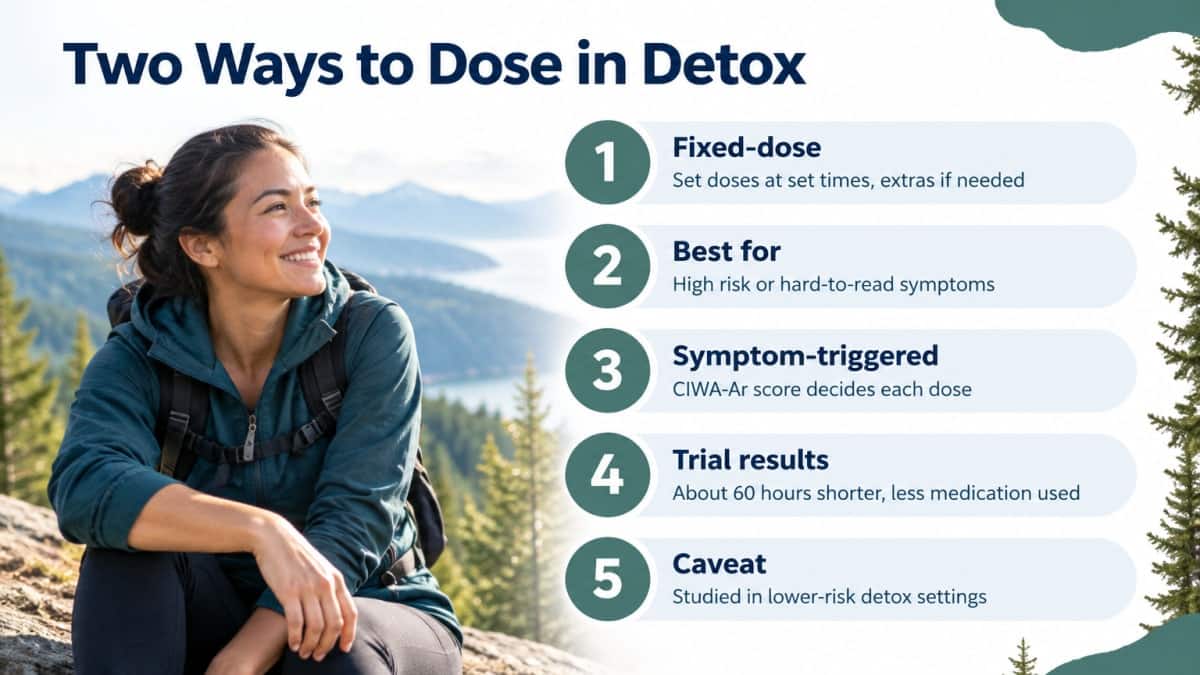
Fixed-dose scheduling means you receive a set dose at set times — say, every six hours — with extra doses available if symptoms break through. It’s predictable and safe for people whose symptoms may be hard to read, who can’t communicate well, or who are at high risk for severe withdrawal.
Symptom-triggered scheduling flips the logic. A nurse scores your withdrawal every few hours using a tool called the CIWA-Ar, which rates things like tremor, sweating, nausea, and anxiety. You receive medication only when the score crosses a threshold 9. If your body stays calm, you get less. If it ramps up, you get more, right when you need it.
Research in specialized, lower-risk detox settings has shown real differences between the two approaches. A meta-analysis of six randomized trials covering 664 patients found that symptom-triggered care shortened treatment by about 60.4 hours on average and reduced total benzodiazepine exposure by roughly 10.5 mg of lorazepam-equivalent compared with fixed-dose scheduling 10. In plain terms: shorter stays, less medication in your body, when the setting and patient are right.
Those are real wins, but they come with a bounded footnote. The same analysis couldn’t draw firm conclusions about mortality, seizures, or delirium, and the authors cautioned that the benefit doesn’t transfer cleanly to general hospitals or sicker patients 10. A 2026 clinical review made a related point — the CIWA-Ar needs trained staff to use well and isn’t a fit for people who are confused, uncooperative, or unable to report what they feel 9.
That’s why you may walk into one program on a fixed schedule and another on symptom-triggered dosing. Neither one is “better” in the abstract. It’s about matching the method to who you are and where you’re being cared for.
Phenobarbital: Where It Fits and Where the Evidence Is Still Thin
Phenobarbital is the one non-benzodiazepine you’re most likely to hear about if you ask a nurse or doctor what else is in the toolkit. It’s a barbiturate, it’s been around for over a century, and in the hands of experienced clinicians, it can either replace benzodiazepines or get added on top of them for severe cases in closely monitored settings 1.
The honest picture of the evidence is more measured than the enthusiasm you’ll find on some medical forums. A systematic review of emergency department use found that randomized trials generally did not show meaningful differences from benzodiazepines on most outcomes, though adjunctive phenobarbital was sometimes linked to lower benzodiazepine use and fewer ICU admissions in retrospective data 6. A 2026 meta-analysis in critically ill adults compared phenobarbital-based and benzodiazepine-based pathways and found no statistically significant difference in intubation (odds ratio 0.62, 95% CI 0.20–1.87) or hospital length of stay 7.
What that means for you, in plain terms: phenobarbital is a real option, not a miracle upgrade. It’s long-acting, which can smooth out severe withdrawal, and it may lower the amount of benzodiazepine you need. But it also carries real risks of oversedation and respiratory depression, especially if other depressants are in your system, which is why it belongs in a setting where someone is watching your breathing and vital signs closely — not in a bottle you take home.
Gabapentin and Carbamazepine: Options for Milder Withdrawal
Not everyone coming off alcohol needs a benzodiazepine. For people with mild-to-moderate symptoms, no history of seizures or delirium tremens, and a care team that can watch them closely, two older medications sometimes come into play: gabapentin and carbamazepine.
Gabapentin is best known as a nerve pain and seizure medication. In alcohol withdrawal, it may help with cravings, insomnia, or depressive symptoms as an adjunct in selected hospitalized patients 1. Carbamazepine, an anticonvulsant, is listed in professional guidance as an appropriate alternative in selected mild-to-moderate cases or when benzodiazepines are contraindicated.
Here’s the honest limit on both. A rapid systematic review of non-benzodiazepine, non-barbiturate options concluded that benzodiazepines remain the treatment of choice, and that gabapentin might be an alternative in specific circumstances but still needs stronger evidence and careful attention to misuse risks in the community 8. In plain terms: these drugs are not a swap-in for severe withdrawal. They may fit someone whose risk score stays low, who has no prior DTs or seizures, and who checks in regularly with a clinician — not someone shaking in bed at 3 a.m. hoping a few pills from an old prescription will carry them through.
Thiamine, Folate, and the Vitamins That Protect Your Brain
Alcohol does two unkind things to the brain at once. It damages nerve cells directly, and it strips out the vitamins those cells need to repair themselves — especially thiamine (vitamin B1). After years of heavy drinking, many people arrive at detox already running on fumes nutritionally, even if they look fine on the outside.
That’s why thiamine, folic acid, and a multivitamin are given from the very start of alcohol withdrawal treatment, not as an afterthought once the shakes settle 1. Thiamine in particular matters because low levels can trigger Wernicke encephalopathy — a serious neurological condition that causes confusion, trouble with coordination, and vision changes, and can leave permanent memory damage if it isn’t caught early.
These aren’t the headline drugs, but they’re part of why you walk out of a supervised detox clearer-headed than you walked in. A bottle of drugstore vitamins at home can’t replicate the dosing, timing, or the clinical eye watching for the subtle signs that something more is going on.
Dexmedetomidine and Other Adjuncts: Helpful, Not a Substitute
Every few years a newer medication gets attention as a possible replacement for benzodiazepines in alcohol withdrawal. Dexmedetomidine is the current example. It’s a sedative used in intensive care settings and has been studied as an add-on to standard withdrawal treatment. On paper, that sounds like it could be an upgrade. In practice, the evidence tells a more careful story.
A 2024 systematic review and meta-analysis looked at dexmedetomidine as an add-on to standard withdrawal treatment and found two things worth knowing. It did not significantly reduce the risk of needing a breathing tube, and it was associated with a 2.68 times higher relative risk of bradycardia — a dangerously slow heart rate 11. In short: it didn’t deliver the safety upgrade people hoped for, and it introduced a cardiac risk of its own.
That’s why dexmedetomidine shows up as an ICU adjunct for selected refractory cases rather than a stand-alone fix. It doesn’t address the underlying seizure risk the way a benzodiazepine does 11. If someone tells you a newer drug has replaced the first-line options for alcohol withdrawal, the current evidence doesn’t back that up.
Matching Medication to the Right Setting of Care
The same person with the same drinking history can end up on very different medication plans depending on where they’re being cared for. That’s not a quirk of the system. It’s the system working the way it should: the medication follows the monitoring.
Outpatient care is reserved for people with mild symptoms, no history of seizures or delirium tremens, a safe home environment, and someone sober nearby. NIAAA draws a clear line here, and the medications used tend to be lower-risk choices like gabapentin or a short, carefully supervised benzodiazepine course with daily check-ins 2, 8. If any of those conditions aren’t met, outpatient isn’t appropriate.
Emergency departments stabilize people in acute crisis — active seizures, severe agitation, or symptoms that escalated faster than expected. Benzodiazepines are front-loaded to get symptoms under control, and phenobarbital sometimes gets added when standard dosing isn’t enough 1, 6. The ED is a starting point, not a treatment plan.
ICU care is where the sickest patients land — those with delirium tremens, respiratory compromise, or multiple medical complications. Here you’ll see high-dose benzodiazepines, phenobarbital, and sometimes dexmedetomidine as an adjunct, with a ventilator and continuous cardiac monitoring on standby 7, 11.
Non-hospital residential detox sits in the middle. It fits people who need around-the-clock nursing and medication management but aren’t medically unstable enough to require a hospital bed. Benzodiazepines are the backbone, dosing can be symptom-triggered or fixed depending on the person, and thiamine and vitamins are part of the standard orders from day one 1, 3. If you’re in the Portland metro, Milwaukie, or anywhere in SW Washington — or coming from out of state — this is the level of care most people picture when they imagine “going to detox.” It’s a real bed with real nurses, not a hospital hallway.
From Withdrawal to Recovery: Medications for Alcohol Use Disorder
Getting through the first week is a real accomplishment. It’s also not the whole story. The medications that carry you through withdrawal — benzodiazepines, thiamine, maybe phenobarbital or gabapentin — do their job and then step aside. The question that shows up around day seven or eight is different: what helps you stay stopped once your body has settled down?
There are medication options approved for alcohol use disorder that your care team can walk you through once the acute withdrawal is behind you. Those conversations work best in context — with a clinician who knows your drinking history, your health, and what you’ve already tried, and who can weigh the pros and cons with you.
Whatever shows up on that list, medications aren’t substitutes for therapy, groups, or the daily work of a new routine. They’re more like scaffolding. Combined with counseling, peer support, and a care team that knows your history, they can tilt the odds in your direction during the months when old habits still have the loudest voice. That’s why a good detox hands you off, rather than hands you back — into partial hospitalization, intensive outpatient, outpatient, and alumni care, with the medication conversation continuing the whole way through.
How a Home-Like Medical Detox Puts This Toolkit to Work
Reading about diazepam, phenobarbital, thiamine, and symptom-triggered dosing on a screen is one thing. Watching it happen in a quiet bedroom with morning light coming through the window, a nurse checking in every couple of hours, and a provider rounding daily is another. That’s what a non-hospital medical detox is built to do: take the same evidence-based toolkit that keeps people safe in a hospital and deliver it in a setting that feels more like a house than a ward.
At Pacific Crest Trail Detox in Milwaukie, just outside Portland, that looks like RNs on site around the clock, providers rounding seven days a week, home-cooked meals, and daily groups so you’re not alone with your thoughts between doses. Benzodiazepines remain the backbone of acute care 3, paired with thiamine, folate, and a multivitamin from the first day 1. Dosing is matched to you — your drinking history, your liver, your age, how your body actually responds in the chair in front of the nurse. Most stays run eight to ten days.
Then the handoff. Detox is step one, not the finish line, which is why PCTD connects directly into partial hospitalization, intensive outpatient, outpatient, and alumni care, with the medication-for-alcohol-use-disorder conversation continuing all the way through. Outcomes are tracked through ERPHealth so the care team can keep improving what they do.
Readers come from Portland, Milwaukie, Gresham, Beaverton, Salem, Vancouver, WA — and often from out of state. Wherever you’re calling from, the goal is the same: get you through withdrawal safely, and give you a real shot at what comes next.
Check Coverage for Medically Supervised Alcohol Detox
Find out what your plan may cover as you consider safe, medically supervised alcohol withdrawal care.
Frequently Asked Questions
Can I safely stop drinking at home with over-the-counter medication?
No. If you’ve been drinking heavily for a long time, suddenly stopping can trigger seizures or delirium tremens, which can be life-threatening.2 Over-the-counter products don’t quiet the overactive nervous system that drives severe withdrawal, and they can’t prevent the dangerous spikes a trained team catches early. The safe move is a phone call to a medical detox or your doctor, not a trip to the drugstore.
Why are benzodiazepines like Valium, Librium, and Ativan used instead of newer drugs?
Benzodiazepines are the established medication class for medically managed alcohol withdrawal because they ease acute symptoms and lower the risk of seizures and delirium tremens.3 The FDA lists acute alcohol withdrawal right on the labels for diazepam and chlordiazepoxide.4, 5 Newer options like dexmedetomidine haven’t shown the same safety upgrade and carry their own risks, including a 2.68x relative risk of bradycardia.11
How do I know if I need medical detox or if outpatient care is enough?
Outpatient care may fit people with mild symptoms, no history of withdrawal seizures or delirium tremens, a sober support person at home, and a reliable way to check in daily.2 If you drink heavily every day, have had a withdrawal seizure or the DTs before, use opioids or benzodiazepines, or live alone, that’s a signal for inpatient or residential detox. When in doubt, let a clinician assess you rather than guessing.
What medications might help me stay sober after detox ends?
After the acute withdrawal phase, your care team can discuss medication options for alcohol use disorder alongside counseling, groups, and continuing care through partial hospitalization, intensive outpatient, or outpatient programs. The right choice depends on your history, health, and goals, and is best decided with a clinician who knows your situation.
How long does medical detox for alcohol withdrawal usually take at Pacific Crest Trail Detox?
Most stays run eight to ten days. The first three to four days tend to be the most intense physically, with benzodiazepines dosed to your symptoms, thiamine and vitamins from day one,1, 3 and RNs checking on you around the clock. The back half focuses on sleep, nutrition, daily groups, and planning your next step into PHP, IOP, outpatient, or alumni care. Length flexes based on your body and history.
Do you accept clients from Vancouver, WA, Salem, or out of state?
Yes. Pacific Crest Trail Detox is in Milwaukie, just outside Portland, and serves people from across the Portland metro — Gresham, Beaverton, Hillsboro — plus Salem, Vancouver, WA, and the broader Pacific Northwest. Out-of-state clients are welcome too, and the admissions team can help with travel logistics and insurance verification before you arrive. A confidential, HIPAA-protected call is the easiest first step to see whether this level of care fits your situation.
References
- Alcohol Withdrawal in Hospitalized Patients. https://www.ncbi.nlm.nih.gov/books/NBK604324/
- Alcohol Use Disorder: From Risk to Diagnosis to Recovery. https://www.niaaa.nih.gov/health-professionals-communities/core-resource-on-alcohol/alcohol-use-disorder-risk-diagnosis-recovery
- Mental Health Issues: Alcohol Use Disorder and Common Co-occurring Conditions. https://www.niaaa.nih.gov/health-professionals-communities/core-resource-on-alcohol/mental-health-issues-alcohol-use-disorder-and-common-co-occurring-conditions
- VALIUM (diazepam) label. https://www.accessdata.fda.gov/drugsatfda_docs/label/2026/013263s095lbl.pdf
- LIBRIUM (chlordiazepoxide hydrochloride) Label. https://www.accessdata.fda.gov/drugsatfda_docs/label/2016/012249s049lbl.pdf
- SAEM GRACE: Phenobarbital for alcohol withdrawal management in the emergency department: A systematic review of direct evidence. https://pubmed.ncbi.nlm.nih.gov/37589203/
- Phenobarbital Versus Benzodiazepine-Based Pathways for Alcohol Withdrawal Syndrome in Critically Ill Adults: A Systematic Review and Meta-Analysis. https://pmc.ncbi.nlm.nih.gov/articles/PMC13501059/
- The Effectiveness of Non-Benzodiazepine, Non-Barbiturate Medications for Alcohol Withdrawal Syndrome: A Rapid Systematic Review. https://pubmed.ncbi.nlm.nih.gov/33264386/
- Alcohol withdrawal: benzodiazepines, neither automatic nor systematic. https://pubmed.ncbi.nlm.nih.gov/41567041/
- Symptom-Triggered Therapy for Alcohol Withdrawal Syndrome: a Systematic Review and Meta-analysis of Randomized Controlled Trials. https://pubmed.ncbi.nlm.nih.gov/30937668/
- Dexmedetomidine as Adjunctive Therapy for the Treatment of Alcohol Withdrawal Syndrome: A Systematic Review and Meta-Analysis. https://pubmed.ncbi.nlm.nih.gov/39338290/