


Key Takeaways
- Oregon licenses adult withdrawal management at two residential tiers — ASAM 3.2-WM and 3.7-WM — and the licensed level must match patient acuity before any other referral factor matters 1.
- Chapter 309 requires an RN physically on site at all times with a 1:5 nurse-to-patient ratio and 24-hour medical consultation, so ask for the current census and ratio on the intake call 3, 4.
- Rural referrals face a workforce gap of 0.56 behavioral-health FTE per 1,000 residents versus 1.60 urban, meaning the closest bed is often not the right-acuity bed and transport to the correct level is the right call 11.
- Run the five-minute verification script on every detox referral — ASAM level, nursing coverage, medical director, escalation protocol, MAT continuation, and communication cadence — before placing a patient in any Oregon program.
What to verify before you sign a withdrawal management referral
You already know what withdrawal looks like when it goes wrong. A benzodiazepine seizure in hour 48. An alcohol detox that slides into delirium tremens because nobody was watching vitals overnight. A patient on buprenorphine whose last dose gets interrupted at admission and who leaves against medical advice by day two. The question isn’t whether detox matters. It’s whether the facility you’re sending your patient to can actually hold the acuity you’re handing them.
Three things decide that. First, the facility’s licensed ASAM level has to match your patient’s withdrawal risk — in Oregon, that means knowing whether you need a clinically managed 3.2-WM program or a medically monitored 3.7-WM program 1. Second, the staffing floor behind the front door has to be real: an RN on site around the clock, a medical director who signs off on protocols, and nursing ratios that scale with census 4. Third, somebody at that facility has to call you back — with an admission confirmation, a mid-stay medical update if something changes, and a discharge summary that lands before your patient does.
Oregon rule gives you leverage on the first two. The third is a culture question, and it’s the one most referring clinicians get burned on. The sections below walk through each verification point, give you a five-minute intake script, and show you what a working communication loop should look like when the facility is doing its job and keeping you in it.
ASAM 3.2-WM vs 3.7-WM: the licensure distinction that drives acuity decisions
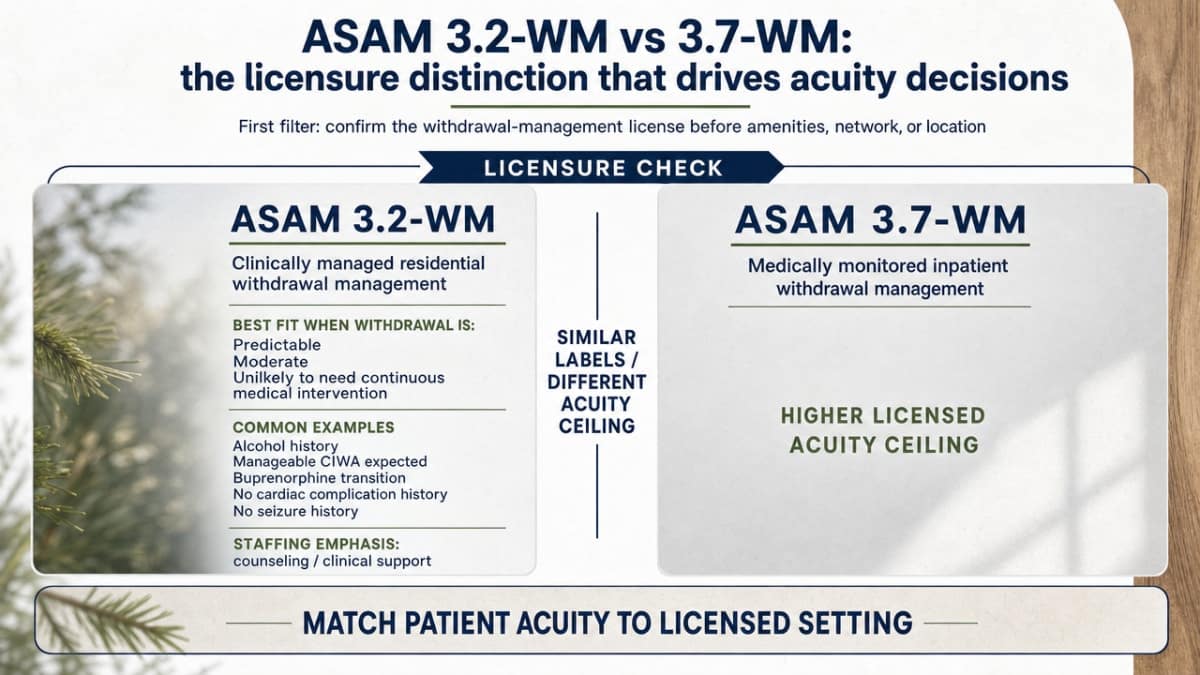
This is the first filter. Before you look at amenities, insurance networks, or location, confirm which withdrawal-management level the facility is actually licensed to deliver. Oregon approves adult programs at two residential tiers: ASAM Level 3.2-WM (clinically managed residential withdrawal management) and ASAM Level 3.7-WM (medically monitored inpatient withdrawal management) 1. The labels sound similar. The acuity ceilings are not.
A 3.2-WM program is built for patients whose withdrawal is predictable, moderate, and unlikely to require continuous medical intervention. Think of the person with a long alcohol history whose CIWA scores you expect to stay manageable, or the opioid-use patient you’re transitioning onto buprenorphine without complicating cardiac or seizure history. Staffing leans on counselors and trained support staff with nursing available, physician-approved protocols guiding medication, and 24-hour medical evaluation and consultation accessible on call rather than at the bedside 3. It’s a residential setting that can hold withdrawal — not a step-down from a hospital floor.
A 3.7-WM program is a different animal. It’s designed for patients whose vitals, mental status, or substance profile could decompensate: severe alcohol withdrawal with prior seizure or DT history, high-dose benzodiazepine tapers, polysubstance presentations where you can’t fully predict the trajectory, or anyone with unstable co-occurring medical issues that need close monitoring. Oregon’s rule requires that medical evaluation and consultation be available 24 hours a day across withdrawal-management programs, and that staffing scale to the number and severity of patients — with the operational ability to transfer or admit to 3.7-WM or a hospital when a patient outgrows the setting 3.
Here’s the practical read for a referral. If your patient’s withdrawal risk is moderate and you want them in a home-like residential environment with structured counseling layered on top of medical oversight, a 3.2-WM license fits. If you’re worried about seizures, autonomic instability, or a benzo taper that could take two weeks and get worse before it gets better, you want 3.7-WM — or you want a 3.2-WM program with a demonstrated, written pathway to transfer, not a hopeful one.
Ask the intake coordinator directly which ASAM level the facility is licensed for, and ask them to say the number out loud. “We do detox” is not an answer. “We’re licensed by OHA at ASAM 3.2-WM for adult clinically managed residential withdrawal management” is. If they can’t name the level, that’s your first data point. If they name a level that doesn’t match your patient’s acuity, ask what their escalation protocol looks like — who makes the transfer call, how quickly, and to which receiving facility. Oregon rule expects programs to have that answer written down 3. You should expect to hear it in plain language within a minute.
Nursing coverage, medical oversight, and the staffing floor Oregon rules actually require
Licensure tells you what a facility is allowed to do. Staffing tells you what it can actually hold at 3 a.m. on a Saturday when a patient’s blood pressure climbs and the next physician call isn’t scheduled until morning. Oregon rule gives you specific numbers to ask about, and the answers should come back fast.
Start with the nurse on duty. Oregon’s behavioral-health rule for withdrawal-management programs requires an RN on duty at the program site at all times — not on call, not reachable, not covering from a sister facility. On site. The same rule sets a nursing ratio of one RN or other licensed credentialed nurse for every five admitted individuals, plus one withdrawal-management program staff member for every ten admitted individuals 4. Those are floors, not targets. A program running at the ratio with a high-acuity census is a program with no slack when a second patient destabilizes.
Ask the intake coordinator two questions. What’s the current census, and what’s the nurse-to-patient ratio tonight? If the answer is vague, ask who the charge nurse is and whether you can speak with them for ninety seconds. A program that treats a referring physician as a clinical partner will put a nurse on the phone. A program that treats you as a lead-source will route you back to admissions.
Medical oversight is the second floor. Oregon’s permanent rule for withdrawal-management programs requires medical evaluation and consultation to be available 24 hours a day, with staffing scaled to patient number and severity and a documented ability to transfer or admit patients to ASAM 3.7-WM or a hospital when the clinical picture changes 3. Chapter 415 adds a written staffing plan requirement tied to the licensed ASAM level, with explicit escalation when acuity or census rises 2. That plan is a document. Ask to see it, or at minimum ask who the medical director is, how often they round, and who covers physician decisions overnight.
Chapter 309 also sets qualifications for withdrawal-management staff — CPR and first-aid training, medical-director involvement, written physician-approved protocols, and emergency transportation arrangements 4. These sound like boilerplate. They become operational the moment a patient needs an ambulance and the question is whether the on-shift staff can execute a transfer without improvising.
A quick way to pressure-test all of this on one call: ask when the last emergency transfer happened, who made the call, how long it took from decision to departure, and what the receiving facility was. You’re not looking for a specific answer. You’re listening for whether the person on the phone has the vocabulary of a program that has actually done it.
The five-minute intake call: what to ask and what the red-flag answers sound like
You don’t have thirty minutes between patients to interview a facility. You have five. Here’s the script that gets you what you need, and the answers that should make you hang up and dial someone else.
“Which ASAM withdrawal-management level are you licensed for?” A clean answer sounds like “OHA licenses us at ASAM 3.2-WM for adult clinically managed residential withdrawal management.” A red flag sounds like “We handle all kinds of detox” or any version that doesn’t name a number. Oregon requires a dedicated withdrawal-management level-of-care application for each licensed program 5, so the person answering your call should know the answer the way an ED charge nurse knows the trauma level.
“Is there an RN on site right now, and what’s your current nurse-to-patient ratio?” You want to hear a yes, a number, and ideally a name. Oregon rule puts an RN on duty at the program site at all times and sets the ratio at one nurse per five admitted individuals 4. If the coordinator says the nurse is “on call” or “covering from another location,” that’s a licensure problem, not a staffing preference.
“Who’s the medical director, and how is physician coverage handled overnight?” Medical evaluation and consultation must be available 24 hours a day 3. You want to hear a specific physician’s name, a cadence for rounding, and a clear on-call structure. “Our medical director reviews charts weekly” is not overnight coverage.
“What’s your escalation protocol if my patient destabilizes?” The answer should name a receiving hospital, a transport method, and who makes the call. If the coordinator pauses or improvises, assume the program hasn’t rehearsed it.
“Will you continue my patient’s buprenorphine from day one?” You’re looking for a yes with a prescriber name attached. A “we’ll have to ask the doctor when they come in” means a potential dose interruption, which means a patient who may walk.
“Who calls me, and when?” Admission confirmation within hours, a mid-stay update if the clinical picture changes, and a discharge summary before your patient’s follow-up visit. If the coordinator can’t describe their communication cadence back to referring clinicians, you’re the one who’ll be calling them.
Why referral quality matters right now in Oregon
Oregon posted its first year-over-year decline in overdose deaths since 2016 last year. Fatal drug overdoses dropped from 1,833 in 2023 to 1,544 in 2024 — a 16% decrease that reflects naloxone saturation, expanded medication treatment, and the hard work of clinicians across the state 8. That number is worth taking in. It’s also not a reason to loosen the standard you hold for a detox referral.
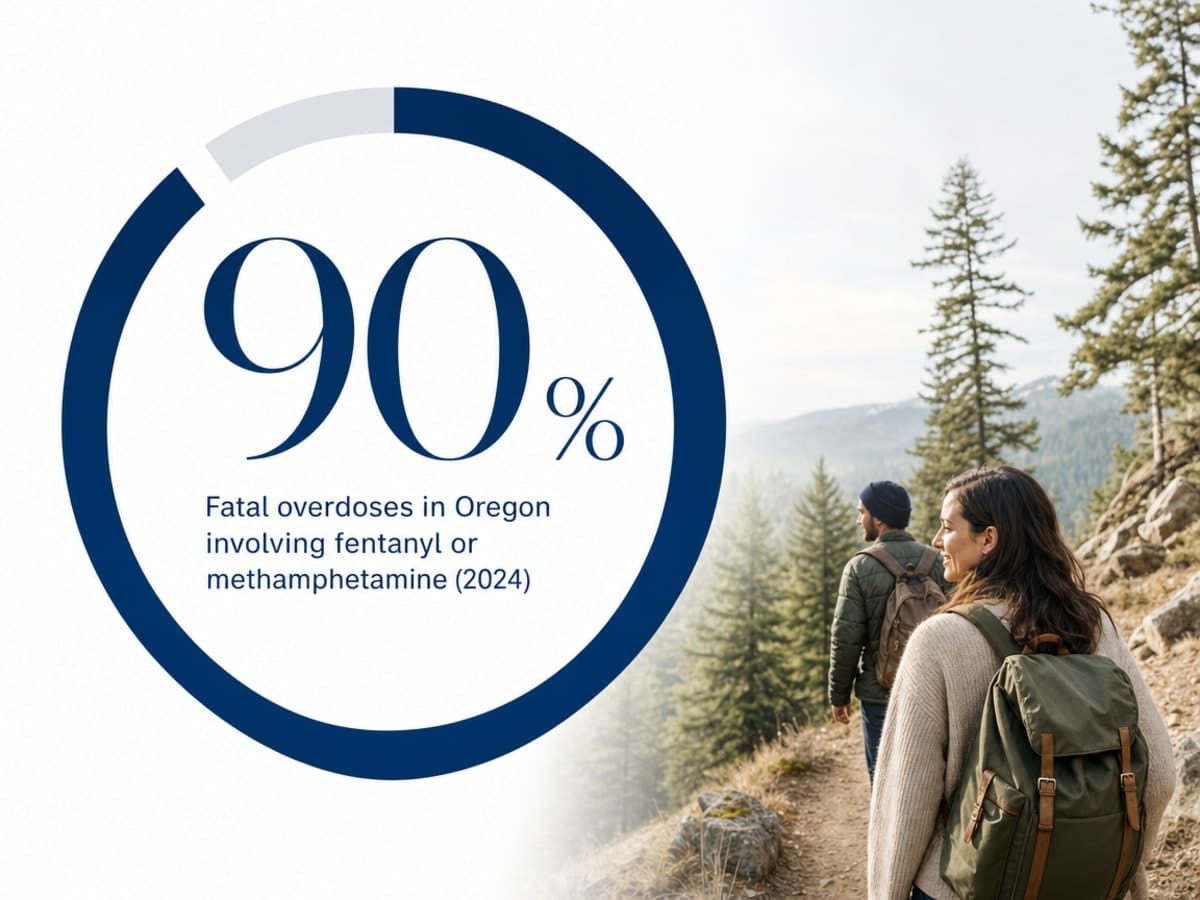
The remaining burden still runs through the same two pharmacology problems you’re already seeing in your exam room. More than 90% of Oregon’s 2024 fatal overdoses involved fentanyl, methamphetamine, or both, and 62.2% involved more than one substance 8. Polysubstance exposure complicates withdrawal assessment, medication selection, and monitoring in ways that a program licensed only for straightforward alcohol detox may not be equipped to hold. When a patient on your schedule has fentanyl and methamphetamine in their recent history, plus an alcohol pattern you’re worried about, you’re not referring a single-substance withdrawal. You’re referring a case that needs a program with nursing on site around the clock and a medical director who can adjust protocols in real time 3, 4.
Capacity is the second pressure. Oregon’s substance-use-disorder system still operates with a modeled 49% gap in needed services across the continuum, from prevention through recovery supports 9. That gap shows up as longer intake calls, fewer available beds on any given day, and real pressure to place a patient wherever a bed opens rather than where the clinical fit is best. The temptation to accept “we can take them tomorrow” without asking the licensure and staffing questions is understandable. It’s also the mechanism by which a patient ends up at a program that can’t hold their acuity.
You can’t fix the capacity gap on a single referral call. You can refuse to let it lower your floor. The verification questions in the previous sections take five minutes. Those five minutes are the difference between a referral that moves your patient forward and one that sends them back to your office — or to an ED — three days later.
Referring from outside the Portland metro: capacity and workforce realities
If you’re practicing in Hood River, Burns, Coos Bay, or anywhere the nearest licensed detox bed is a drive rather than a cross-town referral, the verification framework doesn’t change — but the arithmetic does. Oregon’s 2025 workforce assessment puts behavioral-health provider supply at 1.60 FTE per 1,000 residents in urban areas and 0.56 FTE per 1,000 in rural and remote areas, with at least one Oregon county reporting no licensed behavioral-health providers at all 11. That gap shapes every referral decision you make from outside the I-5 corridor.
What it means practically: the closest facility may not be the right-acuity facility. A patient with a complicated benzo taper doesn’t become a 3.2-WM case because the 3.7-WM bed is three hours away. If you need medically monitored inpatient withdrawal management and your local option is clinically managed residential, the right move is still the right level of care — with transport arranged, a bed confirmed by name, and the receiving program’s medical director briefed before your patient leaves your clinic.
Two resources help close the distance. Behavioral Health Resource Networks operate in every Oregon county and Tribal area, connecting patients to screening, assessment, treatment, recovery, housing, and peer support 12. They’re useful as post-detox partners when your patient will return to a community without a strong continuing-care bench. The Alcohol and Drug Help Line at 1-800-923-4357 and OHA’s provider directories can help confirm current bed availability when your usual contact doesn’t pick up 13.
One more thing worth saying plainly: a rural referral is harder, and the extra calls you make are real work on top of a full schedule. That work is also what keeps your patient from being placed somewhere that can’t hold them.
The warm handoff: closing the loop from detox back to you
Detox is a hinge, not a destination. The hours between discharge and the first continuing-care appointment are when relapse risk spikes and when a referring clinician usually finds out — too late — that nobody arranged the next step. A warm handoff fixes that. SAMHSA’s federal guidance on opioid treatment lays out the principles clearly: coordinated referrals, a mutually agreed transition plan, overdose-prevention education, and access to naloxone at discharge 7. Those principles apply to any detox, not just OTPs, and they’re what you should expect to see documented when your patient leaves the facility.
Here’s what a closed loop looks like from your side of the referral. Within hours of admission, you get a confirmation — your patient arrived, was assessed, and a treatment plan is underway. If the clinical picture shifts mid-stay — a seizure, a transfer to higher care, a decision to extend length of stay — someone calls you before you hear it from the patient or a family member. At discharge, a summary lands in your inbox with the medications continued, the MAT plan if applicable, the next appointment on the calendar, and a named contact for the receiving outpatient or recovery program.
Ask the intake coordinator to describe this cadence in specifics, not slogans. Who signs the discharge summary, and in what timeframe? Who schedules the continuing-care appointment before the patient walks out the door? If your patient needs housing or peer support alongside clinical follow-up, is the facility already connected to a Behavioral Health Resource Network in the patient’s home county 12? If they’re going home with buprenorphine, who’s the prescriber bridging until the first outpatient visit, and has naloxone been dispensed 7? A program that handles these questions crisply is a program that will keep you in the loop. A program that promises to “coordinate care” without naming the mechanics is one you’ll be chasing by phone on day four.
A physician verification table for any Oregon detox referral
Keep this one near the phone. The table below is the operational version of everything above — six verification items, what each one tells you, where the answer actually lives in Oregon rule or OHA guidance, and the red-flag response that should move your patient to a different program.
| What to verify | Why it matters | Where to confirm | Red-flag answer |
|---|---|---|---|
| Licensed ASAM withdrawal-management level (3.2-WM or 3.7-WM) | Determines the acuity the program is authorized to hold and whether your patient’s withdrawal risk fits the setting | OHA licensing page and the program’s dedicated withdrawal-management level-of-care application 1, 5 | “We do all kinds of detox” or any response that doesn’t name a specific ASAM level |
| RN on duty at the site around the clock, with current nurse-to-patient ratio | Confirms a licensed nurse is physically present overnight when withdrawal typically escalates | Oregon Chapter 309 rule: RN on duty at all times, 1 RN per 5 admitted individuals, 1 program staff member per 10 4 | Nurse is “on call,” covering from another facility, or ratio can’t be stated |
| Medical director and 24-hour physician consultation | Ensures someone can adjust protocols or order a transfer at 3 a.m. | Permanent rule 415-050: medical evaluation and consultation available 24 hours a day 3 | No named medical director, or physician review happens “weekly” |
| Written staffing plan and escalation protocol to 3.7-WM or hospital | Shows the program has rehearsed what happens when a patient outgrows the setting | Chapter 415 written staffing plan requirement tied to licensed ASAM level 2, 3 | Coordinator can’t name a receiving hospital, transport method, or decision-maker |
| MAT continuation from day one, with named prescriber | Prevents dose interruption that drives patients to leave AMA | SAMHSA transition and continuity principles for medication treatment 7 | “We’ll ask the doctor when they come in” or no bridge prescriber identified |
| Communication cadence back to the referring clinician | Keeps you in continuity-of-care ownership through admission, mid-stay changes, and discharge | SAMHSA warm-handoff and coordinated-referral guidance 7 | “We’ll coordinate care” with no named contact, timeframe, or discharge-summary turnaround |
Print it, screenshot it, drop it in your EHR referral template — whatever keeps it in reach when the next admission call comes in. Five minutes with these six questions is the floor. A program that answers all six crisply is a program worth sending your patient to.
Where Pacific Crest Trail Detox fits — and what communication to expect
Pacific Crest Trail Detox is a non-hospital medical detox program in Milwaukie that has been running since 2017, serving the Portland metro and the broader Pacific Northwest. For a referring clinician, the practical read is this: it’s a residential setting designed to feel like a home rather than a hospital floor, with medical oversight layered on top for the withdrawal syndromes where that matters most — alcohol, benzodiazepines, and opioids — plus medication-assisted treatment started on day one when buprenorphine or methadone continuity is on the line.
Use the verification framework from the earlier sections before you place the call. Confirm the current ASAM withdrawal-management level and licensure directly with intake 1, 5, and ask the same nurse-coverage and medical-director questions you’d ask any Oregon program 3, 4. The point isn’t to take any facility’s word for its own staffing — it’s to hear a program answer in specifics.
What you should expect once your patient arrives: an admission confirmation back to you within hours, a named clinical contact, a mid-stay call if the picture changes or length of stay needs to extend, and a discharge summary that reaches you before your patient’s first follow-up visit. If medication treatment is part of the plan, the summary should name the bridge prescriber and the next appointment. If the patient’s return community needs housing or peer support alongside outpatient care, the handoff should connect to a Behavioral Health Resource Network in the patient’s county 12, with navigation support through OHA’s Alcohol and Drug Help Line when a local contact isn’t reachable 13.
The continuing-care bench behind detox is the part that keeps the referral from being a one-week event. PCTD runs that bench in-house — partial hospitalization, intensive outpatient, standard outpatient, and alumni support — so the step-down from medical detox doesn’t require a second cold handoff to a program that’s never met your patient. That’s the operational version of warm handoff: fewer transitions, each one documented, with you kept in the loop as the clinician who owns continuity.
Check Insurance Coverage for Detox Admission
Find out if your patient’s detox and treatment costs are covered in minutes.
Frequently Asked Questions
How do I confirm an Oregon detox facility is licensed for the ASAM level my patient needs?
Ask the intake coordinator to name the ASAM withdrawal-management level the program holds — 3.2-WM (clinically managed residential) or 3.7-WM (medically monitored inpatient) — and cross-check it against OHA’s licensing page 1. Each licensed program must submit a dedicated withdrawal-management level-of-care application, separate from any residential-treatment license 5. If the coordinator can’t name the number, treat that as your answer.
What nursing coverage should I expect at a non-hospital Oregon withdrawal management program?
Oregon’s Chapter 309 rule requires an RN on duty at the program site at all times — physically present, not on call — with one RN or other licensed credentialed nurse per five admitted individuals and one withdrawal-management staff member per ten 4. Medical evaluation and consultation must be available 24 hours a day 3. Ask for the current census and ratio on the call; a specific answer should come back quickly.
What communication should the detox facility send back to me as the referring clinician?
Expect an admission confirmation within hours, a mid-stay call if the clinical picture shifts or length of stay extends, and a discharge summary that reaches you before the first follow-up visit. The summary should name the medications continued, the MAT bridge prescriber, the scheduled next appointment, and a contact at the receiving outpatient program. SAMHSA’s coordinated-referral and warm-handoff principles describe this cadence as the standard, not the exception 7.
Can the receiving program continue buprenorphine or other MAT my patient is already on?
It should, from day one, with a named prescriber attached. SAMHSA guidance treats medication continuity and overdose-prevention education — including naloxone at discharge — as core transition principles for any program handling opioid-use disorder 7. Ask the coordinator who prescribes on admission, who bridges to the first outpatient visit, and whether methadone or buprenorphine will be dosed without interruption. “We’ll ask when the doctor rounds” signals a likely dose gap.
What are my options when I’m referring from a rural Oregon county with limited local capacity?
Rural and remote areas report 0.56 behavioral-health FTE per 1,000 residents versus 1.60 in urban areas, with at least one county reporting none 11. The closest bed may not be the right-acuity bed. Confirm the level of care first, arrange transport second. Behavioral Health Resource Networks operate in every Oregon county for post-detox support 12, and the Alcohol and Drug Help Line at 1-800-923-4357 can help locate current availability 13.
When should I escalate a patient to ASAM 3.7-WM or a hospital instead of residential detox?
Escalate when the clinical picture suggests the patient may decompensate: prior seizure or DT history with severe alcohol withdrawal, high-dose or long-duration benzodiazepine tapers, unstable co-occurring medical issues, or polysubstance presentations where you can’t predict the trajectory. Oregon rule requires programs to maintain staffing scaled to severity and a documented ability to transfer to 3.7-WM or a hospital when needed 3. If 3.2-WM can’t hold the acuity, send the patient where it can.
References
- Oregon Health Authority : Licensing and Certification : Providers. https://www.oregon.gov/oha/bh/providers/pages/licensing-certification.aspx
- Health Systems Division: Addiction Services – Chapter 415. https://www.oregon.gov/oha/HSD/Medicaid-Policy/SUDWaiver/415-050-Highlighted-040723.pdf
- OFFICE OF THE SECRETARY OF STATE. https://www.oregon.gov/oha/HSD/HSDRules/Perm415-050.04072023.pdf
- Behavioral Health Services – Chapter 309. https://www.oregon.gov/oha/HSD/RAC/309-018.pdf
- Oregon Health Authority : Substance Use Disorder Service …. https://www.oregon.gov/oha/OHP/Providers/Pages/SUD.aspx
- OFFICE OF THE SECRETARY OF STATE. https://www.oregon.gov/oha/HSD/HSDRules/415-012-changes-12012017.pdf
- Federal Guidelines for Opioid Treatment Programs. https://library.samhsa.gov/sites/default/files/federal-guidelines-opioid-treatment-pep24-02-011.pdf
- 2025 – Opioids and the Ongoing Drug Overdose Crisis in Oregon. https://www.oregon.gov/oha/PH/PREVENTIONWELLNESS/SUBSTANCEUSE/OPIOIDS/SiteAssets/Lists/feature/EditForm/2025%20Oregon%20Opioid%20Overdose%20Report.pdf
- Substance Use Disorder Integration Report. https://www.oregon.gov/oha/HSD/AMH/DataReports/SUD-Integration-Report.pdf
- July 2024 Report. https://www.oregon.gov/adpc/SiteAssets/Pages/reports/July%202024%20Report%20FINAL%20-%20Updated%20September%202024.pdf
- Oregon’s Health Care Workforce Needs Assessment 2025. https://www.oregon.gov/oha/HPA/HP-HCW/Documents/2025-Health-Care-Workforce-Need-Assessment-report-final.pdf
- Behavioral Health Resource Network (BHRN) Program : Providers. https://www.oregon.gov/oha/bh/providers/pages/bhrn-program.aspx
- Oregon Health Authority : Addiction Services : Behavioral …. https://www.oregon.gov/oha/BH/Adults/Pages/Substance-Use.aspx