


Key Takeaways
- An alcohol withdrawal scale like CIWA-Ar is a short checklist a trained nurse uses to measure withdrawal severity right now, scoring 10 signs on a 0 to 67 range.4, 17
- The number is a shared ruler, not a diagnosis, repeated every few hours so the care team can adjust medication and monitoring before symptoms turn dangerous.1
- Scores around 15 signal increased risk for confusion and seizures, and VA/DoD guidance treats scores near 20 or higher as severe withdrawal needing inpatient care.1, 3
- Scoring yourself at home is unsafe because withdrawal can bring seizures or delirium tremens, and people becoming disoriented rarely notice it in themselves.2
What a Number on a Clipboard Actually Means
If you are reading this with shaky hands at 3 a.m., or decoding a text from the ER that said “his CIWA was 18,” start here. An alcohol withdrawal scale is a short, repeatable checklist a trained clinician uses to measure how rough withdrawal is right now, and whether it is getting better or worse hour by hour. The most common one, the Clinical Institute Withdrawal Assessment for Alcohol, revised (CIWA-Ar), rates 10 withdrawal signs on a 0 to 67 range and usually takes about two minutes at the bedside.4, 17
The number is a ruler, not a verdict. It helps a nurse decide whether you need more medication in the next hour, closer monitoring, or a quieter room, and it gives the next person on shift a shared language for what they are watching.1
What Is the Alcohol Withdrawal Scale Clinicians Use Most?
The scale you will hear named most often is the Clinical Institute Withdrawal Assessment for Alcohol, revised, usually spoken as CIWA-Ar. It was published in 1989 as a shortened 10-item version of an earlier tool, built to be quick, repeatable, and useful both at the bedside and in research.4 If a nurse in a Portland hospital or a detox in Milwaukie, Oregon says they are “doing a CIWA,” this is the sheet they are filling out.
CIWA-Ar rates 10 withdrawal signs. Nine of them are scored 0 to 7, and one, orientation, is scored 0 to 4. Add them up and the total runs from 0 to 67.17 A trained nurse can usually complete it in about two minutes, which matters because during the first day or two off alcohol, your body can change faster than that.17
The score is not a diagnosis. It is a shared number that tells the whole care team how your symptoms compare to an hour ago, a shift ago, or yesterday. A low score at breakfast does not promise a low score at midnight, which is why the scale gets used over and over, not once.1
Clinicians also pair the number with the rest of your story: how much you were drinking, how long, past withdrawal seizures, other medications, medical conditions, and what your pulse and blood pressure are doing right now.2 The scale organizes what they see. Their training decides what to do about it.
The 10 Things CIWA-Ar Is Really Watching
Body Symptoms: Tremor, Sweats, Nausea, Headache, Pulse
When a nurse asks you to hold out your hands with your fingers spread, they are not making small talk. They are scoring tremor, one of the first items on CIWA-Ar. A tremor you can barely feel might score a 1 or 2. Visible shaking with your arms extended lands higher. A shake you cannot stop, even at rest, climbs toward the top of the 0 to 7 range for that item.4
Sweating gets the same treatment. A damp forehead is scored differently than a soaked shirt and beads running down your temples. Nausea and vomiting are rated from “no nausea” to constant nausea with dry heaves. Headache is scored by how heavy or tight your head feels, from nothing to extremely severe.17
Pulse and blood pressure are measured too, though they live on the vital-signs sheet next to the scale. A racing heart and climbing blood pressure usually track with a climbing score, and they are part of why early withdrawal gets watched closely even when you feel “not that bad.”18 Your body often tells on itself before your mind catches up.
Perceptual Shifts: Hearing, Seeing, and Feeling Things That Are Not There
Three CIWA-Ar items ask about the senses: tactile, auditory, and visual disturbances. Each is scored 0 to 7.4 This is where people often get quiet, because the symptoms sound scarier than tremor or sweating. They should not.
Tactile means skin sensations. Itching, pins and needles, the feeling of bugs crawling on your arms. A nurse will ask directly, because people rarely volunteer it.
Auditory covers sound. Noises that seem too loud, ringing, hearing voices or sounds that are not in the room. Visual covers light sensitivity and seeing things, from shadows that seem to move to full visual hallucinations.17
Lower scores on these items mean you notice something is off, maybe a flicker at the edge of your vision or a sound that is too sharp. Higher scores mean the perceptions feel real and continuous. These items matter because perceptual disturbances often rise before the most dangerous complications show up, which is why your care team wants to hear about them without judgment.1
Head and Mood: Anxiety, Agitation, and Knowing What Day It Is
The last three items cover what is happening inside your head. Anxiety is rated from calm to “acute panic states.” Agitation is scored by what the nurse sees, from normal activity to constant pacing or thrashing. Both run 0 to 7.4
The tenth item is different. Orientation and clouding of sensorium is scored 0 to 4, which is why the total maxes out at 67 instead of 70.17 A nurse will ask what day it is, where you are, and your name. Getting one wrong is a 1. Being disoriented to place or person is a 3 or 4. That drop in orientation is one of the signals clinicians watch most closely, because it can precede alcohol withdrawal delirium.1
Put all 10 items together and you get a number from 0 to 67 that a trained nurse can produce in about two minutes.17 Educational materials from the VA group scores under 8 to 10 as minimal-to-mild withdrawal, 8 to 15 as moderate, and 15 or higher as severe.17 Those bands guide thinking. They do not override it.
What a CIWA-Ar Score of 8, 15, or 20 Looks Like in a Body
Numbers on a scoring sheet feel abstract until you put them back in a body. Here is what the common thresholds tend to look like from the inside, with the caveat that two people with the same score can feel very different.
Around 8. This is the edge of mild withdrawal.1 You might feel shaky, a little sweaty, mildly nauseous, and wired in a way that will not let you sit still. Sleep is thin or gone. Your pulse is up. You can still answer questions, know where you are, and track a conversation, but your skin feels wrong and small sounds seem loud. Educational materials from the VA call scores under 8 to 10 minimal-to-mild and scores of 8 to 15 moderate.17
Around 15. Now the body is louder than you. The tremor is visible without having to extend your arms. You are sweating through a shirt. Nausea comes in waves. Anxiety has turned into dread without a clear reason. You might see shadows move at the edge of the room or hear sounds that no one else does. A score of 15 or more signals increased risk for confusion and seizures, which is why the care team watches this range closely and rescores often.1
Around 20. This is severe withdrawal territory. VA/DoD guidance identifies CIWA-Ar scores of about 20 or higher as severe and recommends inpatient medically supervised withdrawal, especially for anyone with a history of withdrawal seizures or delirium tremens.3 At this level, orientation often slips, agitation climbs, and the risk of a dangerous complication is real. This is not a wait-and-see number.
Severity Score vs. Risk Score: Why PAWSS Is Not CIWA-Ar
Two scales people confuse all the time: CIWA-Ar and PAWSS. They do different jobs, and mixing them up can send someone down the wrong path.
CIWA-Ar measures what is happening in your body right now. A nurse scores your tremor, sweating, nausea, and orientation, writes down a number, and does it again in a few hours. It is a snapshot that gets repeated.4
The Prediction of Alcohol Withdrawal Severity Scale, or PAWSS, does something different. It is a screen built from risk factors like heavy recent drinking, past withdrawal seizures, past delirium tremens, prior detox episodes, and other substance use. It tries to predict who is likely to develop complicated withdrawal before the hard symptoms show up.6
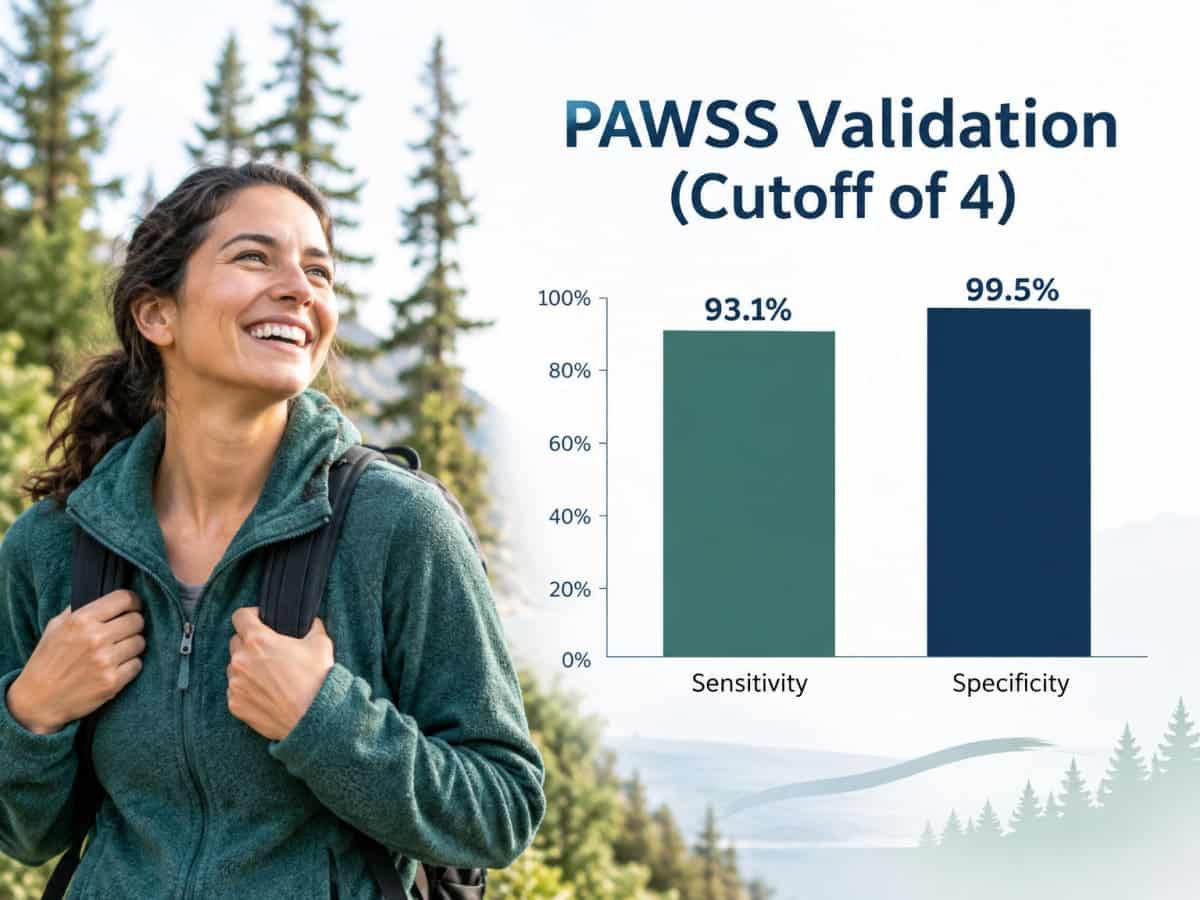
In a prospective validation study of medically ill inpatients, PAWSS at a cutoff of 4 showed 93.1% sensitivity and 99.5% specificity for identifying complicated alcohol withdrawal in that population.5 Strong numbers, but notice the scope: hospitalized patients, not a stranger scoring themselves on a phone at 2 a.m.
The honest translation: PAWSS asks “how worried should we be?” before anything bad happens. CIWA-Ar asks “how bad is it right now?” once withdrawal is underway. A good detox team uses both kinds of thinking, which is one more reason this work does not belong on a kitchen table.
Beyond CIWA-Ar: BAWS, mMINDS, SAWS, and SHOT
BAWS: A Faster Five-Item Check
CIWA-Ar is the household name, but it is not the only tool on the shelf. The Brief Alcohol Withdrawal Scale (BAWS) was built as a five-item alternative, designed to be quicker and less dependent on how well a patient can describe what they feel. A BAWS score of 3 or more predicted a CIWA-Ar score of 8 or higher with 85.3% sensitivity and 65.8% specificity in the study where it was developed.8
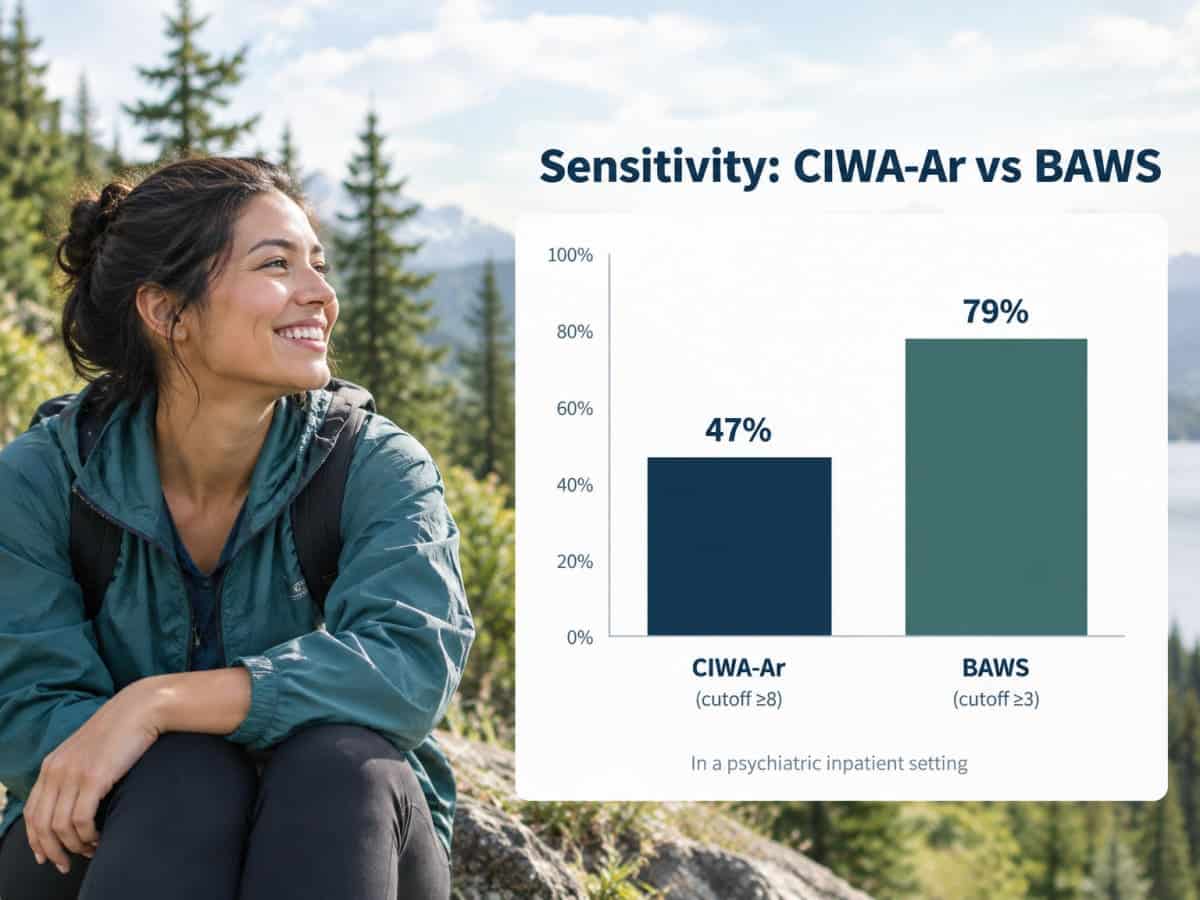
Why bother with a shorter scale? Because CIWA-Ar does not land the same way in every room. In a psychiatric inpatient study, CIWA-Ar at a cutoff of 8 or more caught only 47% of true withdrawal cases, while BAWS at a cutoff of 3 or more caught 79%, with specificity of 88% for both.7 That is a meaningful gap when the patient on the other end of it is confused, anxious, or struggling to answer questions about pins and needles.
The takeaway is not that BAWS beats CIWA-Ar everywhere. It is that no single scale is best in every setting, and good detox teams know which ruler to pick up.
mMINDS, SAWS, and SHOT: Different Rooms, Different Tools
Three more scales round out the picture, each built for a different room.
mMINDS, the modified Minnesota Detoxification Scale, is a nine-item tool that scores observable signs like tremor, sweating, orientation, seizures, and vital signs, without leaning on patient answers the way CIWA-Ar does.12 That matters in intensive care, where patients may be intubated, sedated, or too sick to describe nausea on a 0 to 7 scale. Surgical-ICU guidance recommends mMINDS specifically because CIWA-Ar and BAWS are not validated in critically ill or postoperative patients.10
SAWS, the Short Alcohol Withdrawal Scale, flips the model. It is a 10-item questionnaire the patient fills out themselves, rating five physical and five psychological symptoms, and it was validated in an outpatient setting as easy to use with a single underlying factor across its items.15 Think of it as a check-in tool for someone already stable, not a triage instrument for someone in acute withdrawal.
SHOT is the sprinter. A four-item emergency-department scale covering sweating, hallucinations, orientation, and tremor, it took about one minute in the pilot sample compared with roughly five minutes for CIWA, with a Pearson correlation of 0.71 between nurse-administered scores.16 Useful for a crowded ER triage bay. Not a substitute for sustained monitoring once treatment begins.
Where the Scale Falls Short
Here is what rehab blogs rarely tell you: a withdrawal scale is only as good as the person holding the pen, the patient able to answer, and the setting it was built for.
CIWA-Ar leans heavily on your ability to describe what you feel. Do you have pins and needles on your skin? Are the sounds in the room too loud? If you cannot answer, or cannot answer in English without an interpreter, or you are already delirious, the scale starts to break. A peer-reviewed case report warned that CIWA-Ar may be inappropriate for nonverbal patients, people without English interpretation available, and patients with delirium or psychosis, and that applying the protocol mechanically in those situations has caused iatrogenic harm.9
Setting matters too. In a psychiatric inpatient study where many patients had communication challenges, CIWA-Ar at a cutoff of 8 or more caught only 47% of true withdrawal cases.7 In surgical intensive care, CIWA-Ar and BAWS are not validated at all, which is why that world leans on mMINDS instead.10
Even nurses looking at the same patient do not always land on the same number. A 2025 comparison study found moderate agreement between raters for both CIWA-Ar and mMINDS, and that agreement weakened as withdrawal got worse, exactly when precision matters most.11
The honest conclusion is not that the scale is broken. It is that a number on a clipboard needs trained eyes, repeat scoring, and a care team ready to act when the ruler reaches its limit.
Why You Should Not Score Yourself at Home
You can download the CIWA-Ar form in about 10 seconds. That does not mean you can use it on yourself safely.
The scale was built for a trained nurse watching your pulse and blood pressure, checking your orientation, and seeing whether your tremor at hour four is worse than it was at hour one.4 Alone on a couch, you cannot score your own level of confusion. People who are becoming disoriented are usually the last to notice.
If you are heavy enough into drinking that you are googling withdrawal scales, you deserve someone else holding the clipboard, taking your vitals, and ready to act in minutes. That is a medical setting, not a kitchen table.
What Scoring Looks Like Inside a Real Medical Detox
Picture a quiet room in a residential detox in Milwaukie, Oregon, early evening. You are in a bed that feels more like a guest room than a hospital. A nurse sits down with you, cuffs your arm for a blood pressure reading, counts your pulse, and asks you to hold your hands out. She asks whether anything feels off on your skin, whether the lamp seems too bright, what day it is, who the president is. Two minutes later she writes a number in your chart.4, 17
Then she comes back and does it again. And again. During the first day or two off alcohol, when symptoms change fastest, that cycle repeats every few hours, and medication is adjusted to what the score and your vital signs are telling the team, not to a one-size-fits-all taper.1 Providers round daily. RNs are on site around the clock. If your number climbs toward 15, the room gets quieter, the checks get closer together, and the plan shifts before a seizure or confusion has a chance to catch anyone off guard.1, 3
Even well-designed scoring protocols only help when they are actually used. A 2025-2026 quality-improvement study of a nurse-driven CIWA-Ar protocol across three New York City public hospitals found the recommended protocol was ordered for 887 of 1,500 eligible admissions, or 59.1%.13 That is the gap a dedicated medical detox is built to close: the ruler gets picked up every time, by someone trained to read it, in a setting designed to act on what it says.
When the Number Says It Is Time to Call
You do not need a specific number to make the call. If you are drinking heavily every day and the thought of stopping scares you, that is the signal. If you have had a withdrawal seizure or delirium tremens before, that is the signal. If your last detox was your third, that is the signal too.3
A trained team can assess you, score what is actually happening, and build a plan that fits your history, not a template. In a Milwaukie, Oregon residential detox, that means RNs on site 24/7, providers rounding daily, home-cooked meals, and medication adjusted to what your body is telling the team, hour by hour. Detox usually takes 8 to 10 days, and it connects straight into continued care through PHP, IOP, outpatient, and aftercare so day 11 is not a cliff.
Pacific Crest Trail Detox serves Portland, Milwaukie, Gresham, Beaverton, Salem, Vancouver WA, and welcomes out-of-state clients. Calls are confidential and HIPAA-protected. We want to be your last treatment experience, whether we’re your first detox or your fifth.
Get Help Beyond an Alcohol Withdrawal Score
See whether your plan may help cover medically supervised alcohol detox and the care that can follow.
Frequently Asked Questions
Can I use the CIWA-Ar scale on myself at home?
No. The scale depends on a trained person checking your pulse, blood pressure, orientation, and tremor over time, then acting on what they see.4People who are becoming confused rarely notice it in themselves, and alcohol withdrawal can turn life-threatening with seizures or delirium tremens.2If you are heavy enough into drinking to be searching this, call a medical detox instead.
What CIWA-Ar score means I need to go to detox?
There is no single magic number. VA educational material groups scores under 8 to 10 as mild, 8 to 15 as moderate, and 15 or higher as severe.17VA/DoD guidance identifies about 20 or higher as severe and recommends inpatient medically supervised withdrawal.3History matters too: past withdrawal seizures or delirium tremens often warrants inpatient care even at a lower score.3
What is the difference between CIWA-Ar and PAWSS?
CIWA-Ar measures symptoms happening right now, like tremor, sweating, and orientation, and it gets repeated every few hours.4PAWSS is a screen that predicts your risk of complicated withdrawal before severe symptoms appear, using factors like past seizures, prior delirium tremens, and heavy recent drinking.6One asks how bad it is now. The other asks how worried the team should be ahead of time.
How often do nurses rescore someone during alcohol detox?
Frequency depends on your score and your history, but during the first day or two off alcohol, when symptoms shift fastest, trained nurses typically repeat CIWA-Ar every few hours and more often as scores climb.1Each CIWA-Ar check takes about two minutes at the bedside.17Medication is adjusted to what the score and your vital signs show, not to a one-size-fits-all taper.1
Does a low withdrawal score mean I am safe to stop drinking on my own?
No. A score is a snapshot, and alcohol withdrawal can worsen hours or days after the last drink, including seizures and delirium tremens.2Score bands also depend on who is scoring and the setting; one 2025 study found only moderate agreement between nurse raters, with agreement weakening as withdrawal got worse.11A reassuring number tonight is not a promise about tomorrow morning.
How do I get a withdrawal assessment at Pacific Crest Trail Detox?
Call Pacific Crest Trail Detox in Milwaukie, Oregon for a confidential, HIPAA-protected conversation, or submit the insurance verification form on the website. A team member will ask about your drinking history, past withdrawal, medical conditions, and current symptoms, then help plan next steps. Admissions serve Portland, Milwaukie, Gresham, Beaverton, Salem, and Vancouver WA, and welcome out-of-state clients who need medical detox and continued care.
References
- Introduction to Alcohol Withdrawal. https://pmc.ncbi.nlm.nih.gov/articles/PMC6761824/
- Alcohol Use Disorder: From Risk to Diagnosis to Recovery. https://www.niaaa.nih.gov/health-professionals-communities/core-resource-on-alcohol/alcohol-use-disorder-risk-diagnosis-recovery
- VA/DoD Clinical Practice Guideline for the Management of Substance Use Disorders: Provider Summary. https://www.healthquality.va.gov/guidelines/MH/sud/VADoDSUDCPGProviderSummary.pdf
- Assessment of alcohol withdrawal: the revised clinical institute withdrawal assessment for alcohol scale (CIWA-Ar). https://pubmed.ncbi.nlm.nih.gov/2597811/
- Prospective Validation Study of the Prediction of Alcohol Withdrawal Severity Scale (PAWSS) in Medically Ill Inpatients: A New Scale for the Prediction of Complicated Alcohol Withdrawal Syndrome. https://pubmed.ncbi.nlm.nih.gov/25999438/
- The “Prediction of Alcohol Withdrawal Severity Scale” (PAWSS): systematic literature review and pilot study of a new scale for the prediction of complicated alcohol withdrawal syndrome. https://pubmed.ncbi.nlm.nih.gov/24657098/
- Psychometric Properties of the Revised Clinical Institute Withdrawal Alcohol Assessment (CIWA-Ar) and the Brief Alcohol Withdrawal Scale (BAWS) in a Psychiatric Inpatient Setting. https://pubmed.ncbi.nlm.nih.gov/32209957/
- Development and implementation of an alcohol withdrawal protocol using a 5-item scale, the Brief Alcohol Withdrawal Scale (BAWS). https://pubmed.ncbi.nlm.nih.gov/28699845/
- Iatrogenic delirium on symptom-triggered alcohol withdrawal protocol. https://pmc.ncbi.nlm.nih.gov/articles/PMC7370951/
- Prevention of alcohol withdrawal syndrome in the surgical ICU. https://pmc.ncbi.nlm.nih.gov/articles/PMC9680182/
- Comparison of CIWA-Ar and MINDS Alcohol Withdrawal Assessments in Hospitalized Patients: Comparison of CIWA-Ar and MINDS. https://pubmed.ncbi.nlm.nih.gov/40455631/
- Implementation of mMINDS monitoring for alcohol withdrawal at an inpatient psychiatric facility. https://pmc.ncbi.nlm.nih.gov/articles/PMC12558361/
- Appropriateness, feasibility, and adoption of a nurse-driven CIWA-Ar symptom-triggered protocol for alcohol withdrawal syndrome in New York City public hospitals. https://pubmed.ncbi.nlm.nih.gov/41509653/
- Predictive value of the Clinical Institute Withdrawal Assessment for Alcohol Scale, Revised (CIWA-Ar) score on admission for alcohol withdrawal delirium (AWD) in patients with alcohol use disorder (AUD): A prospective observational study. https://pubmed.ncbi.nlm.nih.gov/41578701/
- A psychometric validation of the Short Alcohol Withdrawal Scale (SAWS). https://pubmed.ncbi.nlm.nih.gov/20570824/
- Feasibility and reliability of the SHOT: A short scale for measuring pretreatment severity of alcohol withdrawal in the emergency department. https://pubmed.ncbi.nlm.nih.gov/21040105/
- CIWA-Ar. https://www.ci2i.research.va.gov/paws/pdfs/ciwa-ar.pdf
- Helping Patients Who Drink Too Much: A Clinician’s Guide. https://www.niaaa.nih.gov/sites/default/files/publications/Guide_Factsheet_2005_English.pdf