


Key Takeaways
- Getting sober runs on four overlapping timelines: hours for alcohol to clear, several days for acute withdrawal, weeks to months for organ healing, and a year or more for brain recalibration 1, 2, 4, 5.
- Alcohol withdrawal can be life-threatening, with seizures and delirium tremens possible 48 to 96 hours after the last drink and sometimes as late as day 7 to 10, which is why medical supervision matters 3.
- The highest-impact decision is matching the level of care to the drinking history: sobering facilities handle 4-48 hours of intoxication, while heavy daily drinkers need certified withdrawal management with 24/7 nursing 8.
- Detox is step one, not the finish line; sustained recovery is built through PHP, IOP, outpatient, and aftercare over months, and sometimes with medication-assisted treatment 1.
The Honest Answer: There Are Four Timelines, Not One
You are probably hoping for one number. A week, maybe two, and you are on the other side. Here is the honest answer: there are four timelines running at the same time, and knowing which one you are asking about changes everything.
The first is hours. Alcohol clears your bloodstream at a fairly steady rate, so by tomorrow morning the drink is gone. The second is days. Acute withdrawal typically starts within about 8 hours of your last drink, may occur days later, peaks between 24 and 72 hours, and some symptoms can continue for weeks 2. The third is weeks to months, when your sleep steadies and your liver begins to repair 4. The fourth is the first year and beyond, when the reward and stress circuits in your brain slowly recalibrate with sustained abstinence 5.
So how long does it take to get sober from alcohol? Physically sober in hours. Through acute withdrawal in several days to over a week under medical supervision. Healing in the body over months. Recovery from alcohol use disorder is measured in months and sometimes years, not days 1. If you only plan for day one, you are planning for the easiest part.
Hours: How Long Until Alcohol Leaves Your System
If your last drink was last night, the alcohol itself may be gone or nearly gone by now, depending on how much you drank, your weight, your liver function, and whether you ate.
Here is where the word sober gets confusing. A blood alcohol concentration (BAC) that has dropped is not the same thing as feeling okay. For a lot of people, the first physical signs of withdrawal start showing up while the alcohol is still leaving the bloodstream, not after. Symptoms tend to occur within 8 hours after the last drink, and may occur days later 2.
So if you woke up shaky, sweating, nauseous, with a racing heart or jumpy nerves, that is not just a bad hangover. That is your nervous system reacting to the absence of a substance it has been working around. Oregon’s health system uses the term sobering for short-term care while intoxicating effects wear off, generally 4 to 48 hours 8. That is a different service from medical withdrawal management, and the distinction matters once symptoms start.
Days 1-10: What Alcohol Withdrawal Actually Looks Like
The Withdrawal Risk Window: Hours to 10 Days
Withdrawal is not one event. It is a window that opens within hours of your last drink and does not fully close for over a week. Knowing the shape of that window helps you make better decisions tonight.
Here is the honest timeline for anyone who has been drinking heavily and regularly:
- First 24 hours after your last drink: Early symptoms tend to occur within 8 hours. Shaking hands, sweating, anxiety, nausea, headache, a racing heart, trouble sleeping. For some people this is uncomfortable but manageable. For others, it is the warning sign that something harder is coming 2.
- Hours 24 to 72: This is the peak for most people. Symptoms can intensify quickly. Blood pressure and heart rate climb. Some people experience hallucinations or seizures during this window 2.
- Hours 48 to 96: This is when delirium tremens, the most dangerous form of alcohol withdrawal, is most likely to appear. DT involves severe confusion, agitation, heavy tremor, and dangerous swings in blood pressure and heart rate 3.
- Days 5 to 10: DT can still emerge up to 7 to 10 days after the last drink, even if the first few days felt relatively calm 3. Some milder symptoms, including sleep disruption, anxiety, and mood changes, can continue for weeks 2.
Why Alcohol Withdrawal Needs Medical Supervision
Alcohol withdrawal, unlike many substances, can be life-threatening. Seizures and delirium tremens are medical emergencies that can escalate within hours 3.
That is why this article will not give you a home taper plan. We cannot tell you how to safely reduce your drinking on your own, because for someone who has been drinking heavily and daily, the right answer depends on your vitals, your drinking history, your other medications, whether you have had seizures before, and what your liver is doing right now. Those are not things you can measure from your kitchen.
Supervised withdrawal management means someone is checking your blood pressure, heart rate, and symptom severity on a regular schedule, and a clinician can give medication to prevent seizures and ease the worst of it before it becomes dangerous. The goal is not to white-knuckle through. The goal is to lower the medical risk so your body has a safer place to land.
What a Typical 8-10 Day Medical Detox Looks Like
Here is what most people do not know until they walk through the door: medical detox for alcohol is not a hospital stay with fluorescent lights and a plastic chair. At a non-hospital residential detox like the one Pacific Crest Trail Detox runs in Milwaukie, Oregon, it looks closer to staying in a house with a nursing station down the hall.
At Pacific Crest Trail Detox, a typical stay runs about 8 to 10 days. Here is roughly what that includes:
- Day 1: Intake, medical assessment, and the start of medication to prevent seizures and ease symptoms. You get your own bed, a meal, and a chance to sleep.
- Days 2 to 4: The hardest stretch for most people. Registered nurses are on site 24/7, checking vitals and adjusting medication. Providers round through the house seven days a week. Meals are home-cooked. You are not expected to perform.
- Days 5 to 7: Symptoms usually ease. You start eating more, sleeping a little better, and sitting in on small group discussions when you feel up to it.
- Days 8 to 10: Medications taper down. The clinical team works with you on a specific plan for what comes next, because leaving detox without one is the most common reason people are back drinking within weeks.
You are not locked in. You are not punished for how you got here. The point of this stretch is to get you physically stable and connected to the next step, whether that is a partial hospitalization program, intensive outpatient, standard outpatient, or ongoing aftercare. Detox is step one, not the whole plan 1.
Weeks 2-12: How Long It Takes Your Body to Recover From Alcohol
Sleep, Appetite, and Energy in the First Month
The first week after detox, most people expect to feel better than they do. The acute symptoms have eased, but your body is still catching up. Sleep is often the loudest problem. You may fall asleep hard, then wake at 3 a.m. with your heart pounding and your brain running. That is normal, and some sleep disruption can continue for weeks 2.
Appetite tends to come back before energy does. Food starts tasting like food again. You might crave sugar, and that is okay; your blood sugar has been riding a rollercoaster for a long time. Try to eat regular meals even when you are not hungry at first.
Energy is the slow one. Weeks two and three can feel oddly flat. You are not depressed in a clinical sense, you are tired in a way that sleep alone does not fix. Short walks, daylight on your face, and a predictable schedule do more here than any supplement. By week four, most people notice they are waking up without dread. That is a real milestone, even if it is a quiet one.
Your Liver, Heart, and Blood Pressure Begin to Heal
Your organs start repairing themselves the day you stop drinking. How much they recover depends on where you were when you stopped.
The liver is the headline. If you have fatty liver, called steatosis, it is fully reversible once alcohol consumption stops. If drinking continues, that same condition can progress to inflammation and more advanced liver injury 4. That is why the window matters. The liver you have at week four is not the liver you had the morning you walked into detox, and the liver you have at month three is better still, as long as you are not pouring alcohol back into it.
For many people, cardiovascular strain from heavy drinking also begins to ease once alcohol is out of the picture. You may notice you are not sweating through your shirt at breakfast anymore, or that stairs do not leave you winded in the same way.
The honest caveat: more advanced damage, including cirrhosis and some cardiovascular changes, may only partially improve 4. That is not a reason to give up on healing. It is a reason to stop the bleeding now, because every month of abstinence is a month your body gets back some ground it would otherwise keep losing.
Months 3-12+: How Your Brain Recovers From Alcohol
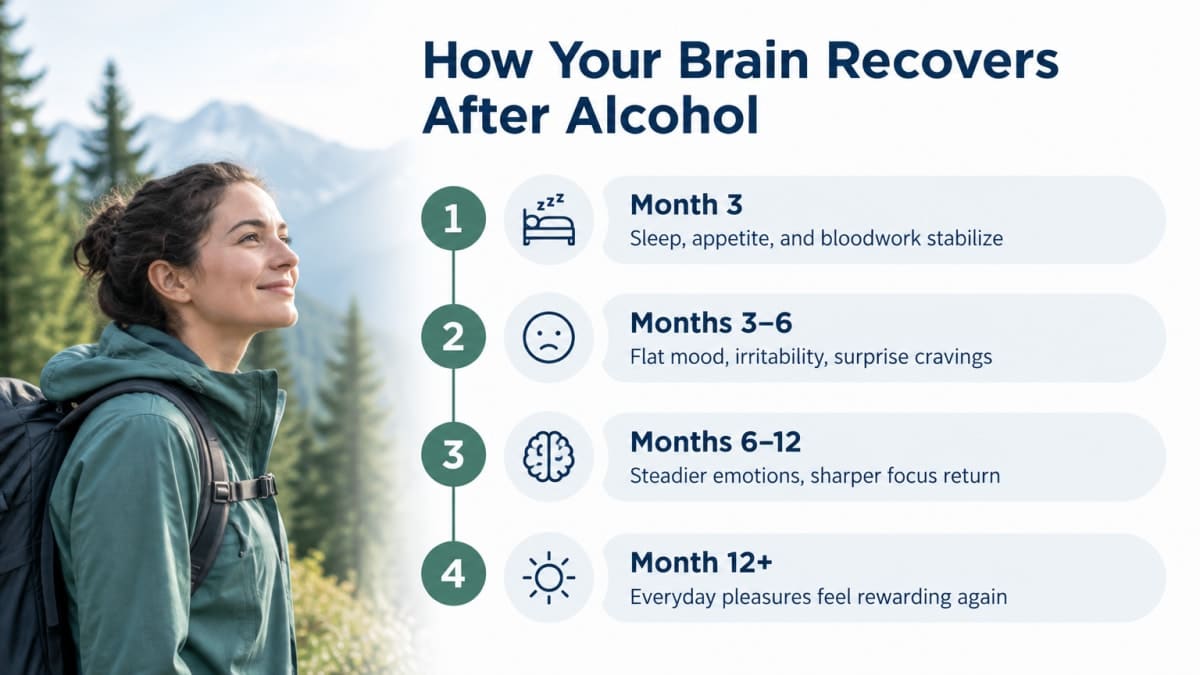
By month three, most of what you can see has already improved. Your sleep is more predictable. Your appetite is steady. Your bloodwork looks better. What is still catching up is harder to see from the outside: the parts of your brain that handle reward, stress, and self-control.
Heavy drinking changes how the brain’s reward system responds to everyday pleasure, how the stress system reacts to pressure, and how the front of your brain weighs long-term choices against short-term relief. Research suggests some of these alcohol-related changes, and the thinking, feeling, and behavior patterns that go with them, can improve or possibly reverse with months of abstinence, although the full capacity for return to normal is not completely understood 5.
What that means in real life: around months three to six, a lot of people describe feeling flat, irritable, or unexpectedly emotional. Small frustrations hit harder than they should. Cravings can show up out of nowhere, especially around old triggers. This is not a sign that recovery is failing. It is a sign that your brain is renegotiating with a world it used to meet through a glass.
By months six to twelve, most people notice their emotions are less volatile, their focus is sharper, and ordinary things, a good meal, a long walk, a real conversation, start feeling genuinely rewarding again. That is the slow win. It is also why NIAAA frames alcohol treatment and continuing care as a process measured in months and sometimes years, not days 1. The acute withdrawal that medical detox manages in the first several days 2, the organ healing that unfolds across the first few months 4, and this longer brain recalibration are different stages of the same recovery, not separate finish lines.
Detox Is Not the Finish Line: Why Weeks 2-52 Matter More Than Day One
Here is the hardest truth in this whole article: most people who relapse did not relapse because detox failed. They relapsed because detox was the whole plan.
NIAAA is clear about this. Detox can be a critical first step, but it is not alcohol treatment on its own. Treatment and continuing care for alcohol use disorder are generally measured in months and sometimes years 1. A medical detox stay gets your body stable. It does not teach you what to do on a Friday night when your coworkers are at the bar, how to sit with grief that no longer has a drink attached to it, or how to rebuild a marriage you have been drinking at for a decade.
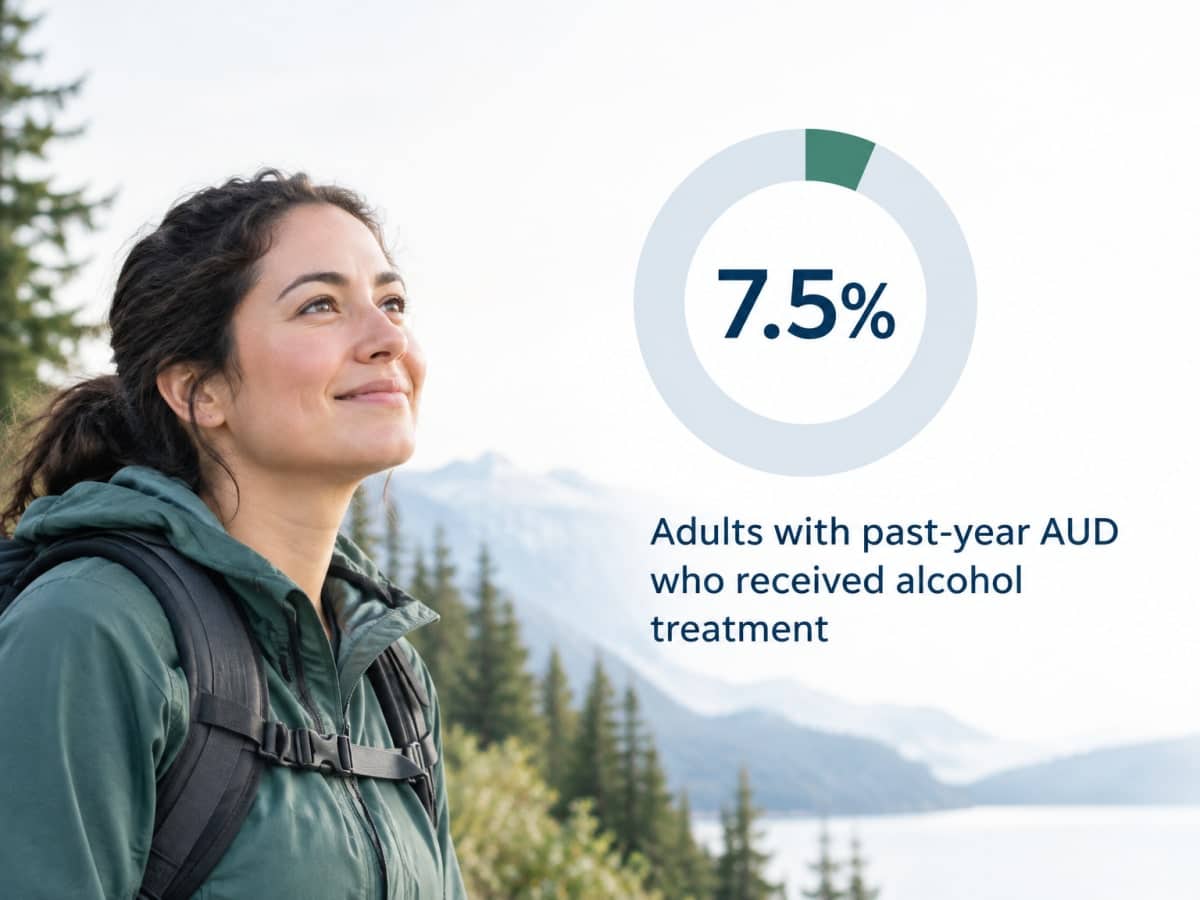
The numbers show how often that gap goes unaddressed. In 2024, roughly 7.5% of U.S. adults with past-year alcohol use disorder received any alcohol treatment at all, about 2.0 million of the 27.1 million adults estimated to have AUD that year 6, 7. That is the self-reported national survey figure, and it covers any form of treatment, not just the depth of care most people with heavy, long-term drinking actually need. Only about 665,000 adults received medication-assisted treatment for AUD 6.
So what should weeks 2 through 52 actually look like? For most people leaving detox, a step-down structure holds the gains: a partial hospitalization program (PHP) in the first few weeks when you still need daily support, intensive outpatient (IOP) a few times a week as you add work and family back in, standard outpatient visits once you have steadier footing, and some form of aftercare or alumni connection running underneath all of it. Medication-assisted treatment is appropriate for a lot of people in this stretch and worth asking about by name.
Day one of detox gets most of the attention because it is the scariest. Weeks 2 through 52 are where sobriety actually gets built.
If You Live in Oregon or SW Washington: Your Local Pathways
If you are reading this from Portland, Milwaukie, Gresham, Beaverton, Salem, or across the river in Vancouver WA, you have more options than you probably think, and they are not interchangeable. Picking the wrong one tonight can waste the window you have.
Oregon recognizes a few distinct levels of care, and the names matter:
- Sobering facilities are registered to provide a safe place while intoxicating effects wear off, generally for 4 to 48 hours 8. These are for someone who is acutely intoxicated and needs to come down safely. They are not medical withdrawal management. If your person has been drinking heavily for weeks or months and is about to stop, a sobering facility is not the right call.
- Certified withdrawal-management programs handle the medical side of stopping alcohol or benzodiazepines, with clinical monitoring at defined levels of care 8. Non-hospital residential detox, like what Pacific Crest Trail Detox provides in Milwaukie, fits here: 24/7 RNs on site, providers rounding seven days a week, home-cooked meals, and a typical 8 to 10 day stay in a house, not a hospital.
- Behavioral Health Resource Networks and county or Tribal programs offer broader community-based support, including help accessing treatment for people without insurance or stable housing 9.
If you are not ready to call a detox center yet, Oregon’s Alcohol and Drug Help Line at 1-800-923-4357 is a free, confidential starting point and can point you toward local options 9. For Vancouver WA and other out-of-state readers, residential detox in the Portland metro is reachable and often covered by insurance; verifying benefits before you travel saves a hard conversation later.
How to Decide What You Need Tonight
If you are the person drinking, or the one sitting across from them, you are probably trying to sort out one question: do we handle this at home, do we drive somewhere, or do we call 911? Here is a short, honest decision guide for tonight.
Call 911 or go to an ER right now if: there has been a seizure, confusion or disorientation, hallucinations, chest pain with a racing heart, or a sudden spike in blood pressure with heavy sweating and tremor. These are signs of severe withdrawal, including delirium tremens, and they can escalate fast 3.
Call a medical detox program today if: you have been drinking heavily most days for weeks, months, or years; your hands shake until the first drink; you have had bad withdrawal before; you take benzodiazepines; or you have been drinking around other health conditions. Alcohol withdrawal tends to begin within 8 hours of your last drink and peak between 24 and 72 hours, so the window to plan is narrower than it feels 2.
A sobering facility is not the right call for someone whose body depends on alcohol daily. Those sites are built for 4 to 48 hours of coming down from intoxication, not for managing withdrawal from long-term heavy use 8.
If you are not ready to call a detox center yet, Oregon’s Alcohol and Drug Help Line at 1-800-923-4357 is free and confidential and can help you think it through 9. One phone call tonight is not a commitment. It is information.
Taking the Next Step Toward Lasting Sobriety
If you have read this far, you already know more than most people do about what the next week and a half, and the next 10 months, will actually ask of you. That is not nothing. Fear usually comes from not knowing. You know now.
Here is what we would tell you if you were sitting across the table: one phone call is not a commitment. It is information. A confidential, HIPAA-protected conversation can tell you what your withdrawal risk looks like, what a medically supervised stay would involve, and what step-down care fits your life after detox ends. Verifying your insurance benefits takes a few minutes and tells you what is actually covered before you make any decisions.
Pacific Crest Trail Detox is a non-hospital medical detox in Milwaukie, Oregon, serving the Portland metro, Vancouver WA, and clients from out of state. We want to be your last treatment experience, whether we’re your first detox or your fifth. When you are ready, call for a confidential assessment or ask us to verify your benefits.
Get Clear About Alcohol Detox Timing
Check your coverage for medically supervised alcohol detox and see what care options may be available.
Frequently Asked Questions
How long does it take to get sober from alcohol?
You can be physically sober in hours as alcohol clears your bloodstream, but if you have been drinking heavily, acute withdrawal typically starts within about 8 hours of your last drink and can last several days to over a week 2. At Pacific Crest Trail Detox, medical detox typically runs 8 to 10 days. Recovery from alcohol use disorder, including sleep, mood, liver, and brain healing, is measured in months and sometimes years 1.
Can I safely detox from alcohol at home?
If you have been drinking heavily most days for weeks or longer, no. Alcohol withdrawal is one of the few that can be life-threatening. Seizures and delirium tremens can appear 48 to 96 hours after your last drink, sometimes as late as day 7 to 10 3. We cannot give you a home taper plan, because the right medication and monitoring depend on your vitals, history, and other health conditions.
How long does alcohol withdrawal last?
Symptoms often begin within about 8 hours of your last drink and peak between 24 and 72 hours, when shaking, anxiety, racing heart, and sweating are usually at their worst 2. Delirium tremens, the most dangerous form, most often appears between 48 and 96 hours but can emerge up to 7 to 10 days later 3. Milder sleep, mood, and anxiety symptoms can continue for several weeks after that 2.
How long does it take for your brain and liver to heal after you stop drinking?
Your liver begins repairing right away. Fatty liver (steatosis) is fully reversible once alcohol consumption stops, though more advanced injury may only partially improve 4. Your brain takes longer. Research suggests some alcohol-related changes in reward, stress, and executive function can improve or possibly reverse with months of abstinence, though the full extent of recovery is still not completely understood 5. Expect visible healing in weeks, deeper changes across months.
What happens after medical detox ends?
Detox gets your body stable; it does not teach you how to live without alcohol. NIAAA describes alcohol treatment and continuing care as a process measured in months and sometimes years, not days 1. Most people step down into a partial hospitalization program, then intensive outpatient, standard outpatient, and ongoing aftercare or alumni support. Medication-assisted treatment is appropriate for many people in this stretch and worth asking about by name.
How do I know if I need medical detox or a sobering facility?
Oregon’s registered sobering facilities are built for someone acutely intoxicated who needs a safe place to come down, generally for 4 to 48 hours 8. They are not withdrawal management. If you have been drinking heavily for weeks or months, your hands shake until the first drink, or you have had bad withdrawal before, you need a certified withdrawal-management program with 24/7 nursing and medication to prevent seizures 8.
References
- Alcohol Use Disorder: From Risk to Diagnosis to Recovery. https://www.niaaa.nih.gov/health-professionals-communities/core-resource-on-alcohol/alcohol-use-disorder-risk-diagnosis-recovery
- Alcohol withdrawal: MedlinePlus Medical Encyclopedia. https://www.medlineplus.gov/ency/article/000764.htm
- Delirium tremens. https://medlineplus.gov/ency/article/000766.htm
- Medical Complications: Common Alcohol-Related Concerns. https://www.niaaa.nih.gov/health-professionals-communities/core-resource-on-alcohol/medical-complications-common-alcohol-related-concerns
- Neuroscience: The Brain in Addiction and Recovery. https://www.niaaa.nih.gov/health-professionals-communities/core-resource-on-alcohol/neuroscience-brain-addiction-and-recovery
- Alcohol Treatment in the United States. https://www.niaaa.nih.gov/alcohols-effects-health/alcohol-topics-z/alcohol-facts-and-statistics/alcohol-treatment-united-states
- Alcohol Use Disorder (AUD) in the United States: Age Groups and Demographic Characteristics. https://www.niaaa.nih.gov/alcohols-effects-health/alcohol-topics/alcohol-facts-and-statistics/alcohol-use-disorder-aud-united-states-age-groups-and-demographic-characteristics
- Oregon Health Authority: Licensing and Certification: Providers. https://www.oregon.gov/oha/bh/providers/pages/licensing-certification.aspx
- Oregon Health Authority: Substance Use Disorder Services: Adults. https://www.oregon.gov/oha/bh/adults/pages/substance-use.aspx