

Key Takeaways
- Hospital detox and licensed residential medical detox are two levels on the same clinical ladder; the right choice depends on how risky withdrawal is likely to be, not cost or comfort.
- A hospital is the safer first stop for severe or unstable withdrawal, delirium tremens, seizures, polysubstance use, pregnancy, active suicidality, or serious medical conditions.1, 12, 13
- Non-hospital medical detox fits mild-to-moderate withdrawal that still needs 24/7 nursing, medication management, and withdrawal scoring, in a home-like setting licensed under Oregon ASAM levels 3.2-WM or 3.7-WM.14, 15
- Research shows inpatient settings finish more people through mild-to-moderate alcohol detox, but any early abstinence advantage fades by six months without continued care.9, 11
- What decides durability is the handoff after stabilization — PHP, IOP, outpatient, MAT, and aftercare — because detox alone generally leads to resumed use.4, 5
The Decision You’re Trying to Make Right Now
You’re trying to figure out where someone should detox, and you’re trying to figure it out while scared, exhausted, or already in withdrawal. Here’s the direct answer: hospital detox and non-hospital medical detox are two levels on the same clinical ladder, not rival products. The right one depends on how risky the withdrawal is likely to be, not on which sounds nicer or costs less.
A hospital emergency department or medical floor is the safer first stop when withdrawal is severe, unstable, or complicated by other medical problems. A licensed residential medical detox fits mild-to-moderate withdrawal that still needs 24/7 nursing, medication management, and a steady handoff into ongoing treatment. Alcohol and benzodiazepine withdrawal can be life-threatening without medical supervision, so this is not a decision to make alone at a kitchen table.1, 3
The rest of this guide walks you through what each setting actually looks like, what the research says, and how to match your situation to the right level of care.
What Does Hospital Detox Actually Mean?
Inside an ER or Medical Floor Admission
Hospital detox usually starts in one of two places: the emergency department or a medical inpatient floor. In the ER, you’re assessed quickly for immediate dangers — seizures, dangerously high blood pressure, dehydration, chest pain, confusion, or signs of delirium tremens. If you need ongoing medical care, you’re admitted to a medical floor where physicians round daily, nurses monitor vital signs around the clock, and medications like benzodiazepines for alcohol withdrawal can be adjusted hour by hour.2, 13
This is the highest level of withdrawal management on the clinical ladder. You’re surrounded by hospital-grade equipment, lab draws happen on demand, and if something goes wrong, a rapid response team is steps away. What you usually won’t find on a general medical floor is a structured addiction program — group therapy, counseling, and recovery planning. The focus is medical stabilization first. Everything else happens after discharge.
When the Hospital Is the Right First Call
The hospital is also the right first call when withdrawal is complicated by something else: a serious heart or liver condition, uncontrolled diabetes, pregnancy, a recent head injury, active suicidal thinking, or psychiatric symptoms that make it unsafe to be anywhere but a medically managed inpatient setting.2, 13 Polysubstance withdrawal — especially alcohol combined with opioids or benzodiazepines — often belongs in a hospital too, because treating one withdrawal can mask or worsen another.12 If you’re not sure, call. An ER triage nurse would rather screen you and send you to a lower level of care than see you back in worse shape tomorrow.
What Non-Hospital Medical Detox Looks Like
24/7 Nursing, Medication, and a Home-Like Setting
Picture a house instead of a hospital wing. You have a bedroom with a real door, a kitchen where someone cooks actual meals, a living room with couches, and a nurses’ station tucked where you can find it any hour of the night. That’s the shape of non-hospital medical detox at Pacific Crest Trail Detox. Registered nurses are on-site around the clock, a medical provider rounds regularly, and medications for withdrawal — benzodiazepines for alcohol, buprenorphine or comfort medications for opioids — get dosed on a schedule that matches what your body is doing.13
Clinically, a complete detox process includes evaluation, stabilization, and fostering readiness for and entry into ongoing treatment.6 At PCTD, that frame is wrapped around a home-like day: you sit in groups, eat meals cooked on-site with other people going through the same thing, sleep in a quiet room, and start building the kind of routine and honest conversation that have to hold up after you leave.
How Oregon Licenses This Level of Care
Non-hospital detox isn’t a loose arrangement someone invented. In Oregon, withdrawal-management programs have to be licensed by the Oregon Health Authority to provide detoxification services at all, and that license comes with written policy, staffing, and safety requirements under state administrative rules.15
OHA sorts these programs by ASAM level. Adult clinically managed residential withdrawal management is Level 3.2-WM — 24-hour support with nursing access for moderate withdrawal. Adult medically monitored inpatient withdrawal management is Level 3.7-WM, which adds 24-hour nursing with physician support when needed.14 A hospital medical floor sits above both at Level 4-WM, with daily physician management for severe or unstable cases.13 Knowing which level a facility is licensed for tells you more than its marketing does.
The ASAM Ladder: Where Each Setting Fits
The American Society of Addiction Medicine organizes withdrawal management into four levels, and once you see the ladder, the hospital-versus-residential question gets a lot less abstract. Each rung describes who’s staffing the floor, how often a doctor lays eyes on you, and what kind of complications the setting can safely handle.13
At the bottom is ambulatory withdrawal management — outpatient visits with medication and check-ins. It fits mild withdrawal when someone has a stable home, no serious medical issues, and reliable support. One step up is ASAM Level 3.2-WM, clinically managed residential withdrawal management, licensed in Oregon by the Oregon Health Authority. This is a 24-hour residential setting with nursing access, built for moderate withdrawal that needs steady monitoring but not hospital-grade equipment.14
Above that sits Level 3.7-WM, medically monitored inpatient withdrawal management — 24-hour nursing with a physician available as needed, used when withdrawal is more intense or complicated but still predictable.13, 14 The top rung is Level 4-WM, medically managed inpatient withdrawal management, which is hospital territory: daily physician management for severe, unstable, or medically risky cases where things can change by the hour.13
When a facility tells you what level it’s licensed at, you learn more than any brochure line about how safe you’ll actually be if things get hard at 2 a.m.
What the Research Says About Outcomes
Completion Rates for Mild-to-Moderate Alcohol Withdrawal
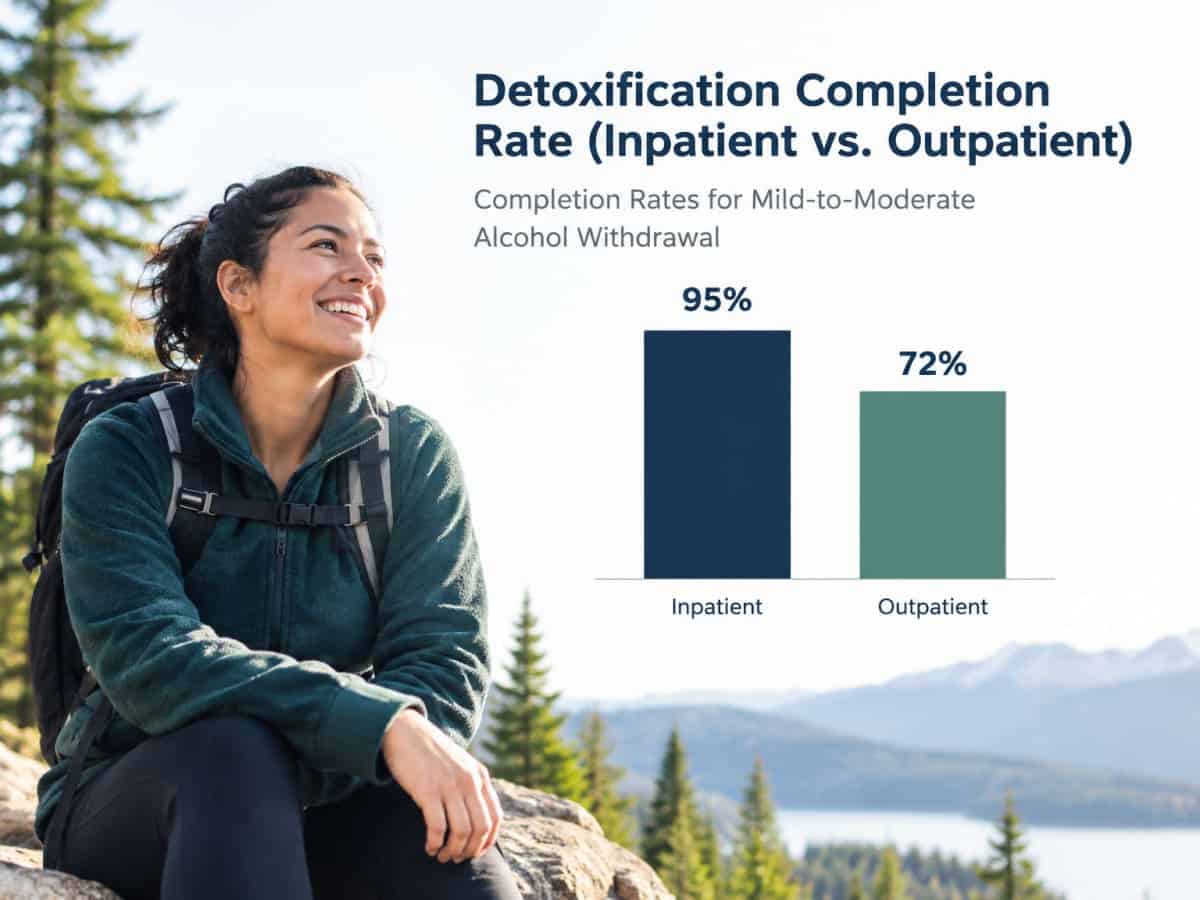
There’s one head-to-head study that keeps showing up when researchers compare these two settings, and it’s worth looking at carefully. A randomized trial of 164 male veterans with mild-to-moderate alcohol withdrawal, published in the late 1980s, found that 95% of people assigned to inpatient detox completed treatment, compared with 72% of those treated as outpatients.9 Inpatient care also cost roughly ten times more per episode in that trial, and no serious medical complications happened in either group.9
Before you let that 23-point gap decide anything, read the fine print. These were selected veterans, all men, all with withdrawal that was already judged mild to moderate — and the trial itself is historical, predating current medication-assisted treatment practice and today’s illicit-drug supply. No one in the study was seizing, hallucinating, or coming off multiple substances at once. The trial doesn’t tell you what happens if your situation is more complicated — it tells you that when withdrawal is predictable and someone is otherwise healthy, both settings can get the job done safely, and the inpatient setting finishes more people.
Why the completion gap? Being in a bed, with meals arriving and medication on a schedule, removes a lot of the ways detox falls apart at home — the phone call, the trigger, the one bad night. That’s the honest case for residential care.
Readmissions, Safety, and the Six-Month Picture
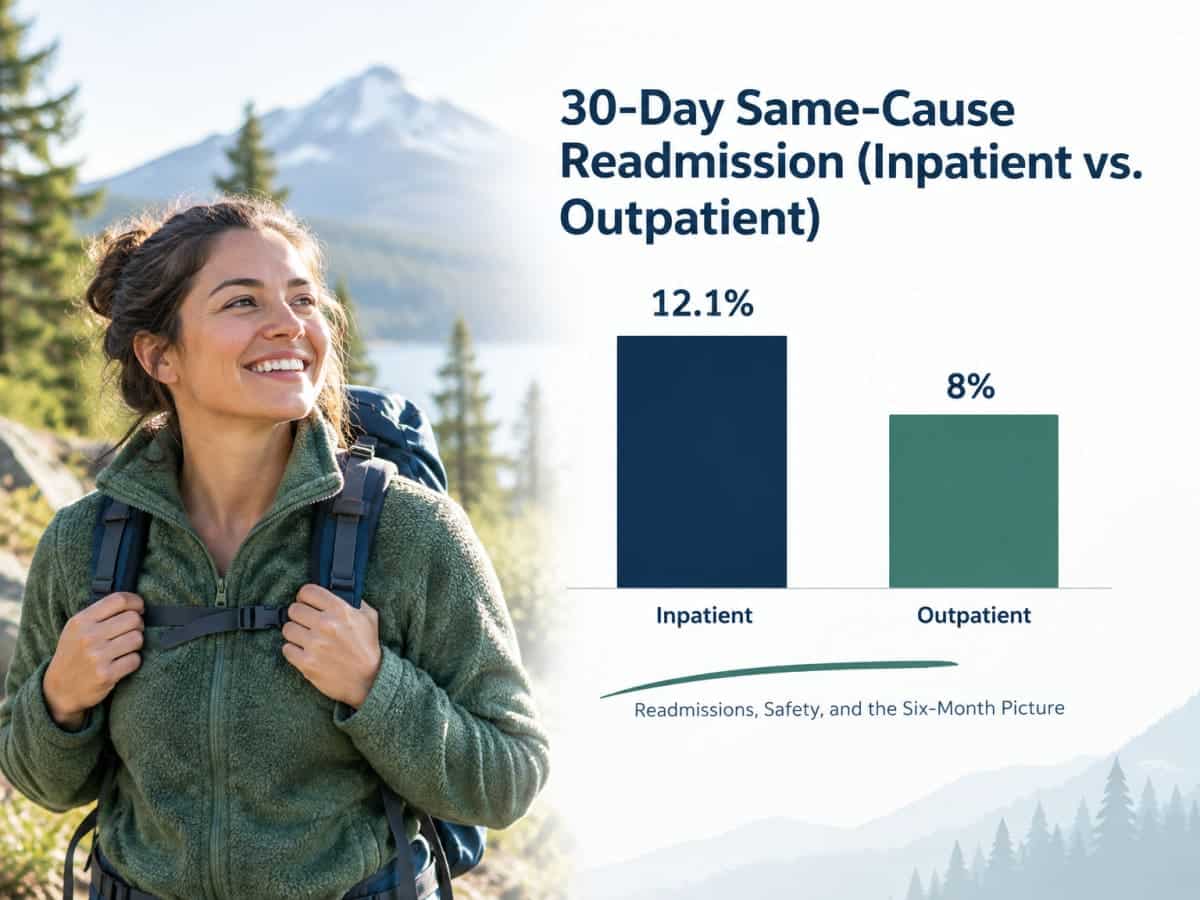
Finishing detox is one thing. Staying stable afterward is another, and the research there is less flattering to the assumption that more intensity equals better outcomes. A randomized trial cited within a hospital placement protocol study reported 30-day same-cause readmission rates of 12.1% for inpatient alcohol detox versus 8.0% for outpatient care, with no seizures or delirium tremens in either group.10 A broader evidence review found no differences in several safety outcomes, including seizures, across comparative studies — and noted that when inpatient care showed an early abstinence advantage in longer follow-up, that advantage was no longer statistically significant by six months.11
Read that twice. The hospital setting didn’t buy more durable sobriety in the studies that followed people out past the first few weeks. The protection it offers is real and important for severe or unstable withdrawal, but it isn’t a head start you keep forever.
What does buy durability is what happens next — the handoff into counseling, medication for opioid or alcohol use disorder, group work, and the slow rebuilding of a life. The walls around detox matter less than the ramp that leads out of it.
A Decision Filter: Which Setting Fits Your Situation
Substance, Severity, and Withdrawal History
Start with what you’ve been using and how your body has reacted when you’ve stopped before. Alcohol and benzodiazepines are the two categories that can kill you during withdrawal, which is why NIAAA warns against suddenly stopping heavy alcohol use without medical assessment.3 If you drink daily and heavily, or if you’ve been on a benzodiazepine like Xanax, Klonopin, or Ativan for months, you need medical supervision — the only question is which level.
Severity is the next filter. Mild-to-moderate alcohol withdrawal — shakiness, sweating, anxiety, trouble sleeping, a fast pulse — can often be managed safely in a licensed residential setting with 24-hour nursing and symptom-triggered medication.13 Severe withdrawal with high fever, confusion, hallucinations, or any history of withdrawal seizures or delirium tremens belongs in a hospital, period.1
History is the quietest predictor people underweight. If a past detox ended in a seizure, a hospital trip, or a near miss, that pattern tends to repeat and often gets worse. Tell the admissions nurse the truth about every prior episode — it changes the placement.
Medical and Psychiatric Conditions That Change the Answer
What else is going on in your body matters as much as what’s coming out of it. Uncontrolled diabetes, serious heart or liver disease, pregnancy, a recent head injury, or a seizure disorder unrelated to substances all push the decision toward a hospital where physicians round daily and labs can be drawn on demand.13 A residential detox can handle a lot, but it isn’t built for a cardiac event or a blood-sugar crisis.
Psychiatric severity shifts the answer the same way. NIAAA notes that the severity of both a substance use disorder and a co-occurring mental-health condition helps determine the appropriate level of care.2 Active suicidal thinking, psychosis, or symptoms that make it unsafe to be anywhere but a medically managed inpatient setting are hospital territory. Stable, treated depression or anxiety is usually workable in a residential program with regular clinical check-ins. If you’re honestly not sure where you land, say so during the phone screen — that’s what the assessment is for.
Polysubstance Use and the Home Environment
Mixing substances changes the math. Clinical guidelines generally recommend inpatient management for people at risk of alcohol withdrawal combined with withdrawal from other substances, including opioids, because treating one syndrome can mask or worsen another.12 Alcohol plus benzodiazepines, alcohol plus opioids, or heavy daily use of three or more substances is a conversation that usually ends with a hospital or a medically monitored inpatient bed, not an outpatient taper.
Then there’s where you’d be sleeping if you weren’t in care. A residential detox exists partly to remove you from the kitchen cabinet, the dealer’s number, and the roommate who’s still using. If home is chaotic, unsafe, or full of triggers, outpatient detox is a setup for a bad night — even when the withdrawal itself looks manageable on paper. The reverse is also true: a quiet home with a sober partner, a flexible work schedule, and a clinic nearby can make ambulatory care a reasonable fit for mild withdrawal. Be honest about which one you actually have.
Opioid Detox in 2026: What Changed
If the last time you looked at opioid detox was five or ten years ago, the map has changed. Fentanyl now dominates the illicit supply, which means withdrawal starts faster, hits harder, and makes the old “wait until you’re sick enough to start buprenorphine” playbook risky. The response from federal regulators and emergency medicine has been to move medication earlier and loosen the walls around where it can start.
Buprenorphine initiation in the emergency department is one of the biggest shifts. A multisite trial of 1,200 people with opioid use disorder — about 70% of whom used fentanyl — found that precipitated withdrawal occurred in just 0.76% of participants when ED teams started buprenorphine using current protocols.18 In plain terms: starting medication in an ER is safer and more workable than the fear around fentanyl suggested.
The other shift is regulatory. SAMHSA’s 2024 revisions to 42 CFR Part 8 made take-home methadone more flexible from the start of treatment and opened the door to telehealth for buprenorphine screening and initiation through opioid-treatment programs.16, 17 For you, that means opioid detox in 2026 doesn’t have to begin on a hospital floor to be evidence-based. It can start in an ER, in a licensed residential detox with a provider who can prescribe buprenorphine, or through an opioid-treatment program — then connect to one of the three FDA-approved medications (methadone, buprenorphine, or naltrexone) for continued care.7
Cost, Insurance, and the Honest Trade-Offs
Cost is real, and pretending it isn’t doesn’t help you make a good decision. The randomized veterans trial that reported the 95%-versus-72% completion gap also found inpatient hospital detox cost roughly ten times more per episode than outpatient care in that study population.9 Those exact dollar figures are decades old and don’t reflect what you’d pay today, but the ratio tells you something that still holds: hospital-level care carries hospital-level charges, and that’s the trade-off you’re buying when withdrawal is severe or complicated.
What you’ll actually owe depends on your insurance plan, the facility’s contracts, and your deductible — not on which setting sounds more affordable in the abstract. Most commercial insurance plans cover medically necessary detox at licensed residential programs and at hospitals, though prior authorization, length of stay, and in-network status vary. Rather than guess, call the admissions line and ask them to verify your benefits. A good program will do that for free, in writing, before you commit — and tell you honestly if a hospital is the safer first stop regardless of what your plan covers.
After Stabilization: The Continuum That Decides Durability
Here’s the part most people underweight when they’re choosing between a hospital bed and a residential detox room: the walls stop mattering the day you walk out. What decides whether you stay stable is what you walk into next. NIDA puts it bluntly — detoxification alone, without subsequent treatment, generally leads to resumed drug use.4 The federal guide is just as direct: medically assisted detoxification is only the first stage of addiction treatment, and it has to be followed by evaluation and entry into ongoing care to do its real job.5
At Pacific Crest Trail Detox, a sturdy continuum usually looks like this:
- Detox stabilizes your body over 8 to 10 days.
- Partial hospitalization (PHP) gives you full clinical days without the overnight stay.
- Intensive outpatient (IOP) steps the hours down while you rebuild work, family, and routine.
- Standard outpatient keeps a lighter touch going for months.
- Aftercare and alumni support hold the line past the first year.
Pick the setting that fits your withdrawal. Then pick the program that already has the ramp built.
Local Context for the Portland Metro and SW Washington
If you’re searching from Portland, Milwaukie, Gresham, Beaverton, Salem, or across the river in Vancouver, Washington, you have real choices close to home. Hospital systems in the metro handle severe or unstable withdrawal in their emergency departments and medical floors. Licensed non-hospital detox programs in Oregon operate under Oregon Health Authority rules and carry specific ASAM designations — 3.2-WM for clinically managed residential care and 3.7-WM for medically monitored inpatient care — so you can ask any facility exactly what it’s licensed to do.14, 15
Out-of-state families call too. People fly in from Washington, Idaho, California, and farther, often because a quieter residential setting in the Pacific Northwest fits what they need after stabilization. The admissions team can walk you through travel logistics and arrival the same day you call.
Talking to a Loved One Who Is Scared to Choose
If you’re the person helping someone decide, you already know the hardest part isn’t finding a facility — it’s getting your person to say yes while they’re sick, scared, and half-convinced they can handle it alone. A few things make that conversation easier.
Lead with the medical facts, not an ultimatum. Alcohol and benzodiazepine withdrawal can cause seizures or delirium tremens without medical care, and that’s a reason, not a threat.1 Ask what they’re most afraid of — the hospital feel, missing work, the kids, the cost — and answer that specific fear instead of arguing about recovery in general.
Offer to make the call together. A good admissions nurse will do the risk screen on speakerphone, say honestly whether a hospital is the safer first stop, and lay out what the next 8 to 10 days actually look like. Your job isn’t to pick the setting. Your job is to get them to the phone.
How to Take the Next Step
You’ve read enough. The next move is a phone call, not another browser tab. A good admissions nurse will ask about what you’re using, how much, how often, your last drink or dose, prior withdrawals, medical and mental-health history, and what home looks like. In fifteen minutes you’ll know whether a hospital is the safer first stop or whether a licensed residential medical detox fits — and either way, you’ll have a plan instead of a knot in your chest.
Pacific Crest Trail Detox serves Milwaukie, Portland, Gresham, Beaverton, Salem, Vancouver, Washington, and families flying in from out of state. Calls are confidential and HIPAA-protected, and insurance verification is free. We want to be your last treatment experience, whether we’re your first detox or your fifth.
Compare Detox Options and Check Coverage
See whether your plan may help cover medically supervised detox and continued care.
Frequently Asked Questions
Is non-hospital detox safe for alcohol or benzodiazepine withdrawal?
It can be, when the program is licensed, has 24/7 nursing, and the withdrawal is mild to moderate. Alcohol and benzodiazepine withdrawal can be life-threatening without medical supervision, so an honest risk screen comes first.3 If you have a history of seizures, delirium tremens, or heavy daily use for years, a hospital is often the safer starting point.1
How long does medical detox usually take?
Most people stay 8 to 10 days in a licensed residential medical detox, depending on the substance, how long you’ve been using, and how your body responds to medication. Benzodiazepine tapers often take longer and are managed on an individual schedule.
Do I need to go to the ER first before entering a residential detox program?
Can I start medication for opioid use disorder during detox?
Yes. SAMHSA recognizes three FDA-approved medications for opioid use disorder — methadone, buprenorphine, and naltrexone — and they can be started during detox depending on the medication and the setting.7 Since the 2024 revisions to 42 CFR Part 8, buprenorphine and methadone initiation have become more flexible across hospital, residential, and opioid-treatment-program settings.16
What happens after detox is finished?
Detox stabilizes your body. What comes next decides whether that stability holds. NIDA is direct that detoxification alone, without continued treatment, generally leads to resumed use.4 A typical ramp runs from detox into partial hospitalization (PHP), then intensive outpatient (IOP), then standard outpatient and aftercare — ideally through one connected program so you’re not starting over each step.
Does Pacific Crest Trail Detox accept clients from outside Oregon?
Yes. Pacific Crest Trail Detox serves Milwaukie, Portland, Gresham, Beaverton, Salem, and Vancouver, Washington, and welcomes clients flying in from Washington, Idaho, California, and beyond. The admissions team can help with travel logistics and same-day arrival. Calls are confidential and HIPAA-protected, and insurance verification is free before you commit to anything.
References
- Alcohol Use Disorder: From Risk to Diagnosis to Recovery. https://www.niaaa.nih.gov/health-professionals-communities/core-resource-on-alcohol/alcohol-use-disorder-risk-diagnosis-recovery
- Mental Health Issues: Alcohol Use Disorder and Common Co-occurring Conditions. https://www.niaaa.nih.gov/health-professionals-communities/core-resource-on-alcohol/mental-health-issues-alcohol-use-disorder-and-common-co-occurring-conditions
- Screen and Assess: Use Quick, Effective Methods. https://www.niaaa.nih.gov/health-professionals-communities/core-resource-on-alcohol/screen-and-assess-use-quick-effective-methods
- Treatment and Recovery. https://nida.nih.gov/publications/science-addiction/treatment-recovery
- Principles of Drug Addiction Treatment: A Research-Based Guide. https://nida.nih.gov/sites/default/files/podat-3rdEd-508.pdf
- Quick Guide For Clinicians Based on TIP 45—Detoxification and Substance Abuse Treatment. https://nida.nih.gov/sites/default/files/samhsa_detoxification_and_substance_abuse_treatment.pdf
- TIP 63: Medications for Opioid Use Disorder. https://library.samhsa.gov/sites/default/files/pep21-02-01-002.pdf
- TIP 63: Medications for Opioid Use Disorder – SAMHSA Library. https://library.samhsa.gov/product/tip-63-medications-opioid-use-disorder/pep21-02-01-002
- Comparative effectiveness and costs of inpatient and outpatient detoxification of patients with mild-to-moderate alcohol withdrawal syndrome. https://pubmed.ncbi.nlm.nih.gov/2913493/
- Who Needs Inpatient Detox? Development and Implementation of a Hospitalist Protocol for the Evaluation of Patients for Alcohol Detoxification. https://pmc.ncbi.nlm.nih.gov/articles/PMC3965748/
- Summary of Evidence – Inpatient and Outpatient Treatment …. https://www.ncbi.nlm.nih.gov/books/NBK507689/
- Concurrent opioid and alcohol withdrawal management. https://pmc.ncbi.nlm.nih.gov/articles/PMC10696169/
- Management of Alcohol Withdrawal in the Emergency Department. https://pmc.ncbi.nlm.nih.gov/articles/PMC7093658/
- Oregon Health Authority : Licensing and Certification : Providers. https://www.oregon.gov/oha/BH/Providers/Pages/Licensing-Certification.aspx
- Action Request Transmittal. https://www.oregon.gov/oha/HSD/AMH-LC/Documents/2025%20-%20Keys%20Amendment.pdf
- 42 CFR Part 8 Final Rule: Expanding Access and Flexibility for Patients Receiving Opioid Use Disorder Treatment. https://www.samhsa.gov/substance-use/treatment/opioid-treatment-program/42-cfr-part-8/for-patients
- 42 CFR Part 8 Final Rule: Frequently Asked Questions. https://www.samhsa.gov/substance-use/treatment/opioid-treatment-program/42-cfr-part-8/faqs
- Buprenorphine initiation in the ER found safe and effective for individuals with opioid use disorder who use fentanyl. https://www.nih.gov/news-events/news-releases/buprenorphine-initiation-er-found-safe-effective-individuals-opioid-use-disorder-who-use-fentanyl
- Drug Overdose Deaths in the United States, 2023–2024. https://www.cdc.gov/nchs/data/databriefs/db549.pdf