


Key Takeaways
- Medical detox for alcohol typically runs 8 to 10 days, but the treatment that follows, residential, PHP, IOP, outpatient, and medication follow-up, is measured in months.
- Program length alone does not predict outcomes; a review of 48 studies found planned and attended treatment duration were not consistently linked to long-term alcohol results 8.
- Stopping heavy drinking cold can be life-threatening, with seizures or delirium tremens possible 2 to 4 days after the last drink, so withdrawal belongs in medical care 14, 16.
- Plan the real calendar in layers: full time off for detox and residential or PHP, then about 9 structured hours a week for IOP, then lighter outpatient and medication check-ins through month twelve 7.
The Short Answer: Detox Is Days, Treatment Is Months
If you’re asking how long alcohol rehab takes, here’s the honest answer: medical detox usually runs about 8 to 10 days, but the treatment and continuing care that follow are measured in months, sometimes years. Detox gets alcohol out of your body safely. Treatment helps you build a life that doesn’t need it.
That distinction matters, because they get mixed up all the time. The National Institute on Alcohol Abuse and Alcoholism is direct about it: detox is a critical first step, but it is not, in itself, alcohol treatment 1. What comes next, residential care, partial hospitalization, intensive outpatient, standard outpatient, medication follow-up, peer support, is where the real work of recovery happens 1, 2.
So when you’re trying to plan time off work or figure out what to tell your family, think in two layers. The first week or so is the medically intensive part. The six to twelve months after that are lighter in hours per week but longer on the calendar. The rest of this guide walks you through what each phase actually asks of you.
Why There’s No Single ‘Rehab Length’ for Alcohol
You want a number. That’s fair. Most people searching this question are trying to figure out how many days they’ll be gone and what to tell their boss. But alcohol treatment doesn’t come in one standard size, and the pages that promise it does are selling a package, not a plan.
The length that’s right for you depends on how heavy and how long your drinking has been, whether you’ve been through withdrawal before, your physical health, your mental health, what’s waiting for you at home, and how much support you have in Milwaukie, Portland, Gresham, Beaverton, Salem, Vancouver WA, or wherever you’re reading this from. The National Institute on Alcohol Abuse and Alcoholism is clear that no single approach works for everyone and that care should move with the person, not the other way around 1, 2.
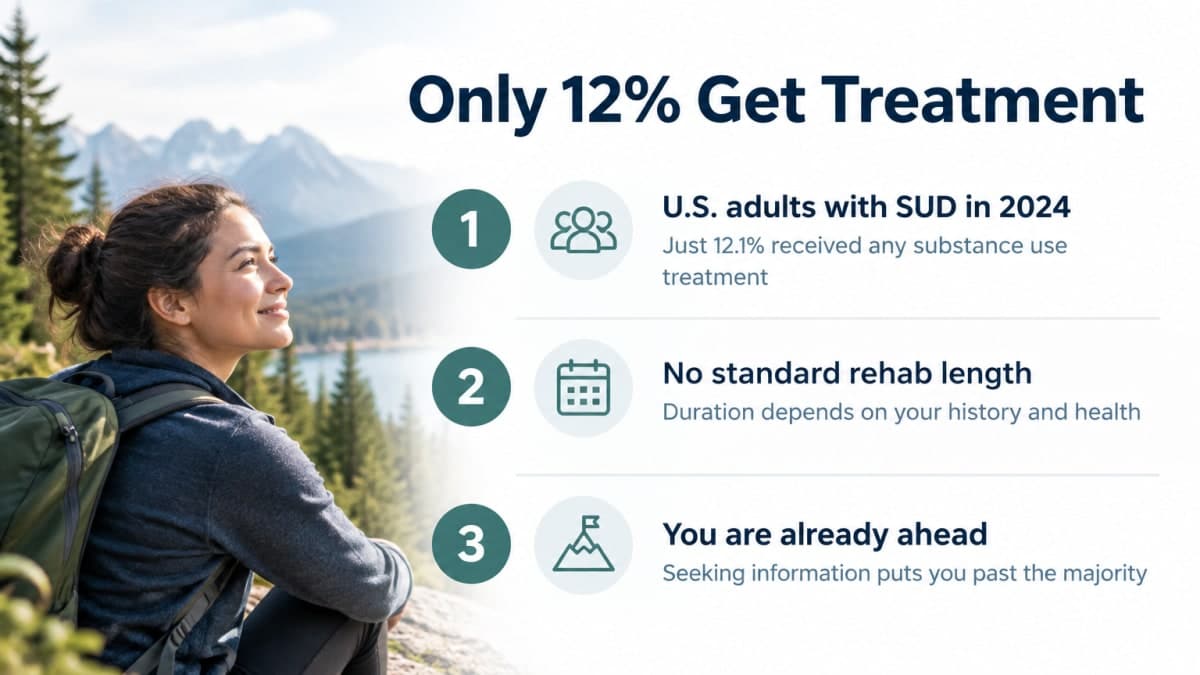
Here’s the part that doesn’t get said enough: most people who could use help never get it. In 2024, only 12.1% of U.S. adults with a past-year substance use disorder received any substance use treatment 12. If you’re reading this, you’re already doing something the majority of people in your shoes don’t do. That matters.
The rest of this guide gives you ranges, not promises, so you can plan around what your real life looks like.
How Long Does Alcohol Detox Take? The First 8-10 Days
Medical detox for alcohol usually takes about 8 to 10 days. That window covers the time it takes your body to clear the alcohol, work through withdrawal symptoms safely, and stabilize enough that you can start thinking clearly about what comes next. The exact number of days depends on how much and how long you’ve been drinking, whether you’ve been through withdrawal before, and what else is going on with your health.
Here’s what the first week or so typically looks like. You come in, get a medical assessment, and a provider decides what medications and level of monitoring you need. The hardest physical days are usually in the middle, when symptoms peak. By the end of the stay, most people are sleeping better, eating real food again, and able to sit through a group without white-knuckling it. That’s the point of detox: not to fix everything, but to get you to a steady enough place that treatment can actually begin 1.
At Pacific Crest Trail Detox in Milwaukie, that stay happens in a home-like setting rather than a hospital floor. Registered nurses are on site around the clock, providers round seven days a week, and meals are home-cooked instead of plated behind a tray slot. If you’re driving in from Portland, Gresham, Beaverton, Salem, or Vancouver WA, or flying in from out of state, you’ll be settled into a bedroom, not a ward.
The next two subsections break the first 8-10 days into what withdrawal actually feels like hour by hour, and why trying to do this alone at the kitchen table is the one piece of this process you shouldn’t improvise.
Alcohol Withdrawal Timeline: Hour by Hour
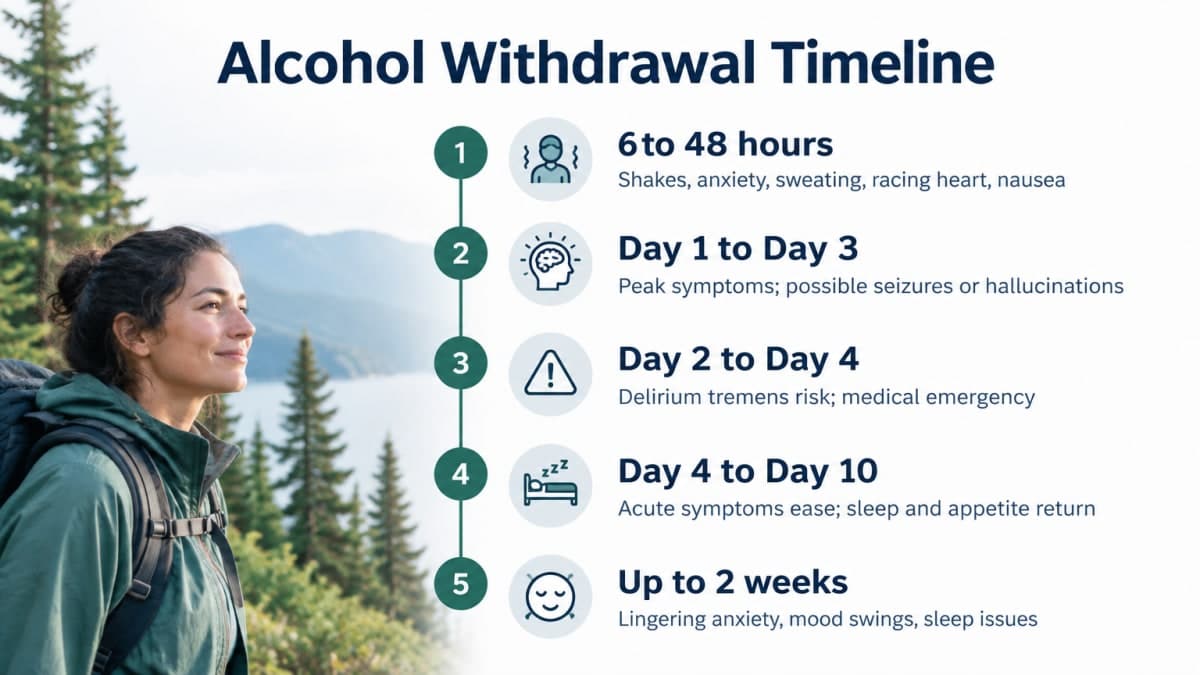
Withdrawal doesn’t wait for you to be ready. For most people who’ve been drinking heavily, symptoms start showing up within about 8 hours of the last drink, peak somewhere between day 1 and day 3, and can keep flickering for up to two weeks before they fully settle 15. Knowing roughly when each stage hits helps you plan the stay and understand why the middle days are the roughest.
- Early hours (roughly 6 to 48 after your last drink): usually the shakes, anxiety, sweating, a racing heart, trouble sleeping, nausea, and a headache that won’t quit 16. This is when a lot of people pour another drink to make it stop. In detox, this is when medications and monitoring start doing that job for you.
- Day 1 through day 3 — peak symptoms: blood pressure and heart rate can climb, and some people develop seizures or hallucinations 15. The most serious complication, delirium tremens, usually shows up 2 to 4 days after the last drink and brings confusion, severe agitation, fever, and dangerous changes in heart rhythm 16. DTs are a medical emergency and are the main reason detox belongs in a monitored setting.
- Day 4 through day 10: acute symptoms start easing. Sleep slowly improves. Appetite comes back. Some people deal with lingering anxiety, mood swings, or sleep problems for up to two weeks, which is normal and worth saying out loud so you’re not blindsided by week two 15.
Why Alcohol Detox Needs Medical Supervision
Medical supervision means someone is checking your vital signs, adjusting medication for your specific withdrawal, and watching for the complications that turn a hard week into an ER visit. At PCTD, that means 24/7 nursing in Milwaukie and providers who round every day, including weekends. If you’ve tried to taper on your own and ended up drinking again, that isn’t a character flaw. It’s what the research says to expect, which is why detox is designed to be the one week you don’t do alone.
After Detox: The Four Levels of Alcohol Treatment
Once detox ends, the question shifts from “am I safe?” to “what helps me stay stopped?” The National Institute on Alcohol Abuse and Alcoholism groups post-detox care into four levels: outpatient, intensive outpatient or partial hospitalization, residential, and intensive inpatient 2. Think of them as a staircase you can move up or down, not a set of competing products.
Most people don’t need all four. A common path after an 8-10 day detox in Milwaukie looks like this: a few weeks of residential or PHP for structure, then IOP a few evenings a week while you go back to work, then standard outpatient and medication check-ins for the rest of the first year. Some people start lower on the staircase if their withdrawal was milder and home is stable. Others step back up if a hard week hits. The next four pieces walk through what each level actually asks of your week.
Residential Treatment: Weeks 2-6
Residential treatment is where you live at a facility and get clinical care all day, usually for two to six weeks after detox. You sleep there. You eat there. Your schedule is built around groups, individual therapy, and recovery skills instead of your inbox. NIAAA lists residential as one of the four levels of care precisely because some people need that kind of structure to get traction before stepping down 2.
Who tends to benefit most? People with heavy, long-standing drinking, people who’ve relapsed after lower levels of care, people with co-occurring mental health symptoms that need daily attention, and people whose home environment makes early sobriety hard. If your roommate still drinks every night or your spouse has their own untreated use, three weeks away can be the difference between a shaky start and a solid one.
At PCTD, residential care flows directly from detox in the same home-like Milwaukie setting, with the same team you already know. That continuity matters when you’re exhausted and don’t want to re-explain your story to a new intake coordinator.
Partial Hospitalization (PHP): About 20-30 Hours a Week
PHP is the step between residential and outpatient. You’re in clinical programming most of the day, typically five days a week, and you either sleep at the facility or in nearby supportive housing. The hours land around 20 to 30 per week. NIAAA groups PHP with intensive outpatient as one of the four levels of care, which tells you it carries real weight even though you’re not in 24-hour care anymore 2.
PHP tends to fit people who finished detox stable but aren’t ready for evenings alone, and people stepping down from residential who want to keep the daily rhythm. You get group therapy, individual sessions, medication management, and skills work on sleep, cravings, and the first awkward conversations with family. Expect to spend four to six weeks here before most teams talk about stepping down to IOP. If you’re commuting in from Portland, Gresham, or Beaverton, plan on PHP eating your workday for about a month.
Intensive Outpatient (IOP): At Least 9 Hours a Week
IOP is the first level where you’re genuinely back in your life. For adults, IOP generally runs at least 9 structured hours per week, usually three sessions of about three hours each, scheduled in evenings or mornings so you can hold a job 7. Most people spend two to four months in IOP, though your team should adjust the length based on how you’re doing, not a calendar.
SAMHSA describes IOP three ways:
- as a step-down from residential or PHP,
- as a step-up from standard outpatient when things get wobbly, or
- as primary care for people who don’t need a residential stay 6.
All three are legitimate uses. If you came out of detox stable, had a safe place to go home to, and have mild-to-moderate alcohol use disorder, IOP as your main treatment can be the right call.
Here’s the part worth saying plainly: for appropriately selected clients, IOP outcomes can be comparable to residential outcomes 7. A 2014 peer-reviewed review of IOP versus residential and inpatient care found both settings generally produced reductions in substance use and more abstinent days at follow-up 11. More hours in a bed isn’t automatically more recovery. The right match for your severity and home situation is.
Outpatient and Medication Follow-Up
Standard outpatient is the longest and lightest phase. You might see a counselor weekly or every other week, meet with a prescriber for medication check-ins once a month, and plug into peer support (AA, SMART Recovery, Refuge Recovery, whatever actually gets you through the door) on your own schedule. NIAAA includes outpatient as the broadest of the four levels of care and notes that behavioral treatment, medication, and mutual-support groups work well in combination 2.
This phase often runs from month four through month twelve, sometimes longer, and it’s where recovery stops being a program and starts being a life. The hours per week are small. The stakes are not. If you came through PCTD’s detox, outpatient support continues through our partner program Oregon Trail Recovery, so the handoff isn’t a cold start with strangers. For readers in Salem or Vancouver WA, a hybrid of in-person groups and telehealth check-ins keeps the drive manageable.
The Full Alcohol Recovery Timeline at a Glance
Here’s the whole arc on one page, so you can see what the next year could look like before you make the call.
- Day 0 — Assessment and admission. A clinical phone call, insurance verification, and a bed waiting that night or the next morning in Milwaukie.
- Days 1–10 — Medical detox. Roughly 8 to 10 days of medically supervised withdrawal, with symptoms starting around 8 hours after the last drink, peaking at days 1–3, and easing by the end of the stay 15.
- Weeks 2–6 — Residential or partial hospitalization. Two to six weeks of structured clinical care, with PHP running around 20 to 30 hours a week 2. Not everyone needs this step. Some people step straight into IOP.
- Months 2–4 — Intensive outpatient. At least 9 structured hours a week for most adults, usually three sessions scheduled around work 7. Two to four months is common, longer if your team recommends it.
- Months 4–12 — Outpatient and medication follow-up. Weekly or biweekly counseling, monthly prescriber visits for medications like naltrexone or topiramate 17, and peer support on your own schedule 2.
- Year 1 and beyond — Aftercare and alumni. Continuing care in the research averages around 9.7 months, though plans range widely based on relapse risk 9. Recovery itself is tracked by NIAAA in remission milestones at 3 months, 1 year, and 5 years 3.
The medically intensive window is short. The lighter work is long. Both count.
Why 30, 60, or 90 Days Isn’t the Right Question
You’ve probably seen the pitches: a 30-day program, a 60-day program, a 90-day program, pick the one your insurance covers. It’s a tidy way to sell treatment. It’s not what the research actually says.
A 2017 systematic review looked at 48 outpatient psychosocial treatment studies covering 8,984 people with alcohol use disorder. Planned treatment durations ranged from 8 to 82 weeks, with a mean of about 18 weeks. Here’s the finding that should change how you shop for care: neither the planned length nor the length people actually attended was consistently linked to long-term alcohol outcomes 8. Longer wasn’t automatically better. Shorter wasn’t automatically worse.
What that means in plain terms: a 90-day stay isn’t a guarantee, and a 30-day stay isn’t a shortcut. What tends to matter more is whether the care matches your severity, whether you stay engaged, and whether the handoff from one level to the next actually happens instead of ending at a discharge paper.
So stop asking “how many days?” Start asking: what level of care do I need right now, who decides when I step down, and what does month four look like after month one ends?
Continuing Care: Months 4-12 and Beyond
Once you’re past the first few months, the work gets quieter. Fewer group hours. Fewer appointments. More ordinary Tuesdays. This is the stretch where a lot of people assume they’re done, and it’s also where a lot of relapses happen. Continuing care is the structure that keeps month six from catching you off guard.
The research backs up why this phase deserves real attention. A meta-analysis of 33 controlled continuing-care studies found that planned continuing care averaged about 9.7 months, with a wide range from roughly 2.8 to 48 months 9. A later review concluded that longer continuing care, especially when the program actively works to keep you engaged rather than waiting for you to show up, tends to help people at higher relapse risk the most 10. In plain terms: the people who stay connected the longest, and whose program chases them a little when they drift, tend to do better.
What continuing care actually looks like at this point is some mix of counseling every week or two, a monthly check-in with a prescriber if you’re on medication, peer support meetings on your own schedule, and an alumni community that keeps you around people who get it. If you came through PCTD, that handoff flows into outpatient support through our partner program Oregon Trail Recovery, so month five isn’t a cold start with strangers. The next two pieces cover what medication for alcohol use disorder looks like through this stretch, and how to think about the recovery milestones that actually mean something.
Medication for Alcohol Use Disorder: How Long People Stay On It
Medications for alcohol use disorder are different from the medications used during detox. The ones used in the hospital or detox unit calm withdrawal. The ones you may stay on afterward, like naltrexone or topiramate, help reduce cravings and the pull toward heavy drinking once you’re already sober 4. The VA/DoD clinical practice guideline recommends offering naltrexone or topiramate for moderate-to-severe alcohol use disorder as part of standard care 17.
How long do people stay on them? Most clinical trials ran about six months, and NIAAA is honest that the evidence doesn’t define a single ideal length 4. In practice, some people stay on medication for six months, some for a year or two, some longer. The decision gets made with your prescriber based on how you’re doing, side effects, your preference, and your relapse risk, not a fixed stop date. If a medication is helping and the side effects are manageable, there’s no clinical reason to rush off it.
Remission Milestones: Month 3, Year 1, Year 5
NIAAA tracks recovery from alcohol use disorder in four remission stages, and knowing them helps you understand why certain months feel like landmarks.
- Initial remission
- Up to 3 months.
- Early remission
- 3 months to 1 year.
- Sustained remission
- 1 to 5 years.
- Stable remission
- Anything beyond 5 years 3.
Month 3 matters because the acute brain changes from heavy drinking are starting to settle. Year 1 matters because you’ve made it through every holiday, birthday, and bad week once sober, which is a different kind of proof than 90 days. Year 5 matters because the research treats it as the point where long-term stability is well established.
NIAAA frames recovery as a marathon, not a sprint, and recommends an initial care plan followed by a continuing care plan, particularly for moderate or severe alcohol use disorder 5. The milestones aren’t finish lines. They’re waypoints that tell you the structure is working.
Time Away From Work, Kids, and School: Planning the Real Calendar
You’re probably doing math on days off work right now. School pickup. The custody schedule. Whether your boss has to know. Here’s a realistic read on what each phase asks of your calendar, so you can plan instead of panic.
- Detox (8–10 days): Full time away. You’re living at the facility in Milwaukie, phone use is limited, and you’re not working or driving. Most people use PTO, short-term disability, or FMLA, which protects your job for up to 12 weeks if you qualify. HR doesn’t need your diagnosis, just the dates.
- Residential or PHP (2–6 weeks): Still mostly off the grid, though PHP sometimes allows evening calls home. If you have kids, this is where a co-parent, grandparent, or trusted friend carries the load. Make the childcare plan before you admit, not from a hallway payphone on day three.
- IOP (2–4 months): Back to work or school. IOP runs at least 9 hours a week, usually three evening or morning sessions, built so you can keep a job 7. Most people in Portland, Gresham, or Beaverton drive to group after work and are home by 9.
- Outpatient (months 4–12): A weekly or biweekly appointment and a monthly medication check. Fits around a normal schedule.
Oregon and SW Washington: What Local Care Looks Like
If you’re reading this from Milwaukie, Portland, Gresham, Beaverton, Salem, or across the river in Vancouver WA, here’s what the local landscape actually looks like. Oregon licenses detox programs under the state’s ASAM withdrawal-management framework. The two levels you’ll see most for adults are 3.2-WM, clinically managed residential withdrawal management, and 3.7-WM, medically monitored inpatient withdrawal management 13. Pacific Crest Trail Detox operates as a non-hospital residential detox in Milwaukie, which means medical oversight in a home-like setting rather than a hospital floor.
For people driving in from Portland or Gresham, admission is usually a 20-to-30-minute trip. From Beaverton or Salem, plan an hour. From Vancouver WA, you’re crossing one bridge. Out-of-state readers are welcome too; many clients fly into PDX and get picked up. After detox, continuing care flows into outpatient support through our partner program Oregon Trail Recovery, so month two isn’t a cold handoff to a stranger’s intake line.
Your Next Step: A Confidential Call
You’ve read the timeline. You know detox is about 8 to 10 days and the care that follows runs for months. The last thing left is picking up the phone, and that’s the part no article can do for you.
A call to Pacific Crest Trail Detox in Milwaukie is confidential and HIPAA-protected. You’ll talk with someone who can walk through your drinking history, your withdrawal risk, and what level of care actually fits, then verify your insurance so you know the cost before you commit. We want to be your last treatment experience, whether we’re your first detox or your fifth.
Call when you’re ready. Verify your benefits when you’re almost ready. Either one is a real step.
Plan Your Next Step After Alcohol Rehab
Check your coverage for medically supported detox and continued care, including outpatient treatment.
Frequently Asked Questions
How long does alcohol detox take at Pacific Crest Trail Detox?
Medical detox for alcohol at PCTD in Milwaukie usually runs about 8 to 10 days. The exact length depends on how heavy and how long your drinking has been, your health, and how your body responds to medication. Nurses are on site 24/7 and providers round daily, so the plan adjusts to you, not a fixed script.
Is a 30-day alcohol rehab program long enough?
There’s no universal answer. A systematic review of 48 studies and 8,984 people with alcohol use disorder found that planned and attended treatment duration were not consistently linked to long-term outcomes 8. What matters more is matching the level of care to your severity, staying engaged, and continuing into outpatient and medication follow-up after the initial stay ends.
Can I detox from alcohol at home instead?
No, and we won’t walk you through how. Abruptly stopping heavy drinking can be life-threatening, and NIAAA directly advises getting medical help to plan a safe withdrawal 14. Seizures and delirium tremens can appear 2 to 4 days after your last drink 16. Those complications need medications and monitoring you can’t safely arrange from a kitchen table.
How much time will I need to take off work for alcohol treatment?
Plan on roughly 8 to 10 days fully off for detox. If you continue into residential or PHP, add two to six weeks mostly off the grid. Once you reach IOP, you’re generally back at work, with about 9 structured hours of treatment per week scheduled around a job 7. Outpatient after that fits around a normal week.
What happens after detox ends?
Detox is the start, not the finish. NIAAA is explicit that detox is a critical first step but is not, in itself, alcohol treatment 1. What follows is some mix of residential care, PHP, IOP, outpatient counseling, medication like naltrexone or topiramate 17, and peer support. At PCTD, that handoff continues through our partner program Oregon Trail Recovery.
Can I come to PCTD if I live outside Oregon?
Yes. Out-of-state clients are welcome and common. Many fly into Portland International and are picked up for the short trip to Milwaukie. Our admissions team can help coordinate travel, verify your insurance, and walk through what to pack. Call for a confidential, HIPAA-protected assessment and we’ll build the plan around your situation.
References
- Alcohol Use Disorder: From Risk to Diagnosis to Recovery. https://www.niaaa.nih.gov/health-professionals-communities/core-resource-on-alcohol/alcohol-use-disorder-risk-diagnosis-recovery
- Recommend Evidence-Based Treatment: Know the Options. https://www.niaaa.nih.gov/health-professionals-communities/core-resource-on-alcohol/recommend-evidence-based-treatment-know-options
- NIAAA Recovery Research Definitions. https://www.niaaa.nih.gov/research/niaaa-recovery-from-alcohol-use-disorder/definitions
- Alcohol Use Disorder: The Role of Medication in Recovery. https://arcr.niaaa.nih.gov/media/1501/download?inline
- Support Recovery: It’s a Marathon, Not a Sprint. https://www.niaaa.nih.gov/health-professionals-communities/core-resource-on-alcohol/support-recovery-its-marathon-not-sprint
- TIP 47 – Clinical Issues in Intensive Outpatient Treatment. https://www.samhsa.gov/resource/ebp/tip-47-substance-abuse-clinical-issues-intensive-outpatient-treatment
- Clinical Issues in Intensive Outpatient Treatment for Substance Use Disorders. https://library.samhsa.gov/sites/default/files/pep20-02-01-021.pdf
- Duration of therapy – Does it matter?: A systematic review and meta-regression of the duration of psychosocial treatments for alcohol use disorder. https://pubmed.ncbi.nlm.nih.gov/29195594/
- How effective is continuing care for substance use disorders …. https://pmc.ncbi.nlm.nih.gov/articles/PMC3840113/
- Impact of Continuing Care on Recovery From Substance Use Disorder. https://pubmed.ncbi.nlm.nih.gov/33500871/
- Substance Abuse Intensive Outpatient Programs. https://pmc.ncbi.nlm.nih.gov/articles/PMC4152944/
- Population Statistics Reports: Substance Use Treatment among People Aged 12 or Older: 2024. https://www.samhsa.gov/data/sites/default/files/reports/rpt56617/2024-nsduh-psr4-sutx-among-sud.pdf
- Oregon Health Authority : Licensing and Certification : Providers. https://www.oregon.gov/oha/BH/Providers/Pages/Licensing-Certification.aspx
- Treatment for Alcohol Problems: Finding and Getting Help. https://www.niaaa.nih.gov/sites/default/files/publications/treatment.pdf
- Alcohol Withdrawal. https://pmc.ncbi.nlm.nih.gov/articles/PMC11801492/
- Treatment of Alcohol Withdrawal. https://pmc.ncbi.nlm.nih.gov/articles/PMC6761817/
- Version 4.0 | 2021 – VA/DOD Clinical Practice Guidelines. https://www.healthquality.va.gov/guidelines/MH/sud/VADoDSUDCPGProviderSummary.pdf