

Key Takeaways
- Alcohol and benzodiazepines both suppress the GABA system, so withdrawal from either can trigger anxiety, tremor, seizures, delirium, or death without medical supervision.6
- Alcohol withdrawal typically runs an acute phase of about 5 to 7 days, while benzo withdrawal typically runs 1 to 4 weeks, extending to 3 to 5 weeks on a taper. Individual timelines vary by half-life, dose, duration of use, polysubstance exposure, and physiology.2
- Alcohol detox typically uses symptom-triggered benzodiazepine dosing guided by CIWA-Ar scoring,5 while benzo detox calls for an individualized gradual taper with shared decision-making.1
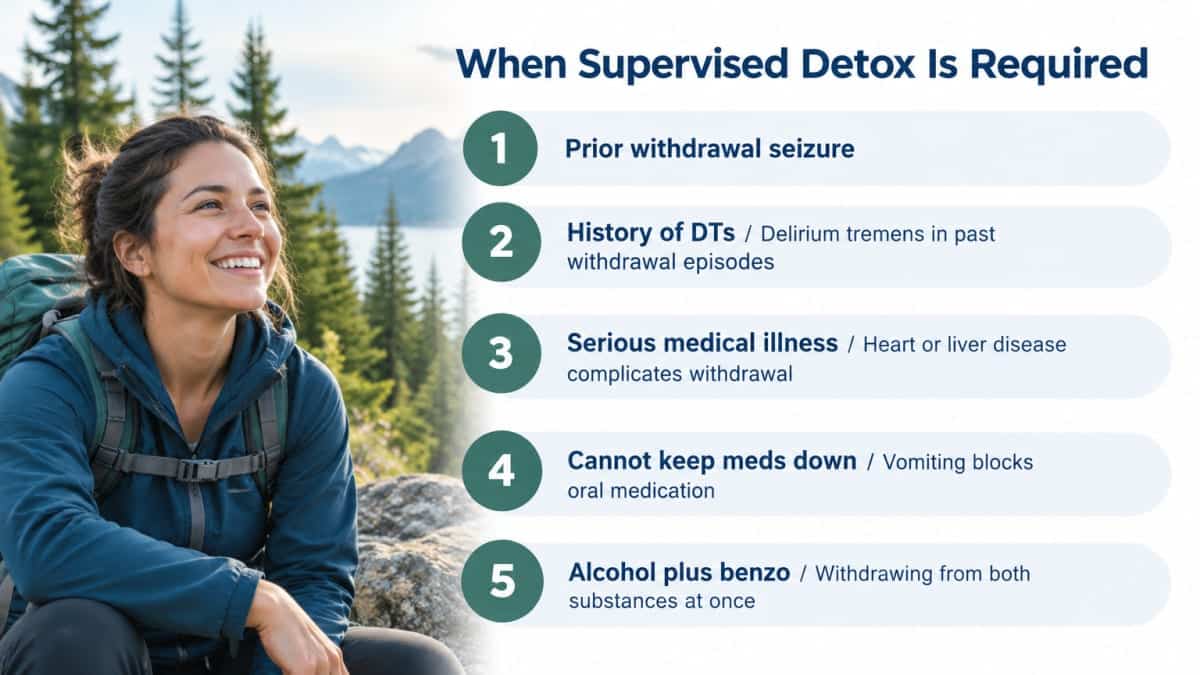
- Anyone with prior seizures, DTs, serious medical conditions, or combined alcohol and benzo use should pursue inpatient medically supervised withdrawal rather than attempting it at home.3
- Detox handles the dangerous window, but lasting recovery usually depends on stepping into PHP, IOP, outpatient, and aftercare, especially for benzo recovery with its longer symptom tail.1
The Same Brake System, Two Different Storms
If you’re trying to figure out how alcohol withdrawal compares to benzodiazepine withdrawal, here’s the short version: both pull the brakes off the same part of your brain, both can be dangerous or even deadly without medical help, and both deserve supervised care. Alcohol withdrawal tends to move fast and clear within about a week. Benzo withdrawal moves slower and usually needs a careful, gradual taper over weeks.2
You’re probably reading this at a hard moment. Maybe it’s late. Maybe you’ve already tried to stop before. Maybe you’re worried about a partner, a parent, or an adult child who’s been drinking too much, taking Xanax or Klonopin or Ativan too long, or doing both at once. You deserve a straight answer, not a scare tactic and not a sales pitch.
Here’s what the next few sections will give you: how each withdrawal actually feels, how long it lasts, where the real medical risks sit, and what a supervised detox does differently for alcohol than it does for benzos. No DIY instructions. Just honest information you can act on.
Why Alcohol and Benzos Share a Withdrawal Blueprint
Your brain has an accelerator and a brake. The accelerator is a chemical called glutamate. The brake is GABA. When everything is working right, those two keep each other in check so you can think clearly, feel calm, and sleep at night.
Alcohol presses the brake. So do benzodiazepines like Xanax, Klonopin, and Ativan. They attach to the same GABA system and amplify its calming signal. That’s why a glass of wine and a dose of Klonopin can feel like cousins: both quiet the noise.
Here’s the catch. When you use either substance heavily or for a long time, your brain adjusts. It turns down its own GABA brake and turns up the glutamate accelerator to compensate. For a while, that balance holds. But when you suddenly take the alcohol or the benzo away, the brake is gone and the accelerator is still floored. Everything speeds up at once. That’s withdrawal.
This is why alcohol and benzo withdrawal share a symptom family: anxiety, tremor, insomnia, racing heart, and in severe cases, seizures, delirium, or death.6 It’s the same brain system misfiring. Medical treatment for both follows the same core logic too, which is restoring GABA activity with a medication and then easing it down slowly, instead of letting the brain crash cold.6
What separates alcohol withdrawal from benzo withdrawal is not the mechanism. It’s the clock, the dose curve, and how long your nervous system needs to find its own balance again. That’s what the next sections unpack.
How Long Does Each Withdrawal Actually Last?
Alcohol Withdrawal: A Fast, Sharp Storm
Alcohol withdrawal tends to move quickly. Symptoms generally begin within hours to days after your last drink, sometimes while there is still alcohol in your system. The first signs are often the ones you already know: your hands shake, your heart pounds, you sweat through your shirt, your stomach turns, and sleep won’t come.
From there, things tend to intensify in the first few days. Blood pressure and heart rate climb. Anxiety spikes. For some people, this is also when a withdrawal seizure can happen, or when something called delirium tremens, the DTs, can set in, bringing confusion, hallucinations, and dangerous swings in vital signs.6
If things go well, and if you have medical support, the acute phase of alcohol withdrawal usually settles down over about 5 to 7 days.2 That doesn’t mean you feel like yourself on day 8. Sleep, appetite, mood, and energy can take weeks longer to level out. But the dangerous window, the part that can land someone in an ICU, is relatively short and front-loaded. It hits hard and then fades.
Benzo Withdrawal: A Slower, Longer Climb
Benzodiazepine withdrawal plays a different game. The clock depends on the drug. Short-acting benzos like Xanax (alprazolam) and Ativan (lorazepam) tend to produce withdrawal symptoms sooner after the last dose. Longer-acting ones like Klonopin (clonazepam) or Valium (diazepam) can delay symptoms before you feel the floor drop, reflecting differences in half-life.
Once it starts, it doesn’t rush. The acute phase of benzo withdrawal typically runs 1 to 4 weeks, and when a careful medical taper is used to protect the brain and body, that window can extend to roughly 3 to 5 weeks.2 Anxiety comes back with a vengeance. Sleep is often shredded. Muscles ache. Sensory input, light, sound, touch, can feel like too much. Seizure risk is real, especially with abrupt stops or high doses.
This is why clinical guidelines are firm: if you’ve been physically dependent on a benzodiazepine, don’t quit cold. The ASAM-led tapering guideline specifically recommends avoiding abrupt discontinuation and using an individualized, gradual taper tied to how your body actually responds, with shared decision-making and psychosocial support built in along the way.1 The VA/DoD provider summary also supports gradual tapering for benzodiazepine withdrawal.4
Some people also experience a longer tail of symptoms, sometimes called protracted withdrawal, where anxiety, sleep issues, or sensory sensitivity linger for months. It’s not everyone, and it’s not permanent, but it’s part of why benzo recovery deserves patience and a clinician in your corner.
Side-by-Side Timeline at a Glance
If you’re a visual thinker, here’s the short comparison. SAMHSA’s reference table puts acute alcohol withdrawal at roughly 5 to 7 days, and acute benzodiazepine withdrawal at roughly 1 to 4 weeks, stretching to 3 to 5 weeks when a taper is used.2 A more recent 2025 clinical review of alcohol withdrawal reinforces that benzodiazepines are first-line and that symptom-triggered management with CIWA-Ar is a common approach during the acute phase.5 That’s the hinge of this whole article. Alcohol is days. Benzos are weeks.
A quick way to hold the difference in your head:
- Alcohol withdrawal: acute phase about 5 to 7 days.
- Benzo withdrawal: acute phase 1 to 4 weeks, up to 3 to 5 weeks on a medical taper, with onset timing shaped by the drug’s half-life.
A few honest caveats. These windows describe typical ranges, not promises. Your personal timeline depends on how long you’ve used, how much, which specific drug and its half-life, your health history, whether you’re using more than one substance, and your individual physiology.2 Someone drinking a fifth a day for a decade with past DTs is a different clinical picture than someone a year into daily Xanax. That’s why the next question matters more than the calendar: who’s watching you while this happens?
What the Symptoms Feel Like, Honestly
The Shared Symptoms: Shakes, Sweats, Sleepless Nights
Here’s where the two withdrawals look like siblings, at least on the surface. Whether your body is coming off alcohol or off a benzo like Xanax, Klonopin, or Ativan, the opening act tends to feel familiar.
Your hands shake. Not a dramatic tremor, usually, but enough that holding a coffee cup or a phone takes effort. You sweat, often at night, waking up with the sheets damp. Your heart feels like it’s working harder than it should, even when you’re sitting still. Your stomach turns on you, nausea first, sometimes vomiting. Food sounds impossible.
Then there’s the anxiety. Not situational worry about a bill or a conversation, but a floor-level dread that doesn’t attach to anything. Your skin feels wrong. Light seems brighter than it should. Small sounds feel loud. Your jaw clenches without your permission.
And sleep, when you need it most, won’t come. Or it comes in short, broken pieces full of vivid dreams. By day two or three without rest, your thinking gets fuzzy, your patience disappears, and the symptoms you already have feel twice as big.6
If this is you right now, you’re not weak. Your brain is doing exactly what it learned to do.
Where the Two Diverge: Seizures, DTs, and Rebound Anxiety
The shared symptoms are the overlap. What separates alcohol withdrawal from benzo withdrawal is where things can go seriously wrong, and when.
With alcohol, the dangerous turn usually comes early and comes hard. In the first few days, a small percentage of people have a withdrawal seizure, often with little warning. Others move into delirium tremens, the DTs: confusion that gets worse by the hour, hallucinations that feel real, blood pressure and heart rate that swing in ways the body can’t absorb. Untreated, severe alcohol withdrawal can kill you.6 That’s not a scare tactic. That’s the reason emergency rooms don’t tell people to just ride it out at home.
Benzo withdrawal carries seizure risk too, especially when someone stops abruptly or has been on high doses for a long stretch. But the arc looks different. The symptoms often build more slowly, and the signature complaint is rebound anxiety, panic that comes back louder than the panic the benzo was originally prescribed to quiet. Some people describe weeks of feeling like their skin is buzzing, like noise hurts, like they can’t settle inside their own body. Severe benzo withdrawal can also involve autonomic instability, seizures, and death, which is why clinical guidelines are clear about not stopping abruptly.6
So the honest answer to “which one feels worse” is: they feel bad in different shapes. Alcohol tends to hit like a wave. Benzos tend to grind. Both deserve a clinician watching the vitals, not a stopwatch on the kitchen counter.
Why Neither Should Be Done Alone at the Kitchen Table
You might be reading this because someone told you to just drink water, take some vitamins, and ride it out. Or because you’ve done it before and figured you could do it again. Here’s the honest piece most internet advice skips: the people who die from alcohol or benzo withdrawal are often the people who thought they’d be fine.
Supervised withdrawal is not about hospital gowns and fluorescent lights. In a non-hospital medical detox, it looks more like a bedroom, a nurse checking in, meals you can actually eat, and a provider who can adjust medication when things shift. What it offers that your kitchen cannot: vital signs tracked around the clock, seizure risk watched for in real time, and medication given on the actual timeline your body needs it, not when you remember to take it.
Here’s the other reason this matters. Severe alcohol and benzo withdrawal can involve autonomic instability, seizures, delirium, and death.6 That’s not a horror story. That’s the clinical reality the guidelines were written to prevent. You deserve a setting where someone else is paying attention while your nervous system finds its footing again.
What Medically Supervised Detox Actually Does Differently
For Alcohol: Symptom-Triggered Dosing and CIWA Monitoring
Here’s what a good alcohol detox actually looks like behind the scenes. A nurse periodically runs through a short checklist called the CIWA-Ar. It scores things you’re already feeling: tremor, sweating, nausea, anxiety, how clear your head is, whether sounds and light feel like too much. The score helps guide what happens next.5
If your score is low, you rest. If it climbs, you receive a dose of a benzodiazepine to quiet the overactive nervous system and lower seizure and DT risk. If it climbs again, the team can give another dose. The medicine meets the symptoms where they are, instead of being scheduled on a clock that may not match your body.5 That’s symptom-triggered dosing, and it’s one of two main approaches clinicians use. The other is fixed-schedule dosing, which gives medication on a set timeline. The choice between symptom-triggered and fixed-schedule approaches depends on severity, monitoring capacity, and whether a patient can reliably report symptoms.7 Benzodiazepine-sparing strategies can also play a role in some protocols with appropriate patient selection and monitoring.8
What you don’t do at home: track your own blood pressure, catch a seizure before it happens, or dose yourself with a controlled medication you don’t have. That’s the whole point of a supervised setting.
For Benzos: An Individualized, Gradual Taper
Benzo detox runs on a different playbook, and the difference matters. There’s no CIWA-Ar scorecard driving doses up and down by the hour. Instead, the medical plan is a gradual taper: your current benzo, or a longer-acting substitute, is reduced in small steps over time so your GABA system can relearn its own rhythm without the brain slamming into withdrawal.1
The ASAM-led tapering guideline is specific about how this should go. Avoid abrupt discontinuation in anyone physically dependent. Tailor the taper to how the individual actually responds, not to a one-size schedule. Use shared decision-making, meaning you’re part of the conversation about pace and adjustments. Pair the medical taper with psychosocial support, because the anxiety, sleep issues, and rebound symptoms that come with benzo withdrawal are not just chemical; they need human help too.1
Compare that side by side with alcohol: symptom-triggered benzodiazepine dosing with CIWA-Ar monitoring on one track,5 and an individualized gradual taper with shared decision-making on the other.1 Two different protocols, two different clocks, two different kinds of attention. That’s why a plan built for one isn’t safe to swap onto the other, and why the clinician in the room matters.
When Someone Is Withdrawing From Both at Once
If you’re drinking daily and also taking a benzodiazepine like Xanax, Klonopin, or Ativan, you’re not in a gray area. You’re in the category clinical guidelines take most seriously. The VA/DoD Clinical Practice Guideline specifically names concurrent sedative-hypnotic withdrawal, meaning alcohol plus a benzo, as a situation that supports inpatient medically supervised management.3 That’s not an opinion. That’s the written standard.
Here’s why. Both substances press the same GABA brake. When you stop both at the same time, your brain isn’t losing one source of calming signal, it’s losing two. The glutamate accelerator that compensated for daily use now has nothing holding it back. Seizure risk climbs. The arc of symptoms can look like alcohol withdrawal early on, then shift into the longer, grinding course that benzos bring. You can feel like you’re turning the corner on day five and get hit by a second wave as the benzo clears your system.
A supervised detox handles this by treating two problems on two timelines inside one plan: symptom-triggered dosing and vitals monitoring for the alcohol piece,5 and an individualized gradual taper for the benzo piece.1 One clinician holding both threads. Not two guesses in a dark bedroom.
What Comes After Detox
Detox clears the substance from your body and gets you through the dangerous window. It doesn’t rewire the habits, relationships, or pain that pointed you toward drinking or taking benzos in the first place. That’s not a failure of detox. That’s the design. Detox is step one, not the whole staircase.
For most people, the next step is a structured level of care that keeps the momentum going. A partial hospitalization program (PHP) runs most of the day, most days of the week, with group work, individual therapy, and ongoing medical check-ins. An intensive outpatient program (IOP) steps the hours down so you can return to work, school, or family while still getting real clinical support. Standard outpatient and aftercare keep you connected longer, because the first year is where most people need the most backup.
Benzo recovery in particular benefits from this continuity. The ASAM-led tapering guideline recommends pairing the medical taper with psychosocial support, not treating the two as separate problems.1 The anxiety and sleep issues that linger after the acute phase respond better to therapy, routine, and connection than to willpower alone.
Getting Help in the Portland Metro and Beyond
If you’re in Milwaukie, Portland, Gresham, Beaverton, Salem, or across the river in Vancouver, Washington, you don’t have to figure this out alone at 2 a.m. with a search bar. A phone call to a medical detox team gets you a real conversation with someone who can hear what you’ve been using, how long, and what else is going on, and tell you honestly what level of care fits.
Pacific Crest Trail Detox is a non-hospital medical detox in Milwaukie with RNs on site around the clock, providers rounding seven days a week, and a continuum that runs from detox into PHP, IOP, outpatient, and aftercare. Many of the people helping you have been where you are. Out-of-state callers are welcome too; some of the best decisions people make are the ones that put a little distance between them and the environment that kept them stuck.
We want to be your last treatment experience, whether we’re your first detox or your fifth. Calls are confidential and HIPAA-protected.
Check Coverage for Medically Supervised Detox
See whether your plan may help cover medically supervised care for alcohol or benzodiazepine withdrawal.
Frequently Asked Questions
Which is more dangerous, alcohol withdrawal or benzo withdrawal?
Both can kill you if handled badly. Alcohol withdrawal tends to turn dangerous faster, with seizures and delirium tremens showing up in the first few days. Benzo withdrawal usually moves slower but drags on longer, with real seizure risk when someone stops abruptly. Severe cases of either can involve autonomic instability, seizures, delirium, and death.6 The honest answer isn’t which is worse. It’s that both need medical supervision.
Can I taper off Xanax or Klonopin at home by myself?
No, and please don’t try. If your body is physically dependent on a benzodiazepine, clinical guidelines are specific about avoiding abrupt discontinuation and using an individualized, gradual taper built with a clinician, not pulled from an internet forum.1 A medical team can adjust the pace when your body pushes back, watch for seizure risk, and pair the taper with psychosocial support so the anxiety and sleep issues don’t flatten you.
What happens if I’m using both alcohol and benzos together?
You’re in the highest-risk category for withdrawal. The VA/DoD Clinical Practice Guideline specifically names concurrent sedative-hypnotic withdrawal as a reason to support inpatient medically supervised management.3 Both substances press the same GABA brake, so stopping both at once removes two sources of calming signal at the same time. Seizure risk climbs, and symptoms can hit in two waves. This is not a situation to manage at home.
How soon do withdrawal symptoms start after my last drink or dose?
With alcohol, symptoms generally begin within hours to days after your last drink, sometimes while alcohol is still in your system. With benzodiazepines, onset depends on the drug’s half-life: shorter-acting medications like Xanax or Ativan tend to produce symptoms sooner, while longer-acting ones like Klonopin or Valium may delay symptoms. If you’re already feeling the shakes, sweats, or rising anxiety, call a medical team today rather than waiting it out.
Does Pacific Crest Trail Detox treat both alcohol and benzodiazepine withdrawal?
Yes. Pacific Crest Trail Detox is a non-hospital medical detox in Milwaukie, Oregon that treats alcohol withdrawal, benzodiazepine withdrawal, and people withdrawing from both at once. RNs are on site around the clock, providers round seven days a week, and you recover in a home-like setting with meals and groups rather than a hospital room. Calls are confidential and HIPAA-protected, and out-of-state callers from across the Pacific Northwest are welcome.
What happens after detox is finished?
Detox clears the substance and gets you through the dangerous window. The habits, pain, and patterns underneath take longer. Most people step into a partial hospitalization program (PHP), then an intensive outpatient program (IOP), then standard outpatient and aftercare, so the support tapers down as your footing grows. For benzo recovery especially, pairing the medical taper with ongoing psychosocial support is part of the clinical standard, not an add-on.1
References
- Joint Clinical Practice Guideline on Benzodiazepine Tapering: Considerations When Risks Outweigh Benefits. https://pubmed.ncbi.nlm.nih.gov/40526204/
- Protracted Withdrawal. https://library.samhsa.gov/sites/default/files/sma10-4554.pdf
- VA/DoD Clinical Practice Guidelines for the Management of Substance Use Disorders Pocket Card. https://www.healthquality.va.gov/guidelines/MH/sud/VADoDSUDCPGPocketCard.pdf
- VA/DoD Clinical Practice Guideline for the Management of Substance Use Disorders: Provider Summary. https://www.healthquality.va.gov/guidelines/MH/sud/VADoDSUDCPGProviderSummary.pdf
- Alcohol Withdrawal. https://pmc.ncbi.nlm.nih.gov/articles/PMC11801492/
- Withdrawal Syndromes. https://www.ncbi.nlm.nih.gov/books/NBK459239/
- Introduction to Alcohol Withdrawal. https://pmc.ncbi.nlm.nih.gov/articles/PMC6761824/
- NPTC Formulary Brief: Alcohol Withdrawal. https://www.ihs.gov/sites/nptc/themes/responsive2017/display_objects/documents/guidance/NPTC-Formulary-Brief-AlcoholWithdrawal.pdf