
Key Takeaways
- A benzodiazepine intervention is not a dramatic confrontation; abrupt stopping can trigger seizures, so the real work is lining up a clinician and medical detox before you speak 13.
- A safe intervention looks small and quiet: one or two trusted people, specific observations, and a prepared handoff to a provider rather than ultimatums or a surprise group confrontation 15.
- Before the conversation, build a pre-intervention checklist: call a medical detox, verify insurance, plan transportation, write down dose and co-use history, and leave tapering decisions to a clinician 12, 1.
- Mixing benzos with opioids or alcohol shrinks your timeline; in 2019–2020 CDC surveillance across 23 states and the District of Columbia, 91.4% of benzodiazepine-involved overdose deaths also involved opioids, so keep naloxone accessible and move quickly 5, 4.
- At the kitchen table, open with specific observations and feelings rather than labels, then listen; empathy keeps the door open while accusations and ultimatums harden resistance 15.
- If they say no, skip the ultimatum and name a smaller next step, then check in over the next 48 to 72 hours with the same door still open 15, 13.
- In Oregon and SW Washington, call a non-hospital medical detox that can admit within 24 to 48 hours, or use state help lines like 1-800-923-4357 to find care fast 16.
- At Pacific Crest Trail Detox, detox typically runs eight to ten days and is only step one; arrange PHP, IOP, outpatient, or aftercare before discharge because some withdrawal symptoms can linger for months 1.
Why a Benzodiazepine Intervention Is Different From Any Other
If you are planning a benzodiazepine addiction intervention for someone you love, the most important thing to understand before you say a word is this: pressuring them to stop taking Xanax, Klonopin, Ativan, or Valium today could kill them. Benzodiazepine withdrawal is not like quitting cigarettes or even detoxing from most opioids. After steady use for even a few weeks, the body can become physically dependent, and stopping abruptly or cutting the dose too fast can trigger seizures and other severe withdrawal reactions that may last for months 13. That single fact changes everything about how you plan the conversation.
So forget what you have seen on television. A benzodiazepine intervention is not a dramatic confrontation where everyone takes turns reading letters and demanding your loved one go to rehab tonight or lose their family. For benzos, that approach is dangerous. The real work happens before anyone sits down to talk. You are lining up a clinician, a bed in a medical detox, and a safety plan so the person has somewhere to land the moment they say yes.
Think of yourself less as a prosecutor and more as a logistics team supporting a scared person. The FDA is clear that no single tapering schedule fits every patient and that stopping should be managed by a provider, not a family member 1. Your job is to open the door to that provider—calmly, honestly, and with a plan already in place.
What a Safe Benzodiazepine Intervention Actually Looks Like
The Quiet Handoff, Not the TV Ambush
Picture something smaller than you’ve been imagining. One or two people your loved one trusts. A kitchen table or a quiet living room. Coffee, not candles. No circle of relatives taking turns reading letters. No surprise. The goal is not to corner someone until they crack; the goal is to walk them through a door you’ve already opened.
That door is a clinician. By the time you sit down, you’ve already called a medical detox, confirmed they can take an admission, and figured out how to get your loved one there today or tomorrow. The conversation itself might last twenty minutes. The preparation behind it took a week.
SAMHSA’s guidance on motivational approaches is clear that empathy, not authority, is what moves people toward treatment, and that pressuring or arguing with someone usually backfires 15. So you’re not there to win a debate. You’re there to say what you’ve noticed, listen to what they say back, and offer a specific next step they can take with you right now.
If that sounds anticlimactic, good. For benzodiazepines, boring is safe. Dramatic ultimatums invite dramatic refusals, and refusals often end with someone trying to quit on their own in a panic, which is exactly the scenario the FDA warns against 1.
Dependence vs. Addiction: Why the Difference Matters Before You Sit Down
Before you plan what to say, get clear on what you’re actually seeing. Physical dependence and addiction overlap, but they are not the same thing, and confusing them can derail a conversation in the first thirty seconds.
Physical dependence means the body has adapted to the medication. The FDA notes it can develop after just several days to weeks of steady use, even when a person takes Xanax, Klonopin, Ativan, or Valium exactly as prescribed 13. Dependence shows up as withdrawal if the dose is cut too fast. It is not, by itself, proof of a substance use disorder.
Addiction is different. It’s a pattern of use that keeps going despite real harm: lost jobs, lost relationships, running out of pills early, using someone else’s prescription, mixing with alcohol to get the effect back, hiding how much they take. A person can be dependent without being addicted. A person can also be both, which is common with long-term benzodiazepine use.
Why does this matter at the kitchen table? Because if you walk in telling someone with a legitimate prescription that they’re a drug addict, you’ve lost them. If instead you say you’re worried about how the medication is working for them and want them to see a provider who specializes in this, you’ve opened a conversation a clinician can finish.
The Pre-Intervention Checklist: Lining Up Care Before the Conversation
Here is the part most families skip, and it is the part that actually works. Before you decide what to say, build the handoff. If your loved one says yes at 2 p.m., you want a clinician expecting them by 4. If they say maybe, you want to be able to call someone that evening. A conversation without a landing pad is just another argument they can walk away from.
Work the sequence in this order.
- Call a non-hospital medical detox and ask whether they can take an admission in the next 24 to 48 hours.
- Verify insurance so you are not holding up admission with a billing question at the door.
- Plan transportation; decide who drives, which car, and what happens with kids, pets, or a shift at work.
- Prepare your observations.
- Pick a time and a quiet place.
- Agree on who does what in the room.
- Pack a small go-bag with ID, insurance card, a phone charger, a few changes of clothes, and any current medication bottles.
The observations step is where SAMHSA’s clinical recommendations do the heavy lifting. Before you call the detox, write down what you actually know:
- which benzodiazepine
- roughly how much per day
- how long they have been taking it
- whether the prescription is theirs or someone else’s
- whether they also drink or use opioids
- any history of seizures or delirium during past attempts to cut back
- any overdose history
- other medical or psychiatric conditions the clinician should hear about 12
You are not diagnosing anything. You are handing a nurse a cleaner starting point so the intake call takes ten minutes instead of forty.
When Benzos Are Mixed With Opioids or Alcohol: Planning for the Highest-Risk Scenario
Why Co-Use Changes the Urgency
If your loved one is taking benzodiazepines alongside opioids—prescribed painkillers, heroin, fentanyl, counterfeit pills bought online—or drinking heavily on top of their Xanax or Klonopin, you are not planning the same intervention someone else is. You are planning a higher-stakes one, and the timeline shrinks.
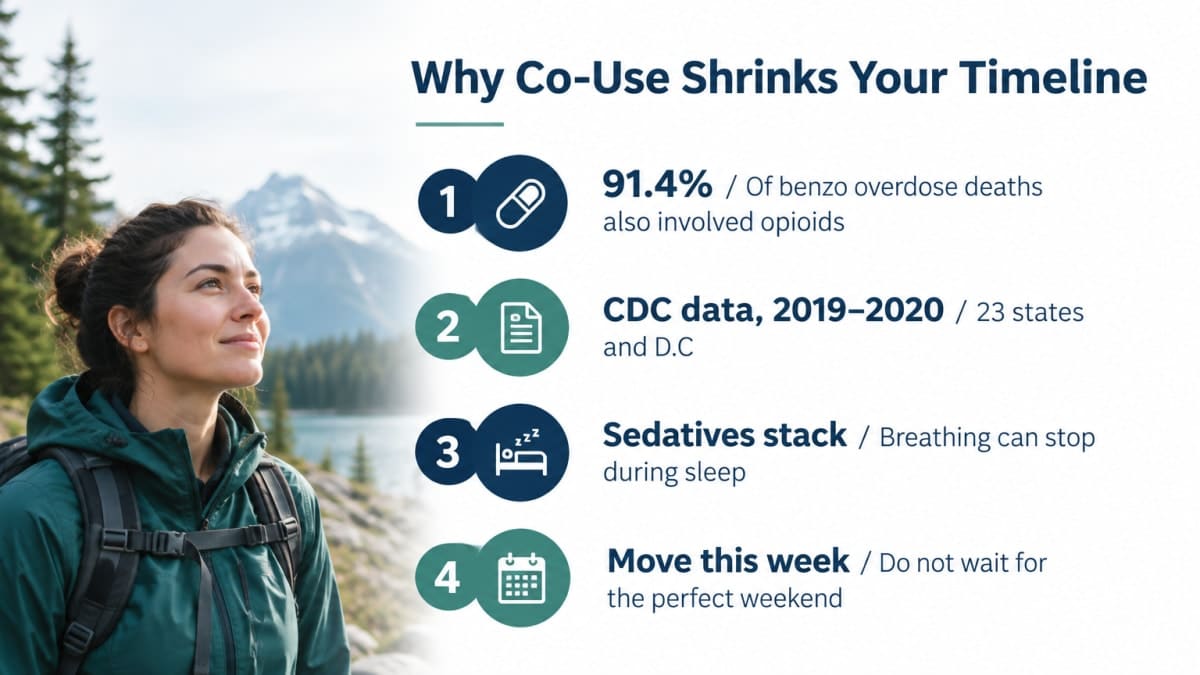
Here is the number that should shape your week. In CDC surveillance of overdose deaths across 23 states and the District of Columbia during 2019–2020, benzodiazepines were involved in 6,982 of 41,496 overdose deaths—about 16.8%—and 91.4% of those benzodiazepine-involved deaths also involved opioids 5. The vast majority of fatal benzodiazepine overdoses are not benzodiazepines alone. They are benzodiazepines plus something else that slows breathing.
The CDC’s prescribing guideline explains the mechanism in plain terms: benzodiazepines can deepen the drop in respiratory drive that opioids cause, and concurrent use raises overdose risk 6. Alcohol does similar damage. Two sedatives on board are not twice as risky as one; they stack in ways that can stop breathing in sleep.
What this means for you: do not wait for the perfect weekend. If co-use is in the picture, move the intervention forward. Call a detox this week, not next month.
The Overdose Risk Gap You Need to Understand
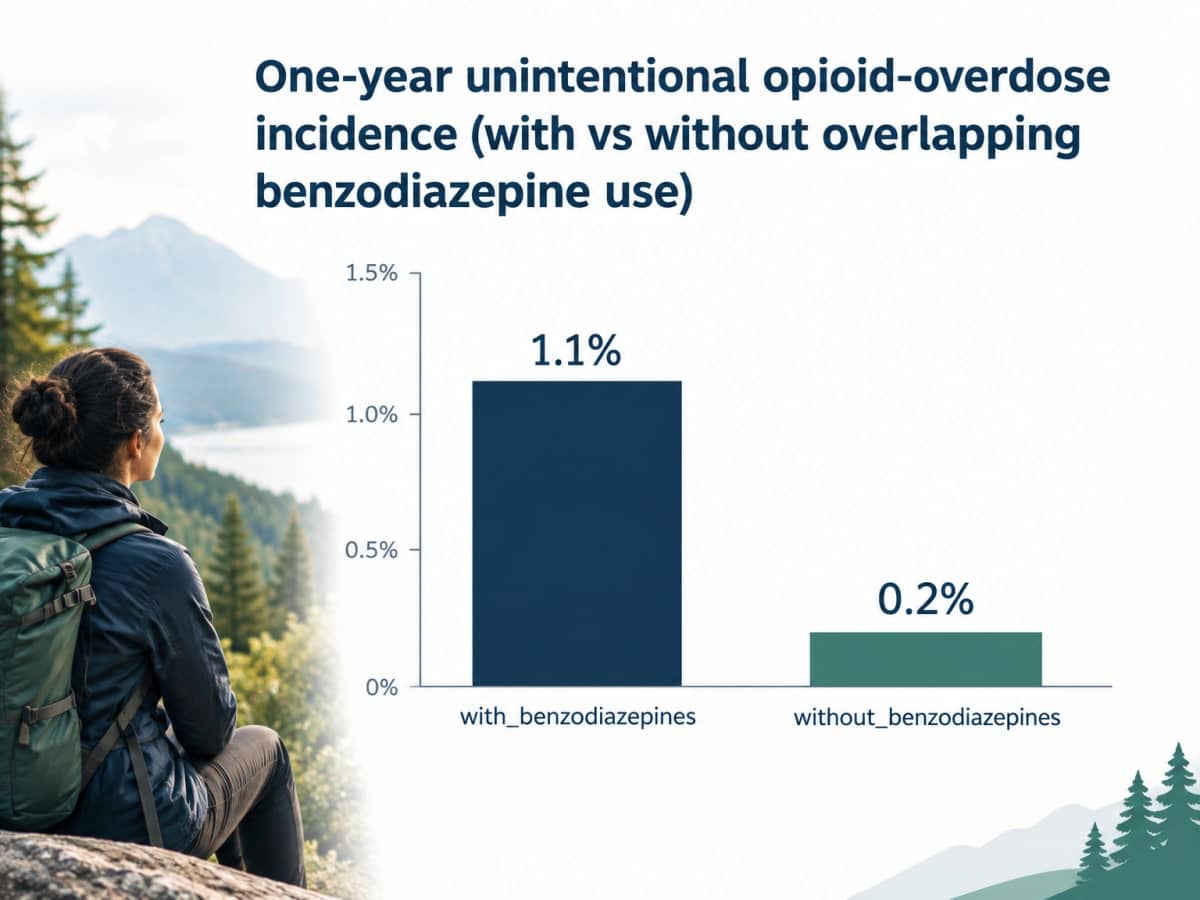
If the surveillance data feels abstract, a cohort study of opioid users makes the gap concrete. Researchers tracked opioid users and found a one-year unintentional opioid-overdose incidence of 1.1% among those with at least 30 days of overlapping benzodiazepine use, compared with 0.2% among opioid users without benzodiazepine exposure 7. That is roughly a fivefold difference in a single year.
This is an observational study, which means it shows a strong association rather than proving that benzodiazepines alone caused each overdose. Other factors—mental health conditions, dose patterns, other substances—contribute too. But the direction is consistent with everything else the CDC and FDA say about mixing central-nervous-system depressants 6, 13. When benzos and opioids ride together, the ceiling for a bad night drops.
Share this with the rest of your family quietly, before the intervention. Not to scare anyone into a lecture, but so everyone understands why you are not negotiating a six-week plan to think it over. You are asking the person you love to walk through a door this week because the math is not on their side if they keep sleeping with two sedatives in their bloodstream.
Naloxone, 911, and the Safety Plan for the Day
Before the conversation happens, build a floor under it. If opioid use is possible—prescribed, illicit, or suspected counterfeit pills—get naloxone in the house. The CDC specifically identifies people using opioids with benzodiazepines as a group who should have it on hand 4. Ask a pharmacist; in Oregon and Washington, it is available without a prescription. Keep it where someone could reach it in the dark.
Be honest with yourself about what naloxone does and does not do. It reverses opioid overdose. It does not reverse benzodiazepine sedation, and it does not treat benzodiazepine withdrawal 4. If your loved one takes only benzos and alcohol, naloxone will not help—emergency medical care is the plan.
Know the signs and the sequence. If breathing is slow, irregular, or stopped, if they cannot be woken, if their lips or fingertips turn gray or blue: call 911, give naloxone if opioids are possible, keep them on their side, and stay with them until paramedics arrive 11. Tell dispatch exactly what was taken, including alcohol. The clinician at detox needs that same information at intake, so write it down tonight.
The Conversation Itself: What to Say at the Kitchen Table
Open With Observations, Not Accusations
Start with what you have actually seen, in your own words, with no labels attached. Not “you’re an addict.” Not “you have a problem.” Something closer to: “I noticed you’ve been running out of your Klonopin before the refill date for the last three months, and last Tuesday you fell asleep at dinner. I’ve been scared.”
That is the whole move. Specific. First-person. Short. SAMHSA’s guidance on motivational approaches is explicit that empathy, not authority, is what moves someone toward treatment, and that argument and confrontation tend to harden the person against change 15. When you lead with a diagnosis, you invite a debate about whether the diagnosis fits. When you lead with what you saw and how it felt, there is nothing to argue with.
After you say your piece, stop talking. Let the quiet sit. Ask one open question—”How are you feeling about all of this?”—and then listen without interrupting, even if what comes back is denial or anger. You are not there to win the next ten minutes. You are there to keep the door open long enough to walk through it together.
What to Say, What Not to Say
A few lines that tend to land:
- “I love you and I’m worried.”
- “I’m not asking you to quit on your own—that’s not safe with these pills.”
- “I called a medical detox today. They can see you tomorrow. I’ll drive.”
- “You don’t have to figure this out alone.”
A few lines that tend to blow things up:
- “You’re killing yourself.”
- “If you don’t go, I’m done.”
- “Everyone here agrees you have a problem.”
- “Just stop taking them.”
That last one is not only unhelpful; it’s dangerous. The FDA is clear that stopping benzodiazepines abruptly or cutting the dose too fast can cause severe withdrawal, including seizures, and that any change should be managed by a clinician 13.
Reflect back what you hear. If they say, “I can handle this myself,” try, “It sounds like you want to stay in control of this. The detox team works with you on the plan—you’re not handing over your life.” TIP 35 calls this reinforcing the person’s own reasons for change rather than overriding them 15.
Who Should Be in the Room (and Who Shouldn’t)
Keep it small. One or two people your loved one actually trusts—usually a spouse, a parent, an adult child, or a close friend who has not been in recent conflict with them. A room full of relatives feels like a trial, and benzodiazepine conversations do not survive that temperature.
Think carefully about who to leave out. If there’s a history of domestic violence, coercion, or someone in the family who tends to escalate quickly, that person does not belong in this conversation. SAMHSA’s family-therapy advisory notes that joint sessions are not appropriate in every circumstance and that safety and violence risk should be assessed before involving relatives 14. Call the detox’s intake line or a counselor first if you’re unsure.
Children do not belong in the room either, even older teenagers. Arrange care beforehand so no one has to improvise around a kid in the hallway while the hardest conversation of the year is happening at the table.
When They Say No: The 48-72 Hour Follow-Up Plan
Sometimes they say no. Not every conversation ends with a bag in the car and a drive to detox, and if you walked in prepared for that possibility, you have not failed. You have planted something.
Resist the ultimatum. “Go today or I’m done” rarely produces a yes; it usually produces a slammed door and someone trying to stop their Klonopin alone that night, which is exactly the scenario the FDA warns against because abrupt discontinuation can trigger seizures 13. SAMHSA’s motivational guidance is clear that pressure tends to harden ambivalence rather than resolve it, and that the goal of one conversation is to keep the next one possible 15.
So before you leave the room, name a smaller next step. A phone call together to an intake line tomorrow. An appointment with their primary care provider this week. A ride to a counselor on Thursday. Any movement in the direction of a clinician counts.
Then plan the 48 to 72 hours that follow. Keep naloxone in the house if opioids are in the picture 4. Check in by text the next morning without arguing the point again. Ask one open question, like “How are you doing with everything we talked about?” and let them answer. On day two or three, offer the concrete option again—same door, still open, still with you.
If their use escalates, if they try to stop on their own, or if breathing changes or a seizure happens, treat it as an emergency and call 911 11. The no you heard on Sunday is not necessarily the no you’ll hear on Wednesday.
Oregon and SW Washington Pathways: Turning a Yes Into an Admission the Same Day
If you live in Portland, Milwaukie, Gresham, Beaverton, Salem, or across the river in Vancouver, you have real options when your loved one says yes. The trick is knowing which number to call first so a willingness that showed up at 10 a.m. is not gone by dinner.
Start with a non-hospital medical detox that can take an admission within 24 to 48 hours. When you call, say the word benzodiazepine early so intake knows this is a withdrawal that needs medical supervision, not an outpatient referral. Ask whether a nurse can speak with you now, what the admission window looks like today, and what to bring. Have the observations you prepared ready: which benzo, how much, how long, co-use with opioids or alcohol, any seizure or overdose history 12.
If you need a second route or you are not sure where to begin, Oregon has publicly listed help lines. The Alcohol and Drug Help Line (1-800-923-4357) and the Oregon Hopeline (1-833-975-0505) can point you toward local treatment and Behavioral Health Resource Networks across the state 16. These are confidential and free. Use them to find a provider, not to replace one.
Out-of-state families planning to travel to Oregon for detox can call ahead the same way. Confirm the admission, verify insurance before you book flights or hit the road, and ask intake what to pack and who meets you at the door.
After the Handoff: Detox Is Step One, Not the Finish Line
When your loved one walks through the detox door, take a breath. You did a hard thing well. But detox is where the medical risk gets managed, not where recovery is finished. At Pacific Crest Trail Detox, a medically supervised benzodiazepine detox typically runs about eight to ten days, and the clinical team individualizes the taper based on the person’s dose, co-use, and withdrawal history 2. What happens in the weeks after discharge is where real change gets built.
Ask the intake team about continued care before admission ends, not the morning of discharge. The usual next steps are a partial hospitalization program, an intensive outpatient program, standard outpatient counseling, medication-assisted treatment when appropriate, and an alumni or aftercare group. SAMHSA’s review of family involvement notes that participation can positively affect engagement and retention when safety allows 14, and a recent systematic review of family-based interventions found most included trials reported positive effects on substance use or family functioning 10. Translation: your role does not end at the curb.
Keep showing up. Drive them to the first outpatient appointment. Hold the honest conversations without going back to the role of enforcer. Recovery from benzodiazepines is slower than most families expect, and some withdrawal symptoms can linger for months 1. Patience is part of the plan.
A Confidential Next Step for Your Family
If you’re reading this at 11 p.m. with a knot in your stomach, you don’t have to figure out the whole plan tonight. You just have to make one call. Pacific Crest Trail Detox is a non-hospital medical detox in Milwaukie, Oregon, serving families across the Portland metro, Salem, Vancouver WA, and out-of-state loved ones willing to travel. Nurses are on site around the clock, providers round seven days a week, and the setting is home-like, not hospital-like.
Call for a confidential assessment or verify insurance before the conversation happens. Every call is HIPAA-protected. We want to be your last treatment experience, whether we’re your first detox or your fifth.
Check Coverage for Benzodiazepine Detox
See what your plan may cover as you consider medically supervised benzodiazepine withdrawal care.
Frequently Asked Questions
Is it dangerous for my loved one to stop taking benzodiazepines on their own?
Yes. The FDA warns that stopping benzodiazepines abruptly or cutting the dose too quickly can cause severe withdrawal, including seizures, and some symptoms can last for months 13. Any dose change should be managed by a clinician who can design an individualized taper, not improvised at home by the person or their family.
Do I need a professional interventionist, or can our family do this ourselves?
Many families handle the conversation themselves if the setting is safe and the plan is calm. SAMHSA’s family guidance notes that joint sessions are not appropriate when there’s violence, coercion, or safety risk 14. If the dynamics are volatile, call a detox intake line or counselor first. A professional can help, but a quiet, prepared conversation often works.
What should I bring or know before calling a detox center?
Write down which benzodiazepine your loved one takes, roughly how much per day, how long they’ve been on it, whether the prescription is theirs, co-use with opioids or alcohol, any history of seizures or delirium during past attempts to cut back, overdose history, and other medical or psychiatric conditions 12. Bring ID, insurance information, and current medication bottles.
What do we do if they refuse to go to detox?
Skip the ultimatum. Pressure tends to harden resistance rather than resolve it 15. Name a smaller next step instead—a call together tomorrow, an appointment with their primary care provider this week. Keep naloxone on hand if opioids are involved 4, check in without arguing the point, and offer the same door again in 48 to 72 hours.
My loved one has a legitimate prescription for Xanax or Klonopin. Does that mean they’re not addicted?
Not necessarily, and not automatically either. Physical dependence can develop after just days or weeks of steady use, even when taken as prescribed 13—that’s biology, not addiction. Addiction is a pattern of use continuing despite real harm. A clinician can sort out which you’re seeing. Your job is to raise the concern, not diagnose it at the kitchen table.
Can we travel to Oregon from out of state for detox at Pacific Crest Trail Detox?
Yes. Pacific Crest Trail Detox in Milwaukie welcomes out-of-state families and will coordinate admission over the phone. Call ahead to confirm the bed, verify insurance before booking travel, and ask intake what to pack and who meets you at the door. Every call is confidential and HIPAA-protected, whether you’re across town or across the country.
References
- FDA requiring Boxed Warning updated to improve safe use of benzodiazepine drug class. https://www.fda.gov/drugs/drug-safety-and-availability/fda-requiring-boxed-warning-updated-improve-safe-use-benzodiazepine-drug-class
- VA/DoD Clinical Practice Guideline for the Management of Substance Use Disorders. https://healthquality.va.gov/guidelines/MH/sud/VA-DoD-SUD-CPG_Final_for-508_v3.pdf
- Patient Guide to Benzodiazepines. https://www.oregon.gov/oha/HPA/DSI-Pharmacy/MHCAGDocs/Final-Patient-guide-benzodiazepines-5.13.2022.pdf
- Lifesaving Naloxone | Stop Overdose. https://www.cdc.gov/stop-overdose/caring/naloxone.html
- Trends in Nonfatal and Fatal Overdoses Involving Benzodiazepines — 23 States and the District of Columbia, 2019–2020. https://www.cdc.gov/mmwr/volumes/70/wr/mm7034a2.htm
- CDC Clinical Practice Guideline for Prescribing Opioids for Pain — United States, 2022. https://www.cdc.gov/mmwr/volumes/71/rr/rr7103a1.htm
- Risk Factors and Outcomes of Opioid Users with and Without Benzodiazepine Use. https://pmc.ncbi.nlm.nih.gov/articles/PMC10077839/
- A systematic review of brief, freely accessible, and valid self-report measures for substance use disorders and treatment. https://pmc.ncbi.nlm.nih.gov/articles/PMC9872256/
- Evidence Based Psychosocial Interventions in Substance Use. https://pmc.ncbi.nlm.nih.gov/articles/PMC4031575/
- Efficacy of Family-based Interventions in Addressing Substance Use Disorders: A Systematic Review on Randomized Controlled Trials. https://pmc.ncbi.nlm.nih.gov/articles/PMC13068785/
- Risks and How to Reduce Them | Overdose Prevention. https://www.cdc.gov/overdose-prevention/manage-treat-pain/reduce-risks.html
- Recommendations from SAMHSA (TIP 63). https://www.mass.gov/doc/recommendations-from-samhsa-re-benzo-and-bupe/download
- FDA requiring Boxed Warning updated to improve safe use of benzodiazepine drug class. https://www.fda.gov/media/142368/download
- The Importance of Family Therapy Advisory 39. https://library.samhsa.gov/sites/default/files/pep20-02-02-016.pdf
- TIP 35: Enhancing Motivation for Change in Substance Use Disorder Treatment. https://library.samhsa.gov/sites/default/files/tip-35-pep19-02-01-003.pdf
- Substance Use Disorder Services. https://www.oregon.gov/oha/BH/Adults/Pages/Substance-Use.aspx