


Key Takeaways
- The first 24 hours depend on information, not possessions: intake staff need an accurate medication list, ID and insurance, and emergency contacts to safely manage withdrawal.
- Bring original pill bottles, a 90-day pharmacy printout, supplement details, last-dose times, and your prescriber’s contact so clinicians can verify dosages without disturbing you.
- If you take methadone, buprenorphine, or naltrexone, continue the medication and bring clinic or prescriber details; Oregon rules prevent denial of entry for being on them 3.
- Organize a folder with photo ID, insurance cards, pre-authorization numbers, medical history, and any veteran or court paperwork to clear admission quickly.
- Write down two or three key phone numbers and plan your release of information carefully, since signed forms dictate who hears updates under federal privacy rules 14.
- Pack about five days of soft, loose, layerable clothing, slip-on shoes, and a warm layer for Milwaukie weather, avoiding drawstrings, belts, or offensive graphics.
- Bring unopened, alcohol-free toiletries plus small comforts like eyeglasses, a CPAP, a paperback, photos, or a familiar pillow to ease the early days.
- Call ahead about phones, vapes, CPAPs, OTC medications, religious items, and outside food, since many are allowed with conditions rather than refused outright 1.
- Leave behind alcohol-containing products, illicit substances, weapons, large amounts of cash, valuables, laptops, smartwatches, and anything with an open flame.
- Know your Oregon rights: personal belongings stay with you under inventory, consent must be informed, and opioid-dependence medications cannot be grounds for denial 1, 3.
- Handle work, childcare, pets, and your ride home before admission so logistics don’t pull focus from treatment during your stay 16.
- If you’re helping someone else pack, focus on medications, release contacts, and pickup plans, then drive them to the door—showing up matters most 12.
The First 24 Hours Start With What You Pack
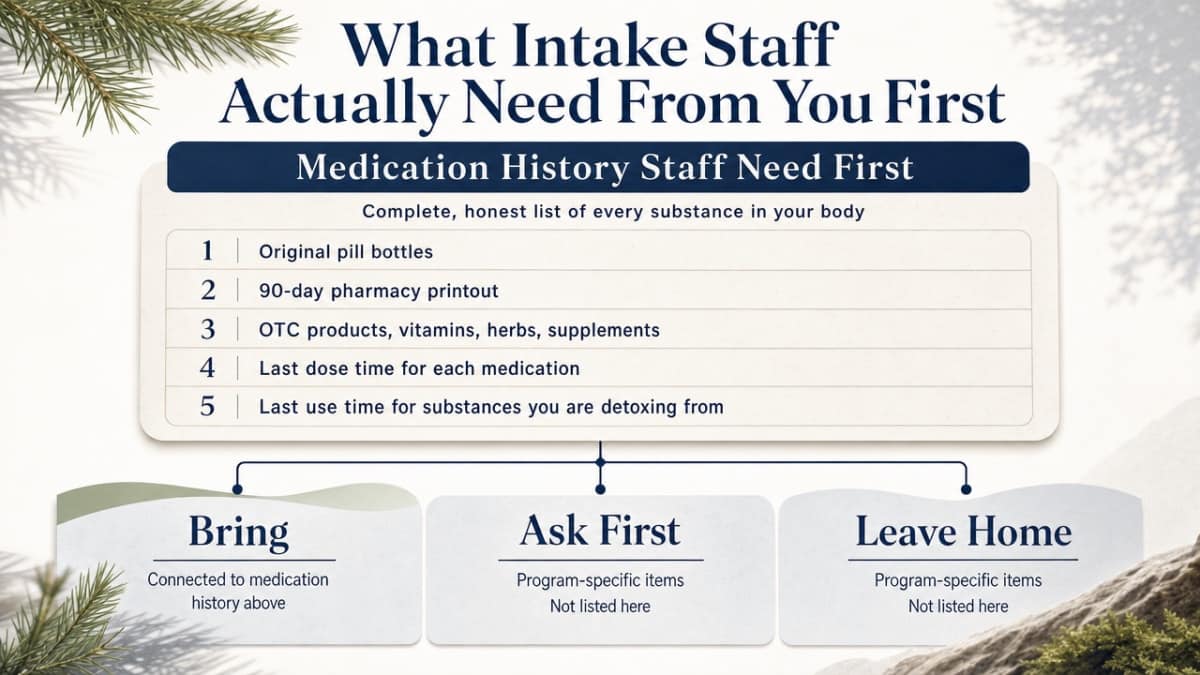
Packing for detox can feel overwhelming, but it doesn’t have to be. What truly matters most is the information you bring for your medical team. In the first hour of intake, staff need three key things: a clear picture of all medications and substances in your system, verification of your identity and insurance, and a contact person for emergencies. The sooner this information is available, the faster the medical team can ensure your safety and comfort during withdrawal, aligning with SAMHSA’s guidance that detox involves assessment, stabilization, and a smooth transition to ongoing care 6.
This guide divides packing essentials into three simple categories: Bring (items that support your care), Ask First (items with varying rules), and Leave Home (items not permitted). Pacific Crest Trail Detox is a home-like medical detox facility in Milwaukie, Oregon, meaning some rules might be more flexible than a hospital’s, while others are stricter. When in doubt, always call us before you pack your bag.
What Intake Staff Actually Need From You First
A Complete, Honest Medication List
The most crucial “item” you can bring is an accurate, honest account of every substance in your body, whether prescribed or not. This information is vital for nurses and prescribers to safely manage your withdrawal. Incorrect assumptions about recent substance use can turn a standard detox into a dangerous situation.
To help the medical team, gather these five things before you arrive:
- Original pill bottles for all prescriptions, including those taken occasionally or inconsistently.
- A pharmacy printout detailing your prescriptions filled over the last 90 days. Any pharmacy can provide this quickly.
- A list of all over-the-counter products, vitamins, herbs, and supplements, as these can interact with prescribed medications.
- The time of your last dose for each medication, and for substances you are detoxing from, the last time you used and how much.
- Your prescriber’s name and phone number, so staff can verify dosages or ask questions without disturbing you.
If you can’t gather all this information, please still come. AHRQ guidelines instruct clinicians to compile medication histories from various sources like family, caregivers, and medical records if a patient cannot provide it themselves 12. Being honest about street substances is just as important as disclosing prescribed medications. What you share at intake is protected and used for your medical care, not for legal action. Staff are focused on preventing medical complications, not reporting.
If You Take Methadone, Buprenorphine, or Naltrexone, Bring the Details
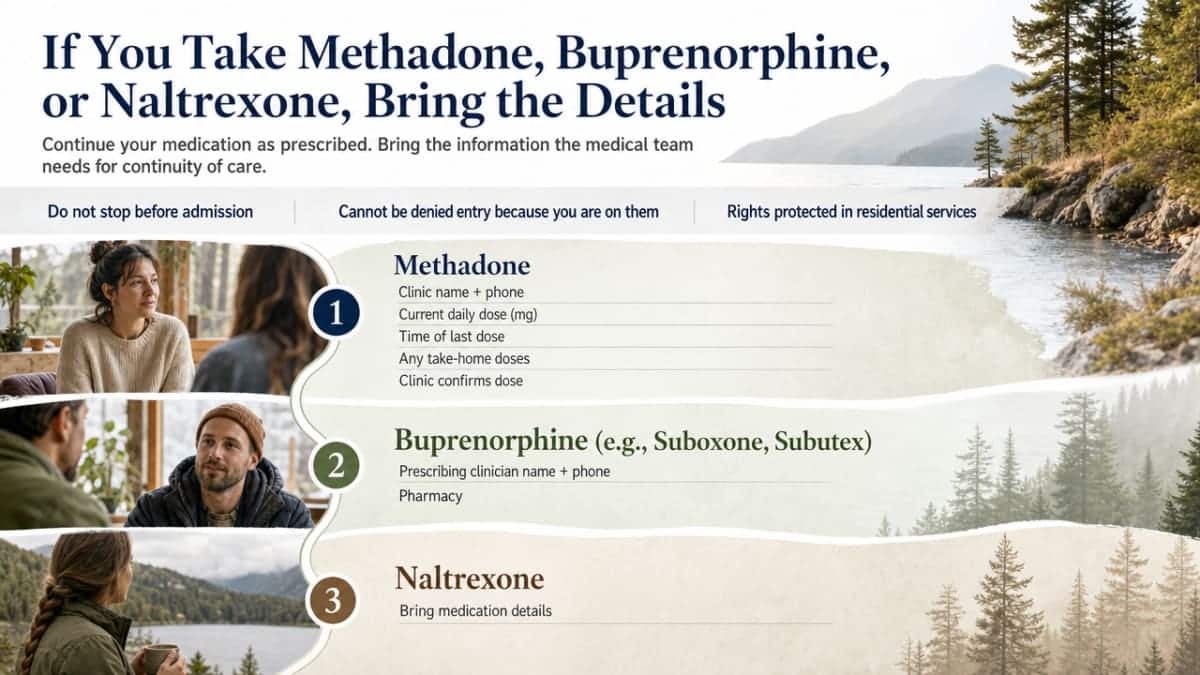
If you are currently prescribed medication for opioid use disorder, do not stop taking it before admission. Oregon regulations protect your right to continue these medications in residential services, and you cannot be denied entry because you are on them 3. Continue your medication as prescribed and bring the necessary details for the medical team to ensure continuity of care.
Each of the three FDA-approved medications requires slightly different information 7:
- Methadone: Provide the name and phone number of your opioid treatment program (clinic), your current daily dose in milligrams, the time of your last dose, and if you have any take-home doses. Your clinic will need to confirm your dose.
- Buprenorphine (e.g., Suboxone, Subutex): Bring your prescribing clinician’s name and phone, your pharmacy, your dose and schedule (e.g., 16 mg once daily), and when you took your last dose. If you received a Sublocade injection, note the date.
- Naltrexone (e.g., ReVia, Vivitrol): Include the prescriber’s name, pharmacy, whether you take the daily pill or monthly injection, and the date of your last dose or shot.
If you also use opioids in addition to your prescribed medication, please disclose this openly at intake. The timing of your last dose and recent use significantly impact how and when your next dose can be safely administered. It’s always better for staff to have this information directly from you.
ID, Insurance, and the Documents That Clear the Door
Having your essential documents organized in a single folder will make the admissions process much smoother. Please bring:
- A government-issued photo ID (driver’s license, state ID, passport, or tribal ID).
- Your insurance card (front and back), including any separate behavioral-health card or member services number.
- Any pre-authorization reference number provided by the admissions coordinator.
- A brief written summary of your medical history: diagnoses, surgeries, allergies, and your primary care provider’s name and phone number.
- If you are a veteran, your VA ID or DD-214.
- If you have court or probation requirements, bring the relevant paperwork or your officer’s contact information so the facility can provide proof of admission.
Emergency Contacts and Who Can Hear What
Before you hand over your phone, write down two or three important phone numbers: your emergency contact, the person managing your responsibilities (children, pets, job), and your primary care provider. These are the numbers staff will need first, and you may not remember them clearly during a stressful moment.
During intake, you will complete a release of information form, specifying who the facility can communicate with and what details can be shared. Federal privacy rules for substance-use treatment are stringent, and you will receive a notice explaining how your health information is used and disclosed, your rights, and how to file a complaint 14. Updated model notices for federally assisted substance-use programs, effective in early 2026, are now more aligned with HIPAA, meaning the forms you sign at admission dictate who receives updates 15.
Consider this in advance. You can authorize your partner to receive clinical updates while limiting information shared with an employer to simply confirming your presence. You also have the right to authorize no one. The form is designed to be specific: name the person, list what can be shared, and set an end date. You can modify this at any time during your stay.
Bring: The Clothing and Comfort Items That Make the Week Easier
Clothes for Three to Seven Days of Rest, Not a Fashion Week
Prioritize soft, loose, and layerable clothing. You’ll be focusing on rest, managing withdrawal symptoms like sweating, and moving comfortably. There’s no need to impress anyone with your wardrobe. Oregon regulations affirm your right to keep and use personal clothing and belongings during residential care, with secure storage for items not in use 1.
For a typical five-day stay, consider packing:
- Five to seven changes of underwear and socks. Pack extra, as withdrawal can involve sweating.
- Three or four pairs of sweatpants or soft joggers, and a similar number of T-shirts or long-sleeve tops. Include one hoodie or zip-up sweatshirt for layering.
- One comfortable pair of pajamas or sleep clothes.
- Slip-on shoes (without laces) for indoor use, and one pair of closed-toe shoes for outdoor walks.
- A warm jacket if you’re visiting during cooler months, as Milwaukie can be cold and damp.
- A robe, if you have one, and a pair of flip-flops for showering.
Avoid items with drawstrings, belts, or offensive graphics, as most residential programs ask you to leave these at home. If you’re unsure about a specific item, pack it separately and let intake staff decide. You won’t be judged for over-packing.
Toiletries, Glasses, and Small Comforts
Bring unopened, alcohol-free toiletries whenever possible. Most facilities, including Pacific Crest Trail Detox, do not permit products like mouthwash, hand sanitizer, aftershave, or perfumes containing alcohol, as they can be ingested and complicate withdrawal. Here’s a list of items that are generally allowed:
- Toothbrush, toothpaste, and alcohol-free mouthwash.
- Shampoo, conditioner, and body wash (travel sizes are acceptable).
- Deodorant (solid, not aerosol), hairbrush or comb, and basic hair ties.
- Lip balm and unscented lotion, which can be very soothing for your skin.
- A week’s supply of feminine hygiene products, if needed.
Small comfort items can make a significant difference. Bring your eyeglasses and a case, your CPAP machine if you use one (notify admissions beforehand), a paperback book or journal, and photos of loved ones. A pillow from home can also help you feel more settled. Oregon regulations require facilities to maintain an inventory of belongings held during treatment, ensuring anything stored for you is tracked and returned 2. If a particular blanket or sweatshirt brings you comfort, pack it. Being kind to yourself during the initial days is essential for a successful detox.
Ask First: Phones, Vapes, CPAPs, and Religious Items
Some items require a phone call to admissions before you pack them, rather than a simple yes or no. Often, the answer is “yes, with conditions.”
- Your phone and charger: Most residential programs restrict phone use during the initial days to promote rest and stabilization. Ask about access times, storage, and whether you can keep your charger.
- Vapes, nicotine pouches, and tobacco: Policies vary. Some programs allow outdoor smoking with sealed packs; others prohibit vape devices due to battery concerns. If you use nicotine, inquire about patches or gum to avoid nicotine withdrawal alongside other symptoms.
- Your CPAP, inhaler, or other medical device: Bring these essential devices and inform admissions in advance so they can arrange for power outlets, cleaning, and overnight checks.
- Over-the-counter medications and supplements: Oregon rules mandate that prescription drugs in residential programs be kept in locked storage, with self-administration requiring written approval and monitoring 1. Your melatonin or ibuprofen will be handled similarly. Bring them in their original bottles for logging and dispensing.
- Religious or spiritual items: Items like prayer beads, a Bible, a Qur’an, a small prayer rug, or a sobriety medallion are generally supported. Ask about items with flames (like candles, which may be swapped for electric versions), sharp edges, or cords to ensure proper accommodation.
- Food, drinks, and sealed snacks: Meals are provided. Outside food is typically limited to sealed items for dietary needs or allergies. Mention any dietary specifications when you call to ensure meals are prepared for your arrival 2.
If the answer is “we’ll secure it for you,” understand that this is a safeguard, not a punishment. Belongings held during treatment are tracked on an inventory you can review and are returned upon your departure 1.
Leave Home: Contraband, Valuables, and Anything You’d Hate to Lose
This section is intentionally brief. If an item could complicate your first 24 hours or the care provided, it’s best left at home or with a trusted person.
Do not bring:
- Alcohol in any form, including mouthwash, cold medicine with alcohol, hand sanitizer, aftershave, perfume, cologne, vanilla extract, or kombucha.
- Illicit drugs, unprescribed pills, kratom, delta-8, or marijuana, even if legal in Oregon. If you arrive with any of these, inform staff immediately; honesty at intake is handled clinically, not punitively.
- Weapons of any kind, such as pocket knives, multi-tools, scissors with long blades, or pepper spray.
- More than $20-$30 in cash, unnecessary credit cards, checkbooks, or expensive jewelry. Wedding rings are usually acceptable, but any item you would be deeply upset to lose should stay home.
- Laptops, tablets, gaming devices, and smartwatches, as they can interfere with rest and focus.
- Candles, incense, lighters, matches, and anything with an open flame.
Oregon regulations grant facilities the authority to secure certain belongings during your stay. Any items held for you will be recorded on a written inventory and returned when you leave 1. Bringing fewer items from this category means less paperwork and a smoother start to your treatment.
Your Oregon Rights at the Door
Understanding your rights before admission can make the initial conversations less daunting. Oregon’s residential behavioral-health rules outline protections that many people are unaware of until they are already in care.
You have the right to keep and use your personal clothing and belongings during your stay, with adequate private, secure storage for items not in active use 1. Your possessions should not be taken from you at the door without clear tracking. Any items the facility holds for safekeeping, such as medications, electronics, or valuables, must be recorded on a written inventory that follows you throughout your stay and is returned upon discharge 1.
Services generally require your written, voluntary informed consent. This means someone will explain what is being offered and what you are agreeing to before any treatment begins 3. You are encouraged to ask questions, even multiple times, to ensure you understand.
Your medical information is protected by federal privacy rules. You will receive a written notice detailing how your information can be used and disclosed, your rights, and how to file a complaint if concerns arise 14. Taking the time to read these forms carefully is an important part of your treatment process.
Life Outside the Front Door: Work, Kids, Pets, and the Ride Home
The most challenging part of preparing for detox isn’t just packing a bag; it’s addressing the unanswered questions about the life you’re temporarily leaving behind. Spending a short time on these logistics before you arrive can significantly ease your first few days in treatment.
Work: You are not required to disclose the reason for your absence to your employer. A simple message stating you are undergoing a medical procedure and will be unreachable for about a week is sufficient. If you need further documentation, inquire with your primary care provider or the facility about FMLA paperwork, and sign a release allowing admissions staff to verify your treatment directly with HR without sharing clinical details 14.
Kids and pets: Arrange for a trusted adult to care for them for the entire duration of your stay, not just the first night. Prepare written permission for medical care for children, include insurance cards, school contacts, pediatrician and vet numbers, feeding instructions, and enough supplies (food, diapers, medication) for the week. Case management guidelines consider these logistical preparations an integral part of your treatment, not a distraction 16.
The ride home: Plan your departure before you arrive. Confirm who will pick you up, typical discharge times, and the plan for your next level of care. This ensures you leave with a prescription, an appointment, and a contact number, rather than just a goodbye.
If You’re the Person Helping Someone Else Pack
If you are assisting a loved one with packing, your support is invaluable. The person entering detox may not be in a state to organize a list, and your calm assistance is already contributing to their recovery.
Focus on a few key questions: What medications are they taking, and when was the last dose of each? Who should the facility be allowed to communicate with, and about what? Who will pick them up when their stay is complete? This information is critical for intake staff during the first hour 12.
Then, handle the practical logistics: gather pill bottles and pharmacy printouts. Locate their ID and insurance card. Pack five days of soft, loose clothing, slip-on shoes, and basic alcohol-free toiletries. Ensure valuables, vapes, and any sharp objects are left at home.
Drive them to the facility and walk them to the door. Your presence and practical help speak volumes; you don’t need to find the perfect words. Simply showing up makes a profound difference.
One Last Pass Before You Zip the Bag
Before you finalize your packing, quickly review this essential checklist aloud. It takes only a couple of minutes and covers the most important items:
- Pill bottles, pharmacy printout, and a note of your last dose times.
- Photo ID and insurance card, kept together in a single folder.
- Three important phone numbers written on paper.
- Five days of soft, loose clothing and slip-on shoes.
- Basic alcohol-free toiletries and your eyeglasses.
- Your CPAP, inhaler, or any other essential medical device.
- Confirmation that nothing from the “Leave Home” list is included.
If something is missing, please come anyway. The support you’ll receive is more important than a perfectly packed bag. You’ve already completed the most difficult step by deciding to seek help. Pacific Crest Trail Detox is here to walk you through every item over the phone, ensuring you know exactly what to pack before you leave home.
Check Your Coverage Before You Pack
See if your insurance supports your detox admission—know what’s covered before you walk through the door.
Frequently Asked Questions
Can I bring my prescription medications to detox?
Yes, you absolutely should. Bring all prescriptions in their original bottles so staff can verify the medication, dosage, and prescribing doctor. Oregon regulations require that prescription drugs in residential programs be kept in locked storage, and any self-administration must be approved and monitored 1. Also, bring a pharmacy printout and your prescriber’s phone number for quick confirmation by the medical team.
Will they take my phone away at admission?
Most residential detox programs limit phone use during the initial days to help you rest and stabilize. Your phone will typically be placed in secure storage, not discarded. Ask the admissions team about when you’ll have access, where it will be held, and if your charger can be stored with it. It’s a good idea to write down two or three important phone numbers on paper before you arrive.
What happens if I’m on methadone or buprenorphine when I arrive?
Continue taking your medication as prescribed. Oregon rules state that a provider cannot deny you entry simply because you are continuing a currently prescribed opioid-dependence medication 3. Bring your clinic or prescriber’s name and phone number, your dose, the time of your last dose, and your pharmacy information. The medical team will coordinate with your existing provider to ensure your treatment continues without interruption 7.
Can my family call to check on me during detox?
Only if you sign a release that specifically names them. Federal privacy rules for substance-use treatment are strict, and you will receive a written notice explaining how your information can be shared 14. At intake, you decide who can receive updates and what information can be shared. For example, you can authorize a partner to receive full clinical updates while limiting an employer to only confirming your presence. You can modify these permissions at any time during your stay.
How many days of clothes should I pack?
Pack enough comfortable, loose, and easy-to-layer clothing for about five days. This includes five to seven pairs of underwear and socks, three or four pairs of sweatpants and tops, pajamas, slip-on shoes, and a warm layer for Milwaukie’s weather. Oregon rules protect your right to keep and use personal clothing, with secure storage provided for items you’re not wearing 1. Laundry facilities are usually available for longer stays.
What if I don’t have insurance or I’m on the Oregon Health Plan?
Please call us before you travel. Pacific Crest Trail Detox accepts most commercial insurance but does not accept the Oregon Health Plan (OHP). If OHP is your only coverage, our admissions team can help direct you to an OHP-contracted program on the same day. Oregon’s behavioral-health benefits do cover detox, residential care, and medication treatment through contracted providers 4. Not having insurance should never be a reason to delay seeking help.
References
- Behavioral Health Services – Chapter 309. https://www.oregon.gov/oha/HSD/RAC/309-018.pdf
- OAR 309-022_Manatt redline_ORIGINAL compared with OAR 309-022_Manatt redline_R2_6.29.19. https://www.oregon.gov/oha/HSD/RAC/309-022.pdf
- Division 18 RESIDENTIAL SUBSTANCE USE DISORDERS AND …. https://www.oregon.gov/oha/HSD/Medicaid-Policy/SUDWaiver/309-018-Highlighted-040723.pdf
- Oregon Health Plan (OHP) Behavioral Health Coverage. https://www.oregon.gov/oha/hsd/ohp/pages/behavioral-health.aspx
- Medication-Assisted Treatment for Opioid Use Disorder. https://www.oregon.gov/oha/hsd/amh/pages/mat.aspx
- TIP 45 Detoxification and Substance Abuse Treatment. https://library.samhsa.gov/sites/default/files/sma15-4131.pdf
- TIP 63: Medications for Opioid Use Disorder – SAMHSA Library. https://library.samhsa.gov/product/tip-63-medications-opioid-use-disorder/pep21-02-01-002
- TIP 63 – SAMHSA Library. https://library.samhsa.gov/sites/default/files/pep21-02-01-003.pdf
- Opioid Use Disorder: Treating | Overdose Prevention | CDC. https://www.cdc.gov/overdose-prevention/hcp/clinical-care/opioid-use-disorder-treating.html
- CDC Clinical Practice Guideline for Prescribing Opioids for Pain — United States, 2022. https://www.cdc.gov/mmwr/volumes/71/rr/rr7103a1.htm
- SAMHSA Overdose Prevention and Response Toolkit. https://www.cdc.gov/overdose-prevention/media/pdfs/2024/04/SAMHSA-overdose-prevention-response-toolkit.pdf
- Appendix, Medication Reconciliation – MATCH Toolkit – AHRQ. https://www.ahrq.gov/patient-safety/settings/hospital/match/appendix/app-7.html
- Chapter 5. Education and Training. https://www.ahrq.gov/patient-safety/settings/hospital/match/chapter-5.html
- Notice of Privacy Practices for Protected Health Information. https://www.hhs.gov/hipaa/for-professionals/privacy/guidance/privacy-practices-for-protected-health-information/index.html
- Model Notices of Privacy Practices. https://www.hhs.gov/hipaa/for-professionals/privacy/guidance/model-notices-privacy-practices/index.html
- TIP 27: Comprehensive Case Management for Substance Abuse Treatment. https://library.samhsa.gov/sites/default/files/sma15-4215.pdf
- VHA Directive 1162.02, Mental Health Residential Rehabilitation. https://www.va.gov/vhapublications/ViewPublication.asp?pub_ID=8400
- Residential Services (Part 820). https://oasas.ny.gov/part-820
- DEPARTMENT OF PUBLIC HEALTH 105 CMR 164.000. https://www.mass.gov/doc/105-cmr-164-licensure-of-substance-use-disorder-treatment-programs/download