


Key Takeaways
- Oregon detox coverage is protected by three overlapping laws: the ACA’s essential health benefits, federal MHPAEA parity, and Oregon’s ORS 743B.427 parity statute 14, 15, 11.
- Most major commercial carriers in Oregon — Regence, PacificSource, Providence, Moda, Kaiser, Aetna, Cigna, and UnitedHealthcare — build detox into their plans, though deductibles, coinsurance, network status, and ASAM licensing determine what you actually pay.
- Grab your insurance card and run a verification call to confirm in-network status, prior authorization rules, covered days, and cost share; OHP members should call 988 or their CCO’s behavioral health line.
The Short Answer, Before Anything Else
If you’re reading this at midnight with your heart pounding, here’s what you came for: yes, insurance almost always covers detox in Oregon. Under the Affordable Care Act, every Marketplace and ACA-compliant commercial plan sold in the state has to cover substance use disorder treatment as an essential health benefit, and that includes medically necessary withdrawal management 14, 13. The Oregon Health Plan (OHP) also lists detoxification directly among its covered behavioral health services 21.
That means if you carry Regence BlueCross BlueShield, PacificSource, Providence Health Plan, Moda, Kaiser Permanente, Aetna, Cigna, or United through your job or the Marketplace, your plan is built to pay for detox when a clinician documents you need it.
One honest note up front: Pacific Crest Trail Detox accepts most major commercial insurance plans but does not accept OHP. If you’re on OHP, we’ll point you toward the right resources further down. If you have commercial coverage, the real question isn’t whether you’re covered — it’s what your specific plan will pay, at which facility, and how quickly someone can confirm it for you. That part usually takes a single phone call.
Why Detox Is a Covered Benefit in Oregon
The Three Laws That Protect Your Coverage
When your insurer picks up the phone, they are not doing you a favor by paying for detox. Three separate laws — one federal consumer protection, one federal parity rule, and one Oregon-specific statute — stack on top of each other to require it. Knowing that changes how you talk to them.
Layer one: the Affordable Care Act. Every plan sold on the Marketplace and every ACA-compliant commercial plan has to cover ten essential health benefits. Substance use disorder services are one of those ten, right alongside emergency care and hospitalization 14. That means SUD treatment is not an optional rider your employer had to check a box for. It is baked into the plan by federal law.
Layer two: federal parity (MHPAEA). The Mental Health Parity and Addiction Equity Act says that if your plan covers mental health and substance use services — and under the ACA, it has to — it cannot make those benefits harder to use than your medical and surgical benefits. Copays, visit limits, prior authorization rules, network standards: all of it has to be comparable to how the plan handles a broken leg or a heart procedure 15.
Layer three: Oregon’s ORS 743B.427. Oregon went further. State law requires every insurer offering behavioral health benefits to run an annual analysis showing that their non-quantitative treatment limits — things like prior authorization criteria and network adequacy — are actually applied the same way for behavioral health as for medical care. The Division of Financial Regulation reviews these reports and publishes findings every year 11.
Three overlapping layers. If one insurer tries to squeeze out of covering your detox, the next law up is already waiting.
What OHP Covers, and Why We Have to Say This Up Front
Let’s be straight with you about the Oregon Health Plan, because it matters both ways.
If you’re on OHP, your detox is covered. The Oregon Health Authority lists detoxification and medication-assisted treatment right there in its behavioral health benefit for substance use disorders, alongside outpatient and residential care 21, 22. That coverage was strengthened by Oregon’s Section 1115 SUD Medicaid waiver, which lets the state draw federal Medicaid funds for residential treatment and withdrawal management — including at facilities with more than 16 beds that were historically shut out of Medicaid payment 3. The current waiver is approved through March 31, 2026 2, and the state’s terms with CMS explicitly include withdrawal management services for OHP members 4.
Here’s the honest part: Pacific Crest Trail Detox does not accept OHP. We wish that were different, and we’re telling you now — not after you’ve filled out an intake form or spent twenty minutes on hold — so you don’t waste a minute of a hard week.
If OHP is your coverage, your detox benefit is real. You just need to use it at an OHP-contracted facility, and we point you toward the right starting places later in this article.
If you have commercial insurance — Regence, PacificSource, Providence, Moda, Kaiser, Aetna, Cigna, United, or almost any employer plan — keep reading. The rest of this guide is written for you, and verifying your specific benefits usually takes one short phone call.


Commercial Carriers That Typically Cover Detox in Oregon
The Carriers You Probably Have
Pull your insurance card out of your wallet. If the logo on the front says one of these names, you almost certainly have detox coverage built into your plan:
- Regence BlueCross BlueShield of Oregon
- PacificSource Health Plans
- Providence Health Plan
- Moda Health
- Kaiser Permanente Northwest
- Aetna
- Cigna
- UnitedHealthcare
Those are the carriers you’ll see most often on Oregon employer plans and Marketplace policies. Pacific Crest Trail Detox is in-network or works with most of them, and the admissions team can tell you exactly where your plan lands in a short phone call.
Why can we say “almost certainly”? Because every one of those carriers sells ACA-compliant plans in Oregon, and every ACA-compliant plan has to cover substance use disorder services as an essential health benefit 14. On top of that, Oregon’s parity law requires those same insurers to cover behavioral health — including detox — comparably to how they cover medical and surgical care 23.
The card in your hand is not just a piece of plastic. It’s a contract that already has your detox benefit written into it. What you don’t know yet is the fine print: your deductible, your in-network hospitals and detox facilities, and whether your carrier wants a quick clinical review before admission. That’s what verification answers.
What Each Type of Oregon Coverage Usually Pays For
Oregon coverage generally falls into three buckets, and each one handles detox a little differently. Finding your bucket first makes the rest of this easier.
Oregon Health Plan (Medicaid). OHP directly lists detoxification and medication-assisted treatment among its covered behavioral health services for substance use disorders, alongside outpatient and residential care 21, 22. There are no premiums and typically no cost sharing beyond small prescription copays. The catch for readers of this article: Pacific Crest Trail Detox does not accept OHP.
ACA Marketplace and commercial plans. This is the bucket most Oregonians land in — Regence, PacificSource, Providence, Moda, Kaiser, and Marketplace policies bought through HealthCare.gov. Every one of these plans has to cover SUD treatment as an essential health benefit under the ACA 14, 13, and Oregon’s parity law requires that coverage be comparable to medical benefits 23. Medical detox, MAT, residential step-down, and outpatient follow-up are all standard covered services. You’ll typically owe your deductible, coinsurance, and copays until you hit your out-of-pocket maximum.
Employer self-funded plans. If you work for a large Oregon employer — think a hospital system, tech company, or public agency — your coverage may be self-funded and regulated under federal ERISA rules rather than by the state. The good news: federal parity (MHPAEA) still applies, which means detox and SUD services must be covered on par with medical care 15. The nuance: state-level parity rules and the DFR’s oversight don’t directly reach these plans, so appeals and complaints route federally. In practice, the covered services look very similar — medical detox, MAT, residential, outpatient — but network lists and prior authorization rules can differ from a fully-insured Oregon plan under the same carrier name.
Why Facilities With ASAM Licensing Matter for Your Bill
Here’s a piece of Oregon-specific fine print that quietly decides whether your insurance actually pays the bill: the facility you walk into has to be licensed at the right ASAM level of care.
ASAM stands for the American Society of Addiction Medicine, and it’s the framework Oregon uses to categorize every level of detox and residential treatment. As of April 1, 2024, every withdrawal management program in the state has to hold a valid license for at least one specific ASAM level — most commonly 3.2-WM (clinically managed residential withdrawal) or 3.7-WM (medically monitored inpatient withdrawal for more complex cases like alcohol and benzodiazepines) 6. On the residential side, every SUD treatment program must also be licensed to a specific ASAM level (3.1, 3.3, 3.5, or 3.7) to keep operating 7.
Why does this land on your bill? Because Oregon ties reimbursement directly to that license. To stay eligible for Medicaid payment, a program has to be licensed or certified for each level of care it delivers 8. Commercial insurers use the same ASAM framework to decide what level of care is medically necessary and whether the facility you chose is set up to deliver it.
The practical version: if you pick a facility that isn’t properly licensed for the level of detox you actually need, your claim can get denied — not because detox isn’t covered, but because the setting doesn’t match the code. When you call to verify, ask the facility which ASAM levels they’re licensed to provide. Pacific Crest Trail Detox is a licensed non-hospital medical detox equipped for the higher-acuity cases (alcohol, benzodiazepines, opioids) where withdrawal can turn dangerous, and admissions can walk you through where your situation fits.
What You Might Actually Pay When Detox Is Covered
Here’s where a lot of scared people get stuck: “covered” is not the same thing as “free.” Your plan can absolutely cover detox and still leave you with a bill. That’s not a scam — it’s how commercial insurance works for everything from a broken ankle to a heart cath. The good news is that only four numbers on your plan actually decide what you owe.
- Your deductible. This is the amount you pay before your insurance starts sharing the cost. Some plans have a $500 deductible; some have $6,000. If you haven’t used much healthcare this year, expect to hit at least part of it during detox.
- Your coinsurance. Once the deductible is met, you and your insurer split the bill — often something like 80/20 or 70/30, with the insurer paying the bigger share.
- Your out-of-pocket maximum. This is the ceiling. Once you’ve paid this much in a plan year through deductibles, coinsurance, and copays, your insurer covers 100% of covered services for the rest of the year. Under the ACA, every plan has to have one 14.
- In-network versus out-of-network. Facilities that are contracted with your carrier cost you dramatically less. An out-of-network detox stay can wipe out an out-of-pocket max in days — or not count toward it at all, depending on your plan.
We are not going to invent an average dollar figure for you. The honest answer is that cost sharing is real even when detox is covered 18, and the only way to get a number that matches your life is to have someone verify your specific plan. A short call with Pacific Crest Trail Detox admissions gives you those four numbers in plain English before you ever pack a bag.
The Parity Gap: Why Verification Still Matters
Here’s the honest truth about parity laws in Oregon: they work on paper, and sometimes they don’t work in practice. The 2025 Behavioral Health Parity Report from Oregon’s Division of Financial Regulation found that most insurers meet parity requirements “as written” — their plan documents look compliant — but many fall short on parity “in operation.” That report flagged higher prior authorization denial rates for behavioral health services than for medical and surgical ones, and more restrictive utilization controls on SUD care 10.
Translation: your plan covers detox. Your plan might also make you fight a little to use it. Not because you’re doing something wrong, and not because detox isn’t a real medical need — but because a claims reviewer might ask more questions about a residential withdrawal management stay than they would about a three-day cardiac observation.
This is exactly why having an admissions team that has done this thousands of times matters. When Pacific Crest Trail Detox verifies your benefits, they’re not just reading numbers off a screen. They’re documenting medical necessity in the clinical language your insurer expects, submitting prior authorization requests the same day, and pushing back when a reviewer tries to authorize a shorter stay than your clinical picture warrants.
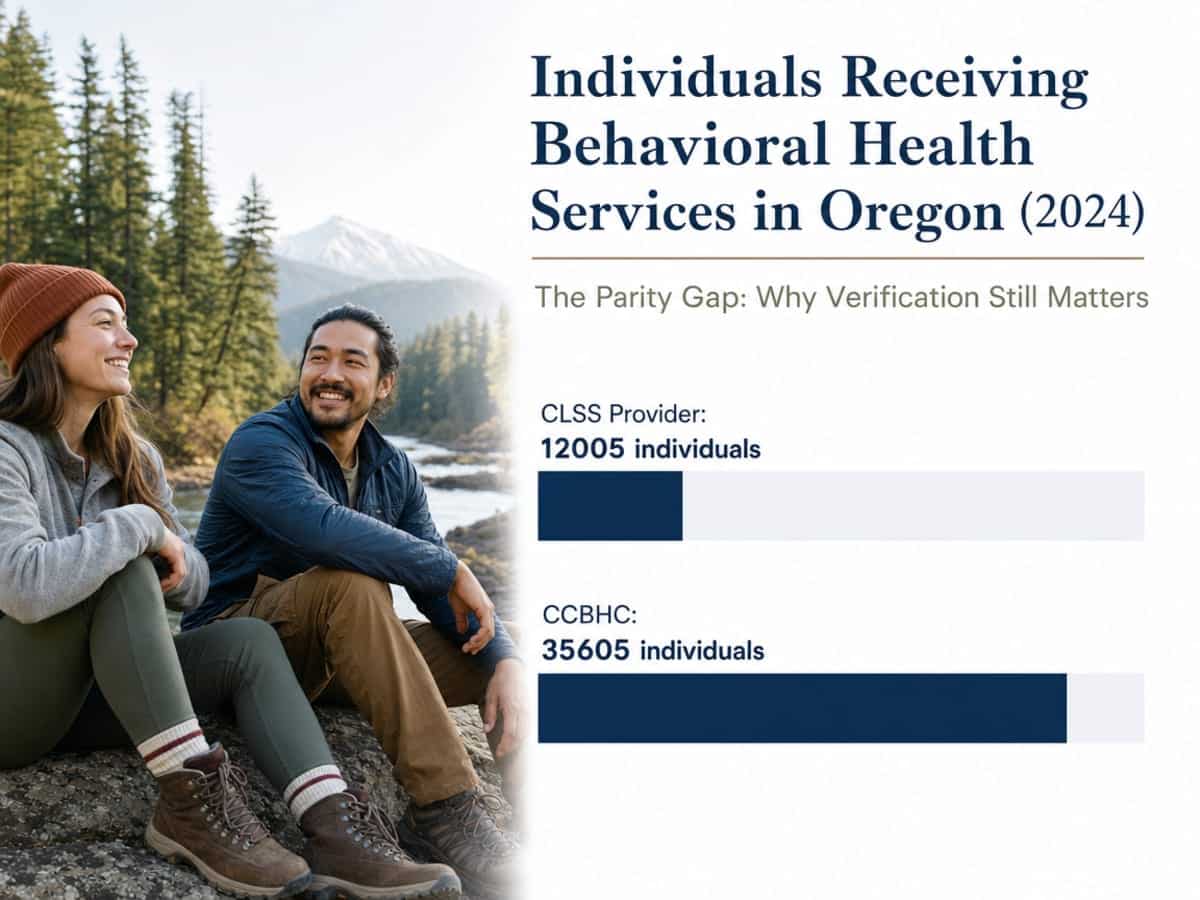
You are not alone in this system. In 2024 alone, 12,005 Oregonians received at least one substance use or mental health service through a culturally and linguistically specific provider, and another 35,605 received services through a Certified Community Behavioral Health Clinic 20. Tens of thousands of your neighbors used their insurance for behavioral health last year. The infrastructure exists. Someone just has to help you use it.
How to Verify Your Detox Coverage Today
Verification sounds bureaucratic. It isn’t. It’s a short, structured phone call that turns a stack of unknowns into four concrete numbers and a yes-or-no on the facility you’re considering. Most people who call Pacific Crest Trail Detox have benefits confirmed the same day, often within an hour.
Here’s what to do right now, in order:
- Grab your insurance card. The front has your member ID, group number, and the plan name. The back has a member services phone number and, often, a separate behavioral health line. You’ll need all of it. If you can’t find your card, log in to your carrier’s app or ask HR for a digital copy.
- Call Pacific Crest Trail Detox first, or call your carrier’s member services line. If you call PCTD, the admissions team runs the verification for you — they pull benefits directly from the insurer and translate the answer into plain English. If you call your carrier yourself, ask specifically for the behavioral health or substance use disorder benefits desk.
- Ask these four questions. SAMHSA recommends confirming specific plan details before starting care, because coverage varies plan to plan even within the same carrier 17:
- Is the facility I’m considering in-network for medical detox and residential SUD treatment?
- Does my plan require prior authorization for withdrawal management, and how quickly can it be requested?
- How many days of detox and residential care are covered, and what is the medical-necessity review process for extending a stay?
- What is my remaining deductible, my coinsurance rate, and my out-of-pocket maximum for this plan year?
4. Get the answer in writing before admission. A written benefits estimate — even a short email from admissions summarizing the verification call — protects you if a claim is questioned later. Under Oregon and federal parity rules, your insurer has to apply the same review standards they use for medical care 23, so document the conversation.
That’s the whole process. Check your coverage in minutes with Pacific Crest Trail Detox, and you’ll walk into the next hard decision with real numbers in your hand instead of dread.
If You Have OHP: Where to Turn Instead
If your card says Oregon Health Plan on the front, your detox is still covered — you just need a different door than the one Pacific Crest Trail Detox can open. OHP lists detoxification and medication-assisted treatment directly among its covered behavioral health services 21, 22, and the state’s SUD 1115 waiver keeps federal Medicaid dollars flowing to residential withdrawal management programs through March 31, 2026 2, 3.
Three starting places will get you further tonight than any search bar:
- Call 988. The Suicide and Crisis Lifeline routes to trained Oregon counselors who can help with substance use crises and connect you to OHP-contracted detox beds.
- Call your CCO’s behavioral health line. The number is on the back of your OHP card. Your coordinated care organization is required to find you a covered detox provider.
- Contact the Oregon Health Authority or visit oregon.gov/oha for the current list of OHP-contracted withdrawal management facilities in your county.
You are not stuck. You just need the right door.
What Happens After Detox — and Why Coverage Continues
Detox is the first door, not the whole house. Getting through withdrawal safely is the medical priority, but the days and weeks after are where recovery actually takes root — and your insurance is built to help fund that part too.
Under the Affordable Care Act, substance use disorder treatment is an essential health benefit, and that language covers a full continuum: medical detox, medication-assisted treatment, residential care, partial hospitalization, intensive outpatient, and standard outpatient counseling 14, 13. Federal parity rules mean your plan cannot cap those follow-up services more tightly than it caps physical rehab after a surgery 15. In Oregon, that continuum is exactly how residential and outpatient programs are licensed under the ASAM levels — 3.1 through 3.7 on the residential side, with outpatient tiers below — so a covered step-down from detox into ongoing treatment is the norm, not the exception 7.
Pacific Crest Trail Detox is built around that same continuum. After medical detox, most people step into partial hospitalization or intensive outpatient at the same facility, then standard outpatient and alumni support — all typically billed through the same commercial plan that covered the detox stay. One verification call sets up the whole path, not just the first three days.
See If Your Insurance Includes Detox Coverage
Find out instantly if your plan supports safe, medically supervised detox in Oregon.
Frequently Asked Questions
Does my insurance really have to cover detox in Oregon?
Yes. Every ACA-compliant Marketplace and commercial plan sold in Oregon is required to cover substance use disorder services, including medically necessary detox, as an essential health benefit 14, 13. Federal parity law and Oregon’s own parity statute require insurers to treat that coverage comparably to how they cover medical and surgical care 15, 23. The Oregon Health Plan also lists detoxification directly among its covered behavioral health services 21.
Which Oregon insurance carriers does Pacific Crest Trail Detox accept?
Pacific Crest Trail Detox works with most major commercial carriers Oregonians carry, including Regence BlueCross BlueShield, PacificSource, Providence Health Plan, Moda, Kaiser Permanente, Aetna, Cigna, and UnitedHealthcare. Because network status can vary by specific plan and employer group even within the same carrier, the admissions team confirms your exact in-network status when they run your verification. One short call tells you where your plan actually lands.
Does Pacific Crest Trail Detox accept the Oregon Health Plan (OHP)?
No. Pacific Crest Trail Detox does not accept OHP. Your OHP detox benefit is still real — Oregon Medicaid covers detoxification and medication-assisted treatment 21, 22 — but you’ll need to use it at an OHP-contracted facility. The fastest starting points are 988 for crisis support, the behavioral health line on the back of your OHP card, and the Oregon Health Authority.
What is prior authorization, and will it delay my admission?
Prior authorization is a quick clinical review your insurer runs before approving payment. A clinician documents why you need this level of care, and the insurer signs off. It usually doesn’t delay admission for medically necessary detox — especially for alcohol or benzodiazepine withdrawal, which is treated as an emergency. Pacific Crest Trail Detox’s admissions team submits the request the same day and pushes back if a reviewer tries to shorten a clinically indicated stay 10.
How much will I actually pay out of pocket if detox is covered?
Honest answer: it depends on four numbers in your plan — your remaining deductible, your coinsurance rate, your out-of-pocket maximum, and whether the facility is in-network. Every ACA plan has an out-of-pocket ceiling, and once you hit it, your insurer covers 100% of covered services for the rest of the year 14. Cost sharing is real even when detox is covered 18, so a verification call gives you real numbers before you commit.
How fast can someone verify my coverage?
Usually within an hour, often faster. Pacific Crest Trail Detox’s admissions team pulls your benefits directly from the insurer, confirms in-network status and any prior authorization requirements, and translates the answer into plain English. SAMHSA recommends confirming specific plan details before starting care because coverage varies plan to plan 17. Have your insurance card ready when you call — front and back — and most of the unknowns turn into answers the same day.
References
- May 29, 2020 – Oregon Health Plan Substance Use Disorder 1115 Demonstration (Preprint). https://medicaid.gov/medicaid/section-1115-demonstrations/downloads/or-health-plan-sud-demo-pa.pdf
- Oregon Health Plan Substance Use Disorder 1115 Demonstration – CMS Listing. https://www.medicaid.gov/medicaid/section-1115-demo/demonstration-and-waiver-list/99466
- Substance Use Disorder 1115 Demonstration Waiver – Oregon Health Authority. https://www.oregon.gov/oha/hsd/medicaid-policy/pages/sud-waiver.aspx
- 11-W00362/10 TITLE: Oregon Health Plan Substance Use – Special Terms and Conditions. https://www.oregon.gov/oha/HSD/Medicaid-Policy/SUDWaiver/STCs-040821.pdf
- Draft 1115 Medicaid Waiver Application – Substance Use Disorder. https://www.oregon.gov/oha/HSD/Medicaid-Policy/SUDWaiver/DRAFT%20SUD%201115%20Waiver%20Application.pdf
- Permanent Administrative Order – Chapter 415-050: Addiction Services (Withdrawal Management). https://www.oregon.gov/oha/HSD/HSDRules/Perm415-050.04072023.pdf
- Permanent Administrative Order – Division 18 Residential Substance Use Disorder Treatment. https://www.oregon.gov/oha/HSD/HSDRules/Perm309.018.4.07.2023.pdf
- ASAM Levels of Care for Licensing and Certification – Providers. https://www.oregon.gov/oha/BH/Providers/Pages/ASAM.aspx
- Substance Use Disorder Service Provider Resources – Oregon Health Plan. https://www.oregon.gov/oha/OHP/Providers/Pages/SUD.aspx
- Report on Behavioral Health Parity – Oregon Division of Financial Regulation (2025). https://dfr.oregon.gov/business/reg/health/Documents/mental-health-parity/20250915-behavioral-health-parity-report.pdf
- Overview of Behavioral Health Parity in Oregon – Legislative Presentation. https://olis.oregonlegislature.gov/liz/2025I1/Downloads/CommitteeMeetingDocument/310084
- Behavioral Health Parity – Oregon Division of Financial Regulation. https://dfr.oregon.gov/business/reg/health/pages/mental-health-parity.aspx
- The Affordable Care Act Transformation of Substance Use Disorder Treatment. https://pmc.ncbi.nlm.nih.gov/articles/PMC5308192/
- Mental Health & Substance Abuse Coverage – HealthCare.gov. https://www.healthcare.gov/coverage/mental-health-substance-abuse-coverage/
- Making the Most of Your Mental Health and Substance Use Disorder Benefits. https://library.samhsa.gov/sites/default/files/sma16-4992.pdf
- The Essential Aspects of Parity: A Training Tool for Policymakers. https://library.samhsa.gov/sites/default/files/pep21-05-00-001.pdf
- Mental Health Treatment: What Does Health Insurance Cover?. https://www.samhsa.gov/find-support/how-to-pay-for-treatment/know-what-your-insurance-covers
- Guidance for Use of SABG and MHBG Funds for Cost-Sharing Assistance for Private Health Insurance Coverage. https://www.samhsa.gov/sites/default/files/grants/guidance-for-block-grant-funds-for-cost-sharing-assistance-for-private-health-insurance.pdf
- Treatment Episode Data Set (TEDS) 2024: Admissions to and Discharges from Substance Use Treatment Services. https://www.samhsa.gov/data/report/treatment-episode-data-set-teds-2024-admissions-and-discharges-substance-use-treatment
- Overview of Behavioral Health in Oregon – Legislative Presentation. https://olis.oregonlegislature.gov/liz/2025I1/Downloads/CommitteeMeetingDocument/310296
- Oregon Health Plan (OHP) Behavioral Health Coverage. https://www.oregon.gov/oha/hsd/ohp/pages/behavioral-health.aspx
- Behavioral Health Coverage : Members – Oregon.gov. https://www.oregon.gov/oha/ohp/members/pages/behavioral-health.aspx
- Mental health parity – Oregon Division of Financial Regulation. https://dfr.oregon.gov/insure/health/understand/coverage/pages/mental-health-parity.aspx
- 2026 Mental Health Parity Evaluation Frequently Asked Questions. https://www.oregon.gov/oha/HSD/OHP/CCO/Mental%20Health%20Parity%20FAQ%202026.pdf
- 2024 Mental Health Parity Evaluation. https://www.oregon.gov/oha/HSD/OHP/CCO/Mental%20Health%20Parity_Protocol_2024.pdf