

Key Takeaways
- Alcohol brain fog usually reflects a mix of disrupted sleep, mild dehydration, inflammation, acetaldehyde exposure, and the body’s adjustment as alcohol wears off, which is why thinking feels slow and patchy the morning after drinking.
- Fog can show up the next morning, two or three days later, or after quitting, and hangover symptoms including fuzzy thinking can last 24 hours or longer 1.
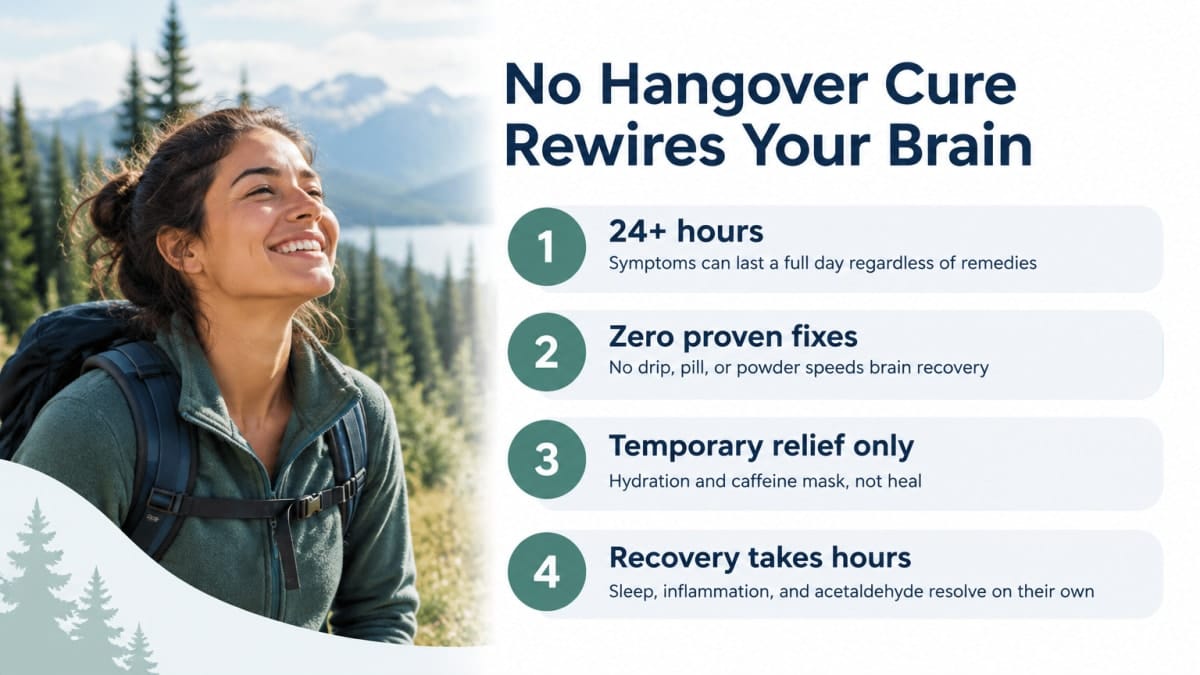
- Water, food, sleep, and time are the honest fixes for mild hangover fog; no remedy has been proven to speed brain recovery from alcohol 1.
- Confusion, hallucinations, seizures, nonstop shakes, or fever cross into withdrawal territory, and heavier or daily drinkers should talk with a detox provider before quitting cold turkey.
That Cotton-Headed Feeling After Drinking, Explained
If your head feels wrapped in cotton the morning after a few drinks, or two days after a wedding, or a week into cutting back, you are not imagining it. Alcohol brain fog is real. It usually means slow thinking, patchy memory, trouble focusing, and a tired brain that will not quite boot up.
Most of the time, that fog lifts on its own with sleep, water, and a little patience. Sometimes it points to something bigger, like withdrawal that needs medical eyes on it. The difference matters, and this guide will help you tell them apart.
You will see three common scenarios where fog shows up, a plain-language look at why it happens, what actually helps, and the specific symptoms that mean it is time to call someone. No shame, no scare tactics, just honest information.
What Alcohol Brain Fog Actually Is
The Plain-Language Definition: Slow Thinking, Short Memory, Low Battery
Alcohol brain fog is not a medical diagnosis. It is the word most people reach for when their head feels slow, fuzzy, and about half-charged after drinking. You know the feeling: you read the same email three times and still miss the point. You walk into the kitchen and forget what you came for. A coworker asks a normal question and your brain takes a long beat to answer.
The four pieces usually show up together. Slow thinking, where simple decisions take longer than they should. Patchy short-term memory, where names and small details slip. Trouble focusing, especially on anything that is not already lit up in front of you. And a low-battery tiredness that coffee does not quite fix.
Alcohol affects attention, sleep, memory, and mood across the whole body, not just one spot in the brain.2 That is why fog feels full-body, not just mental. You are tired, slow, and a little off, all at once.
Why Your Brain Feels Wrapped in Cotton: Sleep, Dehydration, Inflammation, and Acetaldehyde
There is no single villain here. Next-day fog is usually a stack of smaller things, and understanding that stack is the first step to being gentler with yourself about it.
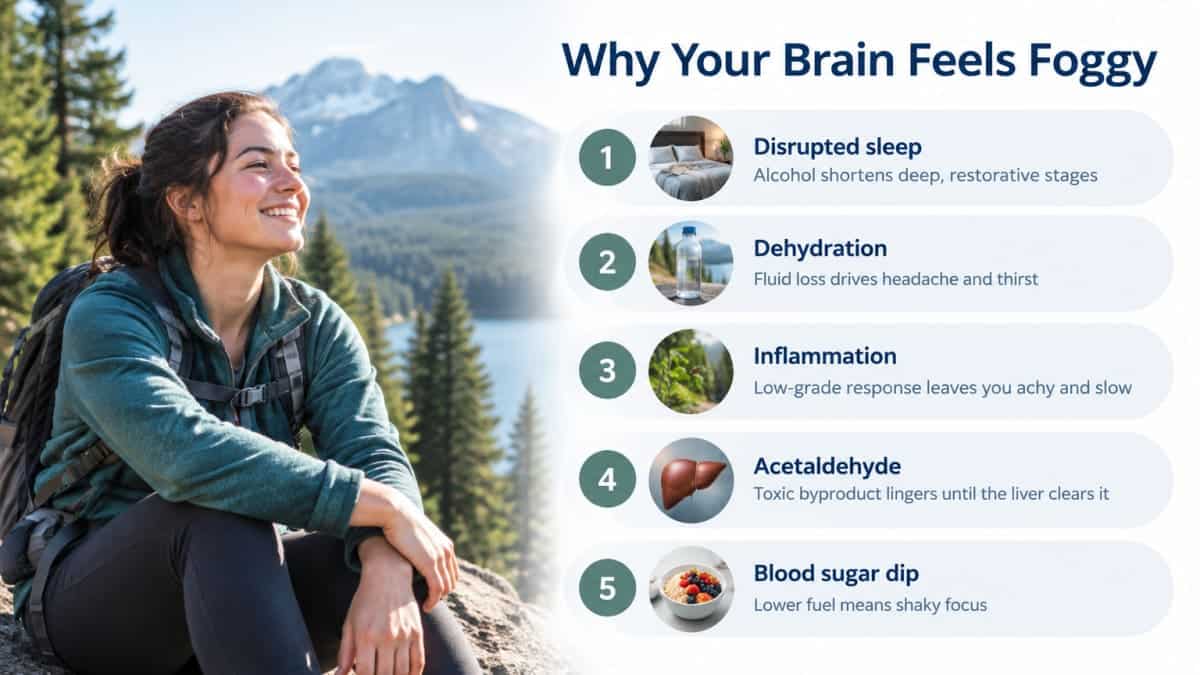
- Disrupted sleep. Alcohol may knock you out quickly, but it tends to disrupt deeper, restorative sleep. You can spend eight hours in bed and wake up as if you slept less. A tired brain is a foggy brain.
- Mild dehydration. Alcohol pulls fluid out of you. By morning, your body and brain are running low on fluid, which shows up as headache, thirst, and that cottony feeling behind your eyes.
- Inflammation. Your body treats alcohol as something to clean up. The resulting low-grade inflammation contributes to the heavy, achy, slow-to-think state that defines a rough morning.
- Acetaldehyde exposure. As your liver breaks alcohol down, it produces acetaldehyde, a byproduct that lingers until your body can clear it. More drinks mean more acetaldehyde, which can add to the symptoms you are feeling.
- Blood sugar changes. Alcohol can affect blood sugar overnight. Lower fuel can mean lower focus and that shaky, hollow feeling that makes concentration harder.
Each piece on its own might be manageable. Stacked together, they help explain why your brain feels wrapped in cotton. Alcohol touches attention, sleep, mood, memory, and coordination across multiple body systems, which is why the fog shows up in so many ways at once.2 It is not weakness. It is biology doing what it does when alcohol is in the mix.
Three Scenarios Where the Fog Shows Up
Scenario One: The Morning After a Normal Night Out
You had three or four drinks at a birthday dinner. Nothing wild. You went to bed at a reasonable hour. And now it is 9 a.m. and your brain is barely online.
This is the most common fog, and it is the one most people recognize. Your head feels heavy. Your thoughts move like they are wading through sand. You open your laptop and stare at it. You pour coffee and still feel half-asleep an hour later. You might feel a little anxious or low, like your emotional dial got turned down.
Hangover symptoms peak when your blood alcohol gets back near zero, and they can stick around for 24 hours or longer, with attention, decision-making, and muscle coordination measurably impaired during that stretch.1 That is why you can feel foggy well into the afternoon even though you stopped drinking the night before.
If this is you once in a while, it usually passes with water, food, and rest. It is uncomfortable, but it is not a signal that something is medically wrong.
Scenario Two: Brain Fog Two or Three Days After Drinking
This one surprises people. You drank Friday night. Saturday was rough, as expected. But now it is Monday morning, maybe even Tuesday, and your head still feels off. You cannot concentrate in meetings. You are forgetting small things. Your mood is flat or jumpy, and you cannot shake the sense that you are running at 70 percent.
A couple of things can be happening here. If you drank more than usual, your sleep probably took a bigger hit than you realized. Restorative sleep rebuilds slowly, and two nights of lousy sleep can trail you for days. Inflammation and the general wear on your body also take time to settle.
If you drink most days and this long tail is becoming familiar, pay closer attention. Alcohol affects attention, sleep, memory, and mood across the whole body, and heavier or more frequent drinking can stretch how long those effects linger.2 Three-day fog is not a diagnosis, but it is worth noticing.
And if the fog comes with shakiness, racing thoughts, or a feeling that something is really off, that moves this out of hangover territory. More on that line in a few sections.
Scenario Three: Fog That Shows Up After You Quit
You decided to stop drinking. Maybe for a week. Maybe for good. You expected to feel better quickly, because that is the story most of us carry: quit the thing, feel clearer.
Then day two hits, and your head feels worse. Day three, you are foggier than you were while drinking. You feel irritable, scattered, maybe sad. Simple decisions feel heavy. You start wondering if you broke something.
You did not. Your body had adjusted to alcohol being around, and now it is adjusting without it. In the first several days, that adjustment can look like fatigue, anxiety, poor sleep, and a thick cognitive fog that feels like a betrayal after all the effort it took to stop. For many people, this is the hardest stretch, and improvement over the following weeks is common as the body settles.
A Realistic Timeline: Hour 12 Through the Weeks That Follow
Everyone’s timeline is a little different, and no two people recover on exactly the same schedule. Here is a general sense of what alcohol brain fog can look like as the hours and days add up. Your experience will vary based on how much you drank, how often you drink, your sleep, your health, and whether you are stopping altogether or just recovering from one night.
Around hour 12 (the morning after). This is peak hangover territory. Your blood alcohol is back near zero, and that is when fuzzy thinking, slow reactions, and trouble focusing hit hardest. Attention, decision-making, and muscle coordination can be impaired, which is why driving or anything requiring sharp judgment is a bad idea right now.1
The next day or two. For a moderate night, much of the fog is often lifting. You might still feel tired or a little flat, but your head is mostly back. For heavier nights, people are often surprised to still feel slow.
A few days in. After a one-off, you should feel essentially like yourself. If you drank heavily or you just quit after regular drinking, this stretch can actually feel worse, not better, as your body works on adjusting.
The first week. For people stopping after regular drinking, this stretch is often where sleep begins to settle and the thickest fog starts to thin, though mood can still swing.
The weeks after. Clarity often keeps improving in waves. Good days, then a foggy afternoon, then more good days. Alcohol affects attention, sleep, mood, and memory across the whole body, and those systems settle at their own pace.2
If your timeline keeps moving the wrong direction instead of slowly forward, that is information worth acting on.
What Actually Helps a Mild Hangover Fog (And What Doesn’t)
The Honest Short List: Water, Food, Sleep, Time
For a mild, one-off hangover fog, the boring stuff is the useful stuff. Nothing on this list is exciting. All of it actually helps.
- Water, slowly. Sip through the morning. You are not trying to chug your way back to clarity; you are gently refilling what alcohol pulled out overnight. Add a glass of something with electrolytes if plain water is not sitting well.
- Real food. Something with protein, some carbs, a little fat. Eggs and toast. A bowl of oatmeal. A sandwich. Food helps steady the shaky, hollow feeling behind the fog.
- More sleep, if you can. A nap, an earlier bedtime, a slower morning. Alcohol disrupted your sleep, and the only real fix is giving your brain another round of rest to catch up on what it missed.
- Time. The one no one wants to hear. Mild fog lifts on its own as your body clears the last of the alcohol and the inflammation settles. Patience counts here.
Why IV Drips, Supplements, and ‘Cures’ Don’t Rewire Your Brain Faster
You have seen the ads. Hangover IV drips delivered to your door. Pills promising a clear head by lunch. Patches, powders, electrolyte sticks branded as the fix. Here is the honest part no one selling these wants to say out loud.
No remedy has been scientifically proven to speed the brain’s recovery from alcohol, and hangover symptoms can last 24 hours or longer no matter what you throw at them.1 That includes the IV bag, the pricey supplement stack, and whatever your coworker swears by. They might make you feel a little better in the moment, mostly through hydration or caffeine, but they are not rewiring anything.
Your brain recovers on its own timeline. Sleep rebuilds. Inflammation calms. Acetaldehyde clears. These processes happen in hours, not minutes, and they do not have a shortcut.
If you catch yourself needing increasingly elaborate workarounds to feel normal after drinking, that pattern itself is worth paying attention to. The fog is information, and so is what it takes to push through it.
The Bright Line: Normal Hangover Fog vs. Withdrawal That Needs Medical Help
Symptoms That Are Uncomfortable but Usually Pass on Their Own
Most alcohol brain fog falls into the uncomfortable-but-fine category. You feel bad, but your body is handling it. Here is what that usually looks like.
- Tiredness that a nap or an early bedtime starts to fix.
- A dull headache that eases with water, food, and time.
- Slow thinking and a short memory for small details.
- A little nausea or no appetite in the morning.
- Feeling flat, mildly anxious, or socially off.
- A soft sensitivity to bright light or loud sound.
None of these are fun. All of them tend to walk back on their own as the hours pass and your sleep, hydration, and blood sugar catch up. If you drank once, slept it off, and feel foggy but basically oriented to where you are, what day it is, and who is around you, you are almost certainly in normal hangover territory.
Symptoms That Mean Call Someone Now: Confusion, Hallucinations, Seizures, Shakes That Won’t Stop, Fever
This is the short list that moves you out of hangover territory and into something that needs medical help, not a quiet morning on the couch. If any of these show up, especially after heavy or daily drinking, call 911 or get to an emergency room.
- Confusion about where you are, what day it is, or who people are. Not forgetful. Genuinely disoriented.
- Hallucinations. Seeing, hearing, or feeling things that are not there, including bugs on the skin, shadows moving, or voices.
- A seizure. Even one. Even brief. This is an emergency every time.
- Shakes that will not stop. Not a mild tremor from being tired. Visible, persistent trembling in your hands, arms, or whole body.
- Fever, racing heart, or heavy sweating that comes on without a clear reason, especially paired with any of the above.
- Severe agitation or a feeling that something is deeply wrong that you cannot talk yourself out of.
These are signs of alcohol withdrawal that can turn dangerous fast. You do not have to be sure. If you are reading this list and recognizing yourself or someone you love, that is enough to make the call.
Why Self-Assessment Isn’t Enough for Heavier Drinkers
If you drink most days, or you drink heavily when you drink, trying to grade your own withdrawal risk from a symptom checklist is riskier than it feels. The research on severe withdrawal shows that no single factor reliably predicts how any one person’s course will go, and risk is shaped by a mix of things like prior withdrawal episodes, past seizures or delirium, repeated attempts to quit, and other medical conditions.3
That is why clinicians use structured tools to look for complicated withdrawal before scary symptoms show up, rather than waiting for confusion or a seizure to prove the point.4 You cannot run that assessment on yourself at 2 a.m. with a search bar.
Here is the gentler version. If you are a heavier or daily drinker and you are thinking about stopping, the safest first step is a short, honest phone call with a detox provider. Not a commitment. Not a sales pitch. A quick conversation about what you have been drinking and whether you need medical eyes on your next few days.
Why Quitting Cold Turkey Can Make the Fog Worse Before Better
Here is the part that catches people off guard. You stop drinking, and for a few days your head feels worse, not better. The fog thickens. Sleep falls apart. You feel jittery, irritable, maybe a little panicky. It feels like a cruel trick after making the hardest decision you have made in a while.
What is actually happening is an adjustment period. Your body had been working around the presence of alcohol, and when alcohol disappears, it takes time to settle. In those first days, that can show up as anxiety, poor sleep, and thick cognitive fog. Alcohol touches attention, sleep, memory, and mood across the whole body, so that adjustment can show up in all of them at once.2
For light or occasional drinkers, this stretch is uncomfortable but usually manageable at home with rest, food, and water. For heavier or daily drinkers, cold-turkey quitting is a different situation. It can escalate into real withdrawal, and alcohol withdrawal is one of the few that can be life-threatening. Shakes that will not stop, racing heart, hallucinations, or a seizure are not signs you are weak. They are signs your body needs medical support to come off safely.
If you have tried to quit before and the first few days knocked you flat, that history matters. Talk to a professional before you try again alone.
What Safe, Medically Supervised Detox Looks Like
If the fog comes with shakes, racing anxiety, or a heavy daily drinking history behind it, the right next step is not another solo attempt. It is a few days in a setting where someone is actually watching how your body is doing.
Safe medical detox starts with a real assessment, not a checklist you fill out in the parking lot. Clinicians look at how much you have been drinking, how long, past withdrawal episodes, prior seizures or confusion, and other health conditions, because risk is shaped by that mix rather than any single factor.3 Structured tools help providers spot complicated withdrawal before it turns into a crisis, instead of waiting for someone to seize to prove the point.4
From there, treatment is individualized. In appropriately monitored settings, symptom-triggered dosing is one evidence-supported approach, where medication is adjusted to your symptoms as nurses track vital signs, sleep, and mental state, rather than running everyone on the same fixed schedule.5 Benzodiazepines are commonly used as a first-line option for preventing severe complications, while alternatives may be considered in selected lower-risk situations under close monitoring, with the overall evidence base described as limited or heterogeneous.6
At a non-hospital detox like Pacific Crest Trail Detox in Milwaukie, that care happens in a home-like setting rather than a hospital ward. RNs are on site 24/7, providers round seven days a week, and much of the staff is in recovery themselves, so you are talking to people who have sat where you are sitting. Detox typically runs 8 to 10 days, and it connects straight into PHP, IOP, outpatient, and aftercare so you are not dropped back into daily life on day nine without a plan.
Reaching Out: A Confidential First Call
If you have read this far and recognized yourself, the next step is smaller than you think. One phone call. No commitment, no intake paperwork at the kitchen table, no stranger showing up at your door. Just a quiet conversation about what you have been drinking, what the last few mornings have felt like, and whether your body needs medical support to stop safely.
Calls to Pacific Crest Trail Detox in Milwaukie are confidential and HIPAA-protected. You can also verify insurance benefits over the phone or online before anything else happens. Many of the people answering have been through recovery themselves, so you are not explaining the fog to someone who has never felt it.
Whether this is your first detox or your fifth, we want to be your last treatment experience. Call when you are ready. Even if ready today just means curious.
Concerned About Alcohol Brain Fog?
Check your coverage for medically supervised alcohol detox and take a supported next step.
Frequently Asked Questions
How long does alcohol brain fog last after a night of drinking?
For most people, the fog from a single night lifts within 24 hours as your body clears the alcohol, your sleep catches up, and your blood sugar steadies. Hangover symptoms, including slow thinking and trouble focusing, can linger 24 hours or longer after a heavier night.1 If it stretches beyond that, pay attention to what else is going on.
Why is my brain fog worse a few days after I stopped drinking?
After you stop drinking, poor sleep, anxiety, and thick fog can show up on days two and three as your body adjusts. Alcohol affects attention, sleep, mood, and memory across the body, so that adjustment can touch all of them at once.2
Can alcohol brain fog be a sign of withdrawal that needs medical help?
Yes. Fog paired with shakes that will not stop, confusion about place or time, hallucinations, a racing heart, fever, severe agitation, or a seizure is withdrawal, not a hangover. Risk is higher if you have had prior withdrawal episodes, past seizures, or repeated attempts to quit, and no single factor predicts your course.3 Call 911 or a detox provider.
Do IV drips, vitamins, or supplements actually clear brain fog faster?
No remedy has been scientifically proven to speed the brain’s recovery from alcohol, and hangover symptoms can last 24 hours or longer no matter what you try.1 IV drips and supplements may offer short-term hydration or a caffeine lift, but they do not rewire anything. Water, food, sleep, and time are still the honest answer.
Will my thinking fully come back if I stop drinking?
Alcohol affects attention, sleep, mood, and memory, and a general overview cannot predict the exact course for any one person.2 How much and how fast things improve depends on how long and how heavily you drank, your sleep, nutrition, and overall health. Improvement varies from person to person.
How do I know if I need medically supervised detox instead of quitting at home?
If you drink daily, drink heavily, have had past withdrawal shakes or seizures, or have tried to stop before and felt knocked flat in the first few days, medical detox is the safer path. Clinicians use structured tools to spot complicated withdrawal before severe symptoms appear, rather than waiting for a crisis.4 A short, confidential phone call is the first step.
References
- Hangovers. https://www.niaaa.nih.gov/publications/brochures-and-fact-sheets/hangovers
- Alcohol’s Effects on the Body. https://www.niaaa.nih.gov/alcohols-effects-health/alcohols-effects-body
- Predictors of Severe Alcohol Withdrawal Syndrome: A Systematic Review and Meta-Analysis. https://pubmed.ncbi.nlm.nih.gov/25011452/
- Prospective Validation Study of the Prediction of Alcohol Withdrawal Severity Scale (PAWSS) in Medically Ill Inpatients. https://pubmed.ncbi.nlm.nih.gov/25234485/
- Symptom-Triggered vs Fixed-Schedule Doses of Benzodiazepine for Alcohol Withdrawal. https://pubmed.ncbi.nlm.nih.gov/15811903/
- Anticonvulsants for Alcohol Withdrawal. https://pubmed.ncbi.nlm.nih.gov/20547800/