


Key Takeaways
- Oregon has one of the highest substance use disorder rates in the country, with 21.6% of adults needing treatment, so working professionals seeking detox are far from alone 2.
- Four privacy layers protect Oregon professionals: HIPAA, 42 CFR Part 2, PDMP access limits requiring a court order, and non-hospital residential settings that keep the experience out of public hallways 6, 11.
- Licensed nurses and health professionals in Oregon can access confidential monitoring through the OSBN Alternative to Discipline Program and HPSP, where self-reporting and treatment often preserves the license rather than ending it 3, 8, 12.
- A medically supervised detox typically runs five to seven days and can be covered under parity rules or Oregon Health Plan, making a private call to a program like Pacific Crest Trail Detox a practical next step 4, 5, 10.
The Fear Behind the Search: Two Crises at Once
If you are reading this at 2 a.m. with shaking hands, or on a lunch break in your parked car, you are already carrying two emergencies at the same time.
The first one is physical. Your body has started to depend on alcohol, or a benzodiazepine like Xanax or Klonopin, or an opioid, and the space between doses is getting harder. You may already know that stopping cold from alcohol or benzos can be medically dangerous — seizures, heart problems, worse. That fear is real and it is correct.
The second one is quieter, and in some ways heavier. It is the fear of being found out. The nursing license you spent years earning. The bar card. The badge. The classroom. The corner office. The clients who trust you. The spouse who does not fully know yet. The colleague who might see your name on a chart or a court docket. You are not just afraid of withdrawal. You are afraid of what withdrawal will cost you socially and professionally.
Both fears deserve to be taken seriously. Neither one should make the other worse.
That is what this guide is for. Not a pep talk. Not a brochure. A plain-language walk through what confidential detox actually looks like in Oregon — what the law protects, what your license board can and cannot do, how much time you really need to take off, and how a place like Pacific Crest Trail Detox in Milwaukie fits into a working life you are trying to keep.
You Are Not the Only Professional Facing This in Oregon
Here is something worth sitting with for a moment: the person you picture when you think of someone in detox is probably not you. It is someone else. Someone whose life has already fallen apart. Someone without a job to protect.
That picture is wrong, and it is one of the reasons professionals wait too long.
Oregon has one of the highest rates of substance use disorder in the country. The Oregon Health Authority reports that 21.6% of adults in the state need substance use treatment, compared with 16.5% nationally 2. That gap is not small. It means roughly one in five adults you passed in traffic this morning, or sat next to in a meeting, or waved to at your kid’s school pickup, is dealing with some version of what you are dealing with.
Many of them are working. Many of them are good at their jobs. Some of them are excellent at their jobs, which is part of how they hide it for so long.
This is not meant to make you feel like a statistic. The opposite. It is meant to loosen the grip of the belief that you are uniquely broken, or that your situation is so unusual no one has built a path for it. Oregon has built paths, precisely because so many working adults need them. Confidential monitoring programs for licensed professionals, parity rules that make insurance treat detox like any other medical care, non-hospital residential detox settings — none of that infrastructure exists by accident.
You are not the first attorney, nurse, teacher, or engineer to open a browser tab like this one. You will not be the last. And the people who answer the phone at a place like Pacific Crest Trail Detox in Milwaukie have spoken with someone in your exact position, probably this week.
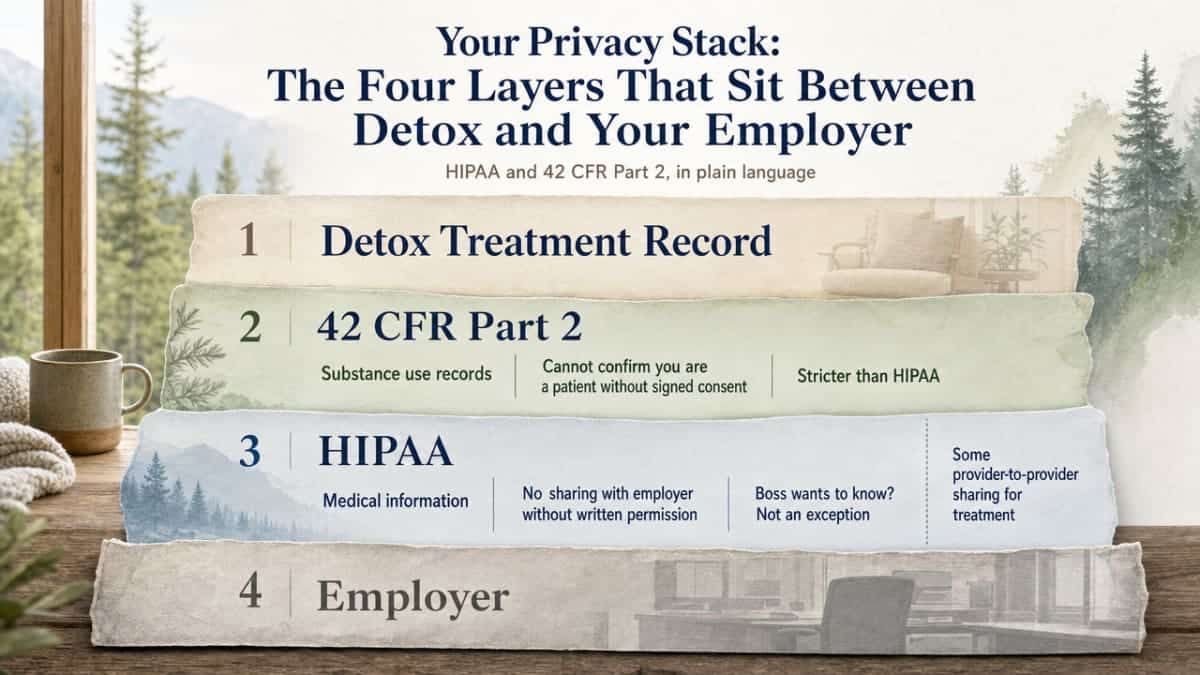
Your Privacy Stack: The Four Layers That Sit Between Detox and Your Employer
HIPAA and 42 CFR Part 2, in Plain Language
Two federal laws already stand between your treatment record and anyone who might use it against you at work.
HIPAA is the one you have heard of. It stops a doctor, hospital, lab, or treatment center from sharing your medical information with your employer, your spouse, your coworkers, or a licensing board without your written permission. There are narrow exceptions, but “my boss wants to know” is not one of them.
42 CFR Part 2 is the quieter law, and for detox it may matter more. It is a federal rule written specifically for substance use treatment records. It says that programs like a medical detox facility cannot even confirm you are a patient there without your signed consent. HIPAA lets some information move between providers for treatment purposes. Part 2 is stricter. Even another doctor cannot pull your detox chart just because they are curious or because they are on the same network.
What that means in practice: your employer cannot call Pacific Crest Trail Detox and ask if you are staying there. They will not get a yes. They will not get a no. They will not get a call back.
Oregon PDMP Patient Rights: Who Can See Your Prescription History
If part of what you are detoxing from is a prescription — Xanax, Klonopin, oxycodone, hydrocodone, tramadol — you may be worried about a different record altogether. Oregon’s Prescription Drug Monitoring Program (PDMP) is a state database of controlled substance prescriptions. Every time a pharmacy fills one for you, it lands there. That fact alone keeps some professionals from asking for help.
Here is what the Oregon Health Authority actually says about that record:
- PDMP information is protected by HIPAA and Oregon law.
- Law enforcement can only obtain your PDMP record with a valid court order — not a phone call, not a hunch, not a request from your workplace.
- Your personal information is destroyed after three years.
- You have the right to a free copy of your own record and the right to see who has accessed it 6, 11.
Read those four points again if you need to. Your employer is not on the access list. Your licensing board is not scrolling through it. If someone did look at your record improperly, you can find out.
Controlled substance prescriptions do not sit in a public file that a curious colleague can search. They sit inside a system with retention limits, court-order requirements, and an audit trail you personally can request. That is not the same as invisibility, and it is not meant to be. It is meant to keep the record useful for medical safety without turning it into a career weapon.
Non-Hospital Setting as a Privacy Feature
The last layer of privacy is not a law. It is a location.
If you detox in a hospital emergency department, you walk in through a public waiting room. You wear a wristband. You are logged into a system that touches billing, radiology, the ED census, and shift-change handoffs. None of that is a HIPAA violation. It is just a lot of people, in a lot of hallways, in a building your coworkers or patients might also visit that week.
A non-hospital residential detox is a different building with a different rhythm. Pacific Crest Trail Detox operates in a home-like setting in Milwaukie — not a clinical corridor, not an ER waiting room, not a hospital wing. There is no wristband. There is no chance of running into a coworker who is there for a broken ankle. The car in the driveway looks like a car in a driveway.
If You Hold a License: What Actually Happens to It
Nurses and the OSBN Alternative to Discipline Program
If you are a nurse in Oregon, this is probably the fear that keeps you awake: that asking for help is the same as handing over your license.
It is not. The Oregon State Board of Nursing runs an Alternative to Discipline Program built specifically for nurses with a substance use problem. It is described as confidential and focused on early intervention and treatment rather than formal discipline 12. In many cases, a nurse who self-reports and enters monitoring keeps their license and returns to safe practice under structured oversight instead of facing a public disciplinary action 8.
Read that again. Self-reporting and entering treatment is not the same as losing your license. In many cases, it is what saves it.
There are real conditions attached. You will be monitored. You will have drug screens. Your return to work will be paced. There will be a period where certain settings or medications are off-limits. That is the trade, and for most nurses it is a trade worth making, because the alternative — being discovered by a coworker, a patient complaint, or a diversion audit — usually is not confidential and usually does not end this well.
Medical detox is often the first step into that alternative pathway. Getting stable first, then walking into the monitoring conversation with a plan already in motion, changes the whole tone.
Physicians and Other Health Professionals: HPSP Monitoring
If you are a physician, dentist, pharmacist, physician assistant, or another licensed health professional in Oregon, there is a parallel path with a different name.
It is called the Health Professional Services Program. The Oregon Health Authority describes HPSP as“a confidential monitoring program for health professional licensees who are unable to practice with skill and safety due to a substance use disorder, a mental health disorder, or both types of disorders”3.
The word to sit with there is confidential. HPSP is not a disciplinary body. It is a monitoring program that a licensee can enter, in many cases, without their board opening a public case file. The program tracks recovery, coordinates with treatment providers, and reports on your progress under defined rules — not on the details of your therapy sessions or your detox chart.
What this means practically: getting through medical detox first gives you something to bring to that conversation. You are not walking in mid-crisis, asking the program to figure out what to do with you. You are walking in stabilized, with a treatment plan underway, saying you are already doing the work. That is a very different meeting than the one you are picturing right now.
Attorneys, Teachers, Tradespeople, First Responders
Not every licensed professional has a confidential monitoring program with a state page and an acronym. You may be an attorney, a teacher, an electrician, a commercial driver, a paramedic, a police officer, a therapist. The specifics of your board or agency will vary, and this article cannot promise what any single one will do.
What is true across the board:
- HIPAA and 42 CFR Part 2 still apply to your detox record.
- Your employer cannot call the treatment center and get information without your signed consent.
- Your medical leave paperwork does not have to name a diagnosis to be valid.
- Your insurance claim goes to you and your plan, not to your licensing board.
Many professions in Oregon have some version of an attorney assistance program, an employee assistance program, or a diversion pathway that treats early self-reporting more favorably than late discovery. A confidential call to your professional association, made after you are medically stable and not before, is often the right sequence.
Get safe first. Get the legal and licensure conversation second, from a stronger position, with a treatment record already started.
What a 5 to 7 Day Medical Detox Actually Looks Like on a Calendar
One of the reasons professionals put this off is that “detox” sounds like a black hole on the calendar — an indefinite disappearance you cannot explain. It is not. For most people withdrawing from alcohol, benzodiazepines, or opioids, medically supervised detox is a defined window of about five to seven days. Long enough to be safe. Short enough to plan around.
Here is what those days usually look like.
- Days 1 and 2 — intake and stabilization. You arrive, you meet the medical team, they do a full assessment and start medicines to ease withdrawal symptoms before they get sharp. This is the part that keeps you out of an emergency room. Alcohol and benzo withdrawal can trigger seizures if it is done alone; that risk drops dramatically once you are under medical eyes and on the right medications.
- Days 3 through 5 — the acute withdrawal window. This is the hardest stretch physically, and it is also the stretch where being in a home-like residential setting, not a hospital wing, tends to matter most. You sleep in a real bed. You eat real food when you can. Nurses check on you. Medications are adjusted. You are not doing this alone in a hotel room with an internet tab open.
- Days 6 and 7 — transition planning. Your body is coming back online. You start talking about what comes next — a partial hospitalization program during the day, an intensive outpatient program a few evenings a week, therapy that can hold your schedule. If you are on Oregon Health Plan, it is worth knowing that OHP covers detoxification, medication-assisted treatment, and counseling as behavioral health services, and members do not need a referral to access this care 4. Commercial insurance operates on parity rules that generally require comparable access.
On a calendar, that is roughly one work week. Some people extend a few days. Some step into a longer residential stay. But the core medical detox — the part that actually keeps you safe — is measured in days, not months. A week of medical leave, paired with a weekend on either side, is often the entire away-from-work footprint before you begin a step-down program built around your job.
Paying for It Without a Paper Trail to Your Boss
How Parity Law Changes What Your Plan Can Require
One of the quiet worries that keeps people from using their insurance is the belief that a detox claim will somehow land on the boss’s desk. It will not. Your insurance claim goes to you and your plan. Your employer sees premiums and enrollment, not the diagnosis codes attached to your care.
What parity law does is change the rules your plan can set for that care. The Mental Health Parity and Addiction Equity Act, as explained by Oregon’s Division of Financial Regulation, requires most health plans to treat substance use and mental health benefits comparably to physical health benefits — the same kinds of copays, the same visit limits, the same rules for how you access treatment. If your plan covers a week in the hospital for a physical condition without a mountain of extra hoops, it cannot pile extra hoops on a week of medical detox.
Oregon has been actively checking on this. The state’s 2024 parity evaluation of Medicaid coordinated care organizations found that the administration of mental health and substance use benefits was largely in parity with medical and surgical benefits 5. On the commercial side, the same federal rules apply 10. If a plan denies your detox stay or piles on preauthorization steps it would not require for a comparable medical admission, you have grounds to push back, and Oregon’s insurance consumer advocates can help.
Framing Time Away: Medical Leave, FMLA, and PTO
You do not have to tell your employer what you are being treated for. You have to tell them, if you want job protection, that you have a serious health condition that needs medical care. That is the language the federal Family and Medical Leave Act uses, and it is the language your HR portal is built around.
A short medical leave for detox — usually a week, sometimes a bit more — fits inside that framework. Your provider fills out the paperwork with dates and a general certification that you are under medical care. The specific diagnosis stays between you and the treatment team. HR handles the leave; they do not receive your chart.
Some people prefer to stack a week of PTO with a weekend on each side, avoid formal leave paperwork entirely, and simply be out of office. Others want FMLA’s job protection even if the away-from-work footprint is short. Either path can work. What matters is that you pick one before the week starts, so you are not making these decisions while you are also managing withdrawal. The intake team at Pacific Crest Trail Detox can help you think through what your specific situation calls for.
Choosing a Detox Program That Respects the Job You Still Have
Not every detox program is built for someone who plans to keep working. Some are designed for people who have lost everything and have nothing but time. That is not you, and it is worth naming what to look for.
- Ask whether the program is medically staffed for alcohol and benzodiazepine withdrawal, not just opioids. These are the withdrawals that can hurt you, and they need medicines on hand and clinicians who know how to titrate them.
- Ask whether the setting is a home-like residential environment or a hospital wing. That question is not about comfort. It is about who might see you in the parking lot and what your intake paperwork looks like.
- Ask how the program handles the step down after detox. A stabilization week that dumps you back into your job with no follow-up is not a plan; it is a countdown. Look for a program that can hand you off directly into a partial hospitalization or intensive outpatient schedule that flexes around a work calendar, so the momentum you built in that first week does not evaporate.
- Ask who answers the phone. The first call tells you a lot. If the person on the other end talks to you like a patient with a life, not a lead with a diagnosis, that is the tone that will carry through your care.
Pacific Crest Trail Detox has been doing this in Milwaukie since 2017, in a residential setting built for exactly this kind of decision — medically supervised withdrawal for alcohol, benzodiazepines, and opioids, with a step-down into outpatient care that can hold a working schedule.
Making the Call: A Doorway, Not a Pitch
Making the call is the hardest part. Not the withdrawal. Not the paperwork. Not the conversation with HR. The call.
You do not have to have your story figured out. You do not have to know which medication you need, which insurance code to quote, or how many days you can take. You just have to say some version of “I think I need help getting off alcohol” or “I’ve been taking more than I’m prescribed and I can’t stop safely.” The person on the other end takes it from there.
You are allowed to make that call today. You are allowed to make it from your car. You are allowed to hang up and think about it. The doorway stays open either way.
Check Your Coverage for Safe, Private Detox
Find out if your insurance supports confidential, medically supervised detox in Oregon.

Frequently Asked Questions
Will my employer or licensing board automatically find out if I go to detox in Oregon?
No. HIPAA and 42 CFR Part 2 keep your treatment record private, and a detox program cannot even confirm you are a patient there without your signed consent. Your employer sees medical leave dates, not diagnoses. Your board is not automatically notified. Disclosure happens only when you sign a release or when a specific legal exception applies.
How much time off work does a medically supervised detox actually require?
For most people withdrawing from alcohol, benzodiazepines, or opioids, medical detox runs about five to seven days. Days 1 and 2 are intake and stabilization, days 3 through 5 handle acute withdrawal, and days 6 and 7 focus on transition planning. Paired with weekends, that often fits inside a single week of medical leave before you step down into outpatient care built around your work schedule.
Can law enforcement or my employer see my prescription history through Oregon’s PDMP?
Your employer cannot see it at all. Law enforcement can only obtain your PDMP record with a valid court order, not a phone call or a request from your workplace. The data is protected by HIPAA and Oregon law, personal information is destroyed after three years, and you have the right to a free copy of your own record and to see who has accessed it 6, 11.
Does insurance cover detox, and will using it create a paper trail my employer can see?
Yes to coverage, no to a trail your employer sees. Federal and Oregon parity rules require most plans to treat substance use benefits comparably to medical care 5, 10. Claims go to you and your plan, not your boss. If you are on Oregon Health Plan, detoxification, medication-assisted treatment, and counseling are covered and you do not need a referral 4. Premiums and enrollment are visible to employers; diagnosis codes are not.
I’m a nurse in Oregon. Will detox cost me my license?
In many cases, no. The Oregon State Board of Nursing runs an Alternative to Discipline Program that offers confidential monitoring and early treatment instead of formal discipline for nurses with substance use problems 8, 12. Self-reporting and entering treatment is often what saves the license, not what ends it. Completing medical detox first lets you walk into that conversation stabilized, with a treatment plan already in motion.
Why choose a home-like residential detox instead of a hospital?
A hospital ED means a public waiting room, a wristband, and a building your coworkers or patients might also visit. A non-hospital residential setting like Pacific Crest Trail Detox in Milwaukie looks like a house from the driveway, with real beds, real meals, and nurses on hand. The clinical care is medically supervised; the surroundings are private. For a working professional, the building itself becomes part of your privacy plan.
References
- 2023 NSDUH Substate and State Estimates – Oregon State Tables. https://www.samhsa.gov/data/sites/default/files/reports/rpt56188/2023-nsduh-sae-state-tables_0/2023-nsduh-sae-state-tabs-oregon.pdf
- Substance Use Disorder Integration Report. https://www.oregon.gov/oha/HSD/AMH/DataReports/SUD-Integration-Report.pdf
- Oregon Health Authority: Addiction Services. https://www.oregon.gov/oha/hsd/amh/pages/addictions.aspx
- Behavioral Health Coverage: Oregon Health Plan Members. https://www.oregon.gov/oha/ohp/members/pages/behavioral-health.aspx
- 2024 Mental Health Parity Evaluation Summary Report. https://www.oregon.gov/oha/HSD/OHP/DataReportsDocs/2024-MHP-Report.pdf
- Prescription Drug Monitoring Program: Patient Rights Handout. https://www.oregon.gov/oha/PH/PREVENTIONWELLNESS/SAFELIVING/PDMP/Documents/Patient_Rights_Handout.pdf
- Oregon Health Authority: Behavioral Health Division. https://www.oregon.gov/oha/hsd/amh/pages/index.aspx
- Oregon State Board of Nursing – Alternative Programs and Discipline. https://www.oregon.gov/osbn/pages/discipline.aspx#alternative_programs
- ADPC NSDUH and Progress Report. https://www.oregon.gov/adpc/SiteAssets/Lists/MeetingEvents/EditForm/ADPC%20NSDUH%20and%20Progress%20Report%20-%20for%20website%2003.11.2024.pdf
- Mental Health Parity – Oregon Division of Financial Regulation. https://dfr.oregon.gov/insure/health/understand/coverage/pages/mental-health-parity.aspx
- Patient Rights – Prescription Drug Monitoring Program. https://www.oregon.gov/oha/ph/preventionwellness/safeliving/pdmp/pages/patient-rights.aspx
- Oregon State Board of Nursing Alternative to Discipline Program. https://www.oregon.gov/osbn/Pages/Alternative-to-Discipline-Program.aspx