


Key Takeaways
- Stopping benzodiazepines abruptly after regular use can trigger seizures and other life-threatening withdrawal reactions 1.
- Risk level depends on dose, duration, the specific benzodiazepine, age, and whether alcohol or opioids are in the mix, not on willpower or motivation.
- Provider-guided outpatient tapering can work for short-term, low-dose use, but no internet schedule can safely replace a plan built around your history and biology 2.
- Non-hospital medical detox offers a middle path with 24/7 nursing, gradual tapering, and a step-down into PHP, IOP, and continued care for lasting recovery 4.
The Honest Answer About Stopping Benzodiazepines on Your Own
Here is the straight answer you came for: benzo detox at home is sometimes reasonable for short-term, low-dose use under a prescriber’s close guidance, but for most people who are physically dependent on Xanax, Klonopin, Ativan, or Valium, stopping on your own is medically risky. The FDA warns that abruptly stopping or rapidly reducing benzodiazepines can cause withdrawal reactions, including seizures, that are life-threatening.1
You are not weak for being scared of this. You are paying attention.
If you have taken a benzodiazepine daily for more than a few weeks, your body may have become physically dependent on the medication.6 Pulling it out suddenly, or cutting too fast off an internet schedule, can trigger seizures, severe panic, confusion, or psychosis, even in people who felt fine on a stable dose. Risk climbs with higher doses, longer use, short-acting drugs like Xanax and Ativan, and any mix with alcohol or opioids.
The honest path is somewhere between quitting alone in a bedroom and sitting in a hospital ER. This article walks you through what cold turkey actually does to the body, what a provider-guided taper looks like, and when a non-hospital medical detox in the Portland metro, Milwaukie, or anywhere in Oregon or SW Washington is the safer call.
Why Benzo Withdrawal Is Different From Other Drugs
What Happens in the Brain When You Stop
When you take Xanax, Klonopin, Ativan, or Valium every day for weeks or months, your body adapts to the medication. On a steady dose, you feel normal. The adaptation is invisible until you stop.
Pull the medication away suddenly and that balance collapses. People describe pounding anxiety, insomnia that will not break, muscle tremors, racing heart, waves of nausea, and a kind of sensory overload where light and sound feel sharp. In more serious cases, withdrawal can tip into seizures, hallucinations, delirium, or psychosis.1
This is not a character problem. Your body is doing exactly what it does when a medication it has learned to expect disappears. Oregon’s state patient guide puts it plainly: people taking these medications for more than about a month are more likely to go through withdrawal and need a provider to help plan a dose reduction.6 That is the biology talking, not weakness.
Short-Acting vs. Long-Acting: Why Xanax and Ativan Hit Harder
Not all benzos leave the body at the same speed, and that single detail changes how withdrawal feels.
Xanax (alprazolam) and Ativan (lorazepam) are short-acting. They work fast and clear fast. Levels in your blood can rise and fall several times between doses, which means your body is already feeling small withdrawal waves between pills. Stop suddenly and the drop is steep. Symptoms often start quickly and hit hard: sharp anxiety, shakes, insomnia, sometimes seizures. Many people on daily Xanax describe feeling like they are going through mini-withdrawals every afternoon, even before they try to quit.
Valium (diazepam) and Klonopin (clonazepam) are long-acting. They build up in the body and leave slowly over days. Withdrawal from these can be delayed and more gradual, but it is not safer by default. Long duration of use, higher doses, or any mix with alcohol or opioids can still make it dangerous.
Short-acting or long-acting, the drug’s half-life is one reason a schedule that worked for a friend online will not necessarily be safe for you. A prescriber has to factor it in.2
Cold Turkey Benzo: The Scenario That Puts People in the ER
Cold turkey is the word people use when they mean “I’m done, I’m flushing them tonight.” It sounds decisive. Sometimes it sounds like the only honest option left. With benzodiazepines, it is the single decision that most reliably sends people to the emergency room.
Seizures are the headline risk, but they are not the only one. Cold turkey discontinuation can also set off delirium, hallucinations, severe agitation, or acute psychosis in people who have never had any of those symptoms before. Blood pressure can spike. Heart rate climbs. Some people describe a terror that does not respond to anything they try. The FDA tells patients directly: trouble breathing, seizures, or other serious symptoms are a 911 situation, not a tough-it-out situation.5
Risk is not evenly distributed. It climbs sharply if you have been taking a benzo daily for more than a few weeks, if your dose is higher, if you are also drinking alcohol or using opioids, or if you have had a hard withdrawal before. Short-acting drugs like Xanax and Ativan are the usual culprits in fast, severe cold turkey crashes because they clear so quickly.
If you have already stopped and symptoms are escalating, that is not the moment to prove something. Call your prescriber or get to an emergency department. If you are still thinking about it, please read the next section before you decide anything.
Honestly Placing Yourself: Lower-Risk vs. Higher-Risk Discontinuation
Before you make any decision about stopping, it helps to look at your own situation honestly. Risk is not a single yes-or-no answer. It sits on a sliding scale, and four factors move the dial more than anything else: how long you have been taking the medication, roughly how much, which drug it is, and what else is in the mix.
Lower-risk situations tend to share a profile. The person has used a benzodiazepine for a short time, often under four weeks. The dose has been small and steady. There is no history of seizures, no daily alcohol use, no opioids on board, and no prior withdrawal that spun out of control. For this reader, a prescriber can often guide a gradual outpatient taper from home with regular check-ins. The deprescribing evidence shows that slow, provider-led tapering improves the odds of actually stopping compared with white-knuckling it or continuing indefinitely.3
Higher-risk situations look different and deserve a different plan. You belong in this group if any of the following is true:
- You have been taking a benzodiazepine daily for more than a few weeks, and especially for months or years.6
- Your dose is on the higher end, or you have been climbing it to get the same effect.
- You are on a short-acting drug like Xanax or Ativan, which clears fast and crashes hard.
- You are also drinking alcohol, using opioids, or mixing other sedatives.
- You have a seizure history, serious heart or lung disease, or unstable psychiatric symptoms.
- You have tried to quit before and ended up in an ER, in a crisis, or back on a higher dose.
- You are 65 or older, which raises the risk of falls, confusion, and medical complications during withdrawal.3
If one item on that list describes you, that is enough. You do not need to check every box to warrant medically supervised care. The VA/DoD clinical guideline specifically notes that higher doses and more complex cases call for longer, carefully monitored tapers rather than quick fixes.4
Place yourself honestly, not optimistically. Your body does not care how busy your week is or how much you want this to be simple. Where you actually land on this scale decides whether a phone call to your prescriber is enough or whether you need a bed, a nurse, and someone watching through the night.
What ‘Withdrawal Home Treatment’ Can and Can’t Look Like
Provider-Guided Outpatient Tapering: When It’s a Reasonable Option
An outpatient taper means you keep living at home, but your prescriber is actively steering the slowdown. You are not guessing. You are not cutting pills based on a forum post. A clinician who knows your history writes a plan, you check in on a schedule, and the plan gets adjusted when symptoms tell you it should be.
This path can be reasonable when the picture is relatively clean: short duration of use, a modest dose, no seizure history, no daily drinking or opioid use, stable physical and mental health, and a prescriber who has time to actually follow you. The deprescribing evidence shows that slow, provider-led tapering improves the chances of successfully stopping compared with continuing the medication or usual care, and it is offered to adults 65 and older regardless of duration, and to adults 18-64 who have used these medications longer than four weeks.3
What this looks like in practice: regular appointments, honest reporting of how you feel between doses, and a willingness to pause or slow the taper when sleep falls apart or anxiety spikes. Oregon’s patient guide is blunt that a taper can take weeks or months and must be set by your provider, not pulled off the internet.6 If your prescriber is comfortable guiding this and your situation genuinely fits, outpatient tapering is a real option.
Why No Internet Schedule Fits Every Person
There is no shortage of taper charts online. The problem is that even the experts disagree on the specifics. A 2024 systematic review of clinical practice guidelines found that organizations are unanimous that benzodiazepines should be reduced gradually and through shared decision-making, but they differ substantially on recommended taper rates, whether to switch to a longer-acting medication, and which supporting medications to add.2
Think about what that means. If pharmacists, physicians, and researchers who read this literature full-time cannot agree on a universal rate, a stranger on Reddit cannot write the right schedule for your body, your history, your dose, and the other medications you take.
Your personal variables matter more than any template. The specific drug and its half-life, how long you have been on it, your age, your liver and kidney function, your sleep, your other prescriptions, whether you are drinking, and whether a previous taper went sideways all change what safe reduction looks like for you.4 A plan that worked beautifully for your coworker could put you in an ER. A plan built around you, adjusted as you go, is the whole point of having a prescriber in the loop.
Signs It’s Time to Escalate Care
Even a careful outpatient taper can hit a wall. Knowing when to stop troubleshooting at home and ask for more help is a skill, not a failure.
Call your prescriber the same day if you notice symptoms building faster than you can manage: sleep collapsing for several nights in a row, panic that will not settle, tremors that get worse instead of better, a racing heart, confusion, or the sense that your mind is slipping sideways. These are signals that the taper needs adjusting or that you need a higher level of care, not that you need to push through.
Go to an emergency department or call 911 right away for a seizure, trouble breathing, chest pain, hallucinations, severe disorientation, or thoughts of harming yourself. The FDA states this plainly in its patient guidance: trouble breathing, seizures, or other serious side effects are a 911 situation.5
Escalation does not have to mean a hospital bed forever. Often it means moving from outpatient tapering into non-hospital medical detox, where you have round-the-clock nursing, a prescriber who can adjust medications quickly, and quiet space to stabilize. That handoff is the next section, and it is the option many people wish they had chosen first.
Non-Hospital Medical Detox: The Safer Middle Path
Most people picture two options when they think about getting off a benzodiazepine: tough it out at home or sit for hours in a hospital emergency room. There is a third option, and it is the one many clients wish they had known about first.
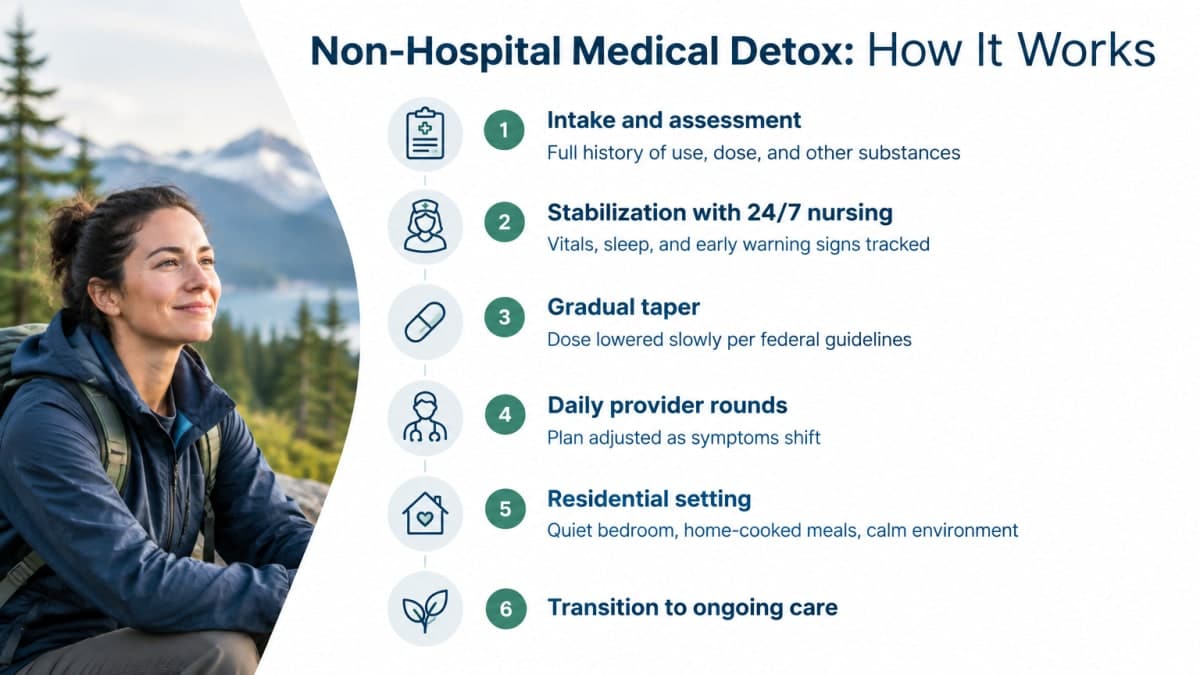
Non-hospital medical detox is a residential setting with real medical care but without the fluorescent lights and shared curtain of an ER. Think closer to a house than a ward. Clients sleep in a quiet bedroom, eat home-cooked meals at a table, and have registered nurses on site 24 hours a day with providers rounding seven days a week. For benzodiazepine withdrawal, that around-the-clock presence is the whole point. The riskiest hours, the ones where a seizure or a wave of severe agitation can arrive without warning, are not hours you want to spend alone.
Here is what the process typically looks like, grounded in the same gradual-tapering approach federal clinical guidelines recommend for benzodiazepine withdrawal management.4
Intake and assessment. A clinician takes a full picture of what you have been using, for how long, at what dose, and what else is in play, including alcohol, opioids, medical conditions, and prior withdrawal attempts. This is where honesty matters more than tidiness. The plan is built from what you actually tell them.
Stabilization with 24/7 monitoring. Nurses track vitals, sleep, anxiety, and any early signs of trouble. If symptoms start climbing, the response is minutes away, not a drive to urgent care.
Individualized gradual taper. The medication is reduced slowly, with adjustments based on how you are actually feeling. The VA/DoD guideline is explicit that tapers should be gradual and shaped by symptoms and tolerability, with longer courses for higher-dose or more complex situations.4 A medically supervised setting lets a provider slow down the day you need to slow down.
Step-down into continued care. Detox usually runs about 8 to 10 days. That is the stabilization window, not the finish line. From there, most people move into a partial hospitalization program, intensive outpatient, standard outpatient, and alumni support, so the taper is not interrupted and the therapy work can actually start. Slow, provider-led discontinuation is what the deprescribing evidence connects to better long-term results.3
For readers in Milwaukie, Portland, Gresham, Beaverton, Salem, or Vancouver, Washington, this kind of residential detox exists in your backyard. For out-of-state families, it is reachable by a short flight into PDX. Either way, it is quieter than a hospital, safer than a bedroom, and built so that detox is a doorway, not a dead end.
If You’re the Family Member Reading This
If you are the spouse, parent, sibling, or adult child doing the 2 a.m. Googling, read this part carefully. You are not overreacting. Benzodiazepine withdrawal is one of the few withdrawals that can actually kill someone, and the person you love may not be in a state to make that call themselves right now.
Watch for a few specific things. A seizure of any kind, even a brief one, is a 911 call. So is trouble breathing, chest pain, severe confusion, hallucinations, or talk of self-harm.5 Shorter warning signs to take seriously, same day: shaking that is getting worse, several nights of no sleep, panic that will not settle, a racing heart, or your person suddenly “not seeming like themselves.” Trust that instinct. You know their baseline.
When you bring it up, lead with worry, not accusation. Something like, “I’m scared about how fast you’re trying to stop, and I don’t want you doing this alone,” lands better than a lecture. Offer to make the phone call with them, or to sit in the room while they do it. Shame keeps people stuck. Steady company gets them to the phone.
You do not have to have the medical answers. You just have to help them reach someone who does.
What Recovery Looks Like After Detox
Detox is the opening chapter, not the whole book. Getting the medication out of your system safely is a real accomplishment, and it is also the easiest part of what comes next. The body takes time to recalibrate after months or years on a benzodiazepine, and the anxiety or insomnia that drove you to the pill in the first place does not vanish the day the taper ends. A survey of 1,207 benzodiazepine users reported wide variation in withdrawal experiences, with symptoms not following a predictable trajectory.7 That is why continued care matters.
After an 8 to 10 day medical detox, most people step down through a partial hospitalization program, then intensive outpatient, then standard outpatient, with alumni support running alongside. Group therapy, individual counseling, and work on sleep, nutrition, and the underlying anxiety all happen here. Many staff are in recovery themselves, which changes how the conversations feel. Recovery is not a straight line, but it is learnable, and you do not have to figure it out alone.
Getting a Confidential Assessment in Oregon or SW Washington
If you have read this far, you already know more than most people about what you are actually dealing with. The next step is smaller than it feels. A confidential phone call with a clinical team gets you a real assessment of your situation, your risk level, and what kind of care actually fits, whether that is outpatient tapering with your prescriber or a residential medical detox bed later this week.
Calls to Pacific Crest Trail Detox in Milwaukie are HIPAA-protected and do not obligate you to admit. You can verify insurance, ask questions for a family member, or simply find out what the next 24 hours could look like. We serve Portland, Gresham, Beaverton, Salem, Vancouver, Washington, and welcome out-of-state families flying into PDX. We want to be your last treatment experience, whether we’re your first detox or your fifth.
Check Coverage for Medically Supervised Benzo Detox
Find out whether your plan may help cover supervised detox and continued recovery care.
Frequently Asked Questions
Can I detox from benzodiazepines at home by myself?
Sometimes, if your use has been brief and low-dose and a prescriber is actively guiding you. For most people who have taken a benzodiazepine daily for more than a few weeks, quitting alone is medically risky. Oregon’s patient guide is direct: anyone using these medications for over a month should work with a provider on a dose-reduction plan.6
How long does benzo withdrawal usually last?
It varies a lot from person to person. A provider-guided taper can stretch over weeks or months depending on your dose and duration.6 A survey of 1,207 benzodiazepine users reported wide variation in withdrawal experiences, with symptoms not following a predictable trajectory for everyone.7 There is no single timeline that fits everyone.
What are the warning signs that I need to go to the ER during withdrawal?
Call 911 or get to an emergency department for a seizure of any kind, trouble breathing, chest pain, hallucinations, severe confusion, or thoughts of harming yourself. The FDA names these specifically as emergency situations during benzodiazepine withdrawal.5 Shorter warnings worth a same-day call to your prescriber include worsening tremors, several nights without sleep, panic that will not settle, or a racing heart that will not calm down.
Is non-hospital medical detox different from going to a hospital?
Yes. A hospital emergency room is built for acute crises and discharges you quickly. Non-hospital medical detox is a residential setting with registered nurses on site 24 hours a day and providers rounding seven days a week, inside a quiet, home-like environment with real beds and home-cooked meals. You get the medical monitoring without the fluorescent lights, shared curtains, and short stay of an ER visit.
How long is a typical stay at Pacific Crest Trail Detox?
Medical detox usually runs about 8 to 10 days, though benzodiazepine tapers can run longer for higher-dose or more complicated cases. Federal clinical guidance recommends gradual tapers shaped by symptoms and tolerability, with longer courses when the situation calls for it.4 Your actual length of stay depends on your drug, dose, duration of use, and how your body responds, not a fixed calendar.
What happens after detox ends?
Detox stabilizes you. The work of staying off a benzodiazepine happens in continued care. Most people step down through a partial hospitalization program, then intensive outpatient, then standard outpatient, with alumni support alongside. Slow, provider-led discontinuation combined with ongoing care gives better long-term results than detox alone.3 Group therapy, individual counseling, and work on sleep and underlying anxiety all happen in this next chapter.
References
- FDA requiring Boxed Warning to be updated to improve safe use of benzodiazepine drug class. https://www.fda.gov/drugs/drug-safety-and-availability/fda-requiring-boxed-warning-updated-improve-safe-use-benzodiazepine-drug-class?
- Prescribing and deprescribing guidance for benzodiazepine use: a systematic review of clinical practice guidelines and consensus statements. https://pmc.ncbi.nlm.nih.gov/articles/PMC10955669/
- Deprescribing benzodiazepine receptor agonists. https://pmc.ncbi.nlm.nih.gov/articles/PMC5951648/
- VA/DoD Clinical Practice Guideline for the Management of Substance Use Disorders. https://healthquality.va.gov/HEALTHQUALITY/guidelines/MH/sud/VA-DoD-SUD-CPG_Final_for-508_v3.pdf
- Benzodiazepine Drug Class: Drug Safety Communication. https://www.fda.gov/safety/medical-product-safety-information/benzodiazepine-drug-class-drug-safety-communication-boxed-warning-updated-improve-safe-use
- Patient Guide to Benzodiazepines. https://www.oregon.gov/oha/HPA/DSI-Pharmacy/MHCAGDocs/Final-Patient-guide-benzodiazepines-5.13.2022.pdf
- Experiences with benzodiazepine use, tapering, and discontinuation: a qualitative study. https://pmc.ncbi.nlm.nih.gov/articles/PMC9047812/