


Key Takeaways
- Pacific Crest Trail Detox works with most major commercial carriers including Aetna, Cigna, Regence, Providence, Moda, PacificSource, UnitedHealthcare, First Choice, MHN, TriWest, and Kaiser PPO products, but not OHP.
- Oregon’s 2025 parity report found insurers often look compliant on paper while prior authorization, concurrent review, and network admission fall short, so every plan still requires individual benefits verification.
- Plan type shapes cost more than the logo on the card: PPOs usually offer in-network and out-of-network behavioral health benefits, while HMO, Marketplace, Medicare, and self-funded ERISA plans vary widely.
- Have your insurance card, policyholder details, substance and last use, prior treatment history, and preferred admission date ready so a free three-minute benefits check can confirm coverage and next steps.
Insurance Carriers Pacific Crest Trail Detox Works With
If you’re looking for help with addiction, you’ve come to the right place. Pacific Crest Trail Detox offers a supportive, home-like medical detox experience in Milwaukie, Oregon, with dedicated doctors and nurses on-site. We also provide a comprehensive recovery program to support you after stabilization. We aim to make the process as clear and stress-free as possible, focusing on your well-being every step of the way.
We work with most major commercial insurance plans. While we do not accept the Oregon Health Plan (OHP), we can guide OHP members to appropriate resources.
Here are some of the carriers we most often help people verify:
- Aetna — verification required
- Cigna (including Evernorth behavioral health) — verification required
- Regence BlueCross BlueShield of Oregon — verification required
- Providence Health Plan — verification required
- Moda Health — verification required
- PacificSource (commercial plans) — verification required
- UnitedHealthcare / UMR / Optum — verification required
- First Choice Health Network — verification required
- MHN / Health Net — verification required
- TriWest — VA Community Care (for eligible veterans) — verification required
- Kaiser PPO products where out-of-network benefits apply — verification required
You’ll notice “verification required” after each name. This is because Oregon’s 2025 behavioral health parity report highlighted that while many insurers appear compliant on paper, their day-to-day operations, including prior authorization and network admission, often fall short of their written promises. So, even if your card features one of these logos, we need to verify your specific benefits to determine your coverage and any potential out-of-pocket costs.
If your carrier isn’t listed, don’t worry. Many self-funded employer plans (sometimes called ERISA plans) operate under various names, and we can still check your benefits. The only firm exclusion is OHP/Medicaid. For everyone else, let’s explore your options together. Reaching out is a significant first step, and we’re here to help you through the rest.
Understanding Insurance “Acceptance” for Oregon Detox
When a detox facility states it “accepts” your insurance, it means they have experience billing that carrier. However, it doesn’t guarantee full coverage, zero out-of-pocket costs, or an immediate bed. These details depend on your specific plan and medical necessity.
Here’s a straightforward explanation of how detox coverage is determined in Oregon:
- Your plan must include the benefit. Most commercial plans in Oregon cover substance use treatment. Oregon’s parity rules mandate that financial requirements and treatment limits for substance use care cannot be more restrictive than those for general medical care. Additionally, Marketplace plans must cover substance use treatment as an essential health benefit.
- Care must be medically necessary. Your plan will assess medical necessity based on its criteria and may request documentation.
- The provider must be approved by your plan. This refers to whether the facility is in-network or if your plan offers out-of-network benefits, which we’ll discuss further.
- Services must be authorized as required by your plan. Some plans require pre-approval, while others review the stay concurrently.
The 2025 Oregon parity report noted that despite written compliance, many insurers had operational gaps in areas like prior authorization and network access. Therefore, “accepted” is our way of saying, “we commonly work with this carrier, and we need to verify your specific benefits to give you accurate coverage information.” We’re here to help you navigate this process.
In-Network, Out-of-Network, and Single-Case Agreements Explained
Understanding these three terms is crucial for knowing your potential costs. Let’s break them down:
In-network means Pacific Crest Trail Detox has a direct agreement with your insurance plan regarding pricing. Your plan pays a predetermined amount, and we agree to accept it. This typically results in the lowest out-of-pocket costs for you, usually involving a deductible, copay, or coinsurance until you reach your out-of-pocket maximum. If we are in-network with your plan, this is often the most straightforward path.
Out-of-network with benefits indicates your plan will still cover a portion of the cost, though usually at a different (often lower) rate, meaning your share will likely be higher. Many PPO plans in Oregon include out-of-network benefits for behavioral health. This is particularly relevant due to Oregon’s parity rules, which require access to substance use treatment comparable to medical care, including out-of-network options if in-network beds are unavailable. When we verify your benefits, we’ll check both in-network and out-of-network options to provide you with clear financial expectations.
A single-case agreement is a unique, one-time arrangement between your plan and our facility for your specific admission. These are considered when you need medical detox urgently, and there are no in-network beds available at the required level of care. While not guaranteed, these agreements are a viable option, and we have successfully guided many families through this process.
It’s important to note that even with strong out-of-network benefits, unexpected costs can arise if authorization or network details aren’t thoroughly confirmed. A GAO report found that individuals with coverage often struggle to find in-network providers and face restrictive approval rules. This is precisely why we verify both your benefits and the authorization process upfront, ensuring transparency before you commit.
Why Insurance Verification is Essential for Detox
Even with good insurance, navigating the path to detox can be challenging. Our goal is to bridge that gap for you. Nationally, a 2025 GAO report revealed that only about 24% of individuals aged 12 and older who needed substance use treatment actually received it. This highlights that having insurance and receiving care are often two distinct realities.
Several factors contribute to this disparity, even for those with coverage:
- Finding an in-network bed can be difficult. The GAO has reported that individuals with coverage frequently struggle to locate in-network behavioral health providers accepting new patients. A directory listing doesn’t guarantee an available bed tonight.
- Prior authorization and concurrent review can cause delays. Oregon’s 2025 parity report indicated that while plans might appear compliant on paper, operational aspects like prior authorization and concurrent review often fell short of parity requirements.
- Medical necessity criteria vary. Each insurance plan uses its own rules to determine the level of detox it will cover, and these rules are applied in real-time during your stabilization process.
Preparing for Your 3-Minute Verification Call
The good news is that once you have a few key pieces of information ready, the insurance verification call is quick and easy. Most delays come from searching for details while on the phone. Gather these items beforehand, and the entire process can take as little as three minutes.
What to have ready before you call:
- Your insurance card — both front and back. A photo on your phone works if the physical card isn’t immediately available. The member ID and group number are the most critical details.
- The policyholder’s full name and date of birth. If the plan is through a spouse, parent, or partner, we need their information, not just yours.
- The substance used and the approximate time of last use. Specify alcohol, opioids, benzodiazepines (like Xanax, Klonopin, Ativan), or other substances. A rough timeline, such as “last drink around 8 last night,” is sufficient.
- Any prior treatment history. This includes detox stays, rehab, or MAT history within the last year or two. A general answer is acceptable if you don’t recall exact dates.
- A preferred admission date — today, tomorrow, or a specific day this week. We will work with your availability.
- A phone number for a callback in case of disconnection or if we need to confirm additional details with your carrier.
While you gather this information, we will contact your plan directly. We ask the questions you shouldn’t have to ask while unwell: Is medical detox a covered benefit? What is the authorization process? Is there a deductible remaining, and what is the coinsurance after that? Oregon parity rules empower you with the right to clear answers about treatment limits, prior authorization, and written explanations for any denials, and we advocate for these rights on your behalf.
If you are a family member making this call for someone else, you do not need their permission to inquire about plan acceptance. We can perform a benefits check using only the insurance card. The individual in withdrawal does not need to be on the phone or answer questions; their priority is rest. You are providing invaluable support by handling this step.
Defining the Level of Care for Insurance Authorization
When your insurance plan asks “what level of care?” during a verification call, it’s not a trick question; it’s the key to how your benefits will be applied. Oregon licenses withdrawal management at different clinical levels, and insurers use these levels to determine coverage. Using an incorrect label can lead to claim denials for care you legitimately received.
Pacific Crest Trail Detox is a non-hospital residential medical detox located in Milwaukie. In Oregon’s terminology, this is a free-standing residential detox facility, offering 24-hour non-hospital care with on-site doctors and nurses. Our setting is home-like, designed for safe withdrawal and a smooth transition to ongoing treatment. We are distinct from hospital inpatient units or outpatient detox programs where you would return home at night. These are three different licensed services, each with unique billing procedures.
Here’s a simplified explanation of the levels of care we typically seek authorization for:
- Medically monitored residential withdrawal management — This is our core detox service, providing 24/7 nursing and medical oversight for withdrawal from alcohol, opioids, or benzodiazepines.
- Sub-acute detox — This is the common term for the same residential level of care, used when withdrawal symptoms are serious but do not necessitate a hospital setting.
- Partial hospitalization (PHP) and intensive outpatient (IOP) — These are crucial step-down programs that support continued recovery after your body has stabilized.
- Medication-supported treatment — This involves using medication to alleviate withdrawal symptoms and reduce cravings, which is covered in the next section.
When we contact your carrier, we specify the exact licensed service to ensure the authorization aligns precisely with the care you will receive, helping to prevent future billing complications.
Medication-Assisted Treatment (MAT) for Withdrawal
When discussing detox coverage, your plan might confirm “withdrawal management” but omit details about medication. Often, medication is authorized separately, yet it’s crucial for making withdrawal safer and more manageable, especially for alcohol, opioids, and benzodiazepines.
At Pacific Crest Trail Detox, our medical team utilizes medication to alleviate symptoms during detox and manage cravings as you progress into the next phase of care. In insurance terms, this is known as medication-assisted treatment, or MAT. It’s important to ask your carrier about specific medications by name, as coverage can vary. For opioid withdrawal and recovery, inquire about buprenorphine (sometimes branded as Suboxone), naltrexone (available orally or as the Vivitrol injection), and methadone. For alcohol withdrawal, ask about naltrexone and acamprosate.
Why is this specificity important? The GAO has reported that prior authorization and other policies can subtly restrict access to opioid use disorder medications, even when a plan technically covers them. For instance, one medication might require pre-approval while another does not. An injectable form might be covered under your medical benefit, while a pill version falls under your pharmacy benefit. We proactively ask these detailed questions during verification to ensure seamless access to the medications that will support your recovery from admission onward.
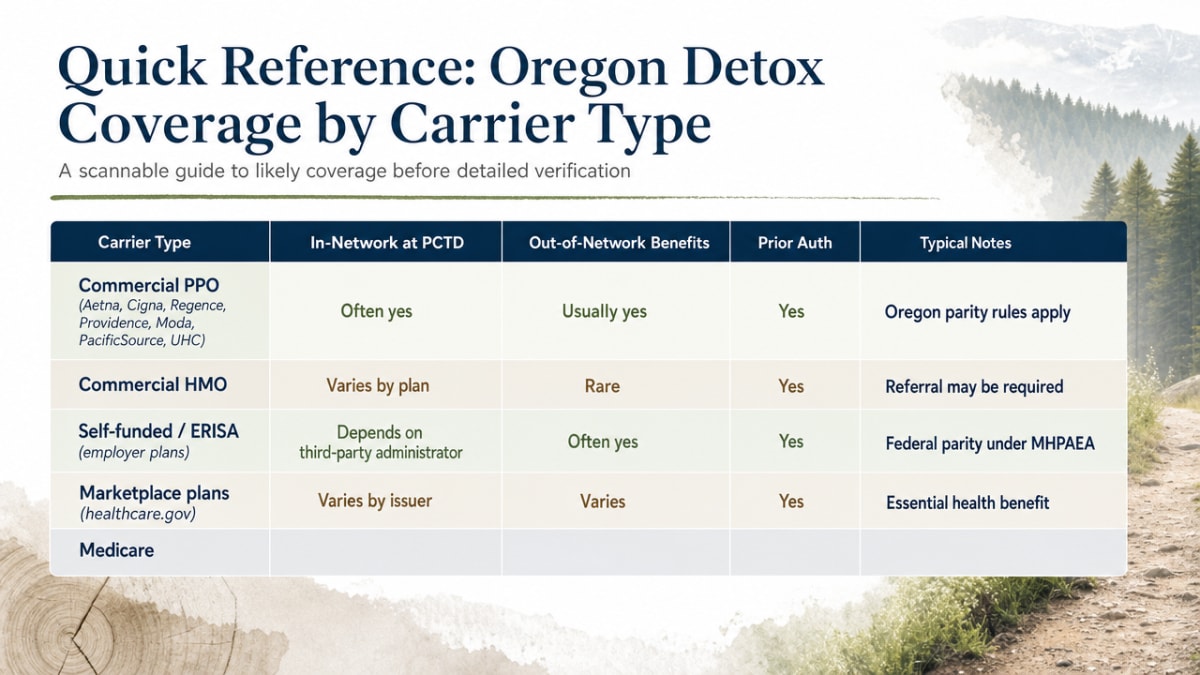
Quick Reference: Oregon Detox Coverage by Carrier Type
Not all insurance cards offer the same benefits. The type of plan often matters more than just the name on the card. This quick reference table can give you an initial idea of your likely coverage before we conduct a detailed verification.
| Carrier Type | In-Network at PCTD | Out-of-Network Benefits | Prior Auth Typical | Notes |
|---|---|---|---|---|
| Commercial PPO (Aetna, Cigna, Regence, Providence, Moda, PacificSource, UHC) | Often yes | Usually yes | Yes | Oregon parity rules apply; benefits comparable to medical care |
| Commercial HMO | Varies by plan | Rare | Yes | Referral may be required; verify network carefully |
| Self-funded / ERISA (employer plans) | Depends on third-party administrator | Often yes | Yes | Federal parity under MHPAEA governs most of these |
| Marketplace plans (healthcare.gov) | Varies by issuer | Varies | Yes | Substance-use treatment is an essential health benefit |
| Medicare (alone) | Limited | Limited | Varies | Residential detox coverage is narrow; ask about supplements |
| OHP / Medicaid | Not accepted at PCTD | N/A | N/A | See the next section for where to go |
| TriWest / VA Community Care | Yes for eligible veterans | N/A | Yes (VA referral) | Needs VA authorization through community-care pathway |
A few important notes on this table: “Often yes” does not mean “yes for your specific plan.” Even within the same carrier, such as two different Aetna plans from different employers, the network, deductible, and prior authorization rules can vary significantly. Oregon’s 2025 parity report highlighted that insurers often document compliance in their written policies but fall short in daily operations, particularly concerning prior authorization, concurrent review, and network admission. This is precisely the gap that our verification process aims to close for you.
If your plan type appears promising in this chart, it’s a good indicator, but not a definitive green light. Allow us to verify your actual benefits before you make any commitments.
Guidance for Oregon Health Plan (OHP) Members
If you have OHP coverage, we want to be upfront: Pacific Crest Trail Detox does not accept the Oregon Health Plan. This is a billing reality for our facility, not a judgment on your situation. The good news is that OHP does cover detox, medication-assisted treatment, counseling, and both outpatient and residential substance use care. You also do not need a primary care referral to seek help for alcohol or drug issues. The care you need is available, and we want to help you find it quickly.
Here’s where to turn if you have OHP:
- Contact your Coordinated Care Organization (CCO). OHP members receive care through a CCO assigned by county. Your CCO’s provider directory lists detox and residential programs within its network. You can find the number on the back of your Oregon Health ID card.
- Utilize the Oregon Health Authority addiction services page. The OHA directs individuals to a behavioral health provider directory to locate programs that accept their coverage, including OHP.
- Specifically ask about withdrawal management. OHP’s covered services include medically monitored withdrawal management, outpatient and residential treatment, and medication-assisted treatment. Be sure to specify the level of care you need when you call.
You’ve already taken a courageous step by seeking help. Even if the next number you dial isn’t ours, that effort still counts significantly.
Marketplace, Medicare, TriWest, and Self-Pay Options
Some plan types don’t fit neatly into our main carrier list, so here are concise answers for them:
Marketplace plans (healthcare.gov). If you purchased your plan through the federal Marketplace, substance use treatment is an essential health benefit, meaning your plan must cover it. However, this is subject to the deductible, coinsurance, prior authorization rules, and network of your specific plan. A “silver plan” from one issuer can behave very differently from a “silver plan” from another. Let us verify your plan before you make any assumptions.
Medicare on its own. Traditional Medicare’s coverage for non-hospital residential detox is limited. If Medicare is your sole coverage, please call us anyway. Many individuals have a secondary plan, a Medicare Advantage product, or a retiree plan from a former employer that could significantly alter your coverage. We can help you identify what to look for on your card.
TriWest and VA Community Care. If you are a veteran eligible for VA community care through TriWest, Pacific Crest Trail Detox works with this pathway. The key detail often missed is that VA community care requires a referral and authorization from the VA, not just a direct call to us. We will guide you through the process of requesting the correct referral from your VA care team.
Self-pay. If you are uninsured, between jobs, or if your plan simply won’t authorize the necessary care, please inquire about our self-pay options. We prefer to have an honest conversation about what’s financially possible rather than have you forgo essential treatment due to unexpected costs.
Verify Your Plan and What Happens Next
You’ve come a long way, especially on a difficult day. The next step is simple: let us review your insurance plan. A benefits check typically takes about three minutes once we have your card details, and it’s completely free, regardless of whether you choose to admit.
Here’s what you can expect after you reach out: We will directly contact your carrier to obtain your real benefits information—including your deductible, coinsurance, in-network status, out-of-network options, and the prior authorization process. We will provide you with honest figures, not a sales pitch. If your plan is a good fit, we’ll guide you through the admission process and what to pack. If it’s not, we’ll inform you and direct you to the best alternative, whether that’s a single-case agreement, a self-pay discussion, or, for OHP members, your CCO’s provider directory.
Pacific Crest Trail Detox offers a comfortable, home-like medical detox environment in Milwaukie, staffed by doctors and nurses, providing medication to ease withdrawal, and a recovery program for after you’re stable. Share your insurance information with us, and we’ll manage the carrier call so you can focus on your health.
Check If Your Insurance Covers Detox Care
Find out instantly if your insurance plan covers detox and treatment at this Oregon facility.

Frequently Asked Questions
Does Pacific Crest Trail Detox accept the Oregon Health Plan (OHP)?
No, we do not accept OHP. We want to be clear about this upfront so you don’t waste time. OHP does cover detox, medication-assisted treatment, counseling, and outpatient and residential care, and you don’t need a referral to seek help. To find a program in your network, call your Coordinated Care Organization using the number on the back of your Oregon Health ID card.
My insurance card says Aetna (or Cigna, Regence, Providence, Moda, PacificSource, UnitedHealthcare). Am I covered?
Coverage for detox is likely, but we still need to verify your specific plan. Oregon’s 2025 parity report indicated that while insurers may appear compliant on paper, they often fall short in operational areas like prior authorization and network admission. Two Aetna plans from different employers, for example, can have vastly different benefits. Share your card with us, and we’ll determine your actual deductible, coinsurance, and authorization path before you commit.
What information do I need to have ready when I call to verify my insurance?
Please have your insurance card (both sides), the policyholder’s full name and date of birth, the substance used and approximate time of last use, any prior detox or rehab in the last year or two, a preferred admission date, and a callback number. That’s all we need. Oregon parity rules ensure your right to clear answers about treatment limits, authorization, and written explanations for any denials, and we will advocate for these rights on your behalf.
What is the difference between in-network and out-of-network, and will it change what I pay?
In-network means your plan and our facility have a pre-arranged agreement on pricing, typically resulting in your lowest out-of-pocket costs. Out-of-network means your plan will still pay, but often at a lower rate, leading to higher costs for you. Many PPO plans offer out-of-network behavioral health benefits, supported by Oregon parity rules for comparable medical care. We verify both options to give you clear financial figures before admission.
Will my plan cover medicine to help with alcohol or opioid withdrawal?
Often, yes, but it’s crucial to ask about specific medications by name, not just “MAT.” For opioids, inquire about buprenorphine (Suboxone), naltrexone (oral or Vivitrol), and methadone. For alcohol, ask about naltrexone and acamprosate. The GAO found that prior authorization and other rules can subtly restrict access to opioid use disorder medications even when technically covered. We ask these detailed questions during verification to ensure you receive the necessary medication without delay.
What if I’m uninsured, on Medicare, or have TriWest/VA coverage?
Please call us regardless of your insurance status. If you’re uninsured, we can discuss self-pay options to help you plan costs transparently. Traditional Medicare alone has limited coverage for non-hospital residential detox, but a secondary plan, Medicare Advantage, or a retiree plan can change your coverage significantly. If you’re a veteran with TriWest community care eligibility, we work with this pathway, though it requires a VA referral and authorization. We’ll guide you on how to request this from your VA care team.
References
- Oregon Health Plan (OHP) Behavioral Health Coverage. https://www.oregon.gov/oha/hsd/ohp/pages/behavioral-health.aspx
- Oregon Health Plan (OHP) Benefits. https://www.oregon.gov/oha/hsd/ohp/pages/benefits.aspx
- Division of Financial Regulation : Mental health … – Oregon. https://dfr.oregon.gov/insure/health/understand/coverage/Pages/mental-health-parity.aspx
- Report on Behavioral Health Parity. https://dfr.oregon.gov/business/reg/health/Documents/mental-health-parity/20250915-behavioral-health-parity-report.pdf
- Coordinated Care Organizations (CCOs) : Medicaid. https://www.oregon.gov/oha/ohp/pages/ccos.aspx
- Oregon Health Authority : Addiction Services. https://www.oregon.gov/oha/hsd/amh/pages/addictions.aspx
- Residential Treatment Facilities : Licensing and Certification. https://www.oregon.gov/oha/hsd/amh-lc/pages/rt.aspx
- Oregon Health Authority : Licensing and Certification : Providers. https://www.oregon.gov/oha/BH/Providers/Pages/Licensing-Certification.aspx
- Reference Manual: Behavioral Health + Addiction. https://www.oregon.gov/oha/HSD/COMPASS/resources/ROADS%20BH%20+%20Addiction%20Reference%20Manual_v1.1.pdf
- Substance Use Disorder Integration Report. https://www.oregon.gov/oha/HSD/AMH/DataReports/SUD-Integration-Report.pdf
- OREGON LAWS 2019 Chap. 284 CHAPTER 284 AN ACT. https://www.oregonlegislature.gov/bills_laws/lawsstatutes/2019orlaw0284.pdf
- The Mental Health Parity and Addiction Equity Act (MHPAEA). https://www.cms.gov/marketplace/private-health-insurance/mental-health-parity-addiction-equity
- Mental health & substance abuse coverage. https://go.cms.gov/3w1pX9b
- GAO-25-107640, Health Care Capsule: Drug Misuse Treatment. https://www.gao.gov/assets/gao-25-107640.pdf
- Mental Health Care: Access Challenges for Covered Consumers and Relevant Federal Efforts. https://www.gao.gov/products/gao-22-104597
- Opioid Use Disorder: Barriers to Medicaid Beneficiaries’ Access to Treatment Medications. https://www.gao.gov/products/gao-20-233
- Provisional Drug Overdose Death Counts. https://www.cdc.gov/nchs/nvss/vsrr/drug-overdose-data.htm
- 2024 Treatment Episode Data Set (TEDS) Detailed Tables – SAMHSA. https://www.samhsa.gov/data/report/2024-treatment-episode-data-set-teds-detailed-tables