Key Takeaways
- The real choice isn’t inpatient versus outpatient, it’s matching the least intensive setting to your withdrawal risk, physical health, and what’s actually waiting for you at home.15
- Non-hospital residential medical detox, licensed in Oregon at ASAM 3.2-WM or 3.7-WM, is often the middle option people are actually searching for, with nurses on site and a home-like setting.12, 14
- Step two decides whether step one holds, so ask any program what day 11 looks like, including PHP, IOP, outpatient, medication, and peer support, before saying yes.19
The real question behind “detox alternatives”
If you’re searching for detox alternatives, you’re probably not asking whether you need help. You’re asking whether there’s a version of help that fits your life. Something that isn’t a hospital. Something that doesn’t cost you your job, your kids’ routine, or the last shred of privacy you’ve been holding onto.
Here’s the honest reframe: the real question isn’t inpatient versus outpatient. It’s which level of care actually matches your withdrawal risk, your physical health, and what’s waiting for you at home. In Oregon, policy requires that level-of-care decisions use the current ASAM criteria and that withdrawal management happen in the most medically appropriate setting.15
Some alternatives are safe and smart. Some can hurt you, especially with alcohol, benzodiazepines, or opioids. And nearly all of them work better when step two, continuing care, is planned before step one begins.19 This guide walks you through the full spectrum so you can pick the least intensive setting that’s still safe for you.
Why people quietly shop for a different kind of detox
Most people don’t search “detox alternatives” because they’re curious. They search it because something in their life makes a hospital stay feel impossible. A job that won’t hold your spot. A toddler who won’t understand where you went. A partner who still doesn’t know how bad it got. A bank balance that already keeps you up at night.
Shame is in there too. Walking into an ER and saying out loud what you’ve been drinking or using can feel worse than the withdrawal itself. If you’ve been to detox before and it didn’t hold, you’re also carrying that memory, and you’re not eager to repeat the exact same experience and hope for a different ending.
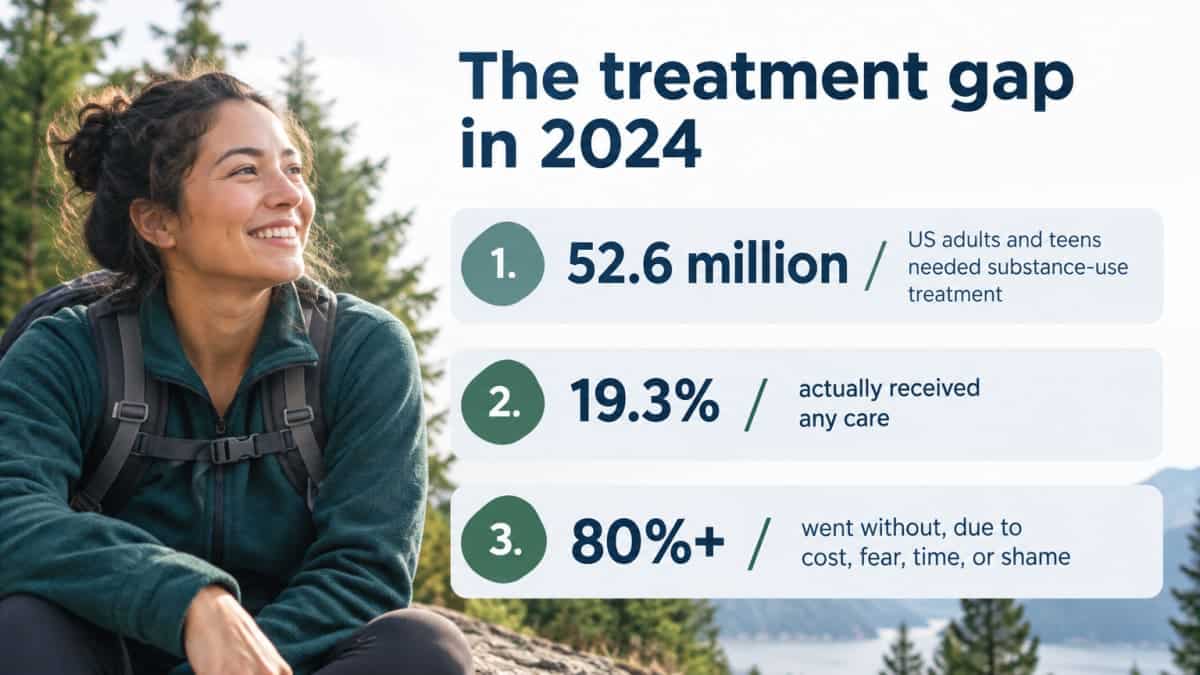
You are not alone in waiting. In 2024, SAMHSA’s National Survey on Drug Use and Health estimated that 52.6 million people aged 12 or older in the United States needed substance-use treatment, and only 19.3% of them received any.16 That gap isn’t about willpower. It’s about access, cost, timing, fear, and the honest sense that the only option on the menu doesn’t fit the life you’re actually living.
So the search for a different kind of detox is reasonable. The goal of this guide is to help you tell the difference between an alternative that is safer, more private, or more livable, and one that just looks easier on the surface and quietly raises your risk.
How clinicians actually choose a level of care (ASAM, in plain English)
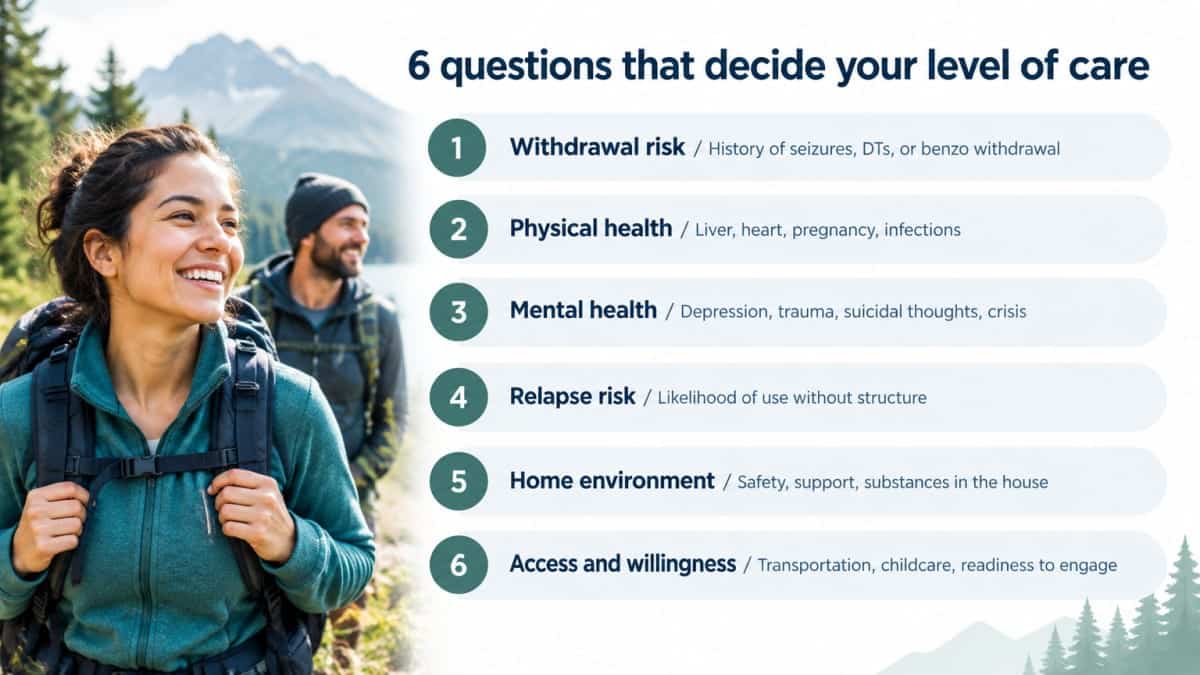
When a clinician decides where you should detox, they’re not reading your preferences. They’re walking through a checklist used across Oregon and most of the country: the American Society of Addiction Medicine’s patient placement criteria. Oregon policy specifically requires that level-of-care decisions use the current ASAM criteria and that withdrawal management happen in the most medically appropriate setting.15
Here’s what that checklist actually asks about you, in plain language:
- 1. Withdrawal risk. How much are you using, for how long, and what happened last time you stopped? Any history of seizures, DTs, or complicated benzo withdrawal moves you up a level fast.
- 2. Physical health. Liver, heart, blood pressure, pregnancy, diabetes, recent injuries, infections. The sicker your body, the more medical monitoring you need while your system resets.
- 3. Emotional, behavioral, and cognitive health. Depression, anxiety, trauma responses, suicidal thoughts, confusion. Not every program can hold someone who is actively in crisis.
- 4. Substance-use related risks. How likely is it that you’ll use again in the next few days without structure? Honest answers matter more than brave ones.
- 5. Recovery environment. Who’s at home. What’s in the cabinet. Whether your roommate is in active use. Whether you have childcare, transportation, a quiet room, food.
- 6. Barriers, preferences, and willingness to engage. Transportation, housing, family support, finances, language, culture, and whether you can and will participate in the recommended setting this week. Ambivalence is normal; a totally shut door is a different situation.
You don’t score yourself. A licensed clinician does, through a clinical assessment that covers all six ASAM dimensions. The output isn’t a verdict; it’s a recommendation for the least intensive setting that can still keep you safe, with shared decision-making built in.15 That’s the whole point. Not the fanciest program, not the cheapest, not the one closest to your house. The one that matches what your body and your life actually need right now.
The spectrum of care people call “detox alternatives”
Outpatient counseling and medication-only pathways
For some people, the “alternative” they’re really looking for is one that doesn’t involve a bed at all. You keep sleeping at home, you keep going to work, and you meet with a prescriber and a counselor on a schedule that fits around your life.
This path makes the most sense when active withdrawal is mild or already behind you. For alcohol use disorder, three FDA-approved medications, naltrexone, acamprosate, and disulfiram, can be prescribed by a clinician and paired with therapy or mutual-support groups.2, 3 For opioid use disorder, the FDA has approved buprenorphine, methadone, and naltrexone, often alongside counseling and recovery services.4, 5
What this isn’t: a safe plan for someone who still drinks a liter of vodka a day or uses fentanyl around the clock. Medication management picks up where acute withdrawal risk leaves off. It’s a real option, and often an underused one, for people whose use has slowed, whose health is stable, and whose home can hold them while they start treatment.
Ambulatory (outpatient) withdrawal management
Ambulatory withdrawal management is detox you drive to. You show up at a clinic in the morning for vitals, medication, and a check-in with a nurse or provider, then go home for the day. In Oregon, this is a recognized setting for withdrawal management when the clinical picture supports it.13
It can work for mild to moderate withdrawal when a few things are true at once: no history of seizures or DTs, no serious medical complications, a sober adult at home who can call for help, and reliable transportation back to the clinic the next morning. If any of those pieces are missing, this isn’t the right level.
Ambulatory detox is cheaper and less disruptive than a bed stay. It’s also less forgiving. Nobody is watching you at 3 a.m. If you’re even unsure whether your withdrawal will stay mild, that uncertainty itself is a reason to be assessed for a higher level of care.
Intensive outpatient (IOP) and partial hospitalization (PHP)
IOP and PHP are structured treatment programs, not detox. They’re worth understanding because many people use them as the step after withdrawal management, and some people with low acute risk use IOP as their primary level of care.
IOP and PHP typically include multiple hours of structured programming per week, with IOP often meeting on evenings and PHP running closer to a full workday schedule, while you go home at night. SAMHSA describes IOP as a modality that can serve as primary treatment, as a step-down after inpatient or withdrawal management, or as a step-up from standard outpatient care.9, 10 A 2014 review of twelve studies found strong, consistent evidence that IOP reduced alcohol and drug use, with outcomes comparable to inpatient or residential care for appropriately selected patients.11
Read that carefully. “Appropriately selected” is the whole sentence. If you need medically monitored withdrawal, IOP is not a substitute. If you’re past acute withdrawal and need structure, accountability, and skills, it can be exactly right.
Non-hospital residential medical detox: the alternative to a hospital stay
This is the option most people picture when they imagine “detox,” and the one most often confused with a hospital. It’s also, for many people, the actual alternative they were looking for.
Non-hospital residential medical detox means you sleep at the facility for roughly 8 to 10 days. Nurses are on site around the clock. A provider sees you regularly. You get medication to ease symptoms, home-cooked meals, a bed in a room that looks more like a house than a ward, and groups during the day. There’s no fluorescent-lit hallway, no beeping monitors, no shared curtain.
In Oregon, this level sits at ASAM 3.2-WM (clinically managed residential withdrawal management) or ASAM 3.7-WM (medically monitored inpatient withdrawal management), depending on how much medical oversight your situation calls for.12 Both are licensed by the Oregon Health Authority and must meet applicable standards.13 State rules also set minimum staffing: at least one registered or licensed nurse for every five admitted individuals, and one withdrawal-management staff member for every ten.14
For most people with alcohol, opioid, or benzodiazepine withdrawal who don’t have unstable medical conditions, this is the setting that balances safety and dignity. You get the medical piece. You don’t get the hospital.
Hospital-based detox and when it’s the right call
Sometimes a hospital really is the right answer. If you have unstable heart, lung, or liver disease, uncontrolled seizures, severe DTs, a serious infection, pregnancy complications, or an active psychiatric emergency, you need the kind of monitoring and rapid escalation only a hospital can provide. Oregon policy is explicit that withdrawal management should happen in the most medically appropriate setting, which sometimes means acute care.15
What a hospital isn’t built for is the week after the medical crisis passes. If a hospital is where you start, the plan still has to answer the next question: where do you go on day three to continue care? For many people, that answer is a non-hospital medical detox, then IOP or PHP, then outpatient.
Alternatives that aren’t really alternatives: cold turkey, rapid detox, and the ER
Some of what shows up in a search for detox alternatives isn’t really an alternative. It’s a shortcut that looks appealing at 2 a.m. and gets more dangerous the closer you look.
Cold turkey at home. For alcohol, stopping suddenly after chronic heavy drinking can trigger seizures and delirium tremens, and NIAAA states that alcohol withdrawal can be life-threatening.1 For opioids, cold turkey is rarely fatal in the moment, but tolerance drops fast, and the dose you used last week can kill you this week.7, 8
Rapid or ultra-rapid detox. The idea of being sedated and waking up past withdrawal is marketed heavily. It doesn’t change the fact that tolerance drops after opioid withdrawal, which leaves the same elevated overdose risk CDC warns about any time a person returns to opioid use after a period of reduced exposure.7
ER-only detox. Emergency rooms stabilize people in crisis. CDC guidance and NIDA both make the broader point that detoxification alone, without connection to medication and continuing care, isn’t sufficient to prevent the next crisis.6, 19 If the ER is where you start, use that visit to get a referral, not to call it done.
Substance by substance: when medical supervision is non-negotiable
Alcohol withdrawal: why unsupervised detox is a life-safety issue
Alcohol is the substance that most often gets underestimated. If you’ve been drinking heavily for months or years and you stop suddenly, your nervous system can go into overdrive. Tremors and sweats are the mild end. Seizures and delirium tremens are the end that kills people, and NIAAA is explicit that alcohol withdrawal can be life-threatening after sudden cessation of chronic heavy drinking.1
You can’t predict your own risk from the number of drinks alone. Prior withdrawal episodes, seizure history, age, liver function, and other health conditions all matter, which is why an assessment, not a guess, decides the setting. Medications like naltrexone, acamprosate, and disulfiram are tools for staying sober after withdrawal, not for getting you through it.2
Benzodiazepines: slow, medical, and never on your own
Benzodiazepines, drugs like Xanax, Klonopin, Ativan, and Valium, are among the substances for which coming off on your own can be unsafe. Decisions about how and where to stop belong with a prescriber and a clinical team, not with you alone at home.
If a program suggests coming off benzos quickly or without a prescriber actively managing your dose, that’s a reason to look elsewhere. The slower, more boring plan is the safer one.
Opioids: tolerance, overdose risk, and the case for medication
Opioid withdrawal is miserable, but the real danger usually comes after. When you stop using, your tolerance drops within days. The dose you handled last month can stop your breathing this week. CDC guidance names this directly: people who return to opioid use after a period of abstinence, including after a detox stay or time in a controlled setting, are at elevated risk of overdose and overdose death.7, 8
That’s why CDC says detoxification alone, without medication for opioid use disorder, is not recommended.6 The FDA has approved three medications for OUD, buprenorphine, methadone, and naltrexone, and SAMHSA’s TIP 63 lays out how they’re used alongside counseling and recovery services.4, 5 You don’t have to stay on medication forever to benefit from it. You do need a real plan for the first weeks after withdrawal, when risk is highest, and naloxone within reach.19
Stimulants, cannabis, and other substances
For stimulants, cannabis, and other substances, the honest question isn’t “will withdrawal kill me?” It’s “what setting gives me a shot at actually finishing and starting treatment?” An assessment that considers your withdrawal risk, physical health, emotional health, recovery environment, and willingness to engage answers that cleanly, and it’s the same ASAM-based process Oregon policy requires for level-of-care decisions.15
Step two matters more than step one: planning continuing care
Here’s the part most people miss when they’re shopping detox alternatives: the setting you detox in matters less than what happens the week after. Detoxification is not treatment. NIDA is direct about this: withdrawal management by itself is not sufficient for recovery, and the gains from any detox fade quickly without medication, counseling, or structured support behind it.19
That’s why the smartest question to ask any program isn’t “what’s your detox like?” It’s “what does day 11 look like?” A good answer sounds specific. You’ll step down into PHP for a few weeks, then IOP in the evenings so you can work, then standard outpatient and an alumni group. If you have alcohol use disorder, you may leave with a prescription for naltrexone, acamprosate, or disulfiram alongside counseling.2 If you have opioid use disorder, you’ll likely leave on buprenorphine, methadone, or naltrexone with naloxone in your pocket, because tolerance drops fast after withdrawal and the first weeks carry real overdose risk.6, 7 In Oregon, 36 Behavioral Health Resource Networks also offer low-barrier screening and assessment, SUD treatment, peer support, harm reduction, and housing services at no cost to eligible Oregonians.18 Plan step two before step one.
What to ask any program before you say yes (Oregon and Washington edition)
Before you give a program a credit card or sign an intake form, call and ask real questions. The answers tell you more than any website will.
What ASAM level are you licensed for? In Oregon, non-hospital residential withdrawal management is licensed at 3.2-WM or 3.7-WM, and the state requires non-hospital programs delivering ASAM 3-WM through 3.7-WM to be properly licensed.12, 13 If the person on the phone can’t name the level, that’s a flag.
Who’s awake at 3 a.m.? Oregon rules set a baseline of one registered or licensed nurse for every five admitted individuals and one withdrawal-management staff member for every ten.14 Ask about overnight coverage specifically, not daytime staffing.
How do you decide my level of care? You want to hear ASAM criteria and a real clinical assessment, not a sales script.15
What happens if I get sicker? Non-hospital settings should have a clear escalation plan to acute care.
A warm, direct next step
If you’ve read this far, you already know more than most people do when they pick up the phone. You know the real question is which level of care matches your body and your home, not whether a hospital is the only option. You know a non-hospital medical detox, with nurses on site around the clock, home-cooked meals, and a bed in a room that feels more like a house than a ward, is often the alternative people are actually looking for. And you know step two, PHP, IOP, outpatient, medication, peer support, matters as much as step one.
Pacific Crest Trail Detox in Milwaukie serves Portland, Gresham, Beaverton, Salem, Vancouver, Washington, and people flying in from out of state. One call starts a confidential, HIPAA-protected assessment. We want to be your last treatment experience, whether we’re your first detox or your fifth.
Check Coverage for Your Detox Options
Find out what your plan may cover for medically supervised detox and continued care.
Frequently Asked Questions
Is there a safe way to detox from alcohol at home?
If you’ve been drinking heavily for weeks, months, or years, no. Alcohol withdrawal can be life-threatening after sudden cessation of chronic heavy drinking, with risks including seizures and delirium tremens.1 You can’t predict your own risk from drink count alone. The safer path is a clinical assessment that recommends the right setting, which may be ambulatory, residential, or inpatient depending on your history and health.
What’s the difference between hospital detox and non-hospital medical detox?
Hospital detox happens in an acute-care setting built for medical emergencies. Non-hospital medical detox is a licensed residential program where you sleep in a home-like room, nurses are on site around the clock, and a provider manages symptoms with medication. In Oregon, non-hospital withdrawal management is licensed at ASAM 3.2-WM or 3.7-WM.12 Hospitals handle unstable medical crises; non-hospital detox handles withdrawal safely for most people.
Can I just do outpatient or IOP instead of residential detox?
Sometimes, yes. SAMHSA describes IOP as a legitimate level of care for people with low acute withdrawal, medical, and psychological risk, and a 2014 review found outcomes comparable to residential care for appropriately selected patients.9, 11 If you’re in heavy alcohol, benzo, or high-dose opioid withdrawal, IOP is not a safe substitute for medically monitored detox. An assessment, not a preference, decides.
How long does medical detox usually take at Pacific Crest Trail Detox?
Detox at Pacific Crest Trail Detox in Milwaukie typically runs 8 to 10 days, though your exact length depends on the substance, your history, and how your body responds. Nurses are on site 24/7, providers round seven days a week, and the days include home-cooked meals and groups so step two, PHP or IOP, has a running start.
Do I have to take medication like buprenorphine or methadone after opioid detox?
You don’t have to, but CDC guidance is clear that detoxification alone, without medication for opioid use disorder, is not recommended because of resumed-use and overdose risk.6 The FDA has approved buprenorphine, methadone, and naltrexone for OUD.4 Tolerance drops within days of stopping, so the dose you used last month can be fatal this week.7 Medication is a choice worth taking seriously.
What happens after detox ends?
Detox is step one, not treatment. NIDA states that withdrawal management by itself isn’t sufficient for recovery.19 A good discharge plan names what’s next: partial hospitalization, intensive outpatient, standard outpatient, medication for alcohol or opioid use disorder, peer support, and sometimes housing help through Oregon’s Behavioral Health Resource Networks.18 Ask about day 11 before day one. The step after detox is what makes detox hold.
References
- Alcohol Use Disorder: From Risk to Diagnosis to Recovery. https://www.niaaa.nih.gov/health-professionals-communities/core-resource-on-alcohol/alcohol-use-disorder-risk-diagnosis-recovery
- Treatment for Alcohol Problems: Finding and Getting Help. https://www.niaaa.nih.gov/publications/brochures-and-fact-sheets/treatment-alcohol-problems-finding-and-getting-help
- Understanding Alcohol Use Disorder. https://www.niaaa.nih.gov/publications/brochures-and-fact-sheets/understanding-alcohol-use-disorder
- Information about Medications for Opioid Use Disorder (MOUD). https://www.fda.gov/drugs/food-and-drug-administration-overdose-prevention-framework/information-about-medications-opioid-use-disorder-moud
- TIP 63: Medications for Opioid Use Disorder – Full Document. https://www.samhsa.gov/resource/ebp/tip-63-medications-opioid-use-disorder
- Opioid Use Disorder: Treating. https://www.cdc.gov/overdose-prevention/hcp/clinical-care/opioid-use-disorder-treating.html
- Assess Risks and Potential Harms of Opioid Use. https://www.cdc.gov/overdose-prevention/hcp/clinical-care/assess-risks-of-opioid-use.html
- Decisions in Recovery: Treatment for Opioid Use Disorder. https://www.cdc.gov/overdose-prevention/media/pdfs/Decisions-in-Recovery.pdf
- Clinical Issues in Intensive Outpatient Treatment for Substance Use Disorders. https://library.samhsa.gov/sites/default/files/pep20-02-01-021.pdf
- TIP 47 – Clinical Issues in Intensive Outpatient Treatment. https://www.samhsa.gov/resource/ebp/tip-47-substance-abuse-clinical-issues-intensive-outpatient-treatment
- Editor’s Note On TIP 47, Substance Abuse: Clinical Issues in Intensive Outpatient Treatment. https://library.samhsa.gov/sites/default/files/sma13-4182_tip_47_editors_note_update_12-2017.pdf
- Oregon Health Authority : Licensing and Certification : Providers. https://www.oregon.gov/oha/BH/Providers/Pages/Licensing-Certification.aspx
- BH P&P Self Evaluation Checklist 2026. https://www.oregon.gov/oha/HSD/OHP/CCO/BH%20P%26P%20Self%20Evaluation%20Checklist%202026.xlsx
- Health Systems Division: Behavioral Health Services. https://www.oregon.gov/oha/HSD/RAC/309-018.pdf
- Behavioral Health Policy Evaluation. https://www.oregon.gov/oha/HSD/OHP/CCO/BH-Policy-Procedure-Evaluation-Criteria.pdf
- Results from the 2024 National Survey on Drug Use and Health. https://www.samhsa.gov/data/sites/default/files/reports/rpt56287/2024-nsduh-annual-national/2024-nsduh-annual-national-html-071425-edited/2024-nsduh-annual-national.htm
- Highlights for the 2024 National Survey on Drug Use and Health. https://www.samhsa.gov/data/sites/default/files/NSDUH%202024%20Annual%20Release/2024-nsduh-nnr-highlights.pdf
- 2025 Opioids and the Ongoing Drug Overdose Crisis in Oregon: Report to the Legislature. https://www.oregon.gov/oha/PH/PREVENTIONWELLNESS/SUBSTANCEUSE/OPIOIDS/SiteAssets/Pages/publications/2025%20Oregon%20Opioid%20Overdose%20Report.pdf
- Treatment and Recovery. https://nida.nih.gov/publications/science-addiction/treatment-recovery