

Key Takeaways
- Alcohol withdrawal headaches happen because the brain, used to alcohol’s calming effect, swings into a hyperexcited state when drinking stops, with glutamate surging while GABA lags behind.9, 10
- The headache usually starts within 6 to 24 hours of the last drink and peaks alongside tremor, sweating, anxiety, and nausea during the first 24 to 48 hours.5, 12
- Up to half of people with alcohol use disorder develop withdrawal symptoms when they cut back, and the 48 to 96 hour window after the last drink is when delirium tremens is most likely to develop.6, 7
- At-home remedies rarely cover heavy or long-term drinking; medically supervised detox treats the whole overactive nervous system with CIWA-Ar scoring, benzodiazepines, fluids, and thiamine.11, 17, 18
The Short Answer: Your Brain Is Overcorrecting
Yes, alcohol withdrawal can absolutely cause headaches, and if your head is pounding right now, you’re not imagining it. When you drink heavily over time, your brain quiets its own excitatory signals and leans on alcohol’s calming effect. Pull the alcohol away, and the “gas pedal” chemicals (glutamate) surge while the “brake” chemicals (GABA) lag behind, leaving your nervous system in a hyperexcited state that often shows up as a headache within hours of your last drink.2, 9, 10
Headache is a recognized early symptom of alcohol withdrawal, usually traveling with tremor, sweating, anxiety, nausea, and trouble sleeping.11, 12 For most people who’ve only had a short period of heavy drinking, it’s uncomfortable but manageable. For anyone who’s been drinking heavily for a long time, has withdrawn before, or is already feeling shaky and sick, that same headache can be the first signal of something that needs medical eyes on it, not a tough-it-out moment at home.1, 6
Why Your Head Hurts When You Stop Drinking
GABA, Glutamate, and the Rebound Effect
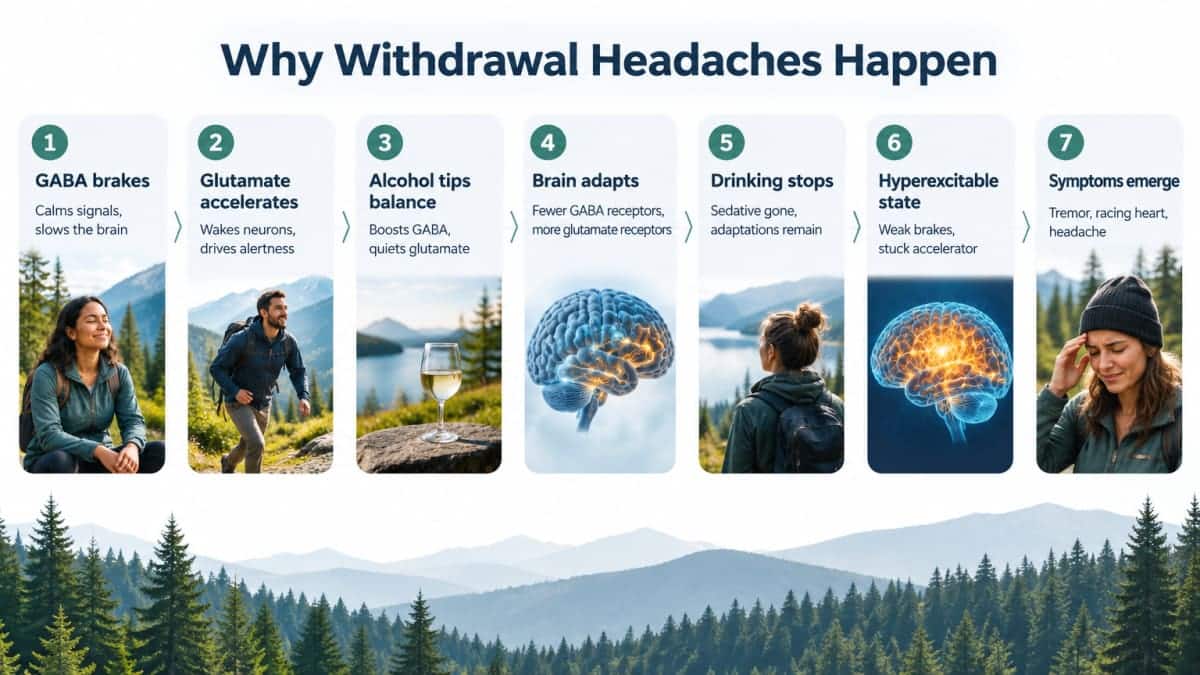
Think of your brain running on two main systems that keep each other in check.
- GABA
- The brake. It calms things down, slows signals, helps you relax and sleep.
- Glutamate
- The gas. It wakes neurons up, pushes signals forward, keeps you alert.
In a brain that isn’t drinking, those two stay roughly balanced.
Alcohol tilts that balance hard toward the brake. It boosts GABA’s calming effect and quiets glutamate’s wake-up signal. That’s part of why a few drinks feel loosening at first. When you drink heavily for weeks, months, or years, your brain notices the imbalance and adjusts. It dials down its own GABA receptors because alcohol is doing that job, and it dials up its glutamate (NMDA) receptors to compensate for being suppressed.9 Your brain is trying to feel normal while swimming in a sedative.
Then you stop drinking. The sedative is gone, but the adjustments stay. For hours and sometimes days, you’re left with weakened brakes and a stuck gas pedal. Researchers describe this as a “Glutamate > GABA state” of hyperexcitability, with your nervous system running hot and your stress chemistry revved up alongside it.10 That same nervous-system overactivity and autonomic arousal is what drives the tremor, racing heart, and headache people feel in early withdrawal.
What Researchers Are Still Learning
The GABA-glutamate story explains a lot, but it doesn’t explain everything about why withdrawal headaches hit the way they do. Pain in the head involves blood vessels, inflammation, and the trigeminal nerve, which carries sensation from your face and scalp. Scientists are still working out exactly how those pieces connect to alcohol withdrawal.
One 2023 study offered a new lead. Working with male mice, researchers found that alcohol withdrawal activated mast cells in the dura (the lining around the brain) and sensitized trigeminal neurons through a receptor called MrgprB2. Mice without that receptor didn’t show the same withdrawal-related headache behaviors.14 The authors suggested it could be a future treatment target.
Important caveat: that’s preclinical work in male mice, not a proven human pathway. It doesn’t change what you should do tonight if your head is pounding. It does suggest withdrawal headaches aren’t just “all in your head” in the dismissive sense. There’s real biology happening, and understanding it is still a work in progress.
When the Headache Shows Up and How Long It Lasts
Most withdrawal headaches don’t wait long. Symptoms typically start within 6 to 24 hours after your last drink, which means if you had your final beer at 10 p.m., your head might start aching by breakfast and definitely by dinner the next day.5 For some people, symptoms can begin as early as about eight hours in.3, 4 The headache usually arrives in that first wave along with tremor, sweating, anxiety, nausea, and trouble sleeping, so it rarely feels like just a headache.11, 12
From there, things tend to intensify before they ease. The headache and the rest of the early symptoms generally climb for the first 24 to 48 hours, then start to settle.12 The broader withdrawal picture peaks at around 36 to 72 hours, which is when you’re most likely to feel wrecked across the board, and the whole episode usually runs about 2 to 10 days for uncomplicated cases.5
Here’s the part that matters: the window when the headache is at its worst, roughly day two to day three, overlaps with the window when the most serious complications are most likely to show up. Delirium tremens, the most dangerous form of alcohol withdrawal, typically develops 48 to 96 hours after your last drink, and its hallmarks are confusion, hallucinations, and autonomic hyperactivity rather than headache alone.7 If confusion, a racing heart, or hallucinations show up alongside your headache in that window, that’s a reason to get medical eyes on you fast.
Timing varies. If you’ve been drinking heavily for years, if you’ve gone through withdrawal before, or if you have other health conditions, your clock can run faster and harder than these ranges suggest.3 The averages are useful for orientation, not for predicting exactly what your body will do.
Is This a Withdrawal Headache or Something Else?
Signals That Point to Withdrawal
A withdrawal headache rarely travels alone. If your head started hurting within 6 to 24 hours of your last drink and you’re also noticing shaky hands, a damp shirt from sweating, a racing pulse, queasiness, or a nervous edge you can’t shake, those are the fingerprints of early alcohol withdrawal.5, 11 Clinicians use a tool called the CIWA-Ar to score exactly this cluster, and headache sits on that list right next to tremor, sweating, anxiety, nausea, agitation, and sensitivity to light and sound.11, 12
A few other patterns point toward withdrawal rather than a one-off headache:
- The pain often shows up with trouble sleeping even though you’re exhausted.
- Noise feels sharper.
- Light feels too bright.
- Your heart may feel like it’s working harder than the moment calls for.12
History matters, too. If you’ve been drinking heavily for weeks or longer, if you’ve felt this exact combination before when you tried to cut back, or if a drink in the morning used to “fix” the shakes, you’re looking at a withdrawal pattern, not a random bad headache. That’s the moment to stop troubleshooting on your own and talk to a clinician.1, 6
Other Likely Culprits After Quitting
Not every headache after your last drink is withdrawal. Several ordinary things pile up when you stop drinking, and any of them can hurt your head on their own.
Dehydration is the usual suspect. Alcohol pulls fluid out of you, and if you’ve been drinking heavily and eating poorly, you may be running low on water and electrolytes before withdrawal even starts. Vomiting makes that worse fast.4 Poor sleep is another one. A night of thin, broken rest leaves most people with a dull, pressing headache the next day, and withdrawal wrecks sleep hard.
A classic hangover can also masquerade as early withdrawal, especially in the first 12 hours. The timelines overlap. The difference tends to show up on day two: a hangover fades, while withdrawal keeps climbing and brings tremor, sweating, and anxiety along with it.5
If you have a history of migraines, stopping alcohol can trigger one. Caffeine changes and skipped meals can also set off headaches that have nothing to do with alcohol.
How Common Is This, Really?
If you’re wondering whether you’re the only one Googling this at 2 a.m., you’re not. Up to about half of people with alcohol use disorder develop some withdrawal symptoms when they stop or cut back on drinking, according to NIAAA.6 A separate clinical review puts the figure at roughly one in two for people who abruptly reduce or stop after regular heavy use.13 Headache sits inside that larger picture as one of the most common early complaints.
What that number actually means: it doesn’t predict severity. Some people get a mild headache, a rough night of sleep, and feel mostly human by day three. Others develop tremor, dangerous blood pressure spikes, seizures, or delirium tremens. The 50% figure is a reminder that withdrawal is ordinary, not rare, and that quietly riding it out alone is the exception more than the rule.6
One hospital study of patients under 21 using the CIWA-Ar assessment found headache in 23.6% of that specific cohort.15 That’s a narrow slice, not a general adult rate, so don’t anchor to it. The broader point holds: headache is one of several symptoms clinicians actively look for because it tends to travel with the others that matter more.11
If you’ve been drinking heavily and your head hurts, you’re squarely inside a well-documented pattern. That’s not a verdict on your character. It’s a signal worth taking seriously.
Red Flags: When a Headache Means Call for Help
A withdrawal headache on its own, with mild shakiness and a rough night of sleep, is usually something a clinician can help you manage. The problem is that the same early hours can tip into something far more serious, and the warning signs are specific. If you’re reading this for yourself or someone you love, these are the symptoms that mean stop troubleshooting and get help now.
Call 911 or go to the nearest emergency room if a headache after quitting drinking shows up with any of the following:
- A seizure, even a brief one, or any sudden loss of consciousness.4, 13
- Confusion, severe disorientation, or not knowing where you are, especially 48 to 96 hours after your last drink, which is the typical window for delirium tremens.7
- Hallucinations (seeing, hearing, or feeling things that aren’t there).4, 13
- A racing or irregular heartbeat, chest pain, or blood pressure that feels like it’s spiking (pounding ears, flushed face, intense pressure).4, 7
- Fever, drenching sweats, or persistent vomiting that keeps you from holding down fluids.4
- A headache that is suddenly the worst of your life, feels different from any you’ve had before, or comes with vision changes, slurred speech, or weakness on one side.
Two more situations also warrant a call to a clinician or a detox facility, even if things don’t feel like a 911 emergency yet:
- If you’ve had a withdrawal seizure or delirium tremens before, your next withdrawal carries a higher risk and should be medically supervised from the start.8
- If you’ve been drinking heavily for a long time, if you take benzodiazepines (Xanax, Ativan, Klonopin) alongside alcohol, or if you have serious heart, liver, or other medical conditions, you fall into the group clinical guidelines specifically flag for inpatient monitoring rather than at-home attempts.8
What Actually Helps a Withdrawal Headache
Why At-Home Fixes Fall Short After Heavy Drinking
If you’ve been drinking lightly for a short stretch and your head is pounding the morning after you stopped, water, a quiet dark room, rest, and a basic over-the-counter pain reliever may be enough to get you through it. Nobody needs a hospital for every bad morning.
The problem is that if you’ve been drinking heavily or daily for a long time, the headache isn’t the whole picture. It’s one piece of a nervous system that’s running too hot, and the ibuprofen on your nightstand doesn’t touch the underlying hyperexcitability driving tremor, anxiety, racing heart, and the risk of seizures or delirium tremens.9, 10, 13 You can rehydrate perfectly and still have a withdrawal seizure on day two.
There’s a harder part, too. Pushing fluids helps dehydration but doesn’t correct the electrolyte and thiamine problems common after heavy drinking, which contemporary protocols address directly to prevent serious brain complications.18 And the moment your symptoms get worse at hour 36, you’re alone with them. NIAAA is direct that withdrawal after prolonged heavy drinking can be painful or even life-threatening and that medication prescribed by a clinician can make it safer.1 This isn’t a willpower problem. It’s a biology problem that needs the right tools.
How Clinicians Treat Withdrawal in a Supervised Setting
In a supervised setting, the headache gets treated as part of a bigger picture, not a stand-alone symptom. A nurse or physician will usually run a structured check called the CIWA-Ar, which scores headache alongside nausea, tremor, sweating, anxiety, agitation, and sensitivity to light and sound. That score, repeated every few hours, tells the team how your nervous system is actually doing and whether you need more medication, less, or a different plan.11
Benzodiazepines are the backbone of treatment. In a recent multicenter cohort of 245,271 hospitalized adults with alcohol withdrawal syndrome, 92.5% received benzodiazepines in the first five days and 11.5% received phenobarbital.17 A toxicology registry of 1,093 cases from 2016 through 2022 showed benzodiazepines still leading, with growing use of phenobarbital, ketamine, and dexmedetomidine in selected patients.16 These medications quiet the overactive nervous system that’s generating the headache, the shakes, and the seizure risk all at once.
Good care doesn’t stop there. Clinicians rehydrate you, correct electrolytes, give thiamine to protect against a serious brain complication tied to heavy drinking, treat the headache directly when it’s safe to do so, and watch for the danger window around 48 to 96 hours when delirium tremens is most likely.7, 18 They can also catch and treat the other symptoms the CIWA-Ar flags before they turn into something that requires an ambulance.11
The honest difference between white-knuckling at home and medical detox isn’t comfort for its own sake. It’s that someone qualified is watching the whole system, around the clock, and can adjust before a bad hour becomes a dangerous one.
What Medically Supervised Detox Actually Looks Like
If you’ve only known withdrawal as something you white-knuckled on your couch, the words “medical detox” probably sound more intense than they are. A non-hospital residential detox isn’t a locked ward or a fluorescent-lit hospital room. It looks closer to a quiet house with people who know what they’re doing.
At a non-hospital facility like the one in Milwaukie that serves the Portland metro, Vancouver, and clients coming in from further out, you check in and get a full medical assessment, usually including a CIWA-Ar score so the team knows exactly where your nervous system is on the headache-to-seizure spectrum.11 Registered nurses are on site around the clock. A provider rounds on you every day. Someone is tracking your blood pressure, pulse, hydration, and symptoms on a schedule rather than waiting for you to call out that something feels wrong.
Medication is tailored to what you actually need. For most people, that means benzodiazepines dosed to your CIWA-Ar score, with thiamine, fluids, and electrolytes added in to protect against the deeper problems heavy drinking leaves behind.17, 18 If your headache needs direct treatment and it’s safe to give, you get it. If your symptoms climb, your dose adjusts before things escalate.
The rest looks surprisingly human. Home-cooked meals instead of a hospital tray. A bed in a shared room with other adults going through the same thing. Daily groups where people in long-term recovery, many of them staff, talk honestly about what helped them. Walks outside when you’re steady enough. A typical stay runs about 8 to 10 days, long enough to get through the peak and the delirium-tremens danger window at 48 to 96 hours with people watching.7
Nobody is there to shame you. You’re not a case number. The team’s job is to get your nervous system back to baseline safely, treat the headache and everything traveling with it, and hand you off to the next step of care rather than discharging you into the same situation that brought you in.
If the Headache Is a Signal, What Comes Next
A withdrawal headache isn’t just pain. It’s your nervous system telling you that your body got used to alcohol, and now it’s trying to find its footing without it. That signal is worth listening to, whether this is the first time you’ve tried to stop or the fifth.
The next step is honest with yourself about where you fall. If you’ve been drinking heavily for weeks or longer, if you’ve tried to quit before and the symptoms scared you, or if your head is pounding alongside shaking hands and a racing heart, you’re a candidate for medical supervision, not a willpower challenge.1, 8 A phone call to a detox facility or your doctor isn’t an overreaction. It’s the move that keeps the next 72 hours from turning into an ER visit.
Detox is also only the first step. Getting through withdrawal safely matters, and so does what comes after. Programs that connect detox to partial hospitalization, intensive outpatient, standard outpatient, and alumni support give you a real shot at not landing back in the same spot in six months.18 Pacific Crest Trail Detox, serving Milwaukie, Portland, Vancouver, and clients coming in from out of state, is built on that continuum, with RNs on site around the clock and a team that’s been where you are. We want to be your last treatment experience, whether we’re your first detox or your fifth. Call or verify your insurance when you’re ready. The headache is the signal. The next call is the answer.
Get Help for Alcohol Withdrawal Headaches
Check your coverage for medically supervised alcohol detox and take a clear next step toward safer support.
Frequently Asked Questions
How long does an alcohol withdrawal headache usually last?
For most people, the headache shows up within 6 to 24 hours of your last drink, climbs for the first day or two, then fades over the next 24 to 48 hours as your nervous system settles.5, 12The broader withdrawal picture can run 2 to 10 days, so some residual soreness and poor sleep may linger even after the sharp pain lets up.5If it’s getting worse past day two, call a clinician.
Can I just take ibuprofen or Tylenol for a withdrawal headache?
A single dose of an over-the-counter pain reliever may take the edge off a mild headache after a short bout of drinking. The problem is that painkillers don’t address the hyperexcited nervous system driving the headache, the shakes, and the risk of seizures or delirium tremens after heavy drinking.9, 13If you’ve been drinking heavily or daily, talk to a clinician before leaning on your medicine cabinet.1
How do I know if my headache is withdrawal or just a hangover?
A hangover usually improves across the day. A withdrawal headache tends to climb and bring friends: shaky hands, sweating you can’t explain, a racing pulse, anxiety, nausea, and trouble sleeping even though you’re wiped out.5, 11, 12If the pain is still intensifying 24 to 48 hours after your last drink, or if you’re reaching for alcohol to make the symptoms stop, that’s a withdrawal pattern. MedlinePlus advises contacting a clinician promptly when withdrawal is suspected.4
When should a headache after quitting drinking send me to the ER?
Go to the ER or call 911 if the headache comes with a seizure, confusion or disorientation, hallucinations, chest pain, a racing or irregular heartbeat, fever, drenching sweats, persistent vomiting, or vision changes.4, 7, 13The window of 48 to 96 hours after your last drink is when delirium tremens is most likely, so new confusion in that stretch is especially urgent.7A sudden “worst headache of your life” also warrants emergency evaluation, withdrawal or not.
Do I need medical detox, or can I stop drinking at home?
If you’ve been drinking heavily for weeks or longer, have withdrawn before, had a prior withdrawal seizure or delirium tremens, take benzodiazepines like Xanax or Ativan, or have serious heart, liver, or other medical conditions, clinical guidelines point to medically supervised withdrawal, not at-home attempts.8NIAAA notes withdrawal after prolonged heavy drinking can be painful or even life-threatening.1A phone call to a detox facility or your doctor is the safest first move.
What happens after detox at Pacific Crest Trail Detox?
Detox is step one. After the typical 8 to 10 day medical stay in Milwaukie, most people step into continued care at the same program: partial hospitalization, intensive outpatient, standard outpatient, and alumni support, with partner outpatient services available locally. That handoff matters because practical reviews stress connecting withdrawal management to ongoing alcohol-use-disorder treatment rather than discharging people back into the same situation.18Groups, individual therapy, and real-world recovery skills carry the work forward.
References
- Should You Cut Down or Quit? | Rethinking Drinking | NIAAA. https://rethinkingdrinking.niaaa.nih.gov/thinking-about-change/cut-down-or-quit
- Introduction to Alcohol Withdrawal. https://pmc.ncbi.nlm.nih.gov/articles/PMC6761824/
- Alcohol Withdrawal. https://pmc.ncbi.nlm.nih.gov/articles/PMC11801492/
- Alcohol withdrawal: MedlinePlus Medical Encyclopedia. https://medlineplus.gov/ency/article/000764.htm
- Withdrawal Management. https://www.ncbi.nlm.nih.gov/books/NBK310652/
- Alcohol Use Disorder: From Risk to Diagnosis to Recovery. https://www.niaaa.nih.gov/health-professionals-communities/core-resource-on-alcohol/alcohol-use-disorder-risk-diagnosis-recovery
- Alcohol Withdrawal in Hospitalized Patients. https://www.ncbi.nlm.nih.gov/books/NBK604324/
- VA/DoD Clinical Practice Guideline for the Management of Substance Use Disorders. https://healthquality.va.gov/HEALTHQUALITY/guidelines/MH/sud/VA-DoD-SUD-CPG_Final_for-508_v3.pdf
- Neurochemical Mechanisms Underlying Alcohol Withdrawal. https://pmc.ncbi.nlm.nih.gov/articles/PMC6761820/
- GABAergic signaling in alcohol use disorder and withdrawal: pathological involvement and therapeutic potential. https://pmc.ncbi.nlm.nih.gov/articles/PMC10623140/
- Management of Alcohol Withdrawal in the Emergency Department: Current Perspectives. https://pmc.ncbi.nlm.nih.gov/articles/PMC7093658/
- Treatment of Alcohol Withdrawal. https://pmc.ncbi.nlm.nih.gov/articles/PMC6761817/
- Alcohol Withdrawal Syndrome: Outpatient Management. https://pubmed.ncbi.nlm.nih.gov/34523874/
- Mast-cell-specific receptor mediates alcohol-withdrawal-associated headache in male mice. https://pubmed.ncbi.nlm.nih.gov/37909038/
- Clinical Characteristics and Treatment Outcomes of Alcohol Withdrawal Syndrome in Patients Under 21 Years of Age. https://pubmed.ncbi.nlm.nih.gov/40520978/
- Trends in alcohol withdrawal management by medical toxicologists in the acute care setting: an analysis of the Toxicology Investigators Consortium (ToxIC) Core Registry, 2016-2022. https://pubmed.ncbi.nlm.nih.gov/40736697/
- Pharmacological Interventions for Alcohol Withdrawal Syndrome Among Hospitalized Adults: A Multicenter Cohort Study. https://pubmed.ncbi.nlm.nih.gov/40877712/
- Alcohol withdrawal syndrome in hospitalized patients: a practical review. https://pubmed.ncbi.nlm.nih.gov/42502044/