


Key Takeaways
- A gateway drug, in pop culture, means one substance pulling people toward harder ones, but researchers use it more narrowly to describe patterns of use order, not proof of cause 1.
- Alcohol often appears first simply because it’s legal, cheap, and everywhere; shared genetics, mental health, early start, and environment explain later drug problems better than alcohol itself 1, 2.
- Age of first drink matters more than the gateway debate: starting at 14 or younger tracks with higher odds of problem substance use by age 20 3, 7.
- If drinking has become heavy or daily, stopping suddenly can be dangerous, and medical detox is the safe first step rather than a solo attempt at quitting 8.
The Honest Answer in 60 Seconds
If you’re asking whether alcohol is a gateway drug, you’re probably worried about someone, maybe yourself. Here’s the straight answer: alcohol often shows up first in a person’s substance-use timeline, but the best current research does not show that alcohol itself pushes people toward harder drugs. What tends to drive later problems is shared vulnerability, things like genetics, mental health, early age of first drink, and the environment around a person, not alcohol acting like a chemical trapdoor 1, 11.
The more useful question is often the quieter one underneath: is alcohol already causing harm right now? That’s where the honest conversation starts.
What People Actually Mean by “Gateway Drug”
The Pop-Culture Version vs. the Science
In everyday conversation, “gateway drug” usually means something simple and scary: try one thing, end up on another, then another, until you’ve lost your life to something you never meant to touch. That version got repeated in school assemblies and public-service ads for decades, and it still shapes how a lot of us think when we worry about a kid, a partner, or ourselves.
The problem is that researchers never meant it quite that way. In the scientific literature, the gateway hypothesis is a narrower idea: that using one substance earlier in life makes a person more likely to use another, often “harder” substance later, with alcohol and tobacco frequently showing up first in the sequence 1. That’s a pattern claim, not a verdict about chemistry.
Here’s where the pop-culture version falls apart. Patterns in data don’t prove cause. Plenty of people drink in high school and never touch another drug. Others start with cannabis, pills, or something else entirely. When researchers looked at who actually ended up with a drug-dependence diagnosis, following or skipping the “typical” order didn’t change the risk much on its own 11. So if someone tells you alcohol is a gateway drug, the honest reply is: it depends on what you mean, and the research is more interesting than the slogan.
Gateway Hypothesis vs. Common Liability, Side by Side
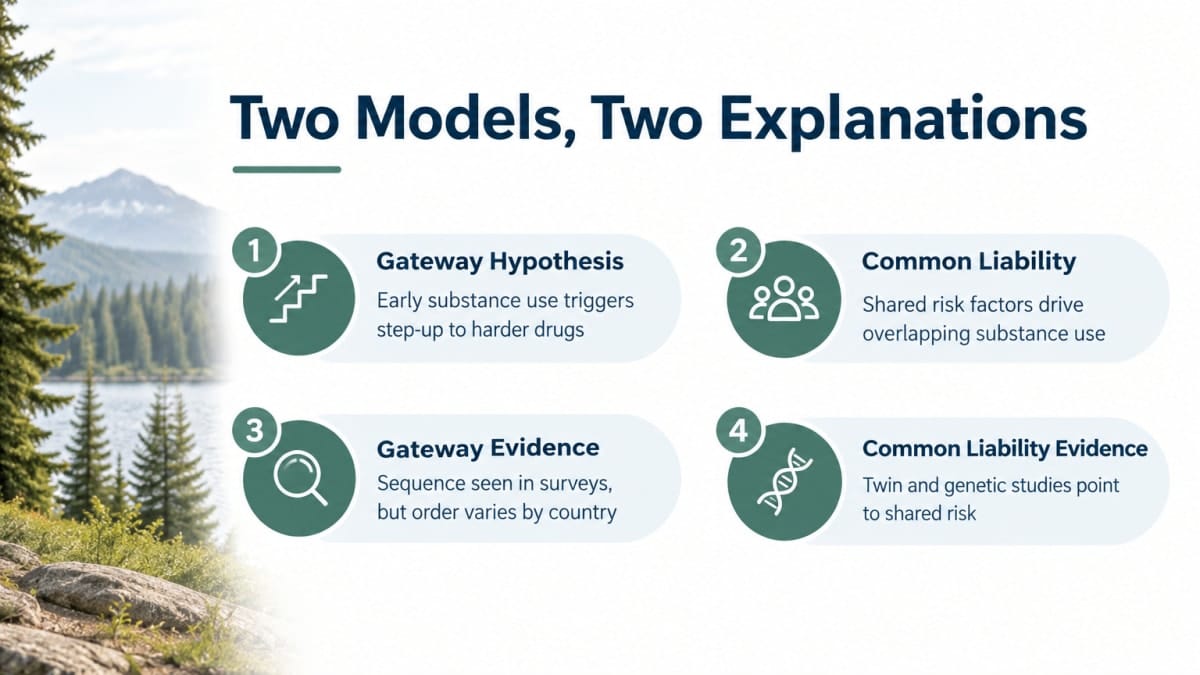
Once you look past the slogan, two real models are doing the heavy lifting in this debate. They’re worth knowing by name, because they lead to very different conversations with your doctor, your teenager, or yourself.
The gateway hypothesis says that using an earlier substance, often alcohol, tobacco, or cannabis, causes a step-up to other drugs through some combination of brain changes, lowered inhibition, or exposure to new social circles. The common-liability model says something quieter and, honestly, more consistent with the data: people who use multiple substances tend to share underlying risk factors, like genetics, mental health, trauma, impulsivity, peer environment, and access, and those shared factors are what drive the overlap. In this view, alcohol often shows up first because it’s legal, cheap, and everywhere, not because it flips a switch toward harder drugs 1.
What does the evidence actually show for each? For the gateway model, you can find the sequence in survey data, but the order isn’t universal. In a cross-national study of 17 countries, the “typical” order of initiation varied with what was available locally, and the authors concluded that gateway patterns“at least partially reflect unmeasured common causes rather than causal effects of specific drugs on subsequent use of others”2. For the common-liability model, twin studies and genetic research keep finding that a lot of the risk for alcohol, tobacco, and cannabis problems travels together in families 1.
For you, as the person reading this at the kitchen table, the practical difference is big. If gateway were the whole story, the main move would be to stop the first drink. If common liability is closer to the truth, the main move is to pay attention to the whole picture, family history, mental health, how early use started, and what alcohol itself is doing right now, rather than fixating on which substance came first.
What the Research Actually Shows About Alcohol and Later Drug Use
Order of Use Across 17 Countries: Sequence Isn’t Destiny
If alcohol really were the switch that flips a person toward harder drugs, you’d expect to see roughly the same order of use everywhere people drink. You don’t. When researchers compared survey data from 17 countries through the WHO World Mental Health Surveys, the “typical” order of initiation shifted depending on what was legal, cheap, and culturally normal in each place 2. In some countries, alcohol came first. In others, the sequence looked different, sometimes dramatically.
That matters because the gateway idea leans on sequence as evidence of cause. If sequence varies by country, availability, and social context, then the sequence itself is telling you more about the environment than about alcohol’s chemistry. The authors said it plainly: the gateway pattern“at least partially reflects unmeasured common causes rather than causal effects of specific drugs on subsequent use of others”2.
Translated into kitchen-table language: a teenager in one country may try alcohol first because it’s at every family dinner. A teenager somewhere else may try something else first because that’s what’s around. What raised their risk of later dependence wasn’t the order, it was the broader exposure, earlier overall start, and the shared factors underneath. If you’ve been losing sleep over whether a first drink is the first domino, the cross-country data takes some of that weight off.
Breaking the “Typical” Order Doesn’t Change Dependence Risk Much
Here’s a finding that often surprises people. A U.S. analysis using the National Comorbidity Study Replication asked a direct question: if someone broke the “usual” sequence, say, used cannabis before ever drinking, or went straight to another illicit drug, did that change their odds of developing dependence later? The short answer was no. Deviations from the typical order were largely unrelated to later dependence risk. Other factors, like how many substances someone was exposed to and how early they started using anything at all, mattered much more 11.
Think about what that means for the gateway story. If alcohol specifically opened a door, people who skipped that door entirely should have been safer. They weren’t. And people who walked through it in the “approved” order weren’t automatically doomed, either.
What this doesn’t mean is that early drinking is harmless. It isn’t. The point is narrower and more honest: the order isn’t carrying the causal weight people have attached to it for decades. The number of substances a person tries, how young they are when they start, and the risk factors they bring with them do more of the work. If you’re trying to figure out where to focus your worry, focus there.
When Genes Did the Causal Work: Smoking, Not Alcohol
One of the hardest things to prove in substance-use research is cause, because you can’t randomly assign people to start drinking. Researchers have gotten creative, though. A technique called Mendelian randomization uses natural variation in people’s genes as a stand-in for random assignment, which gets closer to a true causal test than survey data can.
When a team applied this method to the gateway question, they looked at smoking initiation and alcohol consumption as possible drivers of later cannabis use and cannabis dependence. The signal they found pointed at smoking, not alcohol. Starting to smoke appeared to increase later alcohol consumption, cannabis use, and cannabis dependence in their bidirectional analyses 12. Alcohol consumption did not show the same clear causal push toward other drugs.
That’s a specific, careful finding, not a verdict. Mendelian randomization has limits, and no single study settles anything. But it fits the broader pattern: when researchers try to isolate alcohol’s unique causal role in later drug use, it keeps getting smaller or disappearing, while other factors, including nicotine and shared vulnerability, keep showing up. If you’ve been told alcohol is the gateway, the evidence has quietly moved on from that story.
Why Shared Vulnerability Explains More Than a Gateway
The Genetic Overlap Behind Alcohol, Tobacco, and Cannabis Dependence
If alcohol itself were the thing pushing people toward other substances, you’d expect the risk for alcohol problems to look pretty distinct from the risk for, say, cannabis or tobacco problems. Instead, when researchers look at families, especially twins, they keep finding that the risks travel together.
One twin-based study of adolescents and young adults put a number on it. About 74% of the overlap (phenotypic correlation) among those common liability factors for alcohol, tobacco, and cannabis dependence traced back to a common additive genetic factor 4. In plain terms: a big slice of what makes one person more vulnerable to alcohol dependence also makes them more vulnerable to tobacco and cannabis dependence. It isn’t three separate problems with three separate causes. There’s a shared layer underneath.
That’s a specific finding, and it needs its scope spelled out so you don’t walk away with the wrong impression. The 74% figure describes shared genetic influence on dependence for those three substances during adolescence and young adulthood. It’s not a claim that “addiction is 74% genetic” in general, and it doesn’t predict any one person’s outcome. Genes load the dice. They don’t throw them.
What this means for the gateway debate: if the same underlying vulnerability is driving the overlap, then alcohol showing up first isn’t opening a door to cannabis or tobacco. All three doors were already more likely to open for that person, in whatever order their life, friends, and surroundings presented them. A 2024 review of twin and genome-wide research reaches a similar conclusion, pointing to shared genetic architecture across substance-use disorders rather than one substance pulling a lever on another 5.
Why Newer Work Says It’s Still Not That Simple
Before you lock the common-liability model in as the final answer, there’s a wrinkle worth knowing about. A 2025 analysis went back and asked whether one tidy “general addiction liability” really explains the connections among alcohol, cannabis, tobacco, and opioid-use disorders. The authors reported that they“did not find strong evidence for general addiction liability”and found some substance-specific effects too, including evidence that primary alcohol use raised risk for alcohol-use disorder in particular, rather than cannabis-use disorder 6.
So the picture isn’t “it’s all one shared risk” any more than it’s “alcohol is the gateway.” Both oversimplify. The honest read is that shared vulnerability explains a lot of the overlap you see in surveys and families, and individual substances still have their own risk patterns on top of that.
Why does this matter at the kitchen table? Because it changes where you put your attention. If you’re worried about someone’s drinking, you don’t have to resolve a decades-long academic debate before you act. You can hold two things at once: the risk for substance problems often clusters in people and families, and alcohol itself can become a serious problem on its own. Both are true. Neither one requires you to prove the other wrong before you pick up the phone or ask a hard question at dinner.
If You’re Worried About a Teenager
Why Age of First Drink Matters More Than the Gateway Debate
If you have a teenager at home, the gateway debate probably isn’t what’s keeping you up. The specific thing you’re worried about is: they had their first drink young, or they’re drinking more than you’d like, and you want to know what that means for the next five years.
Here’s where the research gets practical. A 2025 longitudinal study followed a nationally representative Irish cohort from adolescence into early adulthood and asked a clean version of your question. The finding: older age at first alcohol use was linked to lower odds of high-risk alcohol, tobacco, cannabis, and other-drug use at age 20, with a dose-response pattern. The earlier someone started, especially at 14 or younger, the higher their risk of problem substance use later, compared with people who waited 3. The CDC reaches a similar conclusion from a different angle: young people who drink are more likely to misuse prescription or illicit drugs, and earlier drinking is linked to a higher chance of excessive alcohol use or alcohol-use disorder later in life 7.
Notice what this does and doesn’t say. It isn’t proof that alcohol flipped a switch. It’s that early drinking tracks with a bunch of other things, less parental monitoring, more peer pressure, impulsivity, maybe already-rough mental health, that each raise risk on their own. Delaying the first drink matters, not because alcohol is a chemical gateway, but because the whole context around early drinking is what you’re trying to shift 10. If your teen has already started, that’s not the end of the story. It’s a reason to pay closer attention, not to panic.
Family History: Risk, Not Fate
If alcoholism runs in your family, you’ve probably wondered whether your kid is already on a track they can’t change. The honest answer: family history raises risk, but it does not decide the outcome.
Longitudinal research on children of parents with alcohol problems shows higher rates of adolescent substance use on average, but “on average” hides a lot of individual stories. Plenty of kids with heavy family history never develop a problem. Plenty without it do. Pathways vary across different populations and developmental stages, which is why researchers emphasize following diverse youth over time rather than assuming one trajectory fits every family 10.
What this means for you at the dinner table: don’t hide the family history, and don’t use it as a prophecy. Teenagers who know “this runs in our family, and that’s why I’m paying attention” tend to do better than teenagers kept in the dark or told they’re doomed. Risk is a reason to stay close, ask real questions, and get help early if something feels off. It isn’t a verdict.
When Alcohol Itself Has Become the Real Question
Signs Drinking Has Crossed a Line
Here’s the quiet shift this article has been building toward. If you came in asking whether alcohol will lead to something worse, you may be using that question to avoid a harder one: is the drinking itself already the problem? A lot of people arrive at a search bar through that side door. It feels safer to worry about what might happen than to name what’s happening right now.
So look at the actual week you’ve just had. Are you drinking more than you planned to, more nights than not? Have you tried to cut back and found yourself back where you started within a few weeks? Are mornings foggy, afternoons tense, and evenings organized around the next drink? Is someone close to you asking you to stop in a way they weren’t asking a year ago? Are you hiding how much, lying about when, or feeling shame the morning after on a regular basis?
None of those alone makes you an alcoholic. All of them together are a pattern worth taking seriously. You don’t need a dramatic bottom to deserve help. If drinking is costing you more than it’s giving you, that’s enough reason to talk to someone who does this for a living.
Why Alcohol Withdrawal Needs Medical Supervision
A few specific situations should push you toward a medical conversation rather than a solo attempt at quitting. Heavy daily drinking, meaning multiple drinks every day for weeks or months, puts your nervous system in a state where sudden stopping can trigger serious symptoms, including seizures and delirium tremens. A history of past withdrawal symptoms, even mild ones, raises the risk that the next withdrawal will be worse. If you’ve ever had a seizure during a period of cutting back, that’s a flashing light. And if you’re taking a benzodiazepine, Xanax, Klonopin, Ativan, Valium, alongside drinking, the risk goes up again, because benzo withdrawal carries its own medical danger and the two interact.
None of this means you’re too far gone. It means the first step is a supervised one. A medical detox evaluates where you actually are, uses medication to keep withdrawal safe and tolerable, and gets you steady enough to think about what comes next. You don’t have to figure out whether your situation qualifies. That’s what a phone call to a detox team is for.
What Help Looks Like in the Pacific Northwest
If you’ve read this far, you’re probably past the question in the title. The real question is what to do next. Here’s what competent help actually looks like, so you know what to ask for.
A medical detox is the first step when drinking has become heavy or daily. In a non-hospital setting, that means a home-like residence with nurses on site around the clock, providers checking in every day, medication to keep withdrawal safe and tolerable, and meals and groups that treat you like a person, not a chart. Most alcohol detox stays at Pacific Crest Trail Detox run eight to ten days. That window exists because alcohol withdrawal needs real medical eyes on it, not a weekend of white-knuckling 8.
Detox alone isn’t the whole picture, though. What tends to make the difference long-term is what comes after: a partial hospitalization program, intensive outpatient, standard outpatient, and alumni support that keeps you connected once the acute part is over. If a family member is the one struggling, those same steps apply, and you can start by making the call yourself.
Pacific Crest Trail Detox has been doing this work in Milwaukie, Oregon since 2017, serving Portland, Gresham, Beaverton, Salem, Vancouver WA, and out-of-state folks who want to get away from their usual surroundings. Many of the staff are in recovery themselves, which tends to change the tone of the conversation. If you want to verify insurance or talk through what you’re facing, a confidential, HIPAA-protected call is the next step. Create your path to recovery.
Wondering If Alcohol Use Needs Detox?
Check your coverage for medically supervised alcohol detox and take a clear next step.
Frequently Asked Questions
Does drinking alcohol mean someone will end up using harder drugs?
No. Most people who drink never use other drugs. Alcohol often shows up first in surveys because it’s legal and everywhere, but following or skipping the “typical” order of use didn’t change later dependence risk much in one U.S. analysis 11. Shared factors like genetics, mental health, early start, and environment do more of the work than alcohol itself 1.
If alcohol isn’t technically a gateway drug, why do so many people start with it?
Because alcohol is legal, cheap, and present at most family gatherings, workplaces, and social events. In a cross-national study of 17 countries, the order of initiation shifted with what was locally available and culturally normal, not because alcohol chemically opened a door 2. People often start with what’s around them. That’s a story about environment and access, not about alcohol flipping a switch toward harder drugs.
My teenager had their first drink early. How worried should I be?
Pay attention, but don’t panic. A 2025 Irish longitudinal study found that starting at 14 or younger was linked to higher odds of problem substance use at age 20, with risk falling as the first drink was delayed 3. The CDC reports similar patterns 7. Early drinking tracks with other risk factors, so staying close, asking real questions, and getting help early matters more than any single conversation.
Alcoholism runs in my family. Does that mean I’m destined to develop a problem?
No. Family history raises risk, but it does not decide the outcome. Twin research shows shared genetic influence across alcohol, tobacco, and cannabis dependence, which means vulnerability clusters in families 4, 5. Plenty of people with heavy family history never develop a problem. Knowing your history is useful information, not a verdict. It’s a reason to pay attention earlier and get help sooner if something feels off.
How do I know if alcohol itself has already become the real problem?
Look at the last month honestly. Are you drinking more than you planned, more nights than not? Have you tried to cut back and ended up back where you started? Are you hiding how much, waking up foggy, organizing evenings around the next drink, or feeling shame the morning after? You don’t need a dramatic bottom to deserve help. If drinking is costing more than it’s giving, that’s enough.
Why can’t I just stop drinking on my own at home?
Because for heavy daily drinkers, sudden stopping can be dangerous. NIAAA reports alcohol withdrawal can be life-threatening and is responsible for around 260,000 emergency-department visits and 850 deaths each year in the U.S. 8. If you’ve been drinking heavily and daily, or taking a benzodiazepine alongside drinking, the safe first step is a medical evaluation, not willpower.
References
- Common liability to addiction and “gateway hypothesis”: Theoretical, empirical and evolutionary perspective. https://pmc.ncbi.nlm.nih.gov/articles/PMC3600369/
- Evaluating the drug use “gateway” theory using cross-national data: Consistency and associations of the order of initiation of drug use among participants in the WHO World Mental Health Surveys. https://pmc.ncbi.nlm.nih.gov/articles/PMC2835832/
- Early and risky adolescent alcohol use independently predict alcohol, tobacco, cannabis and other drug use in early adulthood in Ireland: a longitudinal analysis of a nationally representative cohort. https://pmc.ncbi.nlm.nih.gov/articles/PMC11934588/
- Stability and Change of Genetic and Environmental Effects on the Common Liability to Alcohol, Tobacco, and Cannabis Dependence Across Adolescence and Young Adulthood. https://pmc.ncbi.nlm.nih.gov/articles/PMC3794456/pdf/nihms492800.pdf
- Generalized genetic liability to substance use disorders. https://pmc.ncbi.nlm.nih.gov/articles/PMC11142744/
- “General Addiction Liability” Revisited. https://pmc.ncbi.nlm.nih.gov/articles/PMC12002852/pdf/nihms-1978772.pdf
- About Underage Drinking. https://www.cdc.gov/alcohol/underage-drinking/
- Alcohol Use Disorder: From Risk to Diagnosis to Recovery. https://www.niaaa.nih.gov/health-professionals-communities/core-resource-on-alcohol/alcohol-use-disorder-risk-diagnosis-recovery
- Testing Whether and When Parent Alcoholism Uniquely Affects Various Forms of Adolescent Substance Use. https://pmc.ncbi.nlm.nih.gov/articles/PMC3342475/
- Does diversity matter? The need for longitudinal research on adolescent alcohol and drug use trajectories. https://pmc.ncbi.nlm.nih.gov/articles/PMC4119610/
- Does the ‘gateway’ matter? Associations between the order of drug use initiation and the development of drug dependence in the National Comorbidity Study Replication. https://pmc.ncbi.nlm.nih.gov/articles/PMC2653272/
- Using Mendelian randomization to explore the gateway hypothesis: possible causal effects of smoking initiation and alcohol consumption on substance use outcomes. https://pmc.ncbi.nlm.nih.gov/articles/PMC9453475/