
Key Takeaways
- The strongest approach combines medically supervised withdrawal when needed, FDA-approved medication like naltrexone or acamprosate, and ongoing behavioral therapy matched to the person 11, 12.
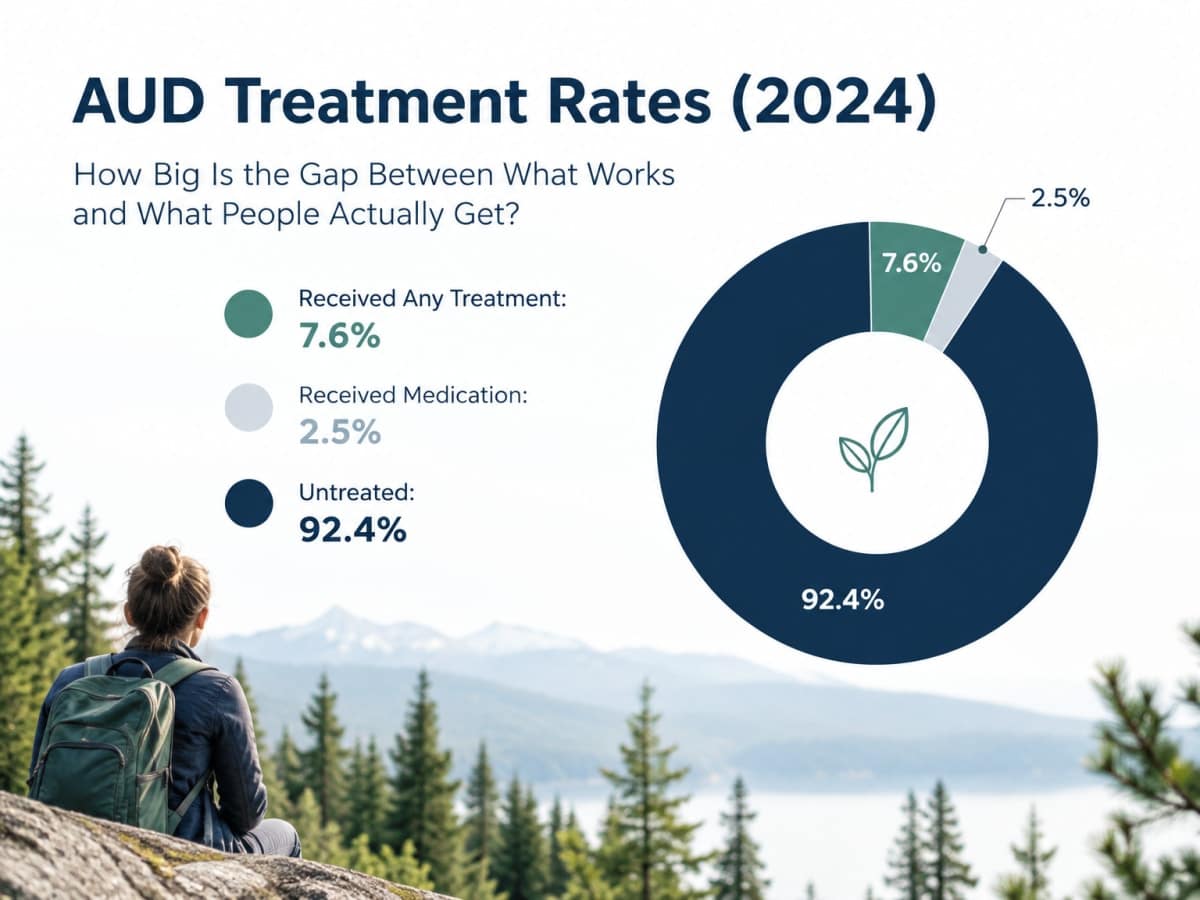
- Only 7.6% of people with past-year alcohol use disorder received any treatment in 2024, and just 2.5% received medication, so unsuccessful past attempts often reflect missing tools rather than personal failure 8.
- Detox safely handles acute withdrawal, which can turn deadly after prolonged heavy drinking, but it does not treat the underlying disorder and must hand off to continued care 2, 13.
- When evaluating a program, ask who staffs withdrawal overnight, which medications can start before discharge, and how the step-down into PHP, IOP, and outpatient actually works 11.
Why “Most Effective” Is the Wrong Question to Start With
If you typed “most effective treatment for alcoholism” into a search bar at 11 p.m. after another bad night, you deserve a straight answer. Here it is: there is no single best treatment that works for every person. The approach with the strongest evidence is a combination of medically supervised withdrawal when it’s needed, FDA-approved medication, and ongoing behavioral care that continues after your body is steady. The National Institute on Alcohol Abuse and Alcoholism puts it plainly: behavioral treatment and medication are about equally effective, and they can be combined and tailored to improve results 11.
That answer probably feels less satisfying than you wanted. You wanted a name. A program. A pill. Something to point at and say, “this one.” What you’re actually looking at is a medical decision with moving parts, and the right question isn’t “what’s the most effective treatment.” It’s “most effective for whom, at what stage, with what else going on?”
A 55-year-old who drinks a bottle of wine every night and has high blood pressure needs something different from a 32-year-old who binges on weekends and struggles with anxiety. Both are real. Both deserve care that fits. The rest of this article walks you through what the research actually says, so you can tell a thoughtful program from a sales pitch.
The Honest Answer: Three Things Working Together
When researchers and federal clinicians talk about what actually helps people stop drinking and stay stopped, they keep circling back to the same three ingredients: safe withdrawal when your body needs it, medication that takes the edge off cravings or makes drinking less rewarding, and talk-based therapy that helps you build a life that doesn’t revolve around alcohol. NIAAA puts behavioral treatment and FDA-approved medication on roughly equal footing, and says the two can be combined and tailored to the person 11. That’s the honest answer. Not one magic bullet. A short list of things that work better together than apart.
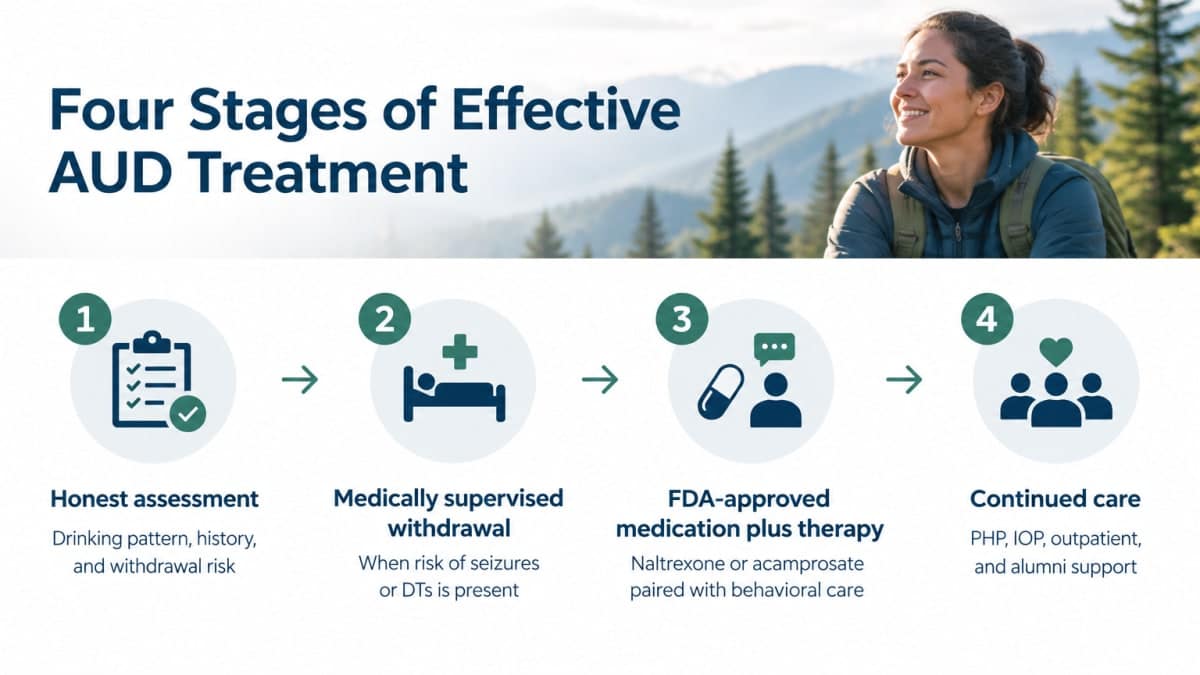
Picture it as four stages that flow into one another. First, an honest assessment of how much you’re drinking, how long you’ve been drinking that way, and whether stopping could put you in medical danger. Second, medically supervised withdrawal if the assessment says you need it, because alcohol withdrawal can turn into seizures or delirium tremens after prolonged heavy use 13. Third, an FDA-approved medication like naltrexone or acamprosate paired with a therapy that fits your life 12. Fourth, continued care that keeps you connected after the acute phase ends, usually some mix of partial hospitalization, intensive outpatient, standard outpatient, and alumni support 11.
You don’t have to figure out which pieces you need on your own. That’s what a good assessment is for. But knowing the four stages exist helps you spot a program that offers all of them and politely walk away from one that only sells you the first.
How Big Is the Gap Between What Works and What People Actually Get?
Here’s the number that explains why you’re confused: in 2024, about 2.1 million people age 12 and older with past-year alcohol use disorder received any alcohol treatment. That’s 7.6%. The share who received medication for AUD was 2.5% 8. More than nine out of ten people who met criteria for the diagnosis got nothing at all last year.
Sit with that for a second. The medications and therapies described in this article aren’t experimental. They’re recommended by federal clinical guidelines and backed by decades of trials. And still, the overwhelming majority of adults who could benefit from them never see a prescriber, never sit with a counselor, never get screened for withdrawal risk. The gap isn’t about whether treatment works. It’s about access, stigma, cost, confusing options, and the quiet belief a lot of people carry that they should be able to white-knuckle this on their own.
If you’ve tried to quit before and it didn’t stick, you probably assumed something was wrong with you. The more honest reading is that you were likely trying without the tools that make quitting possible for most people: a safe way through withdrawal, a medication that calms the pull toward the next drink, and a person who knows what they’re doing to talk it through with you week after week. The treatment that worked for someone you know might not be the treatment that fits you. But some version of real, evidence-based care almost certainly exists for your situation. You’re not broken. You’ve been doing this with your bare hands.
When Alcohol Withdrawal Becomes a Medical Emergency
If you’ve been drinking heavily every day for months or years, stopping cold can hurt you worse than drinking did. That’s not a scare tactic. It’s basic physiology, and it’s the reason the medical detox step exists at all. NIAAA is direct about it: alcohol withdrawal can be life-threatening after sudden cessation of prolonged heavy drinking, with the potential for seizures and delirium tremens 13. The ASAM withdrawal management guideline exists precisely because risk varies so much from person to person that clinicians need a framework to match monitoring and treatment intensity to how dangerous your particular situation is 2.
The reader this section is talking to isn’t someone deciding between therapy styles. It’s someone who is already shaking by late morning, pouring the first drink before noon just to feel normal, or watching a spouse do that. If that’s you, keep reading before you make any plan that involves stopping on your own this weekend.
What Makes Alcohol Withdrawal Different From Other Substances
Opioid withdrawal is miserable. Alcohol withdrawal can kill you. That’s the honest line most people haven’t heard. When heavy, long-term drinking stops, the nervous system that adapted to being constantly sedated goes into overdrive. The result can escalate from shakes and sweats to seizures and delirium tremens, a severe state involving confusion, hallucinations, and dangerous changes in heart rate and blood pressure 13. The ASAM guideline treats alcohol withdrawal as a condition that requires matched clinical monitoring, not a problem you tough out at home 2. Benzodiazepines under medical supervision have the deepest evidence base for managing acute withdrawal safely 13.
Signs You Should Not Try to Stop Drinking Alone
What Medical Detox Actually Does (and Where It Stops)
Medical detox has one job: get your body safely through the acute withdrawal period so you don’t seize, don’t go into delirium tremens, and don’t end up in an ER with your blood pressure spiking. In a non-hospital residential detox, that usually means around-the-clock nursing, providers checking on you daily, and medications like benzodiazepines used under supervision to quiet the overactive nervous system that heavy drinking leaves behind 2. Benzodiazepines have the deepest evidence base for managing acute alcohol withdrawal when a clinician is dosing and monitoring them 13. For most people with moderate-to-severe dependence, the acute phase runs about a week to ten days, give or take based on how long you drank, how much, and what else is going on medically.
The next question is what happens on day 11. A detox stay that doesn’t hand you off to real continued care, whether that’s medication started before you leave, a therapist scheduled for the week after, or a seat in a partial hospitalization or intensive outpatient program, is a medical procedure without a follow-up plan. You wouldn’t accept that from a surgeon. Don’t accept it here.
The Medications With Real Evidence Behind Them
For a long time, the standard advice for drinking problems was willpower, meetings, and maybe a 28-day stay somewhere. Medication barely came up. That’s changed. There are now three medications approved by the FDA specifically for alcohol use disorder, plus a couple of others that federal guidelines take seriously when the approved ones don’t fit. The pills aren’t magic. They don’t make you stop wanting to drink the way a flipped switch would. What they do is tilt the odds in your favor during the months when your brain is still figuring out how to feel okay without alcohol in it. The AHRQ systematic review of outpatient medication for AUD looked at 118 studies and found moderate-strength evidence that oral naltrexone at 50 mg a day helps across several drinking outcomes, with a number needed to treat of 18 to prevent return to any drinking and 11 to prevent return to heavy drinking. Acamprosate came in at a number needed to treat of 11 to prevent return to any drinking 14. In plain English, if 11 people take acamprosate who otherwise wouldn’t, one of them stays sober who wouldn’t have. That’s a real effect for a tablet that most people tolerate without much drama.
Naltrexone, Acamprosate, and Disulfiram in Plain Language
Naltrexone is the one most clinicians reach for first. It blocks the opioid receptors that make alcohol feel rewarding, so when you do drink, the pleasant buzz is muted and the pull toward the next drink is weaker. You can take it as a daily pill or a monthly injection. NIAAA describes it as a medication that helps reduce urges 12, and the AHRQ review backs that up with the strongest evidence of any AUD medication in outpatient care 14. One catch: if you’re taking prescription opioids for pain, naltrexone isn’t a fit.
Acamprosate works differently. It helps calm the restless, anxious, can’t-sleep feeling that lingers for weeks or months after you stop drinking. NIAAA frames it as a medication that helps you maintain abstinence 12. It’s a tablet taken three times a day, which is a lot of pills, but it’s safe to use even if you have liver problems.
Disulfiram is the oldest of the three and the most straightforward. If you drink while taking it, you get violently ill, flushed, nauseous, headachy. The point is to make the next drink feel too dangerous to try. NIAAA describes it as discouraging drinking through that unpleasant reaction 12. It works best for people who have strong support and genuinely want help holding a line they’ve already drawn.
When Off-Label Options Like Topiramate or Gabapentin Come Up
If the three FDA-approved medications don’t fit your situation, you’re not out of options. The VA/DoD clinical practice guideline for substance use disorders actually puts topiramate on the same first-line tier as naltrexone for moderate-to-severe AUD, even though it isn’t FDA-labeled specifically for alcohol 3. It’s a seizure medication that research has shown can also reduce heavy drinking days. It takes some patience to titrate up, and side effects like tingling or cognitive fog can be a trade-off.
Gabapentin shows up in the same guideline as another option, particularly for people whose anxiety and sleep problems make the first few months of sobriety brutal 3. A systematic review of 156 trials across all AUD medications also found evidence for baclofen, a muscle relaxant, in reducing heavy drinking for selected patients 1. These aren’t fringe choices. They’re medications a thoughtful prescriber will discuss with you if naltrexone, acamprosate, or disulfiram aren’t right, whether because of other health conditions, other medications you take, or how your body reacted. The point isn’t to pick a favorite. It’s to know your prescriber has more than one tool.

Behavioral Therapies That Hold Up Under Research
Medication tilts the odds. Therapy teaches you how to live when the pills are doing their quiet work in the background. The two aren’t competitors. NIAAA treats them as roughly equal in effect and better together than either alone 11. The therapies that have real research behind them aren’t mysterious or endless. Most are structured, time-limited, and focused on the specific skills and patterns that keep people drinking or help them stop. Below are the ones a thoughtful program should be able to name, and the places where family involvement actually changes outcomes rather than just making everyone feel like they did something.
CBT, Motivational Enhancement, Contingency Management, and 12-Step Facilitation
NIAAA names behavioral approaches with the deepest track record for AUD: cognitive-behavioral therapy, motivational enhancement, contingency management, 12-step facilitation, and couples or family therapy 15. In plain terms, cognitive-behavioral therapy helps you spot the thoughts, situations, and feelings that steer you toward a drink and build different responses before you’re standing in front of the fridge at 9 p.m. Motivational enhancement is a shorter, conversation-based approach that works on your own reasons for change rather than someone else lecturing you about yours. Contingency management uses small, concrete rewards for verified sober days, and the evidence for it is sturdier than its unfamiliar name suggests. Twelve-step facilitation is a structured therapy that helps you actually use mutual-support groups like AA if that’s a fit, without requiring you to adopt a religion or accept any particular worldview. None of these is the answer. Any of them, matched to the right person with a prescriber on the same team, is a legitimate piece of the answer.
Where Couples and Family Therapy Fit
Drinking rarely happens inside one person’s skin. It happens inside a marriage, a household, a group of adult siblings trying to figure out what to do about Dad. NIAAA lists couples and family therapy alongside the individual therapies for a reason: when the people closest to you are part of the treatment, the day-to-day environment that triggers drinking or supports sobriety starts to shift 15. This matters most when a partner is exhausted and angry, when children are watching, or when the household has quietly organized itself around someone’s drinking for years. A good family session isn’t about blame. It’s about teaching everyone what to say and what to stop saying.
Treating AUD and Mental Health Together
Depression, anxiety, PTSD, and alcohol use disorder travel together more often than not. If you’ve been drinking to quiet a mood you couldn’t name, or if your anxiety has gotten louder every year you’ve leaned on alcohol, you’re not two separate problems stacked on top of each other. You’re one person whose care needs to address both at the same time. A clinical review on integrating treatment for co-occurring conditions is direct that treatment plans for people with co-occurring AUD and mental-health conditions should consider behavioral therapy, pharmacotherapy, and community recovery support rather than treating alcohol use in isolation 5.
Here’s the honest limit. A 2021 meta-analysis of 15 trials looking at integrated cognitive-behavioral therapy for people with both a substance use disorder and a mental-health condition found small, variable effects on substance-use outcomes, with somewhat more consistent improvement in mental-health symptoms 6. Integrated care is still the right approach. It just isn’t a miracle, and anyone who promises you otherwise is selling. One more thing worth knowing: during withdrawal, symptoms can mimic or worsen psychiatric conditions, so a careful assessment separates what alcohol is driving from what was there underneath 15. That distinction changes what gets treated and when.
How to Evaluate a Treatment Program Without Falling for Marketing
Rehab websites tend to look alike. Soft colors, people on docks at sunrise, phrases about new beginnings. The marketing doesn’t tell you much about whether the place can safely get you through withdrawal, prescribe the medications with the strongest evidence, or hand you off to real continued care when the acute phase ends. You need a shorter list of questions than most people realize. The right ones separate programs that match evidence-based care from programs that sell you a comfortable room and hope for the best.
Two areas matter most before you commit to a bed: who is actually on site to keep you medically safe during withdrawal, and whether the program is licensed and accredited to do what it claims to do. If a program can’t answer plainly in either area, that’s your answer about the program. A good one will welcome the questions, because the questions are the same ones its own medical team asks every day.
Questions to Ask About Medical Staffing and Withdrawal Safety
Ask who is physically on site at 3 a.m. if your blood pressure spikes or a seizure starts. A real medical detox has registered nurses present around the clock and providers who round every day, not just a phone line to someone off-site. Ask how the program assesses withdrawal risk at intake, what medications it uses, and when it transfers to a higher level of care. The ASAM withdrawal guideline exists to match monitoring and treatment intensity to how dangerous your particular case is 2, so a program should be able to explain how it does that matching. Ask whether naltrexone or acamprosate can be started before discharge 12.
Licensing, Accreditation, and What Oregon Rules Actually Require
In Oregon, substance-use and co-occurring treatment providers must be licensed or certified for each level of care they offer, and the state distinguishes clinically managed residential detoxification from medical detoxification 9, 10. Those aren’t interchangeable labels. Ask which level the program is licensed for and whether that matches your withdrawal risk. National accreditation from a body like the Joint Commission is a separate signal that an outside reviewer has looked at clinical operations. Licensing alone doesn’t prove quality, but a program that can’t clearly state its state license, its accreditation, and the specific levels of care it’s certified to deliver hasn’t earned your trust yet.
Detox Is Step One: What Continued Care Looks Like in the Portland Metro
Day 11 is the day most people underestimate. Your body feels human again. Sleep is uneven but possible. The acute danger has passed, and the quieter work begins: rebuilding routines, learning new responses to old triggers, and keeping a medication regimen going long enough for your brain to settle into life without alcohol. NIAAA frames this as a continuum, not a single event, ranging from outpatient care through residential and medically directed services, and recommends matching the level of care to what the person actually needs at each stage 11.
In practical terms, that usually looks like a step-down. From medical detox, many people move into a partial hospitalization program, where you spend most of the day in structured treatment but sleep at home or in supportive housing. From there, intensive outpatient drops the time commitment to several hours a few days a week, so you can return to work or family responsibilities while still getting group and individual therapy. Standard outpatient and alumni services keep the connection going for months after that, which is the window when old patterns tend to resurface. Medication like naltrexone or acamprosate often continues through all of these stages rather than stopping when the detox bed is empty 12.
If you live in Milwaukie, Portland, Gresham, Beaverton, Salem, or Vancouver WA, a continuum like this is reachable without leaving the region. Out-of-state families looking at the Pacific Northwest can expect the same sequence. The point isn’t geography. It’s making sure whoever treats your acute withdrawal is already planning for what you’ll do on day 11, day 60, and the Tuesday night six months from now when something hard happens and the old answer is still in the back of your mind.
A Confidential Next Step When You’re Ready to Make the Call
If you’ve read this far, you already know more than most people searching this topic at midnight. You know that “most effective” means a personalized combination, that medications like naltrexone and acamprosate have real evidence behind them, and that detox is a starting point rather than a finish line. The missing piece is a phone call where someone listens to your specific situation, asks about your drinking pattern and medical history, and tells you honestly what level of care fits.
Pacific Crest Trail Detox is a non-hospital medical detox in Milwaukie, serving the Portland metro and welcoming out-of-state families. Registered nurses are on site around the clock, providers round daily, and many staff members are in recovery themselves. Detox typically runs eight to ten days and connects directly to partial hospitalization, intensive outpatient, outpatient, and alumni support through the broader program. We want to be your last treatment experience, whether we’re your first detox or your fifth.
Call for a confidential assessment or ask about verifying your insurance benefits. Conversations are HIPAA-protected, there’s no pressure to admit, and asking questions costs you nothing.
Find Out What Alcohol Treatment May Cover
Check your coverage for medically supervised alcohol detox and the next steps in treatment.
Frequently Asked Questions
Is medical detox always necessary to stop drinking?
No. If you drink moderately and don’t have physical dependence, you may be able to cut back or stop with outpatient support. Medical detox becomes necessary when you drink heavily every day, have had past withdrawal seizures or delirium tremens, also use benzodiazepines, or have serious medical conditions. Alcohol withdrawal can be life-threatening after prolonged heavy drinking, so an honest assessment should decide the setting, not guesswork 13.
Which medication for alcohol use disorder has the strongest evidence?
Oral naltrexone at 50 mg daily has the strongest outpatient evidence in the AHRQ systematic review, which found moderate-strength evidence across several drinking outcomes 14. Acamprosate also has solid evidence for helping people stay abstinent 12. Both are typically first-line. Disulfiram and off-label options like topiramate or gabapentin fit specific situations 3. The best medication for you depends on your health, other medications, and goals.
Do I have to go to rehab, or can I be treated as an outpatient?
Not everyone needs residential care. NIAAA describes a continuum of care that ranges from outpatient services to residential and medically directed programs, with the right level matched to your situation 11. If your withdrawal risk is low and your home environment is stable, outpatient medication and therapy can work. If you drink heavily daily, have withdrawal symptoms within hours of your last drink, or have tried outpatient care without success, residential detox is usually the safer start.
How long does alcohol detox usually take?
For most people with moderate-to-severe dependence, the acute withdrawal phase runs about eight to ten days in a residential medical detox, though your timeline depends on how long you drank, how much, your age, and your overall health. The ASAM guideline matches monitoring intensity to risk, so some people stabilize sooner while others need longer 2. Detox handles the acute phase. The slower work of staying stopped happens in continued care afterward.
What happens after detox is over?
Detox stabilizes your body. Continued care addresses the patterns that kept you drinking. Most people step down through partial hospitalization, then intensive outpatient, then standard outpatient and alumni support over several months 11. Medications like naltrexone or acamprosate often continue through these stages 12. A good detox program starts planning your handoff before you leave, so day 11 has a schedule, a prescriber, and a counselor already in place.
Will my call to Pacific Crest Trail Detox stay confidential?
Yes. Calls to Pacific Crest Trail Detox in Milwaukie are confidential and HIPAA-protected. You can ask questions, describe your situation, and explore whether medical detox fits without committing to anything. The team can also help you verify your insurance benefits without you naming carriers publicly. Whether you’re calling for yourself or for someone you love in the Portland metro, Vancouver WA, or farther away, asking costs you nothing.
References
- PHARMACOTHERAPIES FOR ADULTS WITH ALCOHOL USE DISORDERS: A SYSTEMATIC REVIEW AND META-ANALYSIS. https://pmc.ncbi.nlm.nih.gov/articles/PMC10010623/
- The ASAM Clinical Practice Guideline on Alcohol Withdrawal Management. https://www.samhsa.gov/resource/ebp/asam-clinical-practice-guideline-alcohol-withdrawal-management
- VA/DoD Clinical Practice Guideline for the Management of Substance Use Disorders. https://www.healthquality.va.gov/guidelines/MH/sud/VADoDSUDCPGProviderSummary.pdf
- TIP 49: Incorporating Alcohol Pharmacotherapies. https://library.samhsa.gov/product/tip-49-incorporating-alcohol-pharmacotherapies-medical-practice/sma13-4380
- Integrating Treatment for Co-Occurring Mental Health Conditions. https://pmc.ncbi.nlm.nih.gov/articles/PMC6799972/
- Cognitive-Behavioral Interventions Targeting Alcohol or Other Drug Use and Mental Health Problems in Adults With Co-Occurring Disorders: A Meta-Analysis. https://pmc.ncbi.nlm.nih.gov/articles/PMC8406071/
- Key Substance Use and Mental Health Indicators in the United States: Results from the 2024 National Survey on Drug Use and Health. https://www.samhsa.gov/data/sites/default/files/reports/rpt56287/2024-nsduh-annual-national-report.pdf
- Alcohol Treatment in the United States. https://www.niaaa.nih.gov/alcohols-effects-health/alcohol-topics-z/alcohol-facts-and-statistics/alcohol-treatment-united-states
- OFFICE OF THE SECRETARY OF STATE. https://www.oregon.gov/oha/HSD/HSDRules/415-050-01202023.pdf
- Residential Treatment Facilities. https://www.oregon.gov/oha/bh/providers/pages/rt.aspx
- Recommend Evidence-Based Treatment: Know the Options. https://www.niaaa.nih.gov/health-professionals-communities/core-resource-on-alcohol/recommend-evidence-based-treatment-know-options
- Treatment for Alcohol Problems: Finding and Getting Help. https://www.niaaa.nih.gov/publications/brochures-and-fact-sheets/treatment-alcohol-problems-finding-and-getting-help
- Alcohol Use Disorder: From Risk to Diagnosis to Recovery. https://www.niaaa.nih.gov/health-professionals-communities/core-resource-on-alcohol/alcohol-use-disorder-risk-diagnosis-recovery
- Comparative Effectiveness Review No. 262: Pharmacotherapy for Adults With Alcohol Use Disorder in Outpatient Settings: Systematic Review. https://effectivehealthcare.ahrq.gov/sites/default/files/related_files/cer-262-pharmacotherapy-alcohol-summary.pdf
- Mental Health Issues: Alcohol Use Disorder and Common Co-Occurring Conditions. https://www.niaaa.nih.gov/health-professionals-communities/core-resource-on-alcohol/mental-health-issues-alcohol-use-disorder-and-common-co-occurring-conditions