
Key Takeaways
- Recovery from alcoholism means AUD symptoms are in remission, except craving, and heavy drinking has stopped, with health and relationships repairing gradually over time 1, 6.
- Detox safely manages life-threatening alcohol withdrawal, but it does not treat the disorder underneath; what happens after discharge is the real plan 6.
- Strong continuing care pairs the right mix of FDA-approved medication, counseling, and mutual support with active outreach from the program, which is linked to better drinking outcomes 7, 9.
- Judge a plan by whether heavy drinking has stopped, symptoms are fading, sleep and thinking are returning, and someone calls you when you miss a check-in 1, 2, 5.
Recovery, Defined Honestly: More Than Not Drinking
Recovery from alcoholism is a dynamic, individualized process with two clinical goals: remission from alcohol use disorder (AUD) symptoms other than craving, and stopping heavy drinking. It usually also brings gradual improvements in physical and mental health, relationships, and daily functioning 1, 6. It is not a single event, and it does not end the day you leave detox.
If you came here looking for a straight answer, here it is: putting down the drink matters, and it is not the whole picture. The National Institute on Alcohol Abuse and Alcoholism (NIAAA) frames recovery this way on purpose. Cravings can linger even when the disorder is in remission, so experiencing one does not mean you have failed. Sleep, mood, memory, and relationships tend to repair on their own timeline, and that timeline is longer than most people expect.
Here is the other honest part. Detox handles the dangerous physical withdrawal, which for alcohol can be life-threatening and needs medical supervision. What it does not do is retrain your brain, rebuild your mornings, or hand you the skills to sit with a hard feeling without a drink. Those changes happen after, through counseling, medication when appropriate, peer support, and steady follow-up care 11.
The rest of this guide walks you through what clinical recovery actually looks like, what the first year can feel like week by week, and how to tell whether the plan in front of you is built to hold.
What Does Clinical Recovery From Alcoholism Actually Mean?
The Two-Part NIAAA Definition in Plain Language
Clinicians at the National Institute on Alcohol Abuse and Alcoholism use a specific, two-part definition of recovery from alcohol use disorder. First, your AUD symptoms are in remission, meaning you no longer meet the diagnostic criteria for the disorder, with one exception: craving. Second, you have stopped heavy drinking 1, 6. That is the clinical floor. Everything else NIAAA describes, including better physical and mental health, repaired relationships, and improved day-to-day functioning, tends to grow out of those two anchors over time 1.
Here is why the craving exception matters to you. A craving does not reset the clock. It does not mean you are back at square one, and it does not disqualify you from being in recovery. It means your brain is still rewiring the pathways that alcohol trained. You can want a drink and still be well.
The heavy-drinking piece is worth saying plainly. NIAAA frames recovery as a dynamic, individualized process, not a letter grade 6. Some people aim for complete abstinence from day one. Others start by cutting back under medical guidance. Both can be steps toward recovery, though abstinence is the safest path once AUD is in the picture.
Personal Recovery vs. Clinical Recovery: Why the Gap Matters
There is a difference between feeling recovered and meeting clinical criteria for recovery. Both are real. They are not always the same thing, and the gap between them is where a lot of plans quietly fall apart.
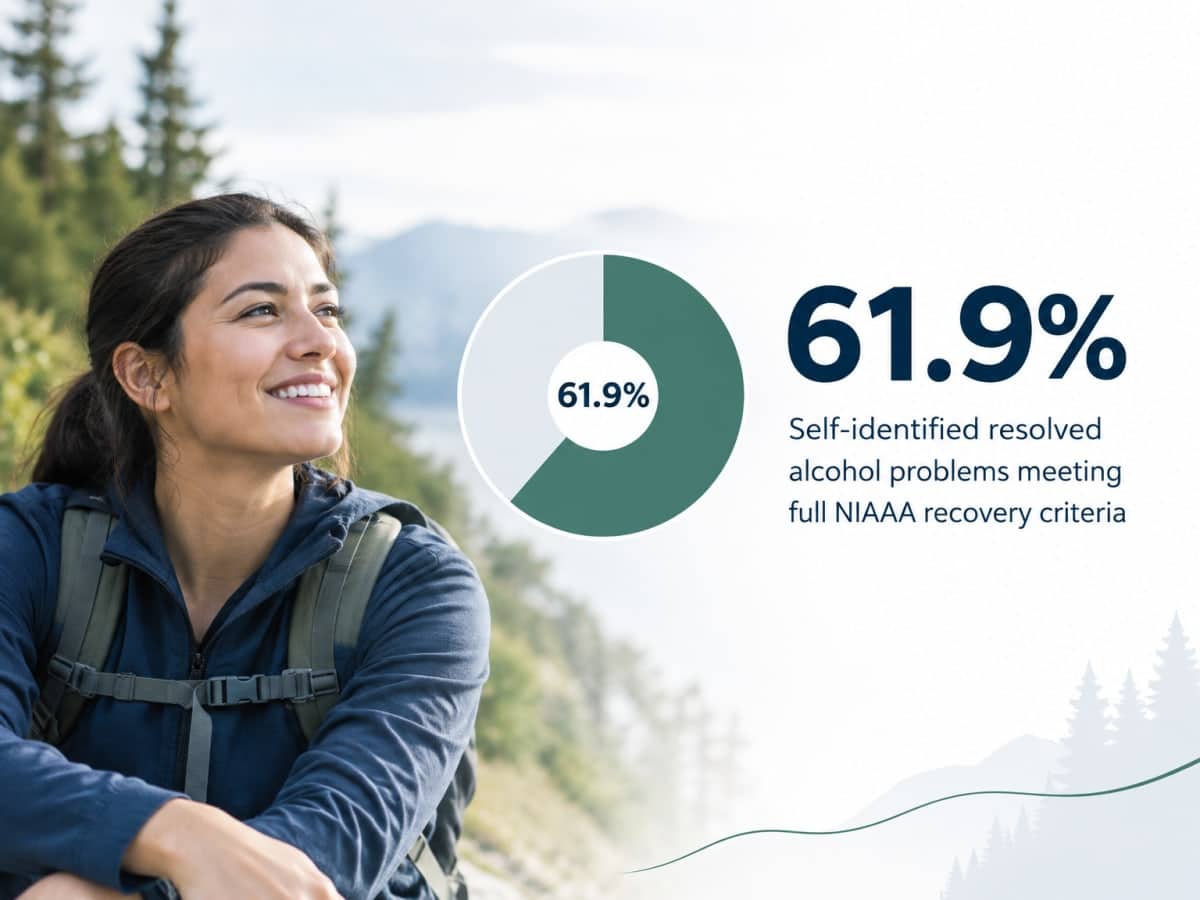
A 2024 latent class analysis tested NIAAA’s definition against how people actually describe themselves. In a cross-sectional online sample of adults who said they had resolved an alcohol problem, 61.9% met NIAAA’s full clinical recovery criteria 3. That is a specific group, people who already identified as having resolved their drinking, not a general population estimate. Still, the number tells you something important: a meaningful share of people who feel done with alcohol are still experiencing patterns a clinician would flag, including continued heavy drinking episodes alongside fewer reported symptoms 3.
Why does this matter for you or someone you love? Because the plan you build after detox should match where you actually are, not just where you feel you are. If you feel steady but still drink heavily on weekends, the clinical picture says you are at real risk for relapse into full AUD. If you have cut out alcohol entirely but your sleep, mood, or relationships still feel wrecked, the clinical picture says your recovery is underway and the deeper repair is still coming.
Honest self-assessment, paired with a clinician who can see what you cannot, is how you close that gap. It is also why detox programs that hand you a discharge paper without a connected next step tend to leave people stranded in exactly this blind spot.
Why Detox Is the Start, Not the Finish
What Medically Supervised Withdrawal Does and Doesn’t Fix
Detox has one job, and it does that job well: get you through acute alcohol withdrawal safely, with your vital signs stable and the worst physical symptoms managed. At Pacific Crest Trail Detox, a non-hospital residential setting with 24/7 nursing, that typically takes about 8 to 10 days. By the end of it, your body is no longer in crisis.
What detox does not do is treat the disorder underneath. NIAAA is explicit on this point. Detox is a critical first step, but it is not, by itself, alcohol treatment 6. The brain changes that drove heavy drinking, the stress responses that still fire when you pass a familiar bar, the sleep problems, the shame, the unaddressed anxiety or trauma, none of those get resolved by clearing alcohol from your system.
Here is what that means in practical terms. If you leave a detox bed without a clear next step, you are being handed a stabilized body and asked to protect it with the same coping tools that got you here. Recovery supports that come next, including medication for cravings or withdrawal and different forms of therapy, are what move you from stabilized to actually treated 11. The handoff is the plan.
Why Alcohol Withdrawal Needs Medical Supervision
This is also why trying to stop cold at home, or tapering yourself without medical guidance, is the wrong move if you have been drinking heavily or daily. You need people who can monitor your vitals, adjust medication, and get you to a higher level of care if something turns.
Oregon regulators treat the standards for this seriously. State rules for residential withdrawal management require a registered nurse on duty at the program site at all times and written procedures for immediate transportation to a general hospital in a medical emergency 10. When you evaluate a detox program in the Portland metro or SW Washington, those are baseline questions worth asking: who is on site overnight, and what happens if something goes sideways at 3 a.m.
What Recovery Can Look Like Across the First Year
Days 1-10: Stabilization and the Body Coming Back Online
The first days of recovery are physical. In a medically supervised setting, your care team manages blood pressure, heart rate, tremor, nausea, and the risk of serious complications with medication and round-the-clock monitoring. Alcohol withdrawal can be life-threatening, which is why this stage belongs in a program with 24/7 nursing, not in a spare bedroom.
Expect sleep to be fractured. Expect appetite to come and go. Expect your emotions to feel loud and strange, sometimes relief and sometimes grief, often inside the same hour. None of that means something is wrong with you. It means your nervous system is recalibrating after months or years of adapting to alcohol.
At Pacific Crest Trail Detox, this stabilization window typically runs about 8 to 10 days. By the end of it, most people are medically stable, eating regular meals, and sleeping in longer stretches. That is the handoff point. NIAAA is clear that detox is a critical first step but not, by itself, treatment 6. The question that matters now is where you go next, and whether someone has already helped you book it.
Weeks 2-4: Cravings Peak, Sleep Shifts, Fog Starts to Lift
Once the acute physical stuff settles, a different stage begins. Cravings often spike in weeks two and three, sometimes triggered by nothing you can name. A song in a grocery store. Friday at 5 p.m. The smell of someone else’s beer. Your brain is still looking for the shortcut it learned, and the pathways do not go quiet overnight.
Here is the reframe worth holding onto: a craving is not a relapse, and it is not evidence that recovery is not working. NIAAA includes craving as the one AUD symptom that can persist even when the disorder is in remission 1. Wanting a drink and being well are not mutually exclusive.
Sleep usually keeps shifting during this window. Vivid dreams are common. Mornings often get easier before evenings do. The mental fog that made simple decisions feel heavy in week one tends to loosen, and you may notice you can read a page without rereading it three times. This is also when structured outpatient care, medication decisions, and a steady weekly schedule start carrying real weight.
Months 1-3: Structured Care, Medication Decisions, Routine
Months one through three are where recovery stops being an emergency and starts becoming a life. For most people, this means stepping into a structured outpatient program, often a partial hospitalization program (PHP) or an intensive outpatient program (IOP), where you spend several hours a day or several days a week in group and individual therapy while sleeping at home or in supportive housing.
This is also when medication decisions tend to stabilize. If naltrexone, acamprosate, or disulfiram is part of your plan, your prescriber watches how you are tolerating it, whether cravings are easing, and whether the dose or option needs to change 7. AHRQ guidance recommends individualized follow-up: higher-risk patients may need weekly check-ins at first, while lower-risk patients can be seen less often 5. If your provider is not asking about side effects and craving intensity at each visit, that is a flag worth raising.
Routine does a lot of quiet work in this window. Regular sleep, regular meals, regular groups, regular movement. None of it is dramatic. All of it is what gives the harder internal work, the trauma, the shame, the relationships, something stable to land on.
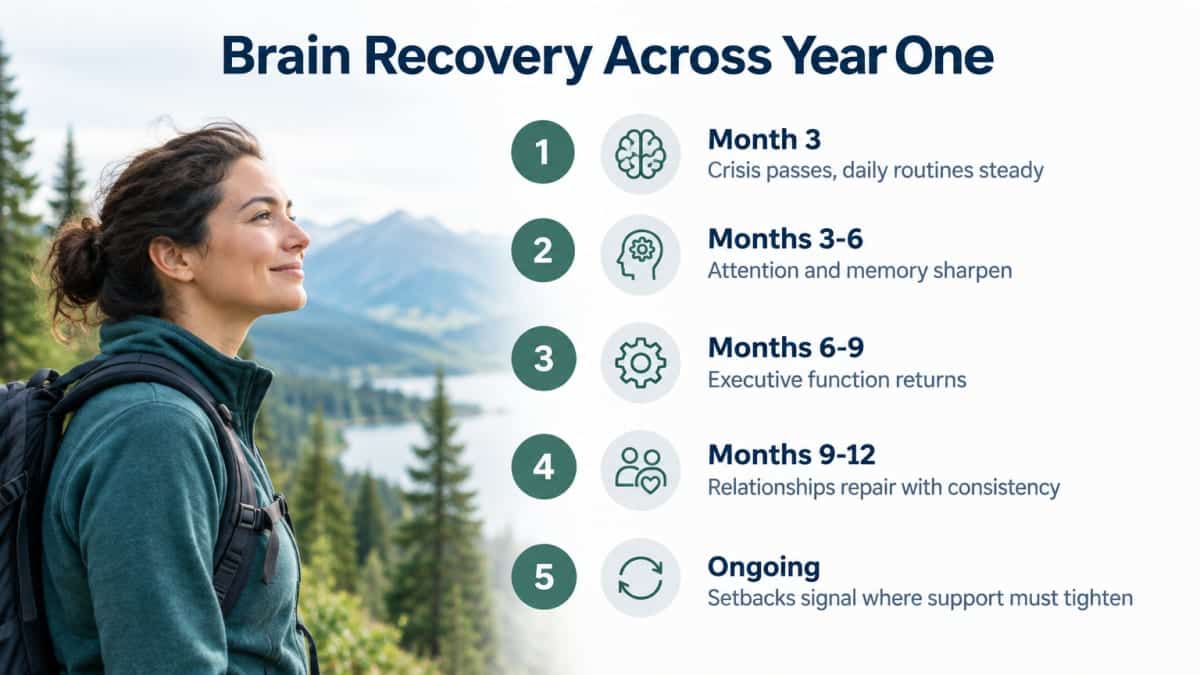
Months 3-12: Brain Healing, Relationship Repair, Real Life
From roughly month three onward, recovery gets quieter and, in some ways, more interesting. The crisis has passed. The real question becomes what kind of life you are building around sobriety.
Your brain is still healing in this window, and that is not a figure of speech. A 2024 systematic review of 18 longitudinal studies, with follow-up periods ranging from 14 to 18 days all the way out to 24 months, found that several neuropsychological functions, including attention, memory, and executive function, recover gradually with prolonged abstinence from alcohol 2. Timing and degree vary from person to person, and the review is careful not to promise an exact schedule. The direction, though, is real: the longer you stay off heavy drinking, the more your thinking tends to come back online.
You may notice it in small ways first. You remember names again. You can hold a plan for the week in your head. You can sit through a hard conversation with your partner without flooding. Relationships that frayed start to have room to repair, slowly, as you prove with time that the person at the dinner table is going to be the same person tomorrow.
This is also when continuing care, mutual support, and relapse-prevention skills do their heaviest lifting. A setback in this window is not the end of recovery. It is information about what support needs to tighten up next.
What Continuing Care After Detox Should Include
Medication: Three FDA-Approved Options for AUD
Medication is not a crutch, and it is not a moral question. For some people in recovery, it is the thing that keeps a craving from turning into a drink long enough for the other work to take hold.
NIAAA identifies three FDA-approved medications for alcohol use disorder: naltrexone, acamprosate, and disulfiram 7. Each works differently, and a prescriber who knows AUD can walk you through how each one is used.
These medications can be used on their own or alongside counseling, and the right fit depends on your history, your health, and what you are trying to protect against 8. If medication is not part of the conversation after detox, ask why.
Counseling, Groups, and Mutual Support
Counseling is where the harder questions get asked. Why does Thursday night hit you so hard? What do you do with the anger that used to get drowned? How do you stay in a marriage you half-wrecked and want to rebuild? Individual therapy, group therapy, and family or couples sessions each handle a different piece of that work, and most structured outpatient programs weave them together across the week.
Mutual support is a different animal, and it earns its own place. NIAAA notes that mutual-support groups can add flexible, low-cost support to professional treatment 8. Twelve-step meetings like AA are one option. SMART Recovery, Refuge Recovery, and online peer communities are others. The point is not which room you sit in. The point is that recovery holds better when you are not the only person in your life who understands what you are carrying.
If a program only offers one flavor of support and treats the rest as optional, that is worth noticing. People are different. The scaffolding should bend to the person, not the other way around.
Active Outreach: The Follow-Up Most Programs Skip
Here is the piece that separates programs that look good on paper from programs that actually hold people. A peer-reviewed review of continuing care for substance use disorders found that four of six methodologically rigorous AUD trials showed significantly better drinking outcomes when continuing care included active outreach beyond usual care 9. Translation: when the program calls you, not just the other way around, people do better.
Active outreach looks like a case manager who checks in by phone, text, or video on a schedule you agreed to. AHRQ guidance on medication follow-up points in the same direction, recommending individualized check-ins where higher-risk patients may be seen weekly at first and lower-risk patients less often 5. The cadence should match your risk, not a billing calendar.
It also looks like someone who notices when you miss a group and reaches out before a quiet week becomes a lost month. If you have a setback, active outreach means a program that helps you reconnect to care instead of closing your chart.
When you are evaluating what comes after detox, ask the direct question: who calls me if I disappear, and how fast? If the answer is vague, keep looking.
How to Tell if a Recovery Plan Is Actually Working
A recovery plan is working when the clinical floor holds and the life around it is slowly getting bigger. On the clinical side, that means heavy drinking has stopped and the AUD symptoms you walked in with, apart from craving, are fading rather than cycling back 1, 6. Craving can still show up. What matters is whether it is decreasing in frequency and whether you have tools and support to ride it out without a drink.
Watch for small, boring signs of progress. Sleep that lasts most of the night. Appetite that shows up on a schedule. A morning you do not dread. The ability to remember a conversation from yesterday. These are the markers the research on neuropsychological recovery is pointing at when it describes gradual improvement in attention, memory, and executive function with sustained abstinence 2.
On the care side, a plan that is working feels active. Your prescriber is asking about side effects and craving intensity, not just refilling a script 5. Groups and individual sessions are tackling the real stuff, not killing time. Someone from the program notices when you miss a check-in and reaches out, because that kind of outreach is tied to better drinking outcomes 9.
If none of that is happening, the plan is not working yet. Say so out loud, and ask what changes next.
Finding Care in Oregon and SW Washington
If you live in the Portland metro, Milwaukie, Gresham, Beaverton, Salem, or Vancouver, WA, you have more options now than you did five years ago. Oregon’s Alcohol and Drug Policy Commission named rapid access to treatment and expanded recovery supports among its major strategic goals in its July 2024 report, and the state has been building out peer services, recovery community centers, and recovery housing to back that up 4. Access still varies by region and payer, so moving quickly when someone is ready matters.
When you call a residential detox program, ask a few direct questions. Is a registered nurse on duty on site at all times? Are there written procedures for immediate transportation to a general hospital if a medical emergency happens? Both are baseline requirements under Oregon’s administrative rules for withdrawal management, and a program that cannot answer cleanly is not the one you want at 2 a.m. 10.
Then ask what happens after discharge. A good program already has your next step scheduled, whether that is a partial hospitalization program, an intensive outpatient program, medication follow-up, or active outreach from a case manager. Pacific Crest Trail Detox is a non-hospital, home-like medical detox in Milwaukie that connects clients directly into continuing care, and the team there often says it this way: we want to be your last treatment experience, whether we’re your first detox or your fifth. If you are ready to talk, a confidential, HIPAA-protected call or an insurance verification is the next move. You do not have to have it all figured out before you reach out.
See What Alcohol Recovery Care May Cover
Check your coverage for medically supported detox and continued care as you consider what comes next.
Frequently Asked Questions
Is recovery from alcoholism the same as being sober?
Not exactly. Sobriety means you are not drinking. Recovery, as NIAAA defines it, means your alcohol use disorder symptoms are in remission (craving excepted) and you have stopped heavy drinking, usually alongside better health, relationships, and daily functioning 1, 6. You can be sober today and still be early in recovery.
How long does it take to recover from alcohol use disorder?
There is no fixed clock. At Pacific Crest Trail Detox, medically supervised withdrawal typically lasts about 8 to 10 days. A 2024 systematic review of 18 longitudinal studies found that attention, memory, and executive function recover gradually across follow-up periods ranging from about two weeks to 24 months, with timing varying by person 2. Expect months, not weeks.
Can you recover from alcoholism without medication?
Yes, many people do. Medication is one option, not a requirement. NIAAA lists three FDA-approved medications for AUD, naltrexone, acamprosate, and disulfiram, that can be used alone or with counseling 7, 8. Counseling, mutual-support groups, and structured follow-up can also carry recovery. A prescriber who knows AUD should walk you through the trade-offs.
What happens after detox at a program like Pacific Crest Trail Detox?
After PCTD’s typical 8 to 10 days of medically supervised withdrawal, most clients step into continuing care, often a partial hospitalization program, intensive outpatient program, or standard outpatient, with medication follow-up and active outreach from a case manager. The CDC describes this ongoing care as including medication to help with cravings and withdrawal as well as different forms of therapy 11. The handoff is scheduled before you leave.
Does a relapse mean recovery has failed?
No. A setback is information, not a verdict. NIAAA notes that setbacks are common during treatment and that many people recover 7. The response that matters is reconnecting to care quickly. A peer-reviewed review of continuing care found better drinking outcomes when programs used active outreach beyond usual care 9. The plan tightens; it does not end.
How do I know if I or a loved one needs medically supervised detox?
If you drink heavily or daily and have ever had shakes, sweats, racing heart, nausea, or seizures when you cut back, you need medical supervision. Alcohol withdrawal can be life-threatening. Oregon rules for residential withdrawal management require a registered nurse on site at all times and procedures for immediate hospital transport in an emergency, which is the baseline to ask about 10.
References
- Support Recovery: It’s a Marathon, Not a Sprint. https://www.niaaa.nih.gov/health-professionals-communities/core-resource-on-alcohol/support-recovery-its-marathon-not-sprint
- Recovery of neuropsychological function following abstinence from alcohol in adults diagnosed with an alcohol use disorder: Systematic review of longitudinal studies. https://pmc.ncbi.nlm.nih.gov/articles/PMC10760842/
- Assessing NIAAA’s Definition of Recovery from Alcohol Use Disorder: A Latent Class Analysis of a Heterogeneous Online Sample. https://pmc.ncbi.nlm.nih.gov/articles/PMC11567663/
- July 2024 Report – Oregon.gov. https://www.oregon.gov/adpc/SiteAssets/Pages/reports/July%202024%20Report%20FINAL%20-%20Updated%20September%202024.pdf
- Overview of Medications Used in the Treatment of Alcohol Use Disorder. https://integrationacademy.ahrq.gov/sites/default/files/2022-11/Medications%20for%20Alcohol%20Use%20FAQ.pdf
- Alcohol Use Disorder: From Risk to Diagnosis to Recovery. https://www.niaaa.nih.gov/health-professionals-communities/core-resource-on-alcohol/alcohol-use-disorder-risk-diagnosis-recovery
- Understanding Alcohol Use Disorder. https://www.niaaa.nih.gov/publications/brochures-and-fact-sheets/understanding-alcohol-use-disorder
- Treatment for Alcohol Problems: Finding and Getting Help. https://www.niaaa.nih.gov/publications/brochures-and-fact-sheets/treatment-alcohol-problems-finding-and-getting-help
- Impact of Continuing Care on Recovery From Substance Use Disorder. https://pmc.ncbi.nlm.nih.gov/articles/PMC7813220/
- Behavioral Health Services – Chapter 309. https://www.oregon.gov/oha/HSD/RAC/309-018.pdf
- Treatment of Substance Use Disorders. https://www.cdc.gov/overdose-prevention/treatment/index.html