


Key Takeaways
- Admission depends on three separate yes/no checks: whether the plan covers substance-use care, whether the facility works with that plan, and whether the specific level of care gets authorized.
- If you can’t find your insurance card, call the facility anyway and read whatever details you have, since admissions teams run verification faster than you can decode a plan yourself.
- Match the card you’re holding to one of five plan types—employer, Marketplace, Medicaid/OHP, Medicare, or self-pay—to know what to expect before dialing.
- A short phone script asking for urgent verification of benefits, cost estimates, and expedited prior authorization gets you a real answer in under an hour.
- Parity law requires substance-use coverage to be no more restrictive than medical coverage 2, but it doesn’t force any plan to cover every level of care.
- Impacted plans generally must decide expedited prior-authorization requests within 72 hours and standard ones within seven calendar days 11, so always ask that detox be marked urgent.
- Ask whether medication for opioid or alcohol withdrawal falls under the medical or pharmacy benefit, because insurers authorize detox stays and medications separately 7.
- A denial can be reversed through written medical-necessity criteria requests, peer-to-peer review, and, for OHP members, a 60-day CCO appeal window 18.
The card in your wallet is not the whole answer
If you’re reading this with shaky hands, or making calls for someone you love who can’t make them right now, take a breath. You are already doing the hardest part. Picking up the phone when you don’t know what your insurance will cover is scary, and it’s also completely normal. Most people in your spot don’t know the difference between a PPO and an HMO, let alone whether their plan counts detox as an “essential health benefit.” You don’t need to know any of that to get a straight answer today.
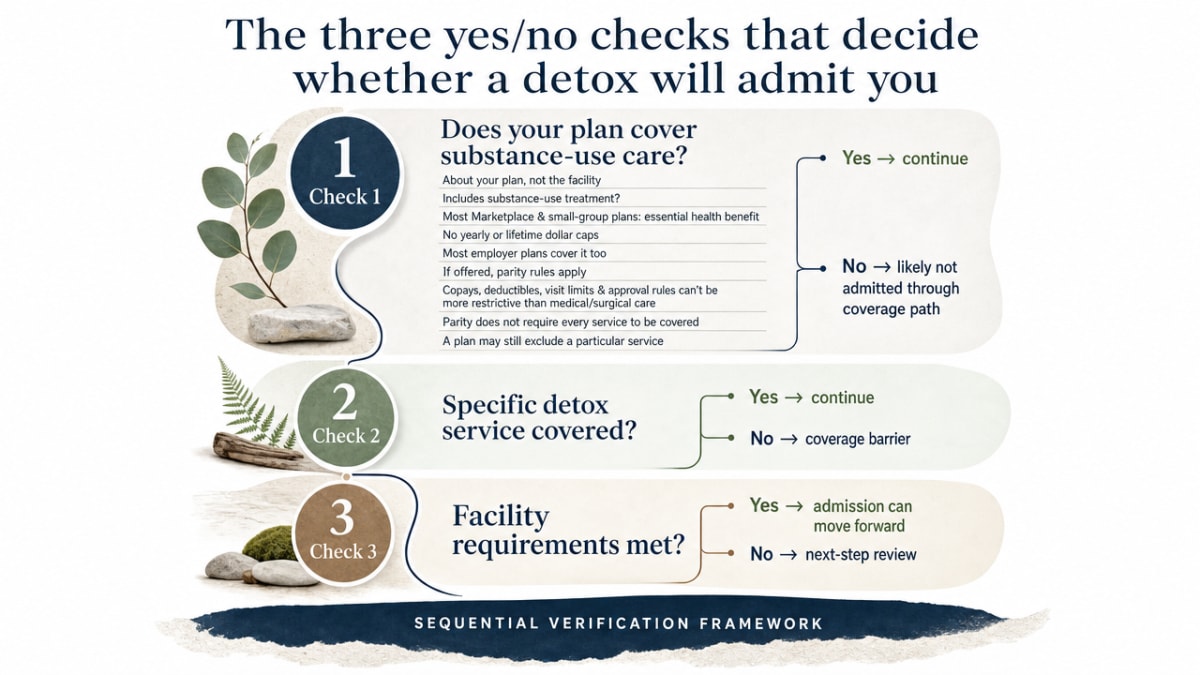
Here is what matters right now: the card in your wallet, or the one you can’t find, is only one piece of three. A detox facility can admit you when the plan covers substance-use care, the facility can work with that plan, and the specific level of care you need is approved. Each of those is a separate yes or no. Once you understand that, you can call any detox that works with multiple insurance providers in the country and get a real answer in under an hour.
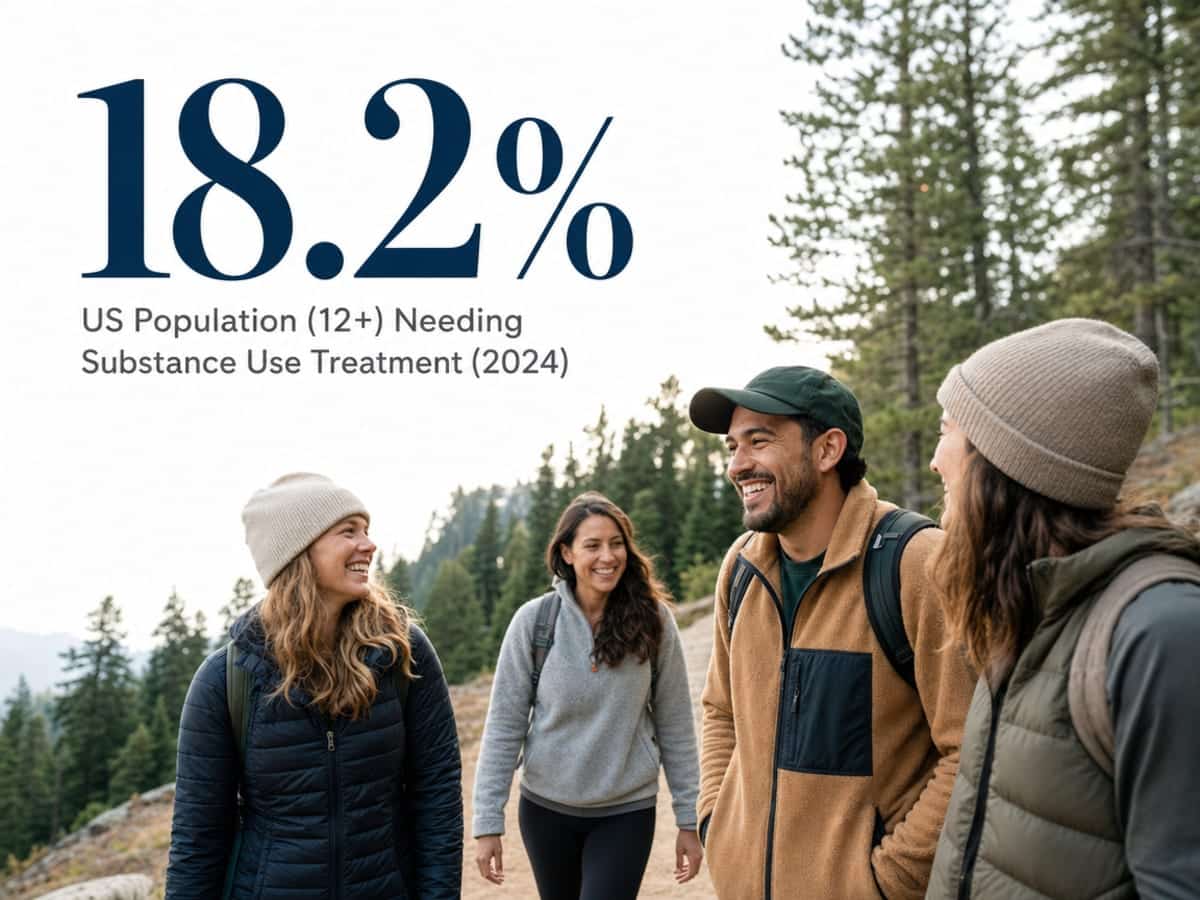
The stakes are worth naming. In 2024, 52.6 million people age 12 or older—18.2% of that group—needed substance-use treatment, and only about 10.2 million, roughly 19.3%, actually received it 20. A lot of that gap is the phone call you’re about to make. The good news is that insurance confusion is a solvable problem, usually within the same day. Pacific Crest Trail Detox, a home-like medical detox in Milwaukie, Oregon, will run those checks for you fast, even if you can’t name your carrier yet. You don’t have to figure this out alone.
The three yes/no checks that decide whether a detox will admit you
Check one: does the plan actually cover substance-use care
The first question has nothing to do with the facility. It’s about your plan. Does it include substance-use treatment at all, and if so, what kind?
Most plans today do. Non-grandfathered Marketplace plans and small-group plans must cover mental-health and substance-use services as essential health benefits, with no yearly or lifetime dollar caps on those benefits 3. Most employer plans cover them too, and the federal parity law says that when a plan does offer substance-use benefits, the copays, deductibles, visit limits, and approval rules can’t be more restrictive than what the plan uses for medical and surgical care 2.
Here’s the honest part: parity doesn’t force any plan to cover every service. A plan can comply with the law and still exclude a particular level of care, like residential treatment 2. That’s why you can’t skip this check, even if someone tells you “all plans cover detox now.”
The fastest way to answer this yourself is to look at the Summary of Benefits and Coverage that came with your plan, or ask the member-services line one question: “Does my plan cover substance-use disorder treatment, including medical detox?” If you don’t have the paperwork, that’s fine. The facility can pull most of this for you from your member ID. One check down.
Check two: can the facility work with that plan
Now the question swings over to the facility. Being covered for detox and being covered at this particular detox are not the same thing.
A facility can be in-network, which usually means the lowest out-of-pocket cost for you. It can be out-of-network but still able to bill your plan, sometimes with a higher cost share, sometimes negotiated down through a single-case agreement. Or it can be a cash-pay-only program that doesn’t work with insurance at all. Licensing is a separate question again. In Oregon, a residential detox has to be licensed by the state to admit anyone for withdrawal care 15, 17, but a licensed facility can still be out-of-network for your specific plan.
This is where a good admissions team earns their keep. When you call Pacific Crest Trail Detox, you don’t have to know whether you’re in-network. The team runs a verification of benefits against your plan, usually in well under an hour, and tells you plainly what the facility can and can’t do with the card you have. If the answer is “we can admit you but there’s a cost share,” you’ll hear that number before you say yes. Two checks down.
Check three: is the specific level of care authorized
The third check is the one most people don’t know exists, and it’s the one that creates billing surprises later. Even when your plan covers substance-use care and the facility can work with your plan, the insurer still has to approve the specific level of care your clinical team recommends.
Medical detox, sub-acute detox, residential treatment, partial hospitalization, intensive outpatient, standard outpatient, and medication treatment are all different levels. Each one has its own medical-necessity criteria. A plan might approve five days of medical detox and then expect you to step down to outpatient, when your clinicians think you need residential care next. That’s a coverage decision, not a clinical one, and it can be appealed.
Federal rules now push plans to answer faster. Under the CMS prior-authorization rule, impacted payers generally have to decide urgent requests within 72 hours and standard requests within seven calendar days 11. Ask the facility to request expedited review for detox admission, since withdrawal from alcohol or benzodiazepines can be life-threatening. When all three checks come back yes, you have a real admission, not a maybe. That’s the whole framework.
If you don’t know what insurance you have, start here
Not knowing what plan you have is more common than you think. People lose cards. They start new jobs. They get added to a parent’s plan, then age out, then get added again. If you can’t name your carrier right now, that is not a reason to put the call off. It’s a reason to make the call sooner, because the admissions team is faster at this than you are.
Start with what you can find in the next ten minutes. Look for a plastic insurance card in your wallet, your car, or a drawer at home. If someone else manages the household paperwork, text them. Check your phone wallet app, since many insurers now store a digital card there. Look at the last medical bill or pharmacy receipt you got, because the plan name is usually printed on it. If you’re on a parent’s or spouse’s plan, their card is your card.
If none of that turns up anything, you still have options. If you have a job, your HR team can tell you your plan in one email. If you’re on Medicaid, in Oregon that’s the Oregon Health Plan, and members can seek substance-use help without a primary-care referral 14. If you’re uninsured, say so plainly when you call; a good detox will tell you about self-pay rates and help you look at coverage you may qualify for.
Then call the facility and read whatever you’ve got out loud. Your name, date of birth, and the member ID number on the card are usually enough for a verification of benefits. Pacific Crest Trail Detox will run that check for you fast, often while you’re still on the phone, so you don’t have to decode the card yourself. One call, one list of what you have, and you’re already past the hardest part.
A coverage-check table for the five plan types most people are holding
You don’t have to memorize insurance rules to use this. Match the card in your hand (or the one you can’t find) to one of the five rows below, and you’ll know what to expect before you dial.
| Plan type | Does the plan cover substance-use care? | Can the facility work with the plan? | Is the specific level of care authorized? |
|---|---|---|---|
| Employer-sponsored (job-based) | Usually yes. When the plan offers substance-use benefits, parity rules say the copays, limits, and approval rules can’t be tougher than for medical care 2. | Depends on network. Ask whether the facility is in-network, out-of-network with billing, or self-pay only. | Medical detox and residential care usually need prior authorization. Ask the facility to request expedited review for withdrawal. |
| ACA Marketplace (healthcare.gov or state exchange) | Yes. Non-grandfathered Marketplace plans must cover substance-use services as essential health benefits, with no yearly or lifetime dollar caps on those benefits 3. | Varies by carrier and metal tier. Out-of-network coverage is often limited or excluded on narrower networks. | Prior authorization applies for most inpatient levels. The medical-necessity criteria must be available on request. |
| Medicaid / Oregon Health Plan (OHP) | Yes. OHP covers substance-use treatment, and members don’t need a primary-care referral to get help for alcohol or drug problems 14. | Depends on the facility. Pacific Crest Trail Detox does not accept OHP; a licensed OHP-contracted provider or your CCO can point you to one that does. | Authorization runs through the member’s coordinated-care organization (CCO). |
| Medicare (65+ or disability) | Yes, for covered substance-use services, with Part A, Part B, and Part D rules depending on the setting and medication. | Depends on the facility. Ask whether the detox accepts Original Medicare, a Medicare Advantage plan, or neither. | Advantage plans often require prior authorization; Original Medicare usually does not for covered inpatient care. |
| Uninsured / self-pay | Not through a plan. Ask about self-pay rates, sliding-scale options, and short-term coverage you may qualify for. | Many facilities accept private pay. Get the total cost in writing before admission. | No insurer authorization, but the facility’s clinical team still decides level of care. |
A quick word on the honest limits of this grid. Parity doesn’t force any plan to cover every service, which is why the first column says “usually” instead of “always” 2. And a licensed Oregon facility can still sit outside your plan’s network, which is why the second column matters as much as the first 15. If you’re an OHP member, that’s not a dead end; Pacific Crest Trail Detox doesn’t take OHP, but the admissions team can help you find a program that does. Whatever row you’re in, the next move is the same: call, read what’s on the card, and let someone run the three checks with you.
The phone script that gets you a straight answer in under an hour
You don’t have to be smooth on the phone. You just need to say the right few things in the right order, and the person on the other end will do most of the work. Here is a script you can read word-for-word.
Start with:“Hi, I need medical detox. I may not have all my insurance details, but I want to find out if you can admit me today. Can you run a verification of benefits for me?”That one sentence tells the admissions team the three things they need to know: this is urgent, you want help right now, and you’re asking them to do the insurance work.
Then hand them whatever you have. Read your name, date of birth, and the member ID and group number from the card. If you don’t have a card, say so, and give them your Social Security number or your employer’s name so they can look you up. If you’re on someone else’s plan, give the subscriber’s name and date of birth too.
Next, ask these four questions in a row and write the answers down:
- Is my plan one you can work with, in-network or out-of-network?
- What will my out-of-pocket cost look like for medical detox?
- Does my plan need prior authorization, and will you request it as urgent?
- When could I be admitted?
Under federal rules, impacted plans generally have to answer urgent prior-authorization requests within 72 hours 11, so “urgent” is the word to use. If anything in the answers is unclear, say, “Can you say that again in plain English?” That’s a totally fair request. You just ran the three checks in one call. That’s a real win.
Parity law is a lever, not a guarantee
You may have heard that insurance has to cover addiction treatment the same as any other health condition now. That’s roughly true, and it’s a useful thing to know when you’re on the phone. It’s also not the whole story, and the difference matters.
The federal parity law, the Mental Health Parity and Addiction Equity Act, says that when a plan offers substance-use benefits, the copays, deductibles, visit limits, and approval rules can’t be more restrictive than what the plan uses for comparable medical and surgical care 2. The September 2024 final rules went further, tightening how plans handle things like prior authorization, step therapy, and provider-network standards for substance-use care. Most of those requirements started phasing in with plan years beginning in 2025, with more arriving in 2026 1. If a plan’s process makes detox clearly harder to get than, say, a cardiac admission, the plan is expected to fix that 8.
Here’s the lever part. If a rep tells you detox needs blanket preauthorization or that your plan automatically excludes a licensed detox facility, those are the exact warning signs federal regulators flag as needing a closer look 4. You can say, out loud, “That sounds like a nonquantitative treatment limitation. Can you send me the medical-necessity criteria you’re using?” Plans generally have to provide that information within 30 days when you ask 7.
How fast the plan has to answer: the 72-hour and 7-day windows
When you’re shaking in a parking lot or helping someone through their second night of alcohol withdrawal, “we’ll get back to you” is not an answer. Here’s the good news: federal rules now put real numbers on how long certain plans can take to decide whether they’ll authorize detox.
Under the CMS Interoperability and Prior Authorization Final Rule, impacted payers generally have to answer expedited prior-authorization requests within 72 hours and standard requests within seven calendar days 11. Expedited is the lane you want for detox. Withdrawal from alcohol or benzodiazepines can cause seizures and death, and that’s exactly the kind of situation the urgent track exists for. The rule phases in primarily in 2026 and doesn’t apply to every insurer or every service, but it has already shifted what admissions teams can reasonably push plans to do 10.
When you call, say two specific things. First: “Please mark this as an urgent prior-authorization request.” Second: “My plan has 72 hours to respond, correct?” Writing down the time and date of the request matters. If the clock runs out, that’s a fact the facility’s billing team can use, not a feeling you have to argue about.
Two honest caveats. A faster answer is not the same as a yes; the plan can still deny based on medical necessity 10. And response windows don’t fix a plan that simply excludes a level of care. Still, knowing the clock exists changes the call. You stop asking and start timing.
Medication for opioid and alcohol withdrawal: a separate coverage question
Medication is often the piece that keeps detox safe, and it’s also the piece people forget to ask about on the first call. Buprenorphine or methadone for opioid withdrawal, and benzodiazepines on a short taper for alcohol withdrawal, are standard medical care, not optional add-ons 22. But insurance treats medication as its own line item, with its own authorization rules, often run through the pharmacy benefit instead of the medical benefit.
That split matters. A plan can approve your detox stay and still deny a specific medication, or cover the medication but not the clinician visit that goes with it. Among people age 12 or older with past-year opioid use disorder in 2024, only 17.0% received medication for it 21. Some of that gap is stigma. A real share of it is coverage friction people never pushed back on.
When you call, add one question to your list: “Does my plan cover medication-assisted treatment for withdrawal, and is it under the medical or pharmacy benefit?” If a plan tries to require you to fail a non-medication detox first, ask for the written step-therapy criteria 7. You’re allowed to see them.
When the answer is no: appeals, escalation, and the Oregon path
A denial is not the end of the conversation. It’s the start of a different one. Plans deny detox stays all the time, and plans also reverse those denials when someone pushes back with the right information. The first thing to do when you hear no is ask for it in writing, including the specific reason and the medical-necessity criteria the plan used. You have the right to those criteria, and the plan generally has to send them within 30 days of your request 7.
The second thing is to let the facility’s utilization team run a peer-to-peer review. That’s a doctor-to-doctor call where the facility’s clinician argues your case directly to the plan’s reviewer. Peer-to-peer reversals happen often, especially when a denial relied on blanket preauthorization or an automatic facility-type exclusion, both of which federal regulators flag as warning signs that may be improper 4. Say the word “parity” on the call. Ask whether the standard being applied to detox is the same one the plan uses for comparable medical admissions 8.
If you’re on the Oregon Health Plan, the path is clearer and the clock is specific. You have 60 days from the notice of adverse benefit determination to file an appeal with your coordinated-care organization, and 120 days after the appeal decision to request an administrative hearing with the Oregon Health Authority 18. Pacific Crest Trail Detox does not accept OHP, but a CCO-contracted detox can, and your CCO is required to help you find one. Denials are hard. They are also beatable more often than people expect.
Getting admitted without a billing surprise
The last mile is where people get hurt financially, and it’s the easiest part to protect yourself on. Before you say yes to a bed, ask the admissions team to put four things in writing: the expected daily rate or bundled price, your estimated out-of-pocket cost based on the verification of benefits, whether the prior authorization is approved or still pending, and what happens if the plan later denies any portion of the stay. A good facility will send that in an email while you’re still on the line.
However you’re covered, Pacific Crest Trail Detox will run the verification, request urgent authorization, and give you the numbers in plain English before you commit. That’s the admission you want.
Check Your Coverage for Safe, Supported Detox
Find out quickly if your insurance covers detox and recovery support here.

Frequently Asked Questions
What if I don’t know what kind of insurance I have?
That’s okay, and it’s common. Grab any card you can find, a recent medical bill, or a pharmacy receipt, since the plan name is usually printed on them. If you have a job, HR can tell you in one email. Then call a detox and read what you’ve got out loud; the admissions team can look up the rest from your name, date of birth, and member ID.
Can a detox facility turn me away if I’m out-of-network?
A facility can decline to admit you, but out-of-network doesn’t automatically mean no. Many detoxes bill out-of-network plans, sometimes through a single-case agreement, often at a higher cost share. Ask for the estimated out-of-pocket number in writing before you say yes. If the cost is too high, ask the admissions team to help you find an in-network option so you don’t lose the day.
How long does it take to get prior authorization for detox?
It depends on the plan and whether the request is marked urgent. Under the CMS prior-authorization rule, impacted payers generally have to decide expedited requests within 72 hours and standard requests within seven calendar days 11. Withdrawal from alcohol or benzodiazepines qualifies as urgent. Ask the facility to request expedited review and write down the date and time the request was submitted.
Does parity law mean my plan has to cover detox?
Not exactly. The parity law says that when a plan offers substance-use benefits, the copays, limits, and approval rules can’t be more restrictive than for comparable medical care 2. It does not force every plan to cover every service, so a plan can comply with parity and still exclude a specific level of care 2. Check your Summary of Benefits and Coverage for what’s actually included.
What happens if my insurance denies the detox stay?
A denial is not the end. Ask for it in writing with the medical-necessity criteria, which the plan generally has to provide within 30 days of a request 7. Let the facility’s clinician do a peer-to-peer review with the plan’s reviewer. If you’re on the Oregon Health Plan, you have 60 days to appeal to your CCO and 120 days after that for an administrative hearing 18.
Does the Oregon Health Plan cover detox at Pacific Crest Trail Detox?
No. Pacific Crest Trail Detox does not accept the Oregon Health Plan. The good news is that OHP does cover substance-use treatment, including detox, and members don’t need a primary-care referral to seek help 14. If you’re an OHP member, call your coordinated-care organization or ask the PCTD admissions team; they can point you toward a licensed OHP-contracted detox so you don’t lose time.
References
- Departments of Labor, Health and Human Services, Treasury Issue Final Rules Strengthening Access to Mental Health and Substance Use Disorder Care. https://www.cms.gov/newsroom/press-releases/departments-labor-health-and-human-services-treasury-issue-final-rules-strengthening-access-mental
- The Mental Health Parity and Addiction Equity Act (MHPAEA). https://www.cms.gov/marketplace/private-health-insurance/mental-health-parity-addiction-equity
- Health Coverage Options for Consumers with Mental Health and Substance Use Disorders. https://www.cms.gov/marketplace/technical-assistance-resources/coverage-mental-health-substance-use-disorders.pdf
- Plan or Policy Non-Quantitative Treatment Limitations (NQTLs) that Require Additional Scrutiny. https://www.cms.gov/cciio/resources/regulations-and-guidance/downloads/mhapeachecklistwarningsigns.pdf
- Mental Health and Substance Use Disorder Parity. https://www.dol.gov/agencies/ebsa/laws-and-regulations/laws/mental-health-and-substance-use-disorder-parity
- New Mental Health and Substance Use Disorder Parity Rules. https://www.dol.gov/agencies/ebsa/laws-and-regulations/laws/mental-health-parity/new-mhpaea-rules-what-they-mean-for-providers
- Understanding Your Mental Health and Substance Use Disorder Benefits. https://www.dol.gov/agencies/ebsa/about-ebsa/our-activities/resource-center/publications/understanding-your-mental-health-and-substance-use-disorder-benefits
- New Mental Health and Substance Use Disorder Parity Rules. https://www.dol.gov/agencies/ebsa/laws-and-regulations/laws/mental-health-parity/new-mhpaea-rules-what-they-mean-for-participants-and-beneficiaries
- 2024 MHPAEA Report to Congress. https://www.cms.gov/files/document/2024-mhpaea-report-congress.pdf
- FACT SHEET: CMS Interoperability and Prior Authorization Final Rule. https://www.cms.gov/files/document/fact-sheet-cms-interoperability-and-prior-authorization-final-rule-cms-0057-f.pdf
- CMS Finalizes Rule to Expand Access to Health Information and Improve Prior Authorization Process. https://www.cms.gov/newsroom/press-releases/cms-finalizes-rule-expand-access-health-information-improve-prior-authorization-process
- GAO-22-104597, Mental Health Care: Access Challenges for Covered Consumers and Relevant Federal Efforts. https://www.gao.gov/assets/gao-22-104597.pdf
- Mental Health and Substance Use: State and Federal Oversight of Compliance with Parity Requirements Varies. https://www.gao.gov/products/gao-20-150
- Behavioral Health Coverage : Members. https://www.oregon.gov/oha/ohp/members/pages/behavioral-health.aspx
- Residential Treatment Facilities : Licensing and Certification. https://www.oregon.gov/oha/hsd/amh-lc/pages/rt.aspx
- Behavioral Health Services – Chapter 309. https://www.oregon.gov/oha/HSD/RAC/309-018.pdf
- PERMANENT ADMINISTRATIVE ORDER. https://www.oregon.gov/oha/HSD/HSDRules/415-012-changes-05102018.pdf
- Oregon Health Plan (OHP) Appeals and Hearings. https://www.oregon.gov/oha/HSD/OHP/pages/appeals-hearings.aspx
- BH-PP-Evaluation-Criteria-1221.xlsx. https://www.oregon.gov/oha/HSD/OHP/CCO/BH-PP-Evaluation-Criteria-1221.xlsx
- Results from the 2024 National Survey on Drug Use and Health. https://www.samhsa.gov/data/sites/default/files/reports/rpt56287/2024-nsduh-annual-national/2024-nsduh-annual-national-html-071425-edited/2024-nsduh-annual-national.htm
- SAMHSA Releases Annual National Survey on Drug Use and Health. https://www.samhsa.gov/newsroom/press-announcements/20250728/samhsa-releases-annual-national-survey-on-drug-use-and-health
- Treatment of Substance Use Disorders. https://www.cdc.gov/overdose-prevention/treatment/index.html