


Key Takeaways
- The first 72 hours follow three stages: evaluation, stabilization with round-the-clock nursing, and readiness planning for continuing care, which SAMHSA calls the baseline for a complete detox 2.
- Medically monitored detox, or ASAM Level 3.7, requires on-site nurses overnight, a reachable physician, structured symptom monitoring, and written next-step plans, verifiable through Oregon’s state licensing rule 3, 4.
- Heavy daily alcohol use or long-term benzodiazepine use carries seizure risk during withdrawal, and current guidelines recommend inpatient management rather than a home taper 11, 15.
- Not everyone needs inpatient care; fewer than 20% of alcohol withdrawal cases require admission, so a trustworthy intake team will steer lighter cases toward outpatient options 10.
- When you call, ask about licensing, 24-hour nurse and physician coverage, medication protocols, experience with your substance, aftercare planning, and insurance verification to gauge program quality 3, 14.
- A trustworthy program shows five markers: accreditation, appropriate medication use, evidence-based therapy, family involvement, and a real continuing-care plan sketched before discharge 14.
- Detox is the beginning, not the finish, with abstinence rates dropping from 68.1% at three months to 36.2% at twelve months, so continued support after discharge matters most 7.
- A capable intake team runs an insurance benefits check the same day you call, so cost questions get answered before you pack a bag rather than at the door.
If you’re reading this at 2 a.m., start here
If you’re on this page in the middle of the night, something has already shifted. Maybe you drank again after promising you wouldn’t. Maybe the pills ran out. Maybe you’re the spouse sitting on the bathroom floor, phone in hand, trying to figure out what to Google next. Whatever brought you here, take one breath. You don’t have to have this figured out tonight.
Here’s the honest version of what you need to know before morning: choosing a first detox is not like choosing a car or a therapist. You’re not going to compare ten places on a spreadsheet. You’re trying to find one safe room, staffed by people who have seen this before, that can hold you (or the person you love) while your body does something hard.
The rest of this article walks through what actually happens inside a real medical detox, how to spot a program that meets real safety standards, what to ask on the phone call you’re dreading, and what recovery honestly looks like on the other side. We’ll translate the clinical language, name the questions worth asking, and skip the parts that don’t help you at 2 a.m.
One more thing before you keep reading. The fact that you’re looking at all, at this hour, means part of you is already moving toward help. That counts. Now let’s make the next step smaller than it feels.
What actually happens in the first 72 hours
The scariest part of a first detox is not the withdrawal itself. It’s not knowing what the room will look like, who will talk to you first, or whether anyone will explain what’s happening to your body. So let’s walk through it.
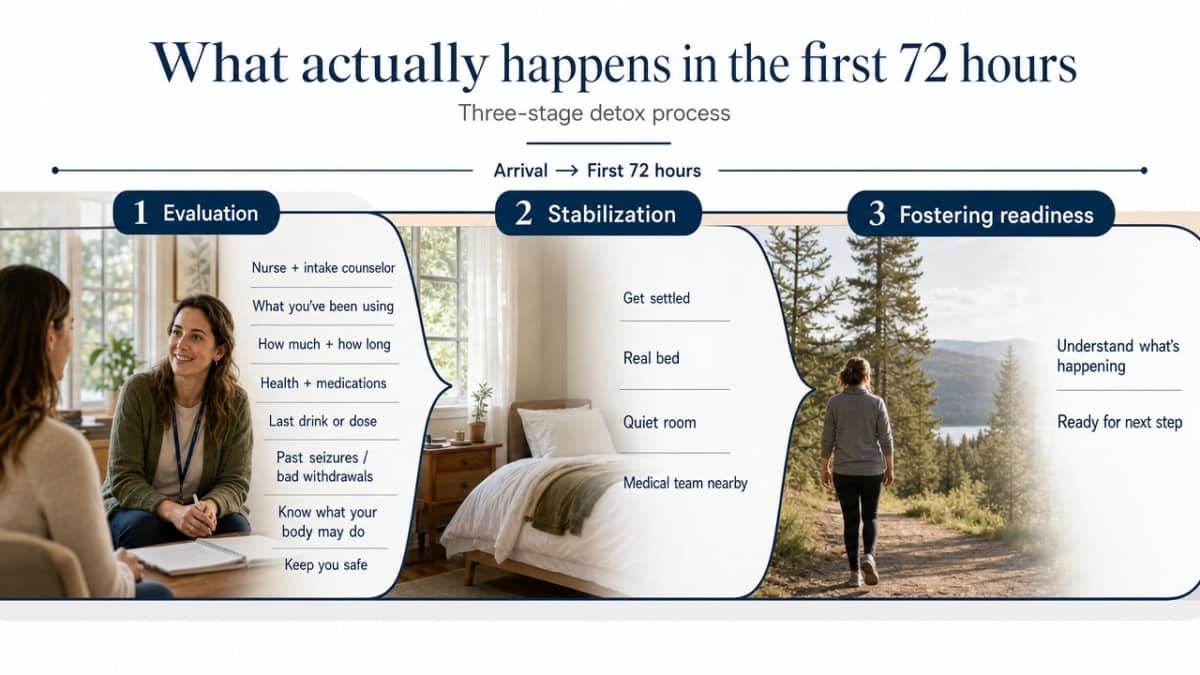
When you arrive, someone sits down with you. Not a clipboard shoved at you in a waiting room, but a real conversation. A nurse and an intake counselor ask what you’ve been using, how much, and how long. They ask about your health, your medications, your last drink or dose, and whether you’ve had seizures or bad withdrawals before. This is the evaluation step, and it exists so the medical team knows exactly what your body is about to do and how to keep you safe while it does it.
Then you get settled. In a home-like detox like Pacific Crest Trail Detox, that means a real bed in a quiet room, not a gurney behind a curtain. Over the next 24 to 72 hours, nurses check on you regularly, take your vital signs, and give you medication if your body needs help easing through withdrawal. This is the stabilization step. You may sleep a lot. You may not sleep much at all. Both are normal. Someone is awake and watching, always.
By day two or three, once you’re steadier, the conversation shifts. A counselor starts talking with you about what comes next: therapy, outpatient support, a plan for going home. This is the third piece, sometimes called fostering readiness for treatment. SAMHSA is clear that a real detox has all three parts, evaluation, stabilization, and this bridge into ongoing care, and that a program missing any one of them is considered incomplete and inadequate 2.
That’s it. That’s the first 72 hours. Hard, yes. Mysterious, no. And you don’t have to do a single minute of it alone.
What ‘medically monitored’ really means (without the acronym)
You’ll see the phrase “medically monitored detox” on almost every facility website, and it can start to feel like marketing language. It isn’t. It’s a specific level of care with specific staffing rules, and once you know what those rules require, you can hear the difference in a five-minute phone call.
The plain-English checklist behind Level 3.7
The clinical name is ASAM Level 3.7, which is the medical shorthand for a detox that is built around round-the-clock nursing and a doctor who is always reachable. The federal guidance that describes this level calls for “highly structured 24-hour services including direct evaluation, observation, and medically monitored addiction treatment,” with “24-hour nursing care with physician availability” 3. Translated out of the manual, here is what that should mean for you the moment you walk through the door.
- Nurses on the floor, all night, every night. Not on-call from home. Actually there, taking your vital signs, watching for the symptoms that matter.
- A physician who can be reached and can adjust your care in real time, including ordering medication to make withdrawal safer and less miserable.
- Structured monitoring, which means someone is measuring how your body is responding on a regular schedule, not just checking in when you ring a bell.
- Medication support when it’s appropriate, for alcohol, opioids, and benzodiazepines especially, so your nervous system isn’t left to white-knuckle it.
- A real plan for what comes next, written down before you leave, not handed to you in the parking lot.
Pacific Crest Trail Detox is built around this checklist, and delivers it in a home-like house in Milwaukie rather than a hospital ward. When you call any detox, ask them to walk you through each of these five things. If any answer is vague, keep dialing.
Why Oregon’s rule is a trust signal you can verify
Here’s something most detox websites won’t tell you: Oregon has its own written rule spelling out what a medically monitored detox has to be. Oregon Administrative Rule 415-050-0120 defines “medically monitored detoxification” as “an inpatient setting that provides medically managed intensive inpatient treatment services,” tied directly to that same Level III.7-D standard used in the federal criteria 4. The state licenses facilities against this rule.
What that means for you: you’re not taking a facility’s word for it. You can ask a detox center whether they are licensed by the Oregon Health Authority for medically monitored withdrawal management, and you can look it up. If the answer is yes, you know a state inspector has walked their halls, checked their nursing coverage, and reviewed their protocols. That is a very different thing than a place that just calls itself a detox on its homepage.
You don’t have to become an expert in state licensing. You just have to know the rule exists, and that a real medical detox will be happy to tell you they meet it.
When you (or your person) actually need this level of care
Not every person who wants to stop drinking or using needs a hospital-style detox. Some do, urgently. The honest question is which category you’re in, and it turns out clinicians ask a fairly small set of questions to sort it out. What you drank or used, how much, how long, and what your body did the last time you tried to stop. If you’ve never made it more than a day without a drink, if you’ve had a seizure during withdrawal before, if you’ve been taking a benzodiazepine like Xanax or Klonopin daily for months or years, or if you have other health problems on top of it, you’re likely someone who needs to be in a bed with a nurse nearby. If your use is lighter, your health is otherwise steady, and you have someone at home paying attention, a less intensive option may fit.
The two sections below break this down honestly. The goal isn’t to funnel everyone into inpatient. The goal is to help you name where you actually are.
Alcohol and benzodiazepines: why home tapers are risky
Alcohol and benzodiazepines share a specific kind of danger when you stop suddenly. Both work on the same calming system in your brain, and when that system has been chemically propped up for a long time, pulling the support away too fast can trigger seizures. With benzodiazepines especially, the withdrawal can be severe and includes seizure risk, particularly after high-dose or long-term use, which is why many cases need inpatient management 15. The 2025 joint clinical guideline on benzodiazepine tapering is even more direct: severe or complicated benzodiazepine withdrawal should be managed in inpatient or residential medically managed settings with structured vital-sign monitoring, seizure-risk assessment, and experienced clinicians 11.
When outpatient or a different level might fit
Here’s the part most detox websites won’t tell you. A review of alcohol withdrawal cases found that fewer than 20% of patients actually required inpatient admission 10. Most people can be managed in outpatient or less intensive settings when their use is lighter, their health is stable, and they have support at home.
If that’s you, an intensive outpatient program or a structured outpatient detox with regular check-ins may be a better fit than a residential bed. A good intake team will tell you that honestly on the phone, even if it means you don’t come through their door. That’s a trust signal, not a rejection.
The admissions call: what to ask while you’re still shaking
Making this call is one of the hardest things you’ll do. Your hands might be shaking. Your voice might crack. That’s okay. The person on the other end has heard all of it before, and if they’re any good, they’ll slow down to meet you where you are.
You don’t need a polished script. But it helps to have a few things written on a piece of paper in front of you, because withdrawal brain is real and you will forget what you meant to ask. Here’s what to keep on that piece of paper:
- “Are you licensed for medically monitored withdrawal management?” In Oregon, this ties directly to the state rule for that level of care 4. A yes should come quickly and clearly.
- “Will there be a nurse on-site the entire time I’m there, including overnight? Is a doctor available around the clock?” These are the two staffing questions that separate a real medical detox from a place that just offers a bed 3.
- “How do you decide when I need medication for withdrawal, and what do you use?” A good program will mention structured monitoring, like checking your symptoms on a regular scoring scale, and giving medication based on what your body is actually doing rather than a one-size dose 12.
- “I’ve been drinking heavily every day” (or “I’ve been on Xanax for two years,” or whatever your truth is). “Have you cared for people like me before?” You want to hear yes, along with a calm explanation of how they’d approach your specific situation.
- “What happens after I leave? Do you help set up the next step?” This is the question most people forget, and it’s one of the most important. SAMHSA lists ongoing recovery support and clear linkage to continuing care among the signs of a quality program 14.
- “Can you check my insurance before I come in?” A solid intake team will run your benefits on the phone or within a few hours, so you’re not walking in blind about cost.
Pay attention to how the answers feel, not just what they say. Are they rushing you? Are they using words you don’t understand without stopping to explain? Are they promising you’ll be cured? Any of those is a reason to keep dialing. The right team will sound patient, specific, and unshockable. If you get that on the phone, trust it. You just did the hardest part.
Five signs of a program worth trusting
Once you’ve made the first call, you’re not evaluating features on a comparison chart. You’re listening for a handful of things that tell you the people on the other end know what they’re doing and won’t drop you when the hard part is over. SAMHSA’s patient guide names five markers that separate quality treatment programs from the rest: accreditation, use of medications when they’re appropriate, evidence-based therapies, family involvement, and real recovery support that extends past discharge 14. Here’s what each one actually sounds like when you’re on the phone or walking through the door.
They’re accredited and state-licensed, and they’ll say so plainly. In Oregon, that means licensure for medically monitored withdrawal management under the state rule 4. A good program will tell you this in the first minute without you having to press.
They use medication when your body needs it. If you’re withdrawing from alcohol, opioids, or benzodiazepines, medication isn’t a shortcut. It’s the safer path. A program that dismisses medication-assisted treatment as “just replacing one drug with another” is not following the current evidence.
They talk about therapy, not just detox. Individual counseling, group work, and family sessions should be part of the conversation from day one, not something bolted on at discharge.
They welcome your family. Not as visitors to tolerate, but as part of the plan. If the program treats your spouse or parent like an interruption, that tells you something.
They have a real answer for what comes next. Partial hospitalization, intensive outpatient, standard outpatient, alumni support, help finding a therapist near your home. The next step should already be sketched before you finish your first week.
Pacific Crest Trail Detox was built around this list. If another program checks all five, that’s a program worth trusting too. What you’re looking for is the pattern, not the logo.
What honest recovery looks like after you walk out
Here is the part nobody wants to say out loud on a first phone call: detox is the beginning, not the finish line. Your body clears the substance in a few days. The habit, the wiring, the reasons you started drinking or using in the first place, those take longer. A good detox center will tell you this on day one, not day seven.
The numbers back it up. In one twelve-month study of people who went through an elective inpatient alcohol detox with structured follow-up, 68.1% were still abstinent at three months. At six months, it was 44.7%. At twelve months, 36.2% 7. Read those numbers slowly. They are not a scare tactic and they are not a promise. They are what happens when real people, in real bodies, do a real hard thing over a real year. The three-month number is genuinely encouraging. The twelve-month number is honest about how long this work takes.
What those numbers also show is that the people who keep some kind of support in their life do better than the people who walk out and try to hold it alone. That is where the choice you make right now matters more than most first-time callers realize. A detox that stops at discharge is a detox that hands you the hardest month of your recovery with no map. A detox that pulls you into what comes next, a partial hospitalization program a few days a week, an intensive outpatient group in the evenings, individual therapy, an alumni community that texts you on Tuesday, is a detox treating the actual problem.
This is why Pacific Crest Trail Detox was built as a continuum rather than a single stop. You come in for the medical part. You stay connected for the human part. Same team, same faces, no cold handoff to a stranger across town. When you’re choosing a first detox, ask what the second month looks like. If the answer is a shrug or a brochure, keep looking. If the answer is a plan with names and days on a calendar, you’re in the right place.
Insurance, cost, and what a good intake team handles for you
Money worry sits right next to fear when you’re trying to make this call. That’s normal, and it shouldn’t be the thing that stops you from picking up the phone. Here’s the honest picture.
Most medical detox stays are covered, at least in part, by commercial insurance. A good intake team will ask for a photo of the front and back of your insurance card and run a benefits check before you ever pack a bag. They should call you back the same day with what your plan covers, what your out-of-pocket portion looks like, and whether prior authorization is needed. If a facility can’t or won’t do that, keep dialing.
Pacific Crest Trail Detox accepts most major commercial insurance plans, though not the Oregon Health Plan (OHP). If you have OHP, ask for a referral to a program that does. You are not being turned away from care, just pointed to the right door.
One more thing worth saying out loud: the cost of a few days in a real medical detox is almost always smaller than the cost of another year of drinking or using. You don’t have to solve the money question tonight. You just have to let someone help you look at it.
What to pack, who can visit, and other things nobody tells you
The practical stuff matters more than you’d think. Not knowing whether you can bring your own pillow is the kind of small unknown that keeps people stuck on the couch for another week.
Pack simple: a week of comfortable clothes, slip-on shoes, toiletries without alcohol in the ingredients, a phone charger, a book if you read, and a photo or two of the people you’re doing this for. Leave the laptop, the work bag, and anything sharp. Most detoxes will check your belongings on arrival. That’s not distrust, it’s part of keeping the space safe for everyone in it.
Phones vary by program. Some allow them during set hours, some hold them for the first day or two while your body settles. Ask on the intake call so you know what to expect. Family visits and calls are usually welcomed once you’re stable, often after the first 24 to 48 hours, because bringing your people into the process is one of the markers of a quality program 14.
You don’t need to arrive polished. You just need to arrive.
Check Your Coverage for Safe Detox Support
Find out if your insurance covers your first step toward safe and supported detox.

Frequently Asked Questions
How long does a first-time medical detox usually last?
Most first-time medical detox stays run three to seven days, though the exact length depends on what you were using, how long, and how your body responds. Alcohol and benzodiazepine withdrawal often need the longer end of that range because your nervous system takes more time to steady. The medical team decides day by day, based on your symptoms, not a fixed calendar. You’ll know before you leave what the next step looks like.
Is it safe to detox from alcohol or benzodiazepines at home?
Usually not, if you’ve been using heavily or daily for a long stretch. Both alcohol and benzodiazepines can cause seizures when you stop suddenly, and severe or complicated benzodiazepine withdrawal is specifically recommended to be managed in an inpatient or residential setting with vital-sign monitoring and experienced clinicians 11. If you’ve had a bad withdrawal before, or you’re on a daily benzo like Xanax or Klonopin, please call a medical detox before trying this alone.
What should I ask when I call a detox center for the first time?
Keep it simple. Ask if they’re licensed for medically monitored withdrawal management, whether a nurse is on-site around the clock with a doctor available, and how they decide when to give medication 3. Ask if they’ve cared for people with your specific substance and history. Ask what happens after you leave, and whether they’ll check your insurance first. How they answer matters as much as what they say.
Can I bring my phone, and can my family visit?
Policies vary. Some programs let you keep your phone during set hours, others hold it for the first day or two while your body settles. Family calls and visits are usually welcomed once you’re stable, often after 24 to 48 hours, because bringing your people into the process is one of the markers of a quality program 14. Ask on your intake call so you know exactly what to expect when you arrive.
Will insurance cover a first-time detox stay?
Most commercial insurance plans cover medical detox, at least in part. A good intake team will run a benefits check the same day you call and tell you what your out-of-pocket portion looks like before you pack a bag. Pacific Crest Trail Detox accepts most major commercial plans but not the Oregon Health Plan (OHP). If you have OHP, ask for a referral to a program that does, and you’ll be pointed to the right door.
What happens after detox ends?
Detox clears your body. The next stretch is where the real work happens. A good program hands you a written plan before discharge, usually some mix of a partial hospitalization program, an intensive outpatient group, individual therapy, and an alumni community that stays in touch. Continuing care after detox is linked to better abstinence outcomes, which is why staying connected matters 13. If a program’s answer for what comes next is a shrug, keep looking.
References
- Detoxification and Substance Abuse Treatment. https://www.ncbi.nlm.nih.gov/books/NBK64115/
- Quick Guide For Clinicians Based on TIP 45 Detoxification and Substance Abuse Treatment. https://nida.nih.gov/sites/default/files/samhsa_detoxification_and_substance_abuse_treatment.pdf
- Overview of Substance Use Disorder Care Clinical Guidelines and the ASAM Criteria. https://www.medicaid.gov/state-resource-center/innovation-accelerator-program/iap-downloads/reducing-substance-use-disorders/asam-resource-guide.pdf
- Oregon Administrative Rule 415-050-0120 (Withdrawal Management). https://www.oregon.gov/oha/HSD/HSDRules/415-050-01202023.pdf
- 12 VAC 30-130-5140 – Covered services: medically monitored intensive inpatient services (ASAM Level 3.7). https://www.law.cornell.edu/regulations/virginia/12VAC30-130-5140
- Home‐based detoxification for individuals with alcohol or drug dependence: A systematic review of the recent literature. https://pmc.ncbi.nlm.nih.gov/articles/PMC11814356/
- Elective alcohol detoxification – a resource and efficacy evaluation. https://pmc.ncbi.nlm.nih.gov/articles/PMC6616188/
- Who Needs Inpatient Detox? Development and Implementation of a Clinical Algorithm. https://pmc.ncbi.nlm.nih.gov/articles/PMC3965748/
- Summary of Evidence – Inpatient and Outpatient Treatment for Alcohol Use Disorders. https://www.ncbi.nlm.nih.gov/books/NBK507689/
- Alcohol Withdrawal Syndrome: Benzodiazepines and Beyond. https://pmc.ncbi.nlm.nih.gov/articles/PMC4606320/
- Joint Clinical Practice Guideline on Benzodiazepine Tapering. https://pmc.ncbi.nlm.nih.gov/articles/PMC12463801/
- Inpatient Alcohol Withdrawal Guidelines (VA Puget Sound). https://www.ci2i.research.va.gov/paws/pdfs/pugetsound.pdf
- Dependency outcome of alcohol-dependent patients after inpatient detoxification and motivation treatment. https://pubmed.ncbi.nlm.nih.gov/9333719/
- Finding Quality Treatment for Substance Use Disorders. https://library.samhsa.gov/product/finding-quality-treatment-substance-use-disorders/pep18-treatment-loc
- Management of Benzodiazepine Misuse and Dependence. https://www.ncbi.nlm.nih.gov/pmc/articles/PMC6286444/