


Key Takeaways
- Oregon’s Health Professionals’ Services Program offers confidential monitoring for physicians, nurses, pharmacists, and dentists, with the Board of Nursing rejoining HPSP effective September 1, 2025 6.
- Mandatory reporting in Oregon is triggered by workplace impairment, not by privately seeking care, so self-referring before an incident preserves the strongest confidentiality protections 3.
- Monitoring agreements run a minimum of two years for mild and five years for moderate or severe substance-use disorders, with evaluation, testing, and monitoring fees paid by the licensee 4.
- Clinicians facing acute withdrawal risk should pursue medical stabilization first, then complete the independent evaluation HPSP requires and consult a board-savvy attorney before signing any agreement 1.
What a 2 a.m. search for help actually needs to answer
You already understand the pharmacology. You know what a benzo taper should look like, why alcohol withdrawal can be fatal, and the half-life of substances. This is precisely why generic rehab content often feels unhelpful at 2 a.m. — it addresses questions you don’t have and overlooks the ones keeping you awake.
You’re likely grappling with two main questions: How can I safely navigate withdrawal? and What will happen to my license if I seek help? Both deserve clear answers. Oregon provides a specific pathway for licensed healthcare workers through the Health Professionals’ Services Program (HPSP). This program covers physicians, nurses, pharmacists, and dentists, offering confidentiality protections for eligible self-referrals who adhere to their monitoring agreement 1, 2. Oregon’s regulations also clearly differentiate between workplace impairment, which mandates reporting, and private treatment-seeking that hasn’t impacted your practice 3. This distinction is crucial.
This guide is written from a peer-to-peer perspective. It explains the two avenues into care, how HPSP operates for each board, what medical detox and medication treatment entail, how to manage costs, and the evidence regarding returning to practice. You deserve care that is private, medically supervised, and delivered by professionals who treat you as a colleague, not a cautionary tale.
The Oregon-specific split: workplace impairment vs. private treatment-seeking
The key distinction that impacts your decision tonight is this: Oregon’s mandatory reporting rules are tied to workplace impairment, not to the private act of seeking help. If you’ve been unable to practice safely during a shift, or if a colleague has reasonable cause to believe you did, that triggers a reporting duty, regardless of your HPSP enrollment status 3. However, if you haven’t been impaired at work and are discreetly seeking care, the Oregon Medical Board indicates there may be no mandatory reporting requirement at all 3.
Consider two paths. The first involves self-referral while you are still performing your job duties effectively. You contact HPSP, undergo an independent evaluation, and if you qualify and comply with your monitoring agreement, your enrollment remains confidential. This is not public discipline, and successful participation is not published on a board website 1, 2. The second path is a board referral initiated after a report about workplace conduct. This leads to a formal investigation. HPSP might still be an option, sometimes in place of or alongside disciplinary actions, but the confidentiality aspects differ, and your record will not be clear 2, 5.
The choice of which path to take is largely still yours tonight, but it might not be next week. A discrepancy in a waste count, a patient complaint about slurred speech, or the smell of alcohol during a handoff could shift you from the first path to the second before you’ve made a decision. This isn’t meant to scare you, but to honestly explain why clinicians who achieve medical stabilization before an incident occurs tend to retain more options—clinically, legally, and professionally.
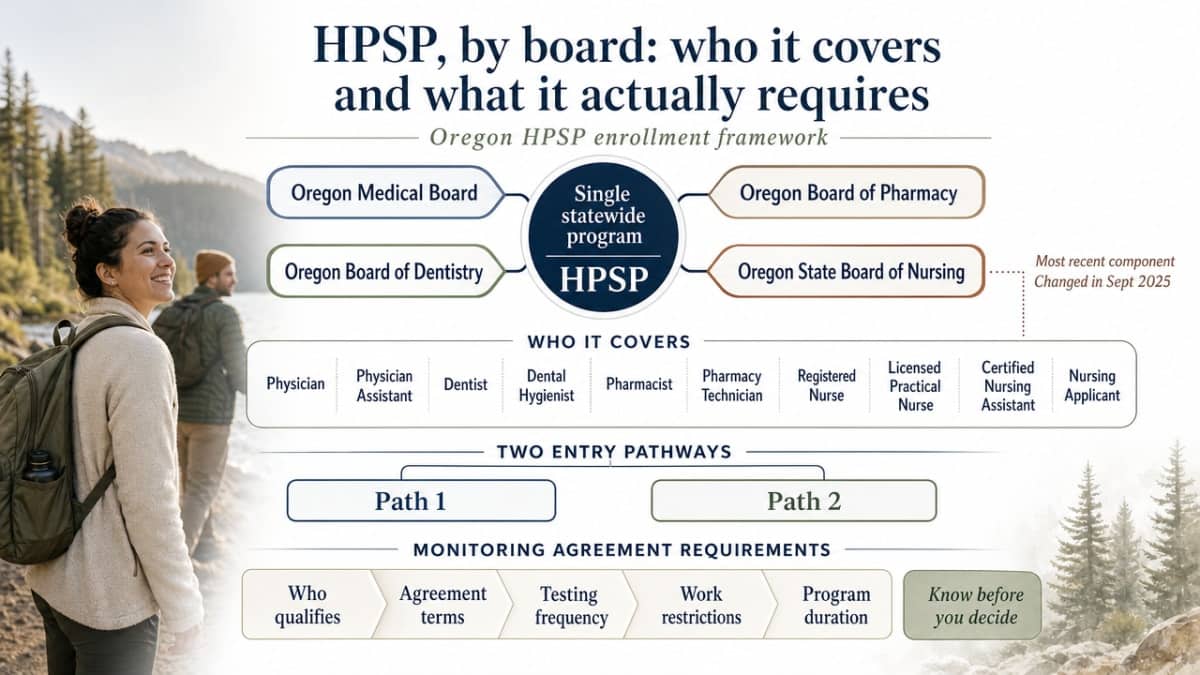
HPSP, by board: who it covers and what it actually requires
If you are considering HPSP, understanding its operational details before making the call is beneficial. Knowing who qualifies, what agreements entail, testing frequency, work restrictions, and program duration allows for an informed decision rather than one driven by fear.
The four participating boards and what changed in September 2025
HPSP is a single statewide program serving licensees from four Oregon boards: the Oregon Medical Board, the Oregon Board of Dentistry, the Oregon Board of Pharmacy, and the Oregon State Board of Nursing 1. If you are a physician, physician assistant, dentist, dental hygienist, pharmacist, pharmacy technician, registered nurse, licensed practical nurse, certified nursing assistant, or a nursing applicant, this program is designed with your license in mind.
The nursing component is the most recent and significant change. The Oregon State Board of Nursing officially rejoined HPSP effective September 1, 2025. This means the Board can now refer eligible licensees or certificate holders to the program as an alternative to, or in addition to, disciplinary action 6. If you are a nurse who previously explored monitoring options a year or two ago and found the process unclear, the current structure is different. Confidential monitoring is now a viable option for qualifying nurses.
For all participating boards, there are two entry points: self-referral or board referral following a complaint or investigation 1. Self-referral, while you are still performing your duties, offers the strongest confidentiality protection because successful participation in HPSP is not considered public discipline and is not posted on a board website, unlike probation 5. This difference—private monitoring versus public discipline—is often the primary reason clinicians who have been silently struggling decide to seek help.
Evaluation, monitoring agreement, testing, and practice limits
Enrollment is not a simple process. For Medical Board licensees, Oregon Administrative Rule 847-065 outlines the steps:
- An independent evaluation by an approved evaluator
- A formal written monitoring agreement
- An approved treatment plan
- Random drug and alcohol testing
- Defined practice limits where necessary
- Follow-up evaluations
- Reporting obligations if circumstances change 4
Other participating boards follow a similar framework, and nursing applicants and licensees undergo a comparable diagnosis and recommendations process before signing an agreement 6.
The independent evaluation is foundational. An approved evaluator will interview you, review your records, and provide a diagnosis with recommendations. These recommendations cover the necessary level of care, whether residential detox is indicated, if medication treatment is appropriate, and any practice restrictions that should apply during stabilization. You cannot choose your diagnosis or bypass this evaluation; both are integral to the confidentiality that follows.
Random testing is a core component. Expect unpredictable urine or hair testing, often managed through a daily check-in system that informs you if you need to test that day. Practice limits might include temporary restrictions on overnight shifts, no access to specific controlled substances, or supervised dispensing. These measures are designed to allow you to continue working while the program verifies your sustained recovery 2, 4. The agreement is binding. Missed tests, check-ins, or meetings are treated as positive results until proven otherwise, and consistent noncompliance can lead to reporting to your board and potential licensure action 2, 4.
Two years or five: how diagnosis severity sets your monitoring floor
The duration of your HPSP enrollment is not flexible. It is determined by your diagnosis, which comes from your independent evaluation. According to Oregon Administrative Rule 847-065, the minimum enrollment period is two years for some mild substance-use disorder cases and five years for moderate or severe substance-use disorders 4. For nurses, the Oregon State Board of Nursing specifies at least 24 months of monitored practice for participants with a substance-use disorder 5. These are minimums; an evaluator or the program may require a longer period based on your clinical situation.
The difference between a two-year and five-year commitment is substantial. Both paths involve random testing, treatment compliance, and reporting on a similar schedule, but the total duration varies. A 60-month path represents a multi-year commitment that will significantly impact your schedule, finances, and calendar.
It’s important to note that you are typically responsible for most costs. Oregon Administrative Rule 847-065 states that the licensee bears responsibility for the evaluation, testing, treatment, and monitoring expenses 4. While insurance may cover the clinical treatment aspects—detox, medication, counseling—monitoring fees and testing costs are usually out-of-pocket. Understanding this upfront allows for proper financial planning.
Medical detox and MAT when you already know the pharmacology
You don’t need a basic explanation of withdrawal. You’ve monitored vitals during CIWA protocols, titrated buprenorphine, and witnessed seizures. What you need is honest information about the clinical experience when you are the patient, and how medication treatment can fit into a monitoring agreement without jeopardizing it. The following sections address these points.
What non-hospital residential detox looks like for a clinician
Non-hospital residential detox serves as a middle ground between an inpatient hospital unit and an outpatient taper. It provides 24-hour medical supervision, scheduled vital sign checks, symptom-driven medication, and a comfortable, home-like environment. For alcohol and benzodiazepine withdrawal, this level of supervision is essential due to the risks of autonomic instability, seizures, and delirium tremens. Attempting a short-acting benzo taper at home while working swing shifts often leads to clinicians ending up in the ED as patients.
At Pacific Crest Trail Detox in Milwaukie, the setting is intentionally residential—featuring comfortable chairs, natural light, and staff who have personal recovery experience—rather than a sterile hospital unit. For a clinician, this offers two distinct advantages. First, dignity: you won’t be sharing a room with a patient you discharged recently. Second, sleep: the initial 72 to 96 hours of alcohol or benzo withdrawal are intense, and a private, restful room is a crucial part of treatment.
Expect an intake assessment that will feel familiar, as you’ve performed the clinician’s side of it many times. Be specific about substances used, last use, quantity, co-occurring psychiatric diagnoses, prior withdrawal history, seizure history, and current medications. Underreporting due to embarrassment is a common reason clinicians are undermedicated during their own detox. For the stabilization phase, Pacific Crest Trail Detox provides medical detox, medication-assisted treatment, sub-acute detox, and a continuum of care into partial hospitalization and intensive outpatient programs. This means the transition from acute stabilization to the next level of care occurs within one program, avoiding the need for a cold referral. If your evaluator or HPSP intake coordinator inquires about the facility’s licensing for the level of care provided, it’s a valid question to ask any facility directly 12.
Buprenorphine, naltrexone, and methadone inside a monitoring agreement
The outdated belief that medication treatment and professional monitoring are incompatible is no longer current Oregon guidance. The Oregon Medical Board states that HPSP supports licensees using buprenorphine or other medication treatment when medically appropriate, properly prescribed, and monitored, with required medication-management documentation during monitoring 3. This is a significant change. If buprenorphine is the appropriate medication for your opioid use disorder, you don’t have to choose between evidence-based care and maintaining your license pathway.
In practice, this means your prescriber and HPSP case manager will communicate. Dosing, refills, and any medication changes will be documented. Random testing is calibrated to expect therapeutic buprenorphine levels, preventing them from being misinterpreted as diversion. Naltrexone—either oral or the long-acting injectable Vivitrol—is a simpler option from a testing perspective for some clinicians who prefer no opioid agonist activity. It is covered on the Oregon Health Plan formulary, alongside methadone, buprenorphine, and Suboxone 10. Methadone is also covered but requires enrollment in a licensed opioid treatment program, which has its own scheduling and privacy considerations to weigh against your work calendar.
For alcohol use disorder, naltrexone and acamprosate are standard options and generally do not raise monitoring concerns. Disulfiram sometimes becomes part of a monitoring agreement itself. Regardless of the medication, the operating rule is consistent: document the prescription with your evaluator before your first random test, not after. Failing to disclose a prescription is how a compliant participant can become noncompliant on paper 2, 4.
Paying for care: OHP, commercial insurance, parity, and HPSP out-of-pocket costs
Financial concerns are often paramount for clinicians, even if they’re addressed last. The reality is that paying for care in Oregon involves two distinct categories, and HPSP costs are often different from what people expect.
First, consider the clinical side. If you have Oregon Health Plan (OHP) coverage, OHP covers screening, assessment, detoxification, residential treatment, outpatient care, counseling, and medications for opioid and alcohol use disorder, including methadone, buprenorphine, Suboxone, and Vivitrol. A referral from a primary care provider is not required to begin treatment 10. This is important at 2 a.m. when the idea of adding a PCP visit to your to-do list might deter you from seeking help.
If you have commercial insurance, federal and Oregon parity rules mandate that many plans treat mental health and substance use benefits comparably to medical benefits. This means copays, visit limits, and prior-authorization rules cannot be more restrictive than those for a comparable medical condition 11. If you receive a denial or face an unexpected authorization hurdle, you have the right to request the medical necessity criteria used by the plan in writing, and you can file an appeal or complaint with the Oregon Division of Financial Regulation. Pacific Crest Trail Detox accepts most commercial insurance for medical detox, medication treatment, partial hospitalization, and intensive outpatient care—covering the stabilization and step-down phases. However, the facility does not accept OHP, so Medicaid members will need an OHP-contracted provider for that phase of care.
Now, for the HPSP costs. Oregon Administrative Rule 847-065 places responsibility for the evaluation, random testing, treatment, and monitoring expenses on the licensee 4. While insurance may cover the clinical treatment it typically covers, the independent evaluation fee, drug-testing lab charges, daily check-in service, and the program’s monitoring fees are usually out-of-pocket for two to five years, depending on your diagnosis 4. Factor these costs into your budget from the start. If a plan denies something you believe is protected by parity, request the written criteria and the appeal process during the same call—this step often converts a denial into coverage.
Return-to-practice evidence, with its limits stated plainly
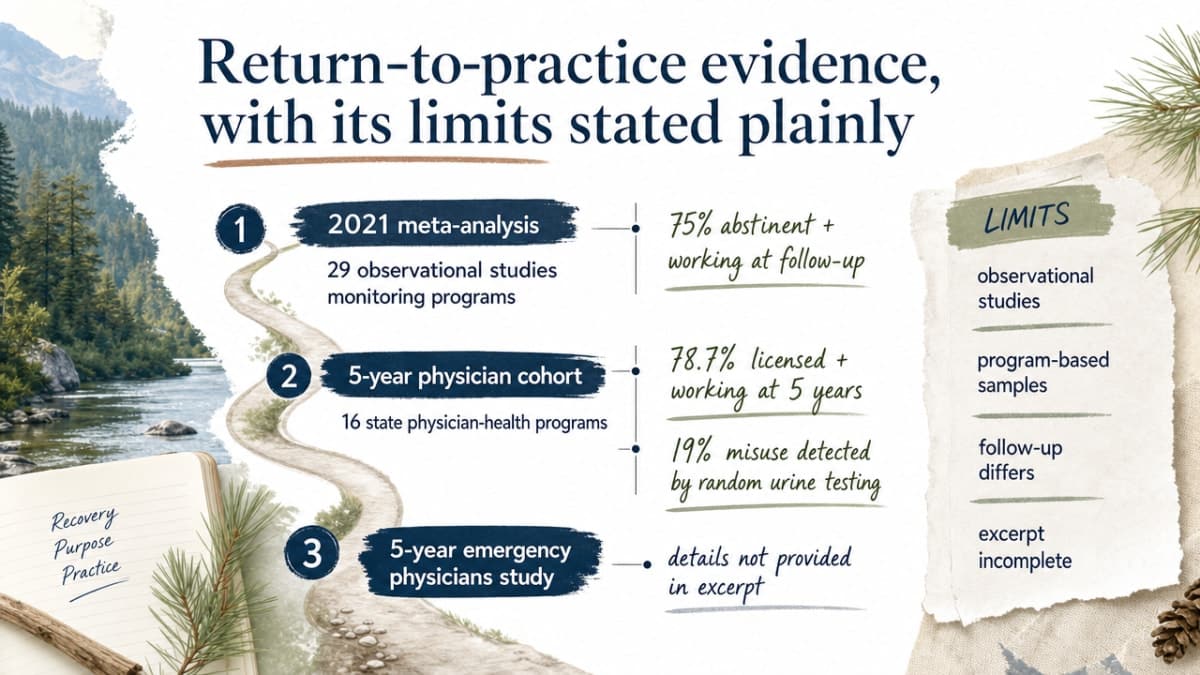
If you fear that seeking help will end your career, the available data is more encouraging than your anxious 2 a.m. thoughts might suggest, and more realistic than a promotional brochure. Three studies are particularly relevant to consider before making a decision.
- A 2021 meta-analysis of 29 observational studies on monitoring programs for healthcare professionals with substance use disorders found that, on average, 75% of participants remained abstinent and were working at follow-up 16.
- Another five-year cohort study of physicians treated through 16 state physician-health programs reported that 78.7% were licensed and working at the five-year mark, with alcohol or drug misuse detected in 19% through random urine testing during that period 17.
- A separate five-year study focusing on emergency physicians—a specialty often prone to believing their career is over—indicated that 84% continued medical practice, compared to 72% of other physicians in the cohort, and 71% completed their monitoring contracts 18.
However, it’s crucial to acknowledge the limitations. The meta-analysis authors caution that the included studies varied significantly in design and population, preventing firm conclusions about overall program effectiveness 16. The physician cohort data is from individuals who entered treatment between 1995 and 2001, so these outcomes do not reflect current Oregon-specific rates 17. Similarly, the emergency physician study is older and limited to clinicians already enrolled in physician-health programs, which inherently selects for motivated individuals with support systems 18. None of these figures specifically describe outcomes for nurses, pharmacists, dentists, or CNAs, nor do they represent HPSP outcomes in Oregon.
Interpret these findings as evidence that structured treatment combined with monitoring, for those clinicians who complete it, is associated with maintaining licensure and employment at rates that should alleviate your worst fears. They are not a guarantee for your individual case.
If a colleague or supervisor is reading this instead
This section is for the charge nurse, pharmacy manager, medical director, or spouse who found this article while seeking guidance for someone else. While the rest of the piece is for the clinician, this part is for you.
State precisely what you observed, once, without attaching a diagnosis. Mention HPSP by name and explain that self-referral while still functioning at work offers the strongest confidentiality protection 1, 2. Then, allow them to decide. Pressing further often leads to silence, not safety.
A sequence that preserves the most options
If you’re looking for a practical order of operations to take away from this article, here it is. While not the only approach, it tends to keep the most options open.
Stabilize medically first. If you are currently at acute withdrawal risk—due to heavy daily alcohol use, high-dose benzodiazepines, or an opioid use pattern that has already resulted in a near-miss—seek medical stabilization immediately. Non-hospital residential detox is appropriate for most of these situations, and the initial 72 to 96 hours should occur under 24-hour supervision rather than at home between shifts. Pacific Crest Trail Detox in Milwaukie offers this stabilization in a home-like setting with medication treatment and a direct step-down into partial hospitalization or intensive outpatient care. You can call them directly to begin this conversation.
Get the independent evaluation. Before anything changes at work, obtain the independent evaluation that HPSP will require anyway 1, 4. If you are going to receive a diagnosis, it’s better for that diagnosis to come through a path you initiated, rather than one triggered by a complaint 2, 3.
Consult a board-savvy attorney. Consult with an attorney or professional advocate who is familiar with your specific board before signing any monitoring agreement 2. The consultation fee will be the most cost-effective hour you spend this year.
Confirm coverage and budget for out-of-pocket costs. Confirm your coverage in writing—OHP for Medicaid members, commercial insurance for others, utilizing parity rights if a plan pushes back 10, 11—and budget for the evaluation, testing, and monitoring fees that will be your responsibility 4.
You already carry enough. Direct your efforts towards people who treat you as a colleague.
Check Your Coverage for Safe Detox Support
Find out if your insurance covers confidential, medically supervised detox and recovery care in Oregon.

Frequently Asked Questions
Will seeking treatment on my own trigger a report to my licensing board?
Not automatically. Oregon’s mandatory reporting rules are tied to workplace impairment, not to the private act of asking for help. If your practice has not been affected and you are quietly pursuing care, the Oregon Medical Board states there may be no mandatory reporting requirement 3. If workplace impairment has already occurred, that triggers reporting regardless of whether you plan to enroll in HPSP 3.
Which Oregon boards participate in HPSP, and what changed in September 2025?
HPSP serves licensees of four Oregon boards: the Medical Board, Board of Dentistry, Board of Pharmacy, and State Board of Nursing 1. The nursing piece is the recent change — the Oregon State Board of Nursing formally returned to HPSP participation effective September 1, 2025, allowing confidential monitoring referrals in lieu of or in addition to discipline for eligible licensees and certificate holders 6.
How long will I be in HPSP monitoring if I enroll?
Length is set by your diagnosis, not negotiated. Under Oregon Administrative Rule 847-065, the minimum enrollment period is two years for some mild substance-use disorder cases and five years for moderate or severe substance-use disorders 4. For nurses, the Oregon State Board of Nursing describes at least 24 months of monitored practice for participants with a substance-use disorder 5. These are floors — an evaluator can require longer.
Can I stay on buprenorphine or naltrexone while being monitored?
Yes, when it is medically appropriate. The Oregon Medical Board states that HPSP supports licensees using buprenorphine or other medication treatment when prescribed and monitored properly, with medication-management documentation required during monitoring 3. Naltrexone, Vivitrol, buprenorphine, Suboxone, and methadone are all covered on the Oregon Health Plan formulary 10. Document the prescription with your evaluator before your first random test, not after.
Does Oregon Health Plan or commercial insurance cover detox and MAT?
OHP covers screening, assessment, detoxification, residential and outpatient treatment, counseling, and medications including methadone, buprenorphine, Suboxone, and Vivitrol — with no referral required from a primary-care provider 10. Commercial plans are governed by federal and Oregon parity rules, meaning copays, visit limits, and prior-authorization rules cannot be more restrictive than for comparable medical conditions 11. HPSP monitoring fees and testing are typically your responsibility 4.
What are the realistic chances I can return to clinical practice?
Better than your worst fear, with honest limits. A meta-analysis of 29 studies found that about 75% of healthcare professionals in monitoring remained abstinent and working at follow-up, though the authors caution the studies varied substantially 16. A five-year physician cohort reported 78.7% licensed and working 17, and 84% of emergency physicians continued practice 18. None are Oregon-specific or guarantee your outcome.
References
- Oregon Medical Board : Health Professionals’ Services Program. https://www.oregon.gov/omb/topics-of-interest/pages/health-professionals-services-program.aspx
- Supporting Licensees with Substance Abuse and Mental Health Disorders. https://www.oregon.gov/omb/board/philosophy/pages/confidential-program-for-substance-abuse.aspx
- Who Must Report to the Board? (Mandatory Reporters). https://www.oregon.gov/omb/investigations/pages/who-is-required-to-report.aspx
- Oregon Administrative Rule 847-065. https://www.oregon.gov/omb/statutesrules/Documents/847-065.pdf
- Monitoring FAQ. https://www.oregon.gov/osbn/Documents/FAQ_Monitoring_01-08-2026.pdf
- Notice of Proposed Rulemaking. https://www.oregon.gov/osbn/Documents/Notice_Div70_RuleHearing.pdf
- Substance Use Disorder Integration Report. https://www.oregon.gov/oha/HSD/AMH/DataReports/SUD-Integration-Report.pdf
- 2025 – Opioids and the Ongoing Drug Overdose Crisis in Oregon. https://www.oregon.gov/oha/PH/PREVENTIONWELLNESS/SUBSTANCEUSE/OPIOIDS/SiteAssets/Lists/feature/EditForm/2025%20Oregon%20Opioid%20Overdose%20Report.pdf
- Oregon overdose deaths are down, CDC data shows. https://www.oregon.gov/oha/erd/pages/oregon-overdose-deaths-are-down-cdc-data-shows.aspx
- Behavioral Health Coverage : Members. https://www.oregon.gov/oha/ohp/members/pages/behavioral-health.aspx
- Mental health parity. https://dfr.oregon.gov/insure/health/understand/coverage/pages/mental-health-parity.aspx
- Substance Use Disorder Service Providers. https://www.oregon.gov/oha/OHP/Providers/Pages/SUD.aspx
- Oregon’s Licensed Health Care Workforce Supply, 2024. https://www.oregon.gov/oha/HPA/ANALYTICS/HealthCareWorkforceReporting/HWRP_Supply_Report_2024.pdf
- Oregon’s Health Care Workforce Needs Assessment 2025. https://www.oregon.gov/oha/HPA/HP-HCW/Meeting%20Documents/5b.%202025%20Health%20Care%20Workforce%20Needs%20Assessment%20draft%20report.pdf
- BHRN Data Profile. https://www.oregon.gov/oha/HPA/ANALYTICS/Documents/DataProfile_BHRN.pdf
- Success Rates of Monitoring for Healthcare Professionals with a Substance Use Disorder: A Meta-Analysis. https://pmc.ncbi.nlm.nih.gov/articles/PMC7828295/
- Five year outcomes in a cohort study of physicians treated for substance use disorders in the United States. https://www.bmj.com/content/bmj/337/bmj.a2038.full.pdf
- Prognosis for Emergency Physician with Substance Abuse Recovery: 5-year Outcome Study. https://pmc.ncbi.nlm.nih.gov/articles/PMC3952884/
- Monitoring outcomes of substance use disorder among healthcare professionals in Utah: A retrospective study of the professionals health program. https://pubmed.ncbi.nlm.nih.gov/41401912/
- Substance Use Treatment Providers’ Perspectives on Barriers and Facilitators for Treatment, Recovery, and Returning to Work for Healthcare Professionals With Nonmedical Substance Use. https://pubmed.ncbi.nlm.nih.gov/40068180/