


Key Takeaways
- Long-term diazepam use causes the nervous system to adapt to the drug, so stopping suddenly after weeks or months can trigger withdrawal that ranges from miserable to life-threatening, including seizures.1
- Because diazepam is long-acting, withdrawal can be delayed, sometimes appearing up to about 3 weeks after the last dose, which can catch people who feel fine early off guard.
- The safest path off diazepam is a gradual, clinician-guided taper rather than stopping suddenly on a self-made schedule.1
- Plan for the work beyond detox: protracted anxiety, broken sleep, and mood swings can linger for weeks or months, which is why continued care like PHP, IOP, or outpatient matters.3
What Diazepam Withdrawal Actually Looks Like
If you’ve been taking diazepam (Valium) for more than a few weeks and you’re thinking about stopping, here’s the straight answer: withdrawal can range from uncomfortable to dangerous. Most people feel anxiety, insomnia, tremor, sweating, nausea, headaches, and heightened sensitivity to light and sound. A smaller group experiences severe symptoms that require emergency care, including seizures, hallucinations, delirium, loss of contact with reality, and suicidal thoughts.2, 3 The FDA warns that stopping suddenly, or cutting your dose too quickly, after weeks or months of regular use can trigger life-threatening withdrawal.1
That is a lot to sit with, and you deserve honesty about it. You also deserve to know that this is a predictable medical event, not a character flaw. Physical dependence on a prescribed medication is not the same as being a “bad patient.” People who took diazepam exactly as directed can still face withdrawal, and the safe path through it looks the same either way: a gradual, clinician-guided taper, not willpower and a calendar.
Why Diazepam Withdrawal Hits Differently Than Other Benzos
If you’ve read about Xanax or Ativan withdrawal and assumed diazepam would follow the same clock, set that expectation aside. Diazepam is a long-acting benzodiazepine, and that single pharmacology fact changes almost everything about what you’re going to feel and when.
Short-acting benzodiazepines like alprazolam (Xanax) and lorazepam (Ativan) leave your system quickly. Withdrawal from short-acting benzodiazepines can begin within hours of the last dose. Diazepam does the opposite. It and its active byproducts stay in your body for days, tapering out slowly on their own. So the first day or two after your last dose can feel deceptively calm. You might think you’re in the clear. You’re not.
With long-acting benzodiazepines like diazepam, withdrawal onset can be delayed, sometimes by up to about 3 weeks after the last dose. The delayed onset catches people off guard, especially those who tried to quit on their own and thought they’d made it past the hard part.
The symptom list itself overlaps heavily with other benzos, anxiety, insomnia, tremor, sensory sensitivity, and in severe cases seizures and hallucinations.3 But the timeline is its own creature, which is why a taper plan built for Xanax is not a taper plan for Valium. The FDA is explicit: don’t stop suddenly after weeks or months of use, and don’t let anyone rush the reduction.1
When Do Diazepam Withdrawal Symptoms Start and Peak?
The Diazepam Withdrawal Timeline
No two people run the exact same clock, but diazepam withdrawal tends to follow a recognizable arc. Knowing the shape of it helps you tell the difference between “this is expected” and “this is an emergency,” and it keeps you from panicking when symptoms show up late.
The first days after your last dose. You may feel surprisingly okay. Mild unease, maybe a little trouble sleeping, perhaps some edginess. Because diazepam lingers in your system, the first day or two often feel like a non-event. This is the window where people quitting on their own convince themselves they’ve beaten it. They haven’t.
As withdrawal sets in. Anxiety climbs. Sleep breaks apart. Your hands may shake. You might sweat through the sheets, feel your heart racing, or notice that lights are too bright and sounds are too loud. Nausea, vomiting, diarrhea, headache, and deep muscle pain are all on the reported symptom list, along with irritability, panic attacks, and spikes in blood pressure.3 For a smaller group, this window is also when the dangerous stuff can appear, seizures, hallucinations, delirium, loss of contact with reality, or suicidal thoughts.2
As symptoms ease. The acute phase gradually, unevenly, starts to settle. “Gradually” is the honest word here. You may have a good afternoon followed by a brutal night, then two decent days, then a hard one. That stop-and-start pattern is normal for diazepam, not a sign something is wrong.
Weeks to months. A real subset of people experience protracted withdrawal, lingering anxiety, patchy sleep, and mood swings that fade slowly over weeks or months.3 It isn’t permanent, and it isn’t a verdict on your recovery. It’s your nervous system recalibrating after a long time on a drug that was doing some of the regulating for it.
Why Symptoms Can Show Up Days After Your Last Dose
Diazepam is long-acting, and its byproducts hang around in your body for days after you stop. That slow fade is why the first day or two can feel calm, and why withdrawal from long-acting benzodiazepines may be delayed, in some cases by up to about 3 weeks. The drug is essentially tapering itself out of your system before withdrawal fully kicks in.
This matters for one practical reason: if you quit on a Monday and feel fine, do not assume you’re done by Wednesday. People get caught here all the time. They stop, feel okay, skip calling a clinician, and then end up in an ER with a seizure or a full-blown panic crisis. The FDA is direct about this: after weeks or months of use, don’t stop suddenly, and don’t let anyone rush your reduction.1 A delayed start is still a start.
The Three Tiers of Symptoms You Need to Tell Apart
Common Acute Symptoms Most People Experience
Most of what you’ll feel during diazepam withdrawal falls into one bucket: uncomfortable, sometimes miserable, but not dangerous. Knowing what belongs in this bucket keeps you from spiraling every time your body does something new.
The symptoms reported on the official diazepam label read like a laundry list of nervous-system overdrive:
- Anxiety that feels larger than any worry you can name.
- Insomnia, often the kind where you fall asleep for an hour and jolt awake.
- Irritability and panic attacks.
- Shaking hands or a fine tremor you notice when you reach for a cup.
- Muscle pain and stiffness that settles into your back, jaw, and shoulders.
- Nausea, vomiting, and diarrhea.
- Headache.
- Elevated blood pressure and a faster-than-normal heartbeat.
- Sensory sensitivity, where light looks too sharp, sounds feel invasive, and your own skin seems noisy.3
These symptoms are your brain and body relearning how to regulate without the medication they’d adapted to. That doesn’t make them easier to sit through, but it does make them predictable. You might wake up drenched in sweat and convinced something is terribly wrong. Usually, it isn’t. It’s your nervous system turning the volume knob back up after months or years of having it turned down.
The next section covers the symptoms that are a different story entirely, the ones where you stop reading and pick up the phone.
Severe Symptoms That Mean Call 911 Now
Seizures. A convulsion, loss of consciousness, uncontrollable jerking, or waking up on the floor with no memory of what happened. Benzodiazepine withdrawal seizures can be life-threatening, which is exactly why the FDA warns against stopping suddenly after weeks or months of use.1
Hallucinations. Seeing, hearing, or feeling things that aren’t there. Shadows moving. Voices. Bugs on your skin. This is not your imagination running wild. It’s a documented severe withdrawal reaction.2
Delirium or loss of contact with reality. Severe confusion about where you are, what day it is, or who the people around you are. Agitation that doesn’t match the situation. Not recognizing your own home or family.2
Psychosis, mania, or catatonia. Paranoid thinking, racing thoughts that can’t be interrupted, or the opposite, a frozen, unresponsive state.3
Suicidal thoughts or actions. New thoughts of harming yourself or ending your life. The FDA label is explicit that suicidal thoughts can occur during Valium withdrawal and are a reason to seek emergency care immediately.2
Unusual movements you can’t control. Twitching, jerking, or stiffness that feels unlike your normal tremor.2
If you’re reading this on behalf of someone else and you see any of these, treat it the way you’d treat chest pain. Call for help, say the person is in benzodiazepine withdrawal, and let the emergency team take it from there. You are not overreacting.
Protracted Withdrawal: Symptoms That Can Linger for Weeks or Months
There’s a third category that catches a lot of people off guard, and it deserves honest attention: protracted withdrawal, sometimes called post-acute withdrawal. The official diazepam labeling acknowledges that some symptoms can persist well after the acute phase ends.3
What this looks like in real life is a slow fade rather than a clean finish. After the sharpest symptoms ease, you may notice anxiety that comes and goes in waves, sleep that still breaks up in the middle of the night, mood swings that don’t match your life, and a general sense that your nervous system is running a half-step behind. Some people describe it as feeling emotionally raw, or like their stress tolerance is lower than it used to be.
Two things to hold onto. First, this is not permanent. Your brain is relearning how to produce its own calm after a long time with chemical help, and that recalibration takes time, not willpower. Second, protracted symptoms are not a reason to go back on diazepam. They’re a reason to stay connected to care, keep sleep and movement steady, and give yourself more runway than you think you need.
Who Is at Highest Risk for Dangerous Withdrawal
Not everyone who stops diazepam ends up in an ER. But certain patterns raise the odds of a severe withdrawal, and it’s worth knowing where you fall before you make any decisions about stopping.
Long-term use. The FDA is specific that people who have taken benzodiazepines for weeks or months are the ones at real risk if they stop suddenly or reduce the dose too quickly.1 Years of daily use raises that risk further. Your nervous system has had a long time to adapt, and it needs a long runway to adapt back.
Higher daily doses. The more diazepam your body has been working around, the more disruptive it is to pull that support away quickly. Dose matters as much as duration.
A history of a prior withdrawal reaction. If you’ve ever had a serious reaction coming off a benzodiazepine, that history alone is a reason to detox under medical supervision, not at home.
If you recognize yourself in any of these, you are exactly the person the FDA’s warning was written for. The next sections lay out what safe discontinuation actually looks like, so you don’t have to figure it out alone.
The One Thing the FDA Wants You to Know Before You Stop
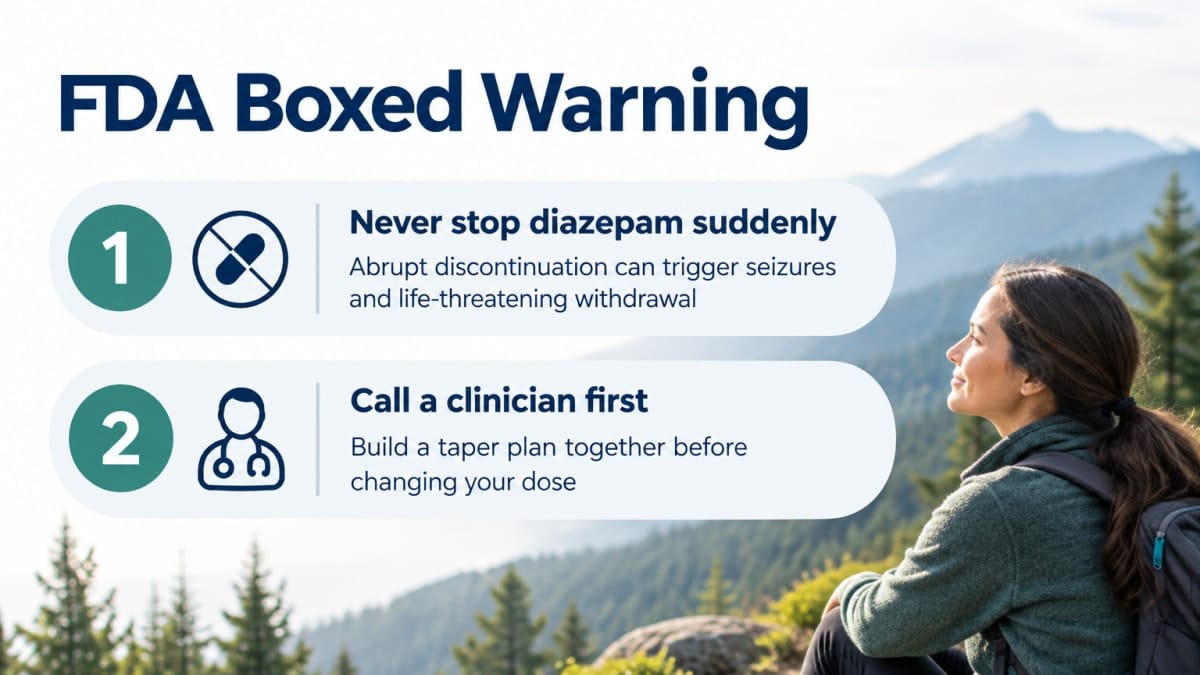
That warning is not written for people who popped a pill at a wedding. It is written for the reader this article is actually about, someone who has been on diazepam long enough that their body has adapted to it. If that’s you, the safest move you can make today is not quitting. It’s calling a clinician and building a plan together. You are not overreacting by asking for help, and you are not weak for needing a taper. You are following the manufacturer’s own instructions and the FDA’s own guidance.1
What Safe, Medically Supervised Discontinuation Looks Like
Why a Gradual, Individualized Taper Is the Standard of Care
The international clinical consensus on getting off diazepam is remarkably consistent: go slow, and build the plan around the person, not the drug. A recent consensus guideline from the British Association for Psychopharmacology reviewed the available evidence and found that while high-quality research on benzodiazepine withdrawal treatment remains limited, the shared clinical agreement strongly favors gradual, individualized dose reduction over abrupt discontinuation.4
What that looks like in practice varies. Some clinicians use fixed reductions, around 1 to 2 mg of diazepam every 2 to 4 weeks. Others use percentage-based cuts, roughly 5 to 10% of the current dose every 2 to 4 weeks.4 Both approaches share the same logic: small enough that your nervous system can keep up, slow enough that you don’t get ambushed.
The honest part is that the guideline also acknowledges disagreement about optimal pace, and notes that some people need slower reductions, outright pauses, or temporary stabilization when a cut destabilizes them.4 That’s not failure. That’s the plan working, because the plan is supposed to flex to your body, not the other way around.
This is why you don’t want to design the taper yourself. The pacing numbers above are the starting point for a clinical conversation, not a schedule to screenshot. Dose, duration of use, age, other medications, and how you’re actually feeling week to week all shape what happens next.
Inside a Residential Medical Detox: What to Actually Expect
“Medically supervised detox” sounds clinical and vague, so here’s the concrete version. In a residential medical detox, you check into a facility and stay there while a clinical team manages the withdrawal in real time. At Pacific Crest Trail Detox, detox typically lasts around 8 to 10 days.
Registered nurses are on site 24 hours a day. That matters because the symptoms you’re most afraid of, seizures, hallucinations, severe panic, suicidal thoughts, don’t keep office hours.2 If something starts to shift at 3 a.m., someone trained is already in the building. Medical providers round through the facility seven days a week to adjust the taper, treat symptoms as they come up, and change course if your body isn’t responding the way the first plan expected.
The setting itself is designed to look less like a hospital and more like a house. Private or semi-private bedrooms. Home-cooked meals instead of cafeteria trays. Shared living spaces where you can sit with coffee and a book. Daily group therapy, where you meet other people going through something similar and realize the shame you brought in the door isn’t yours to carry alone.
Days have a loose structure, meals, groups, time to rest, time to talk with a counselor one-on-one. Nothing is designed to break you down. Everything is designed to keep you safe while your nervous system does the hard work of recalibrating. For many people, especially those with a history of long-term diazepam use, that supervised environment is the difference between a controlled medical event and an ER visit.
After Detox: Why the Work Doesn’t Stop at Day 10
Here’s the part that doesn’t get said often enough: finishing detox is a beginning, not a finish line. Your body is through the sharpest part of the withdrawal, but your nervous system is still recalibrating, and the circumstances that led to long-term diazepam use, chronic anxiety, insomnia, trauma, pain, are still there waiting.
That’s why detox is designed to hand off directly to the next level of care. For some people, that’s a partial hospitalization program (PHP) that meets most of the day. For others, it’s an intensive outpatient program (IOP) a few evenings a week, or standard outpatient therapy, or an alumni community that stays in touch for years. The exact mix depends on your life, your work, and what kind of support you had before.
Skipping that step is where a lot of people get hurt. You feel clear-headed at the end of detox, decide you’ve got it from here, and six weeks later the same stress that landed you on diazepam is back without a plan to meet it. Continued care is how the clear-headed version of you builds something that holds.
If You’re the Family Member Watching This Happen
If you’re the spouse, parent, adult child, or close friend reading this because someone you love is on diazepam and talking about stopping, your instincts are probably right. The fear in your gut is a reasonable response to a real medical situation, not an overreaction.
A few things that help:
- Learn the short list of emergency symptoms, seizures, hallucinations, severe confusion, suicidal talk, and unusual movements they can’t control, so you can act fast if they appear.2
- Do not try to help them taper at home from a schedule you found online. Even well-meaning dose cuts can backfire with a long-acting drug like diazepam.1
- If they’re resistant to detox, resist the urge to argue them into it; instead, ask what scares them about it and listen. Shame is often the real barrier, not logic.
- And take care of yourself. Watching someone go through withdrawal is exhausting, and your steadiness matters more than your perfect words.
Taking the Next Step in the Portland Metro or Beyond
If you’ve read this far, you already know the honest answer: diazepam withdrawal is manageable, but it’s not something to do alone on your couch. The next step is a phone call, not a plan you build by yourself. Pacific Crest Trail Detox is a non-hospital, home-like medical detox in Milwaukie, just outside Portland, with RNs on site around the clock and providers rounding seven days a week. We work with people from across Oregon and SW Washington, Portland, Beaverton, Gresham, Salem, Vancouver, and welcome clients from out of state who want a calmer setting to get through this safely.
Call for a confidential assessment or verify your insurance online. Conversations are HIPAA-protected, and asking questions does not commit you to anything. We want to be your last treatment experience, whether we’re your first detox or your fifth.
Check Coverage for Safe Diazepam Detox
Find out whether your plan may help cover medically supervised care for diazepam withdrawal.
Frequently Asked Questions
How long do diazepam withdrawal symptoms last?
Because diazepam is long-acting, withdrawal may be delayed and can appear later than with short-acting benzodiazepines, sometimes up to about 3 weeks after the last dose. Some people also experience protracted symptoms, lingering anxiety, patchy sleep, mood swings, that fade over weeks or months.3 A supervised taper tends to shorten and soften the whole arc.
Can you die from stopping diazepam cold turkey?
Yes, and that is not an exaggeration. The FDA warns that stopping benzodiazepines suddenly, or cutting the dose too quickly, after weeks or months of regular use can trigger severe, potentially life-threatening withdrawal, including seizures.1 If you have been taking diazepam daily for more than a few weeks, do not quit on your own. Call a clinician and build a taper plan together.
Am I addicted to diazepam if I took it exactly as prescribed?
Not necessarily. Physical dependence and addiction are different things. Taking diazepam as prescribed for weeks or months can make your body adapt to it, which is why withdrawal happens when you stop. That is physiology, not a character flaw. Addiction involves compulsive use despite harm. Either way, the safe way off is the same, a gradual, clinician-guided taper, not willpower alone.
What symptoms during diazepam withdrawal mean I should go to the ER?
Call 911 or go to the nearest emergency department for seizures, hallucinations, severe confusion or loss of contact with reality, psychosis or catatonia, unusual movements you cannot control, or any new suicidal thoughts.2 Do not drive yourself. Tell the emergency team the person is in benzodiazepine withdrawal. If you are the family member watching, treat these signs the way you would treat chest pain.
Do I need residential detox, or can my regular doctor taper me?
It depends on how long you have taken diazepam, your dose, your age, whether you drink or use opioids, and whether you have ever had a withdrawal seizure. Some people taper safely with their primary care clinician. Others need around-the-clock nursing and daily medical oversight, especially long-term users.1 An honest conversation with a detox intake team can sort out which path fits you.
Can I come to Pacific Crest Trail Detox from outside Oregon?
Yes. Pacific Crest Trail Detox is in Milwaukie, just outside Portland, and welcomes clients from SW Washington and from out of state who want a calmer, home-like setting to get through diazepam withdrawal safely. Many people choose to travel for detox because stepping out of their usual environment helps. Call for a confidential, HIPAA-protected assessment or verify your insurance online. Asking questions does not commit you to anything.
References
- FDA expands Boxed Warning to improve safe use of benzodiazepine drug. https://www.fda.gov/drugs/drug-safety-and-availability/fda-requiring-boxed-warning-updated-improve-safe-use-benzodiazepine-drug-class?
- VALIUM (diazepam) tablets, for oral use, C-IV. https://www.accessdata.fda.gov/drugsatfda_docs/label/2026/013263s095lbl.pdf
- DIAZEPAM tablet – DailyMed – NIH. https://dailymed.nlm.nih.gov/dailymed/drugInfo.cfm?setid=ba953b22-f0cd-4be5-9e0e-178bded88727
- Evidence-based consensus guidelines for the pharmacological management of substance dependence: Recommendations from the British Association for Psychopharmacology. https://pmc.ncbi.nlm.nih.gov/articles/PMC13222391/