


Key Takeaways
- Alcohol use disorder is diagnosed on a mild, moderate, or severe spectrum using 11 DSM-5-TR signs over the past year, not by passing through fixed stages 1.
- Two symptoms already meets the clinical threshold, so waiting to hit rock bottom before seeking help is outdated and costly thinking 1.
- Alcohol withdrawal can be life-threatening for dependent drinkers, which is why morning shakes, prior seizures, or daily heavy use call for medical assessment before stopping 2.
- Detox stabilizes the body but does not treat AUD alone; lasting change comes from stepping into PHP, IOP, outpatient, and alumni support afterward 1.
When Drinking Stops Being a Choice
If you’re reading this at the end of a long night, or in the quiet after another argument about the bottles in the recycling bin, start here: the stages of alcoholism aren’t a staircase you climb. Modern medicine describes alcohol use disorder (AUD) as a spectrum, measured by how many of 11 specific signs show up in your life over the past year, and sorted into mild, moderate, or severe 1.
That shift matters. It means you don’t have to hit some mythical rock bottom to qualify for help. It also means that if your body has grown dependent on alcohol, stopping on your own can be genuinely dangerous 2.
You’re not weak. You’re not broken. You’re looking at a treatable medical condition, and the next pages will help you see where you actually stand.
Why the Old “Stages of Alcoholism” Model Misses the Point
You’ve probably seen the chart somewhere: four stages, maybe seven, each with a tidy name like “pre-alcoholic” or “chronic.” That model comes from E.M. Jellinek’s work in the 1950s, and while it shaped how a generation talked about drinking, it doesn’t match how clinicians diagnose the condition today.
The problem with stage charts is that they make alcoholism look like a train on a track. First you drink socially, then you drink to cope, then you lose control, then you hit bottom. Real life rarely moves that cleanly. A corporate attorney in Beaverton can drink two bottles of wine every night for a decade and never miss a deposition. A college student in Salem can slide into a severe problem in eighteen months. A grandmother in Vancouver might only drink after 5 p.m. and still shake in the morning. None of them fit neatly on a staircase.
Modern clinical practice uses a different framework. The DSM-5-TR, which is the diagnostic manual your doctor actually uses, describes alcohol use disorder on a severity spectrum: mild, moderate, or severe, based on how many of 11 specific symptoms have shown up in the past 12 months 1. There are no stages to pass through and no label you have to earn.
This matters for one reason. If you’ve been waiting to “get bad enough” to deserve help, the current medical model says that wait is costing you. Two symptoms is already a diagnosis. Two symptoms is already a reason to call someone.
How Alcohol Use Disorder Is Actually Measured Today
The 11 Signs on the DSM-5-TR Checklist
Instead of asking what stage you’re in, your doctor would ask whether any of these 11 things have happened to you in the past year. This is a plain-language paraphrase of the DSM-5-TR criteria that NIAAA uses 1. Read them slowly. You only need two to meet the diagnosis.
- You’ve ended up drinking more, or for longer, than you meant to.
- You’ve wanted to cut down or stop, or tried to, and couldn’t.
- You’ve spent a lot of time drinking, or being sick from drinking, or recovering from it.
- You’ve had cravings — a strong urge or pull to drink.
- Drinking has gotten in the way of what you need to do at work, school, or home.
- You’ve kept drinking even when it caused problems with people you love.
- You’ve given up or cut back on things you used to care about — hobbies, workouts, time with your kids — because of drinking.
- You’ve gotten into situations while drinking that could have hurt you (driving, swimming, walking home alone).
- You’ve kept drinking even though it was making you feel depressed, anxious, or physically sick.
- You’ve needed more alcohol to feel the same effect, or the same amount doesn’t hit like it used to (tolerance).
- You’ve felt withdrawal when the alcohol wore off, or you’ve had a drink to make those feelings stop 1.
Count what’s true for you in the past 12 months. Two or three signs is mild alcohol use disorder. Four or five is moderate. Six or more is severe 2.
Nothing on this list requires you to drink every day. Nothing on it requires a DUII, a job loss, or a hospital visit. If you recognized yourself more than twice, that’s not a character flaw. That’s a medical finding, and it’s one that detox and treatment teams see every week.
Mild, Moderate, and Severe: What Each Range Looks Like in Real Life
Numbers on a checklist can feel abstract, so here’s what each range tends to look like when it walks through the door of a detox in the Portland metro.
Mild (2–3 signs). You might be the person who swore off wine on Monday and opened a bottle by Thursday. Maybe you’ve started drinking a little earlier, or hiding how many you had, or snapping at your partner about it. You still show up to work. You still make it to your kid’s soccer game. But the quiet voice in your head has started asking questions you can’t quite answer. Mild AUD is still AUD, and it’s the easiest place to turn things around 2.
Moderate (4–5 signs). Drinking is now shaping your week. You’ve canceled on friends because you were too hungover. You’ve promised yourself you’d stop at two and ended at six, more than once. There may be a little tolerance creeping in — the first drink doesn’t do what it used to. Mornings are rough. You might feel anxious until the afternoon, and better once you’ve had a drink. That last part matters, because it’s a sign your body is starting to lean on alcohol.
Severe (6 or more signs). This is where drinking has become the organizing fact of your day. You plan around it, you need it, and when you don’t have it, your body reacts — shaking hands, sweats, a racing heart, sometimes seizures. People at this end of the spectrum often can’t stop safely without medical help 1. If this is you, or someone you love, the next section is the one to read.
Risky Drinking vs. a Diagnosis: Where the Line Really Sits
Here’s a distinction that trips a lot of people up: drinking too much and having alcohol use disorder are not the same thing. You can do one without the other. Many people do both.
The CDC defines binge drinking as four or more drinks on an occasion for women or five or more for men, and heavy drinking as eight or more drinks a week for women or 15 or more for men 4. Those numbers describe risk patterns, not a diagnosis. They tell you your drinking is in a zone that raises the odds of injury, liver disease, cancer, and early death — the CDC estimates that excessive alcohol use is linked to approximately 178,000 deaths annually in the United States 4— but hitting those thresholds does not automatically mean you have AUD.
AUD is diagnosed by what alcohol is doing to your life and your body, not by the pour count alone 1. Some people drink well above the heavy-drinking line and never develop two of the 11 symptoms. Others drink less and tick off six.
So two honest questions sit side by side. Is my drinking risky by the numbers? And is it starting to run the show?
The Signs People Notice First (and the Ones They Hide)
The first signs of a drinking problem are rarely dramatic. They’re small, livable, and easy to explain away.
What people often notice first in themselves: a second glass that turns into a fourth without quite meaning to. Waking up tired even on days you didn’t feel drunk the night before. A low hum of guilt when the recycling clanks on the way to the curb. Snapping at your partner over something small and knowing, somewhere underneath it, that you’re really defending the bottle.
What people around you tend to notice first: your breath in the afternoon. The way you steer every dinner toward a place that serves wine. Canceling plans with your kids or your friends and blaming work. Being present but not quite there.
And then there are the things people hide, often for years. The bottle in the garage, behind the paint cans. The vodka in the water bottle at your desk. The quick drink in the car before walking into the house. The mouthwash in the glove box. The shaking hands that steady after the first sip of the day — a signal your body has started depending on alcohol, not just your evenings 1.
Hiding is exhausting. It’s also one of the clearest signs that part of you already knows. You don’t have to wait for someone to catch you. The fact that you’re reading this is enough reason to make a quiet phone call and talk to someone who won’t flinch.
Why Alcohol Withdrawal Is One of the Few That Can Kill You
Most people assume alcohol withdrawal is a rough few days of sweating it out on the couch. For a casual drinker, it might be. For someone whose body has grown dependent, it’s a different story — and it’s one of the only withdrawals that can actually end a life.
Here’s why. When you drink heavily for a long stretch, your brain adjusts. It dials down its own calming chemistry because alcohol is doing that work for it. Pull the alcohol away suddenly, and the brake lines are gone. Your nervous system revs with nothing to slow it. That’s where the shaking, racing heart, soaring blood pressure, insomnia, and crawling anxiety come from. In severe cases, it can escalate to seizures or delirium tremens — confusion, hallucinations, dangerous spikes in heart rate and temperature — which can be fatal without medical care. NIAAA is direct about this: stopping suddenly after prolonged heavy drinking can cause life-threatening withdrawal 2.
A medically supervised detox is not a punishment or a last resort. It’s a setting where nurses watch your vitals, a provider manages symptoms with medication, and the dangerous part of stopping is handled by people who do this every day 1. That’s the difference between quitting alone and quitting safely — and often, it’s the difference that lets the next chapter happen at all.
The Treatment Gap: Most People Who Need Help Never Get It
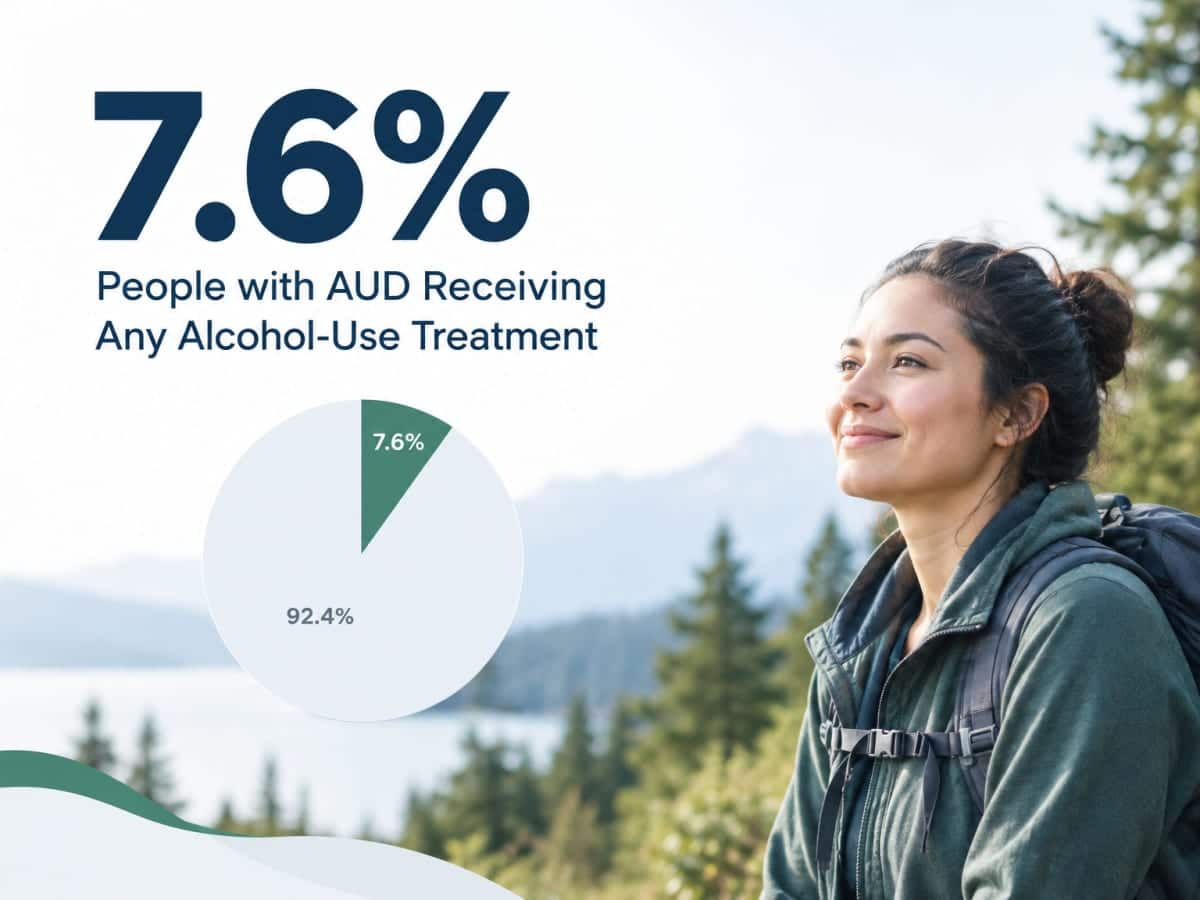
Here’s the hard truth about alcohol use disorder in this country: most people who have it don’t get treated for it. In 2024, only about 2.1 million people age 12 or older with AUD received any alcohol-use treatment — roughly 7.6% of everyone with a past-year diagnosis, according to NIAAA’s analysis of the National Survey on Drug Use and Health 3. That number is self-reported, so it leans on whatever people counted as “treatment,” from a single counseling session to a full residential stay. Even with that generous definition, more than nine out of ten people who meet the criteria never make it through a treatment door.
Sit with that for a second. If you’ve been quietly wondering whether you should call someone, you are not an outlier. You are part of the overwhelming majority who recognized something was off and didn’t act on it yet. The reasons are familiar — cost, shame, not knowing where to start, worrying what work or family will think, hoping it’ll resolve on its own. None of those are character flaws. They’re just the friction that keeps a treatable condition untreated.
The good news hiding in that statistic is that the bar for being “treatment-worthy” is lower than you think. You don’t have to be the worst case on the block to pick up the phone.
What This Looks Like in Oregon and SW Washington
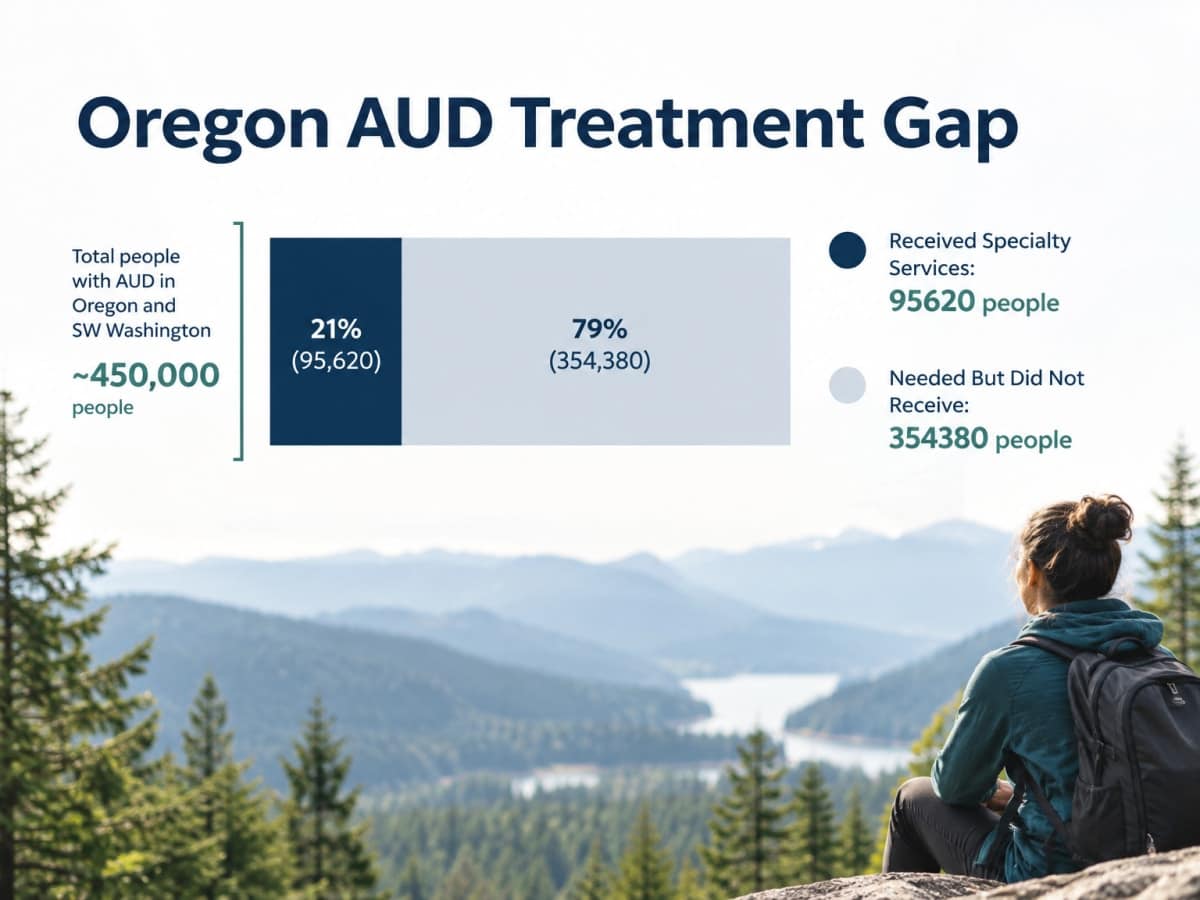
Zoom in from the national picture and the gap gets personal. A 2022 Oregon analysis estimated that more than 450,000 Oregonians had alcohol use disorder, and about 354,380 of them needed but did not receive specialty-facility services — these are 2022 estimates and may not reflect current counts 10. That’s a staggering share of your neighbors — people in Portland, Milwaukie, Gresham, Beaverton, Salem, and across the river in Vancouver — carrying a treatable condition without the care that treats it.
Part of the problem is capacity. A 2024 state capacity analysis identified 301 withdrawal-management facilities in Oregon when the modeled need was 888 — a shortage of more than 180% 7. That gap is why calling early matters. The person who starts looking for a detox bed on a Tuesday morning has more options than the person who waits until Friday night.
There is some movement in the right direction. Across Oregon’s coordinated care organizations, alcohol or substance-use screening rose from 60.2% in 2023 to 65.0% in 2024, meaning more primary-care conversations are catching drinking problems earlier 9. More screening only helps if people act on what they hear. If a provider has already told you your drinking is concerning, that’s your opening, not your scolding.
If you’re not ready to call a facility directly, Oregon’s Alcohol and Drug Help Line (1-800-923-4357) is a confidential starting point and runs 24/7 8. One phone call doesn’t commit you to anything. It just stops the waiting.
What Medically Supervised Detox Actually Involves
If the word “detox” conjures up a hospital gurney or a locked ward, let that picture go. In Oregon, medically supervised detox is a regulated level of care 5. At Pacific Crest Trail Detox, that means a nurse takes your vitals through the night, a provider orders medication to blunt withdrawal symptoms, and someone is awake at 3 a.m. when your heart is pounding and you can’t sleep. It is clinical, but it doesn’t have to feel sterile.
The first few hours are an assessment. Staff ask what you’ve been drinking, how much, how long, what other substances are in the mix, and what your health history looks like. They check for the risk factors that make withdrawal dangerous — prior seizures, previous DTs, heavy daily use, benzodiazepines on board. That picture decides what medications you get and how closely you’re watched. Withdrawal management is designed as short-term care to stabilize symptoms and prepare you for ongoing recovery services 11.
From there, the next several days are about stabilization. At Pacific Crest Trail Detox, most people stay about 8 to 10 days, long enough for the acute withdrawal to pass and for sleep, appetite, and clear thinking to come back online. In a home-like residential program in Milwaukie, that looks less like a ward and more like a house with real meals, daily groups, and staff who have often been through recovery themselves.
Detox stabilizes the body. It does not, by itself, treat alcohol use disorder 1. That’s why the next section matters as much as this one.
Detox Is Step One: What Continued Care Looks Like
Finishing detox feels like a victory, and it is. It’s also the beginning. The acute withdrawal is over, your head is clearer than it’s been in months, and the real work — figuring out why alcohol got this grip on your life, and building something stronger in its place — starts now. Short-term withdrawal management is designed to stabilize you and hand you off to ongoing care, not to replace it 11.
Continued care usually steps down in intensity. A partial hospitalization program (PHP) runs most of the day, five or six days a week, and gives you structure while you sleep at the residence or at home. An intensive outpatient program (IOP) drops to a few sessions a week so you can start reconnecting with work and family. Standard outpatient keeps a lighter counseling rhythm going for months. Aftercare and alumni groups keep you tethered to people who understand, often for years.
Each step teaches something the last one couldn’t. Groups show you that your story isn’t unique. Individual therapy gets under the drinking to the anxiety, grief, or trauma that fed it. Family sessions help the people around you learn a new way to be in the room with you.
Detox alone has a rough track record. Detox connected to a real continuum is a different conversation entirely 1.
How to Talk to Someone You Love About Their Drinking
If you’re the one worried about someone else, you’ve probably rehearsed the conversation a dozen times in your head and never had it out loud. That’s okay. The goal isn’t a perfect speech. It’s one honest sentence that lands without putting them on trial.
Pick a sober moment, not the middle of a bad night. Morning is usually better than evening. Lead with what you’ve seen, not what you’ve labeled: “I noticed you’ve been drinking more after work, and you seem exhausted” lands differently than “You’re an alcoholic.” Say what you’re afraid of. Say that you love them. Then stop talking and listen, even if what comes back is defensive or angry. That reaction is often the shame talking, not the person.
Have one concrete option ready before you start. In Oregon, the Alcohol and Drug Help Line at 1-800-923-4357 is confidential, free, and open around the clock 8. You can offer to sit next to them while they call, or to call first yourself and relay what you learned. If their body already shakes in the morning or they’ve had a seizure before, don’t push them to quit cold — ask them to be medically assessed first 2.
You can’t make someone ready. You can make the next step smaller than it looks.
A Confidential Next Step
If any part of this article felt like a mirror, the next move is smaller than it looks: one phone call, no commitment. A conversation with Pacific Crest Trail Detox in Milwaukie is confidential and HIPAA-protected. You can ask what a medically supervised stay actually involves, what your insurance covers, and what continued care looks like after you leave — PHP, IOP, outpatient, and alumni support, all connected to the same team 1.
You don’t have to be certain. You just have to be willing to make one call. We want to be your last treatment experience, whether we’re your first detox or your fifth.
Ready to Get Help With Drinking?
Check whether your plan may cover medically supervised alcohol detox and support for what comes next.
Frequently Asked Questions
What are the stages of alcoholism in simple terms?
The old “stages of alcoholism” model (early, middle, late) is a cultural shorthand, not how doctors diagnose drinking problems today. Clinicians use alcohol use disorder on a severity spectrum: mild (2–3 symptoms), moderate (4–5), or severe (6 or more) based on 11 specific signs in the past year 1, 2. Where you land can shift as drinking changes.
How do I know if my drinking has crossed into alcohol use disorder?
Count honestly. If two or more of these have shown up in the past year — drinking more than you meant to, trying to cut back and couldn’t, cravings, drinking causing problems at work or home, needing more to feel it, or withdrawal when you stop — you meet the clinical threshold for AUD 1. Two symptoms is already a diagnosis worth talking to someone about.
Is it dangerous to stop drinking on my own?
It can be. If you’ve been drinking heavily for months or years, stopping suddenly can trigger seizures or delirium tremens, which can be life-threatening without medical care 2. Warning signs that you need a medical assessment first: shaking hands in the morning, sweating until you drink, a prior withdrawal seizure, or daily heavy use. Please don’t white-knuckle it alone — get assessed.
How long does medically supervised alcohol detox take?
At Pacific Crest Trail Detox, most people stay about 8 to 10 days, though it varies with your drinking history, health, and whether other substances are involved. The first days focus on managing withdrawal symptoms with medication while nurses monitor your vitals around the clock. By the end, acute withdrawal has passed, sleep and appetite return, and you’re stable enough to step into continued care — the real work of recovery.
What happens after detox at Pacific Crest Trail Detox?
Detox stabilizes your body; it doesn’t treat alcohol use disorder by itself 1. After detox in Milwaukie, most people step into continued care at Pacific Crest Trail Detox or through partner program Oregon Trail Recovery: partial hospitalization (PHP), intensive outpatient (IOP), standard outpatient, and alumni support. Each level drops the intensity while keeping you connected to counselors, groups, and people who understand what you’re walking through.
How can I help a loved one in Oregon or SW Washington who may need detox?
Start sober, in the morning, with one honest sentence about what you’ve seen and that you love them. Have one option ready: Oregon’s Alcohol and Drug Help Line at 1-800-923-4357 is confidential and open 24/7 8. If they shake in the morning or have had a seizure, don’t push them to quit cold — ask them to be medically assessed first. A confidential call to a Portland-metro detox is a small, safe next step.
References
- Alcohol Use Disorder: From Risk to Diagnosis to Recovery. https://www.niaaa.nih.gov/health-professionals-communities/core-resource-on-alcohol/alcohol-use-disorder-risk-diagnosis-recovery
- Understanding Alcohol Use Disorder. https://www.niaaa.nih.gov/publications/brochures-and-fact-sheets/understanding-alcohol-use-disorder
- Alcohol Treatment in the United States. https://www.niaaa.nih.gov/alcohols-effects-health/alcohol-topics-z/alcohol-facts-and-statistics/alcohol-treatment-united-states
- Data on Excessive Alcohol Use. https://www.cdc.gov/alcohol/excessive-drinking-data/index.html
- Oregon Health Authority: Licensing and Certification: Providers. https://www.oregon.gov/oha/BH/Providers/Pages/Licensing-Certification.aspx
- Oregon Health Authority: Residential Treatment Facilities. https://www.oregon.gov/oha/BH/Providers/Pages/RT.aspx
- Alcohol and Drug Policy Commission: Treatment. https://www.oregon.gov/adpc/Pages/Treatment.aspx
- Substance Use Disorder Services. https://www.oregon.gov/oha/BH/Adults/Pages/Substance-Use.aspx
- Oregon Medicaid insurers improved behavioral health care quality in 2024. https://www.oregon.gov/oha/erd/pages/oregon-medicaid-insurers-improved-behavioral-health-care-quality-in-2024.aspx
- Oregon Substance Use Disorder Services Inventory and Gap Analysis. https://www.oregon.gov/oha/HSD/AMH/DataReports/SUD-Gap-Analysis-Inventory-Report.pdf
- Alcohol and Drug Policy Commission: HB 4002 MOUD Report. https://www.oregon.gov/adpc/Documents/HB%204002%20(2024)%20ADPC%20MOUD%20Report%20September%2018%202025.pdf