Key Takeaways
- Detox medications are chosen based on the substance, your history, and what comes next, not a single universal protocol that applies to everyone.
- Alcohol and benzodiazepine withdrawal can be life-threatening and require supervised care, typically using benzodiazepines or a slow taper with close monitoring4, 5, 7.
- Opioid withdrawal is managed with buprenorphine, methadone, lofexidine, or naltrexone, with the 2024 SWIFT trial showing rapid naltrexone induction succeeded in 62.7% of participants versus 35.8% on the standard track7.
- Finishing withdrawal is only the first step; continuing medication and connecting to PHP, IOP, or outpatient care is what protects against relapse and overdose after tolerance drops11, 12.
What a doctor may actually prescribe during withdrawal
Medical detox medications are a short, targeted list of drugs a provider may use to keep you safe and reasonably comfortable while your body clears a substance. The specific medications depend on what you’ve been using, how long, how much, your medical history, and what kind of care you’ll step into after detox. There is no single pill or protocol that covers every person.
For alcohol withdrawal, benzodiazepines like diazepam or chlordiazepoxide are the standard, along with supportive care5. For opioid withdrawal, you may be offered buprenorphine, methadone, lofexidine for symptoms, or naltrexone once opioids have cleared1, 2. For benzodiazepines, the answer is almost always a slow, supervised taper rather than stopping cold7, 8.
Some of these medications are only for getting you through the first week or two. Others, like acamprosate, naltrexone, or buprenorphine, can continue into ongoing recovery3, 2. The sections below walk through each, honestly, so you know what to expect before you ever pick up the phone.
Why the medication menu depends on the substance, not a single protocol
If you’ve been reading online, you may have noticed that “detox medications” gets talked about like one thing. It isn’t. The drugs a provider reaches for depend almost entirely on what your body has been dependent on, because different substances cause different withdrawal syndromes, and the risks look nothing alike.
Alcohol withdrawal can be life-threatening without medical treatment, which is why it is managed with careful, scheduled sedating medications and close monitoring4, 5. Benzodiazepine withdrawal can also be severe, with seizures and delirium as serious risks, so a supervised taper is the standard7, 8. Opioid withdrawal rarely kills you, but it is miserable and carries a serious overdose risk afterward, so the medication plan is built around easing symptoms and, when it fits, starting a longer-term medication like buprenorphine, methadone, or naltrexone1, 2. Stimulants and cannabis have no FDA-approved medications for use disorders, so care focuses on sleep, appetite, mood, and getting you ready for what comes next13.
Your history matters too. Liver and kidney function, other prescriptions, pregnancy, how much you’ve been using, and whether you plan to continue medication after detox all shape the choice. That’s why a good program assesses you before deciding anything, instead of handing every person the same packet.
Medications used for alcohol withdrawal
Benzodiazepines: the standard first-line choice
If you’ve been drinking heavily for a long stretch, the medication most likely to show up on your chart is a benzodiazepine. Diazepam and chlordiazepoxide are the examples named in federal guidance for alcohol withdrawal5. They work on the same brain receptors as alcohol, which is why they can quiet the shakes, racing heart, anxiety, and risk of seizures that come with alcohol withdrawal.
Alcohol withdrawal isn’t just uncomfortable. In its severe forms, it can be life-threatening, which is why medical supervision matters so much here4. A nurse or provider will check in on you often, usually using a withdrawal scale to measure symptoms like tremor, sweating, pulse, and agitation. Your dose is adjusted based on what your body is actually doing, not a one-size-fits-all plan.
Some programs give benzodiazepines on a fixed schedule and taper them down over several days. Others use what’s called symptom-triggered dosing, where you get medication when your scores climb. Both approaches are evidence-based. The point you should hold onto: you shouldn’t be white-knuckling this at home, and you shouldn’t be sedated to the point you can’t talk, either. Done right, the goal is calm, awake, and safe.
Where phenobarbital fits, and what the recent evidence actually shows
Phenobarbital is an older seizure medication that has come back into the alcohol withdrawal conversation over the last few years. It works on some of the same brain pathways as benzodiazepines but through a slightly different mechanism, and some clinicians use it either alone or alongside a benzodiazepine for people with severe withdrawal.
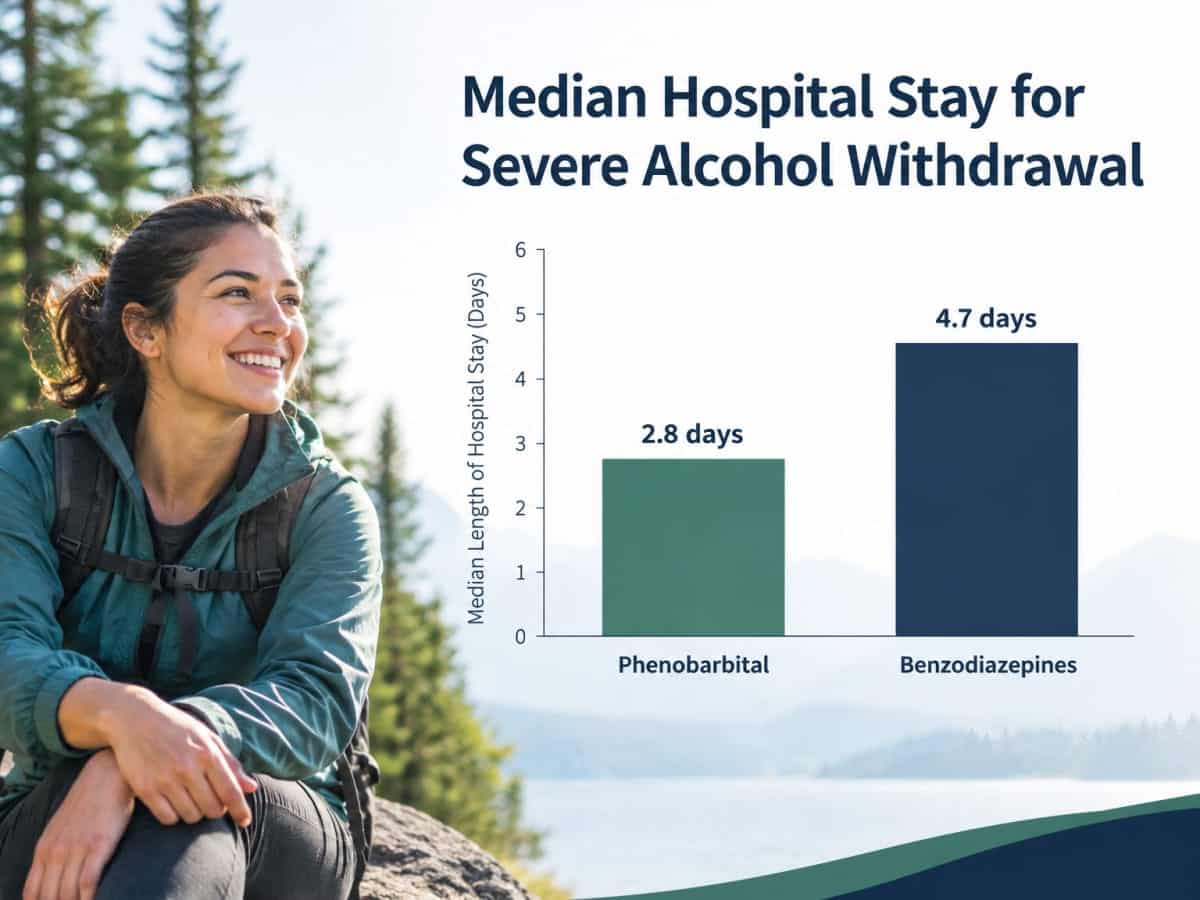
Here’s where you need the honest version. A 2024 retrospective study of people hospitalized with severe alcohol withdrawal reported a median hospital stay of 2.8 days with scheduled phenobarbital compared to 4.7 days with benzodiazepines9. That looks compelling at first glance. The important caveat is that it was retrospective — meaning researchers looked back at charts rather than randomly assigning treatments — so the observational design limits causal conclusions and the groups may not have been identical in ways that affected outcomes.
A systematic review of phenobarbital in emergency department settings pulled together the available studies and found the evidence base was limited and inconsistent, with randomized trials generally not showing clear superiority over benzodiazepines8. In plain terms: phenobarbital may be a reasonable tool in experienced hands, but it isn’t a proven upgrade for everyone.
What you should take from this: if a program mentions phenobarbital, it’s not a red flag, but it’s also not a shortcut. The deciding factor is whether the people watching you are trained to adjust medications in real time and recognize when something is going sideways.
Supportive medications: fluids and comfort care
Benzodiazepines get the headline, but a lot of what makes alcohol detox safer is quieter. You’ll likely get IV or oral fluids to correct dehydration and electrolyte imbalances, especially if you’ve been vomiting or barely eating. Anti-nausea medications, something for sleep in the first few nights, and medications for high blood pressure or headaches are common additions. None of these are glamorous. All of them are part of why you’ll feel human again by day three or four instead of wrecked for weeks.
Medications used for opioid withdrawal
Buprenorphine
Buprenorphine is one of three FDA-approved medications for opioid use disorder, available as buprenorphine alone, as a buprenorphine/naloxone combination, and as an extended-release monthly injection. All have been identified as safe and effective when used as directed2.
Here’s what it actually does. Buprenorphine is a partial opioid agonist, meaning it attaches to the same brain receptors as heroin, fentanyl, or oxycodone, but turns the signal down instead of all the way up. For you, that usually translates to the shaking, chills, bone aches, and crawling anxiety of withdrawal easing within an hour or two of the first dose. It also blunts cravings, which is often the harder battle.
Timing matters. In a supervised setting, a provider will time the first dose carefully based on where you are in withdrawal1. Many people continue buprenorphine well past detox as part of ongoing treatment, which is a decision you’ll make with your prescriber, not one you have to settle on day one.
Methadone during medically supervised withdrawal
Methadone is the oldest medication in the opioid-use-disorder toolkit and still one of the most effective. It’s a full opioid agonist, which means it fully occupies the same receptors as the opioids you’ve been using. Taken at the right dose, it stops withdrawal and quiets cravings1.
In the United States, methadone for opioid use disorder is dispensed through federally regulated opioid treatment programs rather than a regular pharmacy2. Inside a residential detox, methadone may be used short-term to manage withdrawal, with a plan built with you for what happens after discharge. Some people transition off it; others continue methadone treatment through an outpatient opioid treatment program because it’s what keeps them stable.
If you’re coming off fentanyl or long-term high-dose opioids, methadone can be a steadier option than a quick taper. Your care team will walk you through what’s realistic.
Lofexidine and clonidine for withdrawal symptoms
Not everyone wants to start buprenorphine or methadone, and not every situation calls for it. For symptom relief without an opioid medication, providers often reach for lofexidine or clonidine. Lofexidine is FDA-approved for acute opioid-withdrawal symptoms1. Clonidine is used off-label for the same purpose and has been around longer.
Both work by calming the overactive stress response that makes opioid withdrawal so brutal. They can take the edge off the sweating, racing heart, high blood pressure, cramping, and restlessness. Neither one is an opioid, and neither one treats cravings the way buprenorphine or methadone do.
These medications are often paired with other comfort meds for sleep, nausea, and muscle aches. They can also bridge you to a naltrexone start, which is where the next piece comes in.
Naltrexone and the 2024 rapid-induction evidence
Naltrexone is the odd one out in the opioid medication list. It isn’t an opioid at all; it’s a blocker. The extended-release injectable form sits on your opioid receptors for about a month, so if you were to use again, you wouldn’t feel the effect. That’s useful for some people, especially those who don’t want a daily medication and have a clear plan for continuing care1, 2.
The catch has always been getting started. Because naltrexone requires complete opioid cessation first, you need to be fully opioid-free before the first dose. According to NIDA’s summary, the standard induction took 10 to 15 days of opioid-free time, and a lot of people couldn’t make it through that window6.
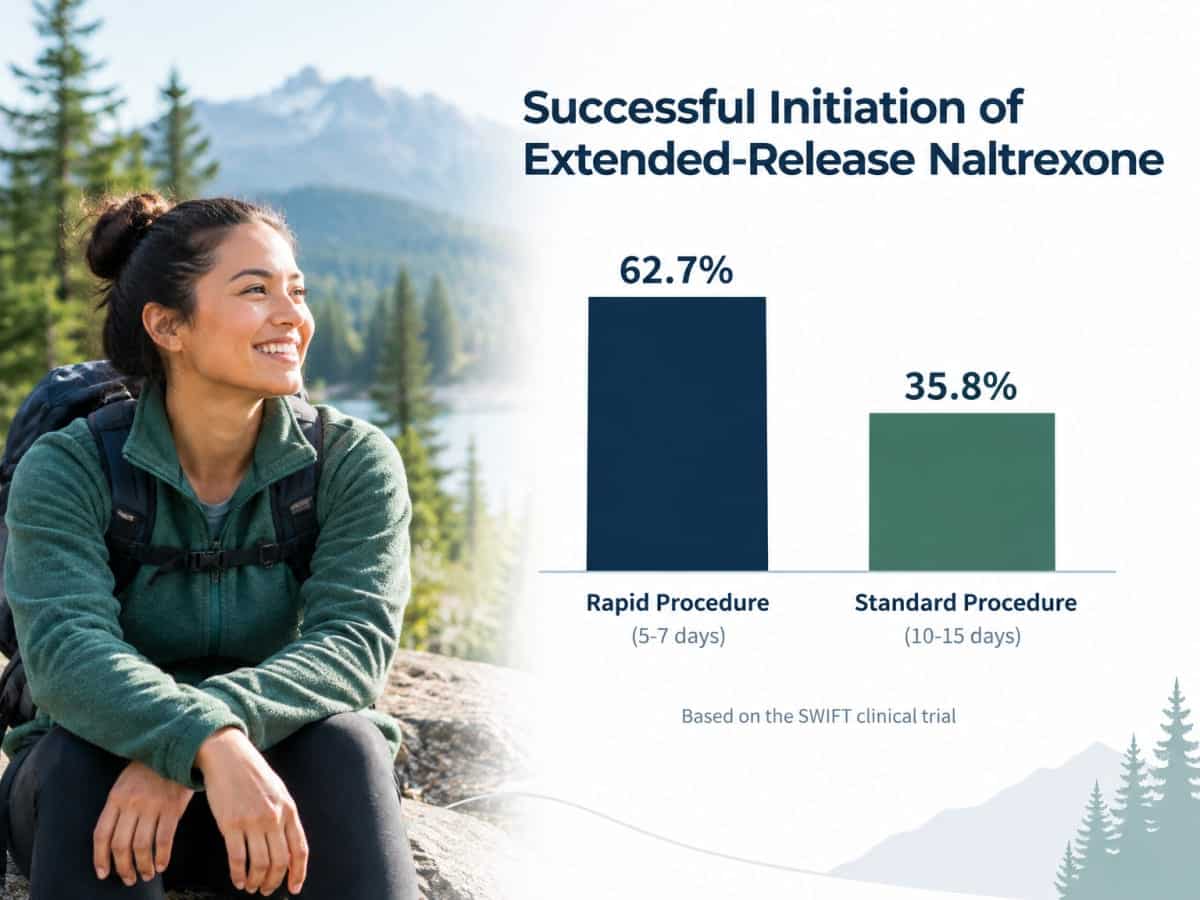
The 2024 SWIFT trial changed the conversation. Researchers studied 415 people at six community-based inpatient addiction-treatment facilities and compared a 5- to 7-day rapid induction to a conventional 12- to 14-day procedure. Successful initiation happened in 62.7% of people assigned to the rapid procedure versus 35.8% of those on the standard track7. NIDA’s summary of the trial reports the same finding: rapid initiation worked better than the standard approach for getting people onto the medication6.
What that number doesn’t mean is that you can do this at home. The rapid procedure required inpatient care and more intensive management, and serious adverse events, while uncommon, happened more often in the rapid group. In plain terms: this is a protocol that works because trained people are watching you around the clock and adjusting medications as your body reacts. If naltrexone is on the table for you, the setting is part of why it works.
Medications used for benzodiazepine withdrawal
The medication plan here is almost always a slow, supervised taper rather than a stop. ASAM’s joint guideline recommends gradual, individualized tapering with monitoring, with an initial pace that generally includes dose reductions of about 5% to 10% every 2 to 4 weeks, adjusted based on response8. In a residential setting, a prescriber will build the taper for your body, nurses will check on you around the clock, and supportive medications for sleep, nausea, and anxiety may be added so you aren’t white-knuckling the dip between doses.
You will not find a safe at-home taper schedule in this article, because there isn’t one that works for every person. Dose, duration of use, other medications, and medical history all change the plan. What a good program gives you is clinical supervision and the ability to adjust in real time.
Stimulant and cannabis withdrawal: what doctors can and cannot prescribe
Here’s the honest answer most websites won’t give you straight: no FDA-approved medications are currently available for stimulant or cannabis use disorders, and behavioral therapies remain the primary treatment approach13. If someone promises you a pill that fixes meth withdrawal, be skeptical.
That doesn’t mean a medical team sits on their hands. Supervised care treats what’s actually happening in your body: non-habit-forming sleep aids for the first few nights, something for nausea or headaches, blood pressure monitoring if you were using heavily, and medications for anxiety or low mood when the clinical picture calls for it.
The bigger piece here is what comes after. Because medication isn’t the main lever for stimulants or cannabis, behavioral treatment carries more of the weight, which is why connecting detox to a PHP or IOP program matters even more for these substances than it does for alcohol or opioids13.
Withdrawal medications vs. ongoing recovery medications: a map
One of the most confusing things about reading up on detox is that the same medication names keep popping up in two different contexts. Buprenorphine appears in the withdrawal section and the long-term treatment section. Naltrexone shows up for alcohol and for opioids. It helps to see the whole picture laid out at once, so you can tell the difference between what gets you through the first week and what might be part of your life for a year or longer.
For alcohol, the withdrawal week usually leans on benzodiazepines like diazepam or chlordiazepoxide, sometimes phenobarbital in severe cases, plus supportive care5. For ongoing recovery, the FDA-approved options shift to acamprosate, naltrexone (oral or the monthly injection), and disulfiram, each with a different job3, 4.
For opioids, the lines blur in a useful way. Buprenorphine and methadone can carry you through withdrawal and keep going as long-term treatment, so there isn’t always a hard stop between detox and after1, 2. Lofexidine is a withdrawal-only tool; extended-release naltrexone is an after-detox tool once you’re opioid-free1. Benzodiazepines are managed with a gradual, supervised taper rather than abrupt discontinuation7, 8. For stimulants and cannabis, no FDA-approved medications are currently available; care is symptom-targeted during withdrawal and behavioral afterward13.
Why continued care after detox matters for safety
Here is the part most people don’t hear until they’re already in a detox bed: finishing withdrawal is the easier half. Detoxification clears a substance from your body and gets you through the acute phase, but it does not, by itself, treat the underlying substance use disorder13. Walking out the door on day eight without a next step is the point where risk actually spikes.
For opioids especially, this is a safety issue, not just a therapy preference. Your tolerance drops after even a short period without use. A dose you handled a month ago can cause an overdose now11, 12. That is why CDC guidance specifically warns against detoxification without a plan for continued medication treatment and why overdose education and naloxone are part of a responsible discharge11. If buprenorphine, methadone, or naltrexone is part of your plan, continuing that medication after detox is often what keeps you alive while the rest of the work happens.
For alcohol, the acute danger passes, but relapse-prevention medications like acamprosate, naltrexone, or disulfiram are generally started in the weeks after withdrawal, not during it3, 4. For stimulants and cannabis, where no FDA-approved medication exists, structured counseling in a PHP or IOP carries most of the weight13. The pattern is the same across substances: detox is the starting line. The step into partial hospitalization, intensive outpatient, standard outpatient, or aftercare is where the medication, the therapy, and your life start lining up in the same direction.
What safe, supervised detox looks like in Oregon
Oregon doesn’t let just anyone hang a shingle and call it detox. Residential withdrawal-management programs here have to be licensed by the state, and the Oregon Health Authority spells out which level of care a facility is approved to provide14, 15. The two most common names you’ll see are adult clinically managed residential withdrawal management and adult medically monitored inpatient withdrawal management. Those labels sound bureaucratic, but they tell you something practical: how much medical oversight is actually built into the building you’d be staying in.
In a non-hospital medical detox, you should expect nurses on site 24 hours a day and a provider rounding regularly, not just on call from somewhere else. You should see a real intake assessment that looks at your substance history, other medications, mental and physical health, and what you want after detox, before anyone decides on a medication plan. Vitals checked often. Withdrawal scales used, not guessed at. A home-cooked meal instead of a cafeteria tray. Group time with people going through the same week. A typical stay runs around 8 to 10 days, which gives your body time to clear the substance and gives the team time to build a next step with you, whether that’s partial hospitalization, intensive outpatient, or ongoing medication treatment. If a program can’t tell you what happens on day nine, that’s worth asking about before you commit.
Talking with a provider about verifying coverage and next steps
If you’ve read this far, you probably have a shorter list of questions than when you started, and one bigger one: what does the actual phone call sound like? A good first conversation with a detox provider is a confidential clinical screen, not a sales pitch. Expect questions about what you’ve been using, how much, how recently, your other medications, your health history, and whether you’ve been through withdrawal before. That information is what shapes the medication plan before you ever arrive.
Insurance verification happens in the same call or a secure form, and you don’t need to know your policy numbers by heart. Pacific Crest Trail Detox is a non-hospital medical detox in Milwaukie serving the Portland metro, SW Washington, and out-of-state families, and the team will walk through benefits with you, explain what detox and continued care at PHP, IOP, or outpatient would look like, and answer what day nine actually involves. Calls are HIPAA-protected. We want to be your last treatment experience, whether we’re your first detox or your fifth.
Check Coverage for Medically Supported Detox
See whether your plan may help cover medically supervised detox and withdrawal support.
Frequently Asked Questions
Can I detox at home with over-the-counter medications?
Not safely for alcohol, benzodiazepines, or opioids. Alcohol withdrawal can be life-threatening and needs medical supervision4, 5. Benzodiazepine withdrawal can also be severe, including seizures, and should not be stopped abruptly without clinical supervision7, 8. Opioid withdrawal rarely kills you, but tolerance drops fast, and going back to a previous dose after a few days without can cause an overdose11, 12. Over-the-counter medications don’t address the real risks.
How long does a typical medical detox stay last?
Most people stay about 8 to 10 days in a non-hospital residential detox, though the exact length depends on the substance, your medical history, and how your body responds to medications. That window gives providers time to safely taper or stabilize medications and to build a next step with you, whether that’s partial hospitalization, intensive outpatient, or ongoing medication treatment.
Will I be sedated or ‘knocked out’ during withdrawal?
No. The goal of medical detox isn’t to put you under; it’s to keep you safe, calm, and able to participate. Benzodiazepines for alcohol withdrawal and tapers for benzo withdrawal are dosed to quiet dangerous symptoms, not to erase the week. You should be awake enough to talk with staff, eat meals, sleep at night, and start thinking about what comes after.
Do I have to stay on medication after detox is over?
Not necessarily, and it’s a decision you make with your prescriber. For opioids, continuing buprenorphine, methadone, or extended-release naltrexone after detox is often what keeps people safe, because tolerance drops quickly11, 12. For alcohol, acamprosate, naltrexone, or disulfiram may be started after withdrawal to support staying sober3. For stimulants or cannabis, no FDA-approved medications are currently available, so behavioral treatment carries the weight13.
What if I live outside Oregon or in SW Washington?
Pacific Crest Trail Detox in Milwaukie regularly serves people from Portland, Gresham, Beaverton, Salem, Vancouver WA, and families coming in from out of state. Traveling for detox is common and often helpful, since being away from the usual triggers for a week or two can make the whole experience land differently. The admissions team can walk you through logistics on the first call.
How do I find out if my insurance covers medical detox?
The fastest way is a confidential insurance verification call or secure online form with a detox provider. You don’t need to decode your policy on your own; the team runs the benefits check, explains what detox and continued care would cost, and tells you what’s covered before you commit to anything. Calls are HIPAA-protected, and asking about coverage doesn’t commit you to admission.
References
- Medications for Opioid Use Disorder. https://nida.nih.gov/research-topics/medications-opioid-use-disorder
- Information about Medications for Opioid Use Disorder (MOUD). https://www.fda.gov/drugs/food-and-drug-administration-overdose-prevention-framework/information-about-medications-opioid-use-disorder-moud
- Recommend Evidence-Based Treatment: Know the Options. https://www.niaaa.nih.gov/health-professionals-communities/core-resource-on-alcohol/recommend-evidence-based-treatment-know-options
- Understanding Alcohol Use Disorder. https://www.niaaa.nih.gov/publications/brochures-and-fact-sheets/understanding-alcohol-use-disorder
- Medication for the Treatment of Alcohol Use Disorder: A Brief Guide. https://library.samhsa.gov/sites/default/files/sma15-4907.pdf
- Faster approach for starting extended-release naltrexone to treat opioid use disorder shown effective. https://nida.nih.gov/news-events/news-releases/2024/05/faster-approach-for-starting-extended-release-naltrexone-to-treat-opioid-use-disorder-shown-effective
- Rapid Initiation of Injection Naltrexone for Opioid Use Disorder: A Stepped-Wedge Cluster-Randomized Clinical Trial. https://pubmed.ncbi.nlm.nih.gov/38717773/
- SAEM GRACE: Phenobarbital for alcohol withdrawal management in the emergency department: A systematic review of direct evidence. https://pubmed.ncbi.nlm.nih.gov/37589203/
- Phenobarbital Versus Benzodiazepines for the Treatment of Severe Alcohol Withdrawal. https://pubmed.ncbi.nlm.nih.gov/38247044/
- Evaluation of the Use of Phenobarbital and Benzodiazepines in Severe Alcohol Withdrawal. https://pubmed.ncbi.nlm.nih.gov/38978925/
- CDC Clinical Practice Guideline for Prescribing Opioids for Pain — United States, 2022. https://www.cdc.gov/mmwr/volumes/71/rr/rr7103a1.htm
- Decisions in Recovery: Treatment for Opioid Use Disorder. https://www.cdc.gov/overdose-prevention/media/pdfs/Decisions-in-Recovery.pdf
- Treatment and Recovery. https://nida.nih.gov/publications/drugs-brains-behavior-science-addiction/treatment-recovery
- Oregon Health Authority: Licensing and Certification. https://www.oregon.gov/oha/BH/Providers/Pages/Licensing-Certification.aspx
- Action Request Transmittal. https://www.oregon.gov/oha/HSD/AMH-LC/Documents/2025%20-%20Keys%20Amendment.pdf