


Key Takeaways
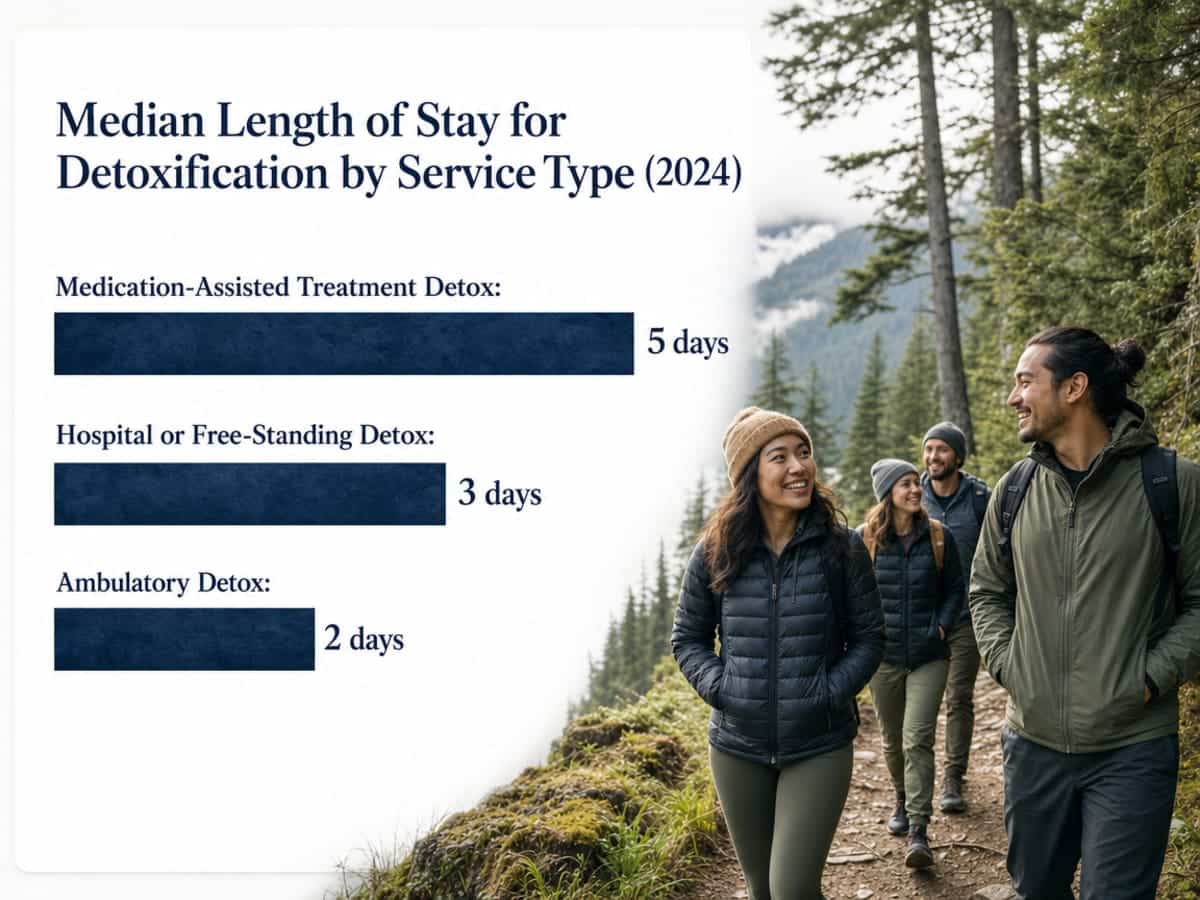
- Medical detox typically runs 2 to 7 days, with 2024 national medians of 5 days for medication-assisted, 3 for residential, and 2 for ambulatory 1.
- Day ranges vary by substance: alcohol 5 to 7 days, short-acting opioids 4 to 10 days, methadone 14 to 21 days, and benzodiazepines often weeks of tapering 2, 4.
- Length depends on substance history, mixed use, prior seizures, medical and mental-health conditions, home support, and the dosing protocol the clinical team uses 5.
- Discharge is a hand-off, not a finish line — a scheduled next appointment, continuing medication, and a step into PHP, IOP, or outpatient care shape what comes after 4, 8.
How Many Days Should You Plan For?
If you’re reading this at 2 a.m. with a calendar open in another tab, trying to figure out how many days to tell your boss, your kids’ school, or the person watching your dog — you’re asking the right question. The honest answer is a range, not a single number. Most people clear the acute part of medical detox in about 2 to 7 days. Where you land inside that window depends on what substance is involved, how your body responds, and the kind of program you enter.
National treatment data gives you a starting point to plan around. In 2024, the median length of stay was 5 days for medication-assisted detox, 3 days for hospital or free-standing residential detox, and 2 days for ambulatory (outpatient) detox 1. Those are midpoints, which means half of stays were shorter and half were longer. They are not a promise, and no reputable program can hand you a guaranteed discharge date on day one.
Here’s what to do with that information. Plan for the longer end of the realistic range for your situation, not the shortest. If a 3-day stay turns into 5, you want slack in your schedule, not a scramble. The sections below break down day ranges by substance, explain what stretches a stay, and walk you through what happens the morning you’re discharged — because the day you leave detox is a hand-off into the next step, not the finish line.
The Honest Day Ranges by Service Type
Here is where national numbers get useful. The SAMHSA Treatment Episode Data Set for 2024 reports a median length of stay of 5 days for medication-assisted detox, 3 days for hospital or free-standing residential detox, and 2 days for ambulatory (outpatient) detox 1. Those are national midpoints across hundreds of thousands of discharges, which is about as close to an honest baseline as this question allows.
Read the numbers for what they are. Medication-assisted detox tends to run a day or two longer because the medical team is not just getting you through withdrawal — they are starting a medication like buprenorphine and making sure you tolerate the dose before you leave. Hospital or free-standing residential detox clocks in shorter on average because the goal is acute stabilization: get the dangerous part behind you under 24-hour nursing, then step down. Ambulatory detox is the shortest because you are sleeping at home and coming in for check-ins and medication, so the “stay” is counted differently.
What the medians do not tell you is the shape of your own stay. Half of all discharges were shorter than these numbers and half were longer. If you have been drinking heavily for years, had a withdrawal seizure before, mix alcohol with benzodiazepines, or live alone with no one to watch you, your clinical team will likely plan for the longer side of the range. If your use is more recent and your overall health is steady, you may land on the shorter side.
One practical move: when you call a program, ask what their typical stay looks like for someone with your substance and history, and ask what would make it longer. A straight answer on day one is a sign of a program that is planning around you, not around a bed turnover.
What Withdrawal Actually Looks Like, Day by Day
Alcohol: 5 to 7 Days, With the First 48 Hours as the Watch Window
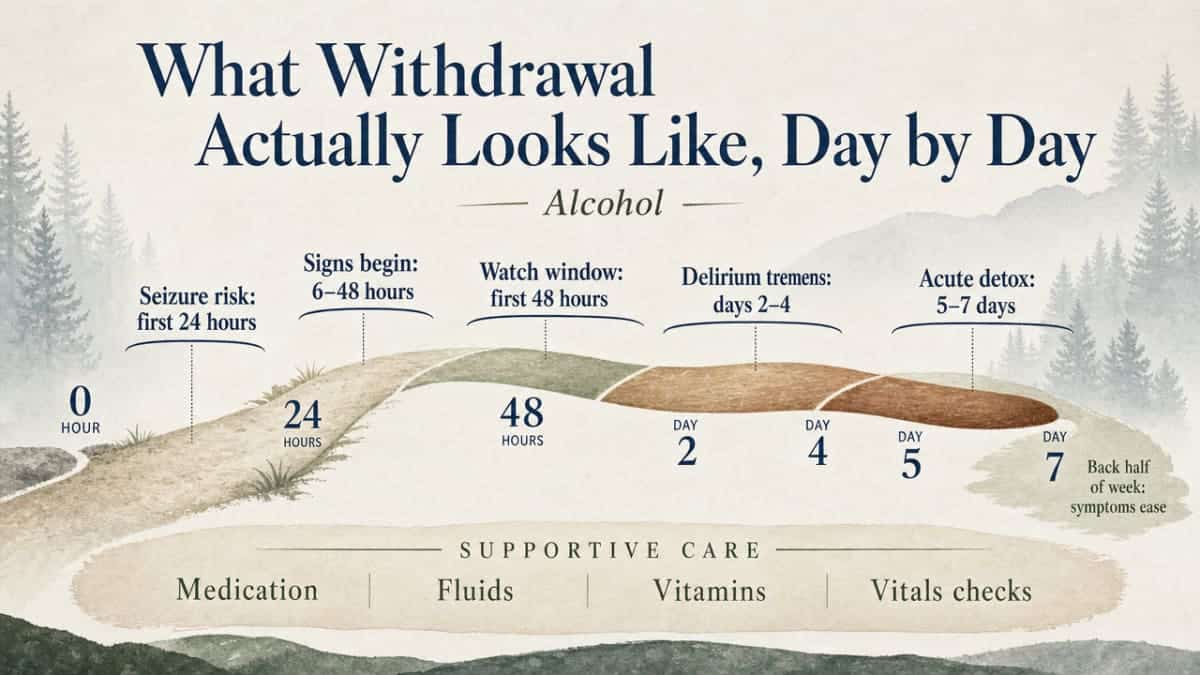
If alcohol is what brought you here, your body is on a specific clock. Signs usually show up 6 to 48 hours after heavy drinking slows or stops — shaking hands, sweating, racing heart, nausea, trouble sleeping, feeling jumpy or on edge 3. That first stretch is the one your medical team watches most closely, because withdrawal seizures most often happen inside the first 24 hours, and delirium tremens — the serious confusion-and-agitation complication people fear — usually shows up 2 to 4 days after the last drink 3.
The acute part of alcohol detox typically runs about 5 to 7 days 4. That is the window where medication, fluids, vitamins, and someone checking your vitals every few hours do the heavy lifting. By the back half of that week, most people are sleeping a little better, eating something, and feeling the fog lift.
A quick note on what the research actually looks like: a systematic review of alcohol-withdrawal medication trials found a median trial length of 6 days, with individual trials ranging from 1 to 28 days 6. That range is wide for a reason. Someone with a short, moderate drinking history and no medical complications moves through faster than someone with decades of daily heavy use, prior withdrawal seizures, or liver and heart issues layered on top.
Plan for a full week if alcohol is the main substance. If you clear detox in 4 or 5 days, you have cushion for the ride home, a grocery run, and one night of real sleep before anything else is on your calendar.
Opioids: 4 to 10 Days for Short-Acting, Longer for Methadone
Opioid withdrawal is miserable, but it is usually not medically dangerous the way alcohol or benzo withdrawal can be. That changes the math on what the medical team is doing — mostly keeping you comfortable, keeping you hydrated, and starting a medication that calms the withdrawal and sets up what comes next.
For short-acting opioids — heroin, oxycodone, hydrocodone, fentanyl in most forms — symptoms generally start 8 to 24 hours after the last use and run about 4 to 10 days 2. Day 2 and day 3 are typically the roughest: deep bone and muscle aches, stomach cramps, chills alternating with sweats, restless legs, zero sleep. By day 5 or 6, the physical storm starts easing. Methadone is a different animal. Because it leaves the body slowly, methadone withdrawal can stretch 14 to 21 days, with a longer, lower-grade tail of fatigue and sleep trouble 4.
Those windows look different side by side. Alcohol tends to cluster around 5 to 7 days 4. Short-acting opioids land in that 4 to 10 day range 2. Methadone runs 14 to 21 days 4. Short-acting benzodiazepines can take 2 to 4 weeks or longer, and long-acting benzos 2 to 8 weeks or longer 2. If you are planning childcare, time off, or a houseguest to help, those are the ranges to build around.
One more thing worth saying out loud: opioid detox length matters less than what comes next. If you are leaving without a plan for medication to continue, the clock you should be watching is the one before your next appointment, not the one on the discharge paperwork.
Benzodiazepines: The Longest Clock in Detox
If Xanax, Klonopin, Ativan, Valium, or a similar prescription is part of your situation, take a breath. This is the one where fast is not safe, and where a program with real medical oversight matters most.
Short-acting benzodiazepines like Xanax and Ativan can start producing withdrawal symptoms 1 to 2 days after the last dose, and the symptoms may continue for 2 to 4 weeks or longer 2. Long-acting benzos like Klonopin and Valium take longer to show up — about 2 to 7 days — and the withdrawal itself can stretch 2 to 8 weeks or longer 2. Those weeks are not spent in a detox bed. The acute, medically monitored piece is usually a handful of days focused on preventing seizures and stabilizing your nervous system. The longer tail is managed through a slow, careful taper, often continued in outpatient care.
What this means for your plan: the question is not just “how many days in detox” but “what does the taper look like after?” A reputable program will not yank you off a benzo cold. They will stabilize you, often cross you onto a longer-acting medication, and build a step-down schedule that may run weeks after you leave the facility. If you are mixing a benzo with alcohol, assume the longer end of every range, and assume a bed with 24-hour nursing — not an outpatient check-in.
Stimulants and Mixed Use: Shorter Medical Window, Longer Mood Tail
Cocaine, meth, and other stimulants work on a different pattern. The physical withdrawal is rarely life-threatening on its own, so the medically supervised stay tends to be shorter — often clustered in that 2 to 5 day range where the medical team is watching for dehydration, heart issues, and the mood crash. What catches people off guard is what comes after: deep fatigue, flat mood, strong cravings, and sleep that will not settle. Those symptoms can linger well past the acute window, which is why support beyond detox matters so much 4.
Mixed use changes the picture entirely. If you have been using meth plus drinking heavily, or taking opioids with a benzo, the medical team plans around the most dangerous substance first — usually the alcohol or the benzo — and your stay stretches to match that longer clock. Be honest at intake about everything you have been using, including the things you think are small. A clear picture on day one is what keeps you safe on day three.
Why Two People Using the Same Drug Can Have Very Different Stays
Picture two people checking into the same program on the same morning, both there for alcohol. One goes home in 2 days. The other stays 5. Nobody did anything wrong. The difference is in the details the medical team is reading hour by hour.
One of the biggest levers is the medication protocol itself. In alcohol withdrawal care, a symptom-triggered approach — where you get medication based on a scored assessment of what your body is actually doing — has been linked to an average stay of about 2 days, compared with 3 days under a fixed dosing schedule that gives medication on a set clock regardless of symptoms 5. That is a one-day difference in neighboring rooms, driven entirely by how the clinical team dosed the same medication. Zoom out to the broader research, and the randomized trials of alcohol-withdrawal medications had a median length of 6 days with individual trials ranging from 1 to 28 days 6. That 1-to-28 spread is the honest picture of how much variation is possible.
Protocol is only part of it. Your own history writes the rest. How long you have been using, how much, and how recently. Whether you have been through withdrawal before and how it went. Whether you have had a seizure during a past detox. Whether you are mixing substances — alcohol plus a benzodiazepine, opioids plus a stimulant — because the medical team plans around the most dangerous one, and that stretches the clock. Age, liver and heart health, pregnancy, diabetes, and untreated mental-health conditions like severe anxiety or trauma all shape how your body moves through withdrawal and how carefully the team needs to step you down.
The Discharge Day Is a Hand-Off, Not a Finish Line
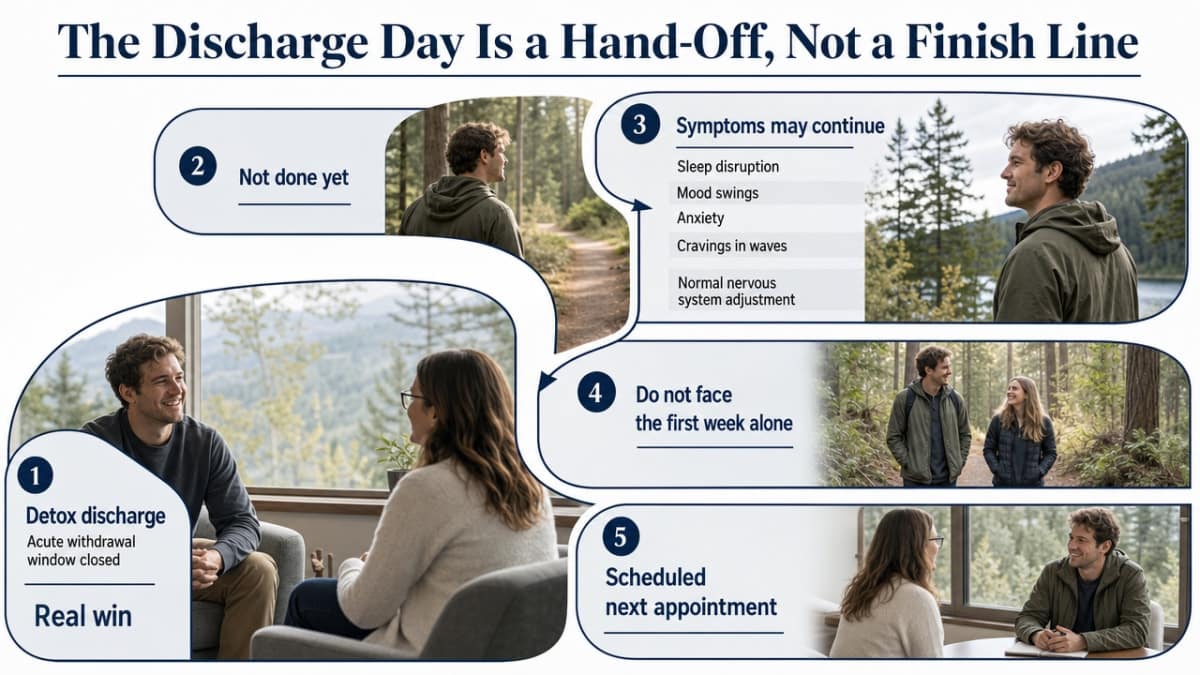
Here is the part a lot of first-time families miss. The morning you walk out of detox, your body has cleared the substance and the dangerous window has closed. That is a real win worth naming. But you are not done, and no good program will pretend you are. Discharge is a hand-off into the next piece of care, not a graduation.
There is a clinical reason this matters. SAMHSA explicitly notes that some symptoms continue after the acute withdrawal phase ends — sleep that will not settle, mood swings, anxiety, cravings that come in waves 4. Those are not signs that detox failed. They are the normal tail of a nervous system learning to run without a substance it had come to expect. The job of the week after detox is to not face that tail alone.
What a strong hand-off looks like in practice: a scheduled next appointment on the calendar before you leave, a written plan for medication if you are starting one, phone numbers you can actually reach after hours, and a clear step into the next level of care — usually a partial hospitalization program (PHP) a few days a week, an intensive outpatient program (IOP) in the evenings so you can keep working, or standard outpatient counseling. Pacific Crest Trail Detox is set up this way on purpose. The same team that watches over you in detox at the Milwaukie house helps you walk into PHP, IOP, outpatient, and alumni support without starting over with strangers.
Ask about the hand-off on the first phone call, not the last day. Something like: “What does the week after discharge look like for someone in my situation?” If the answer is specific, you have found a program that is planning for your recovery, not just your bed.
Opioid Detox: Why the Next Appointment Matters More Than the Last Day
If opioids are the reason you’re reading this, the most important sentence in the whole article is this one: detox by itself is not treatment for opioid use disorder. That is not an opinion from a brochure. It is the CDC’s clinical position, and the reason matters for how you plan your week. Detoxification without continuing medication for opioid use disorder is specifically not recommended, because it raises the risk of resumed use, overdose, and overdose death 8, 9. Your tolerance drops fast during those 4 to 10 days. If you use again at your old dose after discharge, your body is no longer built for it.
So the day on your discharge paperwork is the wrong thing to circle. The right thing to circle is the appointment that comes next — the one where you continue the medication that was started in detox, or start one for the first time. Three FDA-approved medications are used for opioid use disorder: methadone, buprenorphine, and naltrexone 11. Each has a different schedule, and each shapes what your week after detox looks like differently.
Access to those medications is in a better place than it was two years ago. The updated federal rule for opioid treatment programs took effect in April 2024, with expanded take-home flexibility and patient-centered admission policies designed to help people stay in care while they return to work and family 10, 11. In plain terms: it is easier now to get a medication plan that fits around a job and a school pickup.
Before you say yes to a detox bed, ask one question: “What medication will I leave on, and when is my next appointment to continue it?” A specific answer on day one is what makes the discharge day a hand-off instead of a cliff.
Outpatient, Residential, or Hospital: Picking the Setting That Fits
Three main settings exist for medical detox, and the right one is less about preference and more about safety. A hospital setting is the right call when the medical picture is complicated — unstable vitals, serious heart or liver disease, a history of withdrawal seizures or delirium tremens, pregnancy with heavy use, or a mental-health crisis that needs psychiatric care alongside the detox. Hospitals are built for that level of acuity, and the national median stay there runs about 3 days 1.
Non-hospital residential detox — which is what Pacific Crest Trail Detox provides in Milwaukie — is the middle ground, and it fits most people who need 24-hour nursing and medication support but do not need an ICU. You sleep in a home-like room instead of a hospital bed, a medical team checks on you around the clock, and the same staff helps you walk into the next step of care when you’re ready. For alcohol and opioid detox with real medical risk, this is where most stays land.
Outpatient (ambulatory) detox is the shortest on paper, with a median of 2 days of billed service 1, and it works for a narrow slice of people — mild to moderate alcohol withdrawal, no prior seizures, a steady home, someone sober nearby, and a reliable ride for daily check-ins 7. For opioid withdrawal, the clinical evidence favors inpatient or residential settings because closer monitoring and the ability to start medication for opioid use disorder on-site change the odds of staying in care 7. If you are not sure which setting fits, say yes to an assessment call. A good clinical team will tell you plainly which door is the safer one to walk through this week.
Planning the Logistics: Work, Kids, Pets, and the Ride Home
Let’s talk about the stuff that keeps you up at night, the stuff that has nothing to do with withdrawal and everything to do with the life you’re trying to pause for a week. You are not being shallow for worrying about your job and your dog at the same time you’re worrying about your health. You are being a responsible adult, and the logistics are solvable.
Build your plan around 7 days off, not 3. If your stay runs shorter, you have a buffer for the ride home and a quiet day before anything else is scheduled. For work, you don’t have to tell your employer what the medical appointment is for. Medical leave protections exist precisely so you can get care without broadcasting a diagnosis. Ask your HR contact about short-term medical leave or FMLA if your workplace qualifies, and keep the conversation about dates, not details.
For kids, pets, and the quiet household things — plants, mail, the car in the driveway — pick one trusted person and give them a short list. Pack a bag the night before intake: comfortable clothes, slip-on shoes, a phone charger, your insurance card, your current medication bottles, and a book or two that doesn’t require focus. Arrange your ride both ways in advance; you will not want to drive on discharge day. If you are starting a medication like buprenorphine or methadone, know that the 2024 federal rule expanded take-home flexibility, which can make returning to work and school pickup more workable than it used to be 11. Ask on your first phone call what your week back will realistically look like. You deserve a timeline you can actually plan around.
See Your Detox Coverage and Stay Timeline
Find out how long detox could take and what insurance will cover before you start.
Frequently Asked Questions
How long does medical detox usually take?
For most people, the acute part of medical detox runs about 2 to 7 days, with the exact length depending on the substance, your health, and the kind of program. Alcohol usually takes about 5 to 7 days, short-acting opioids about 4 to 10 days, and benzodiazepines often require a longer, slower taper that continues after you leave the detox bed 2, 4.
Will I feel back to normal when detox ends?
Probably not all the way, and that’s okay. The dangerous window has closed, but sleep, mood, anxiety, and cravings can stay unsettled for weeks as your nervous system resets 4. That tail is normal, not a sign that detox failed. Plan for a quiet first week back and lean on the next step of care — therapy, outpatient groups, or medication follow-up — so you’re not riding it out alone.
What makes a detox stay longer than expected?
A few things stretch the clock. Mixing substances, especially alcohol with a benzodiazepine, means the team plans around the most dangerous one. A past withdrawal seizure, serious medical or mental-health conditions, or heavy long-term use also add days. The medication protocol matters too — a fixed-schedule approach has been linked to about a 3-day stay versus 2 days with symptom-triggered dosing in cited alcohol-withdrawal care 5.
Can I detox from opioids at home or as an outpatient?
For most people, no. Clinical evidence favors inpatient or residential settings for opioid withdrawal because closer monitoring and on-site access to medication for opioid use disorder improve the odds of staying in care 7. The CDC is clear that detox alone, without continuing medication, raises the risk of return to use and overdose because your tolerance drops fast 8, 9. The next appointment matters more than the discharge day.
How much time off work should I request?
Plan for about 7 days off, even if your stay runs shorter. That gives you a buffer for the ride home, a day of rest, and the first follow-up appointment without a scramble. You don’t have to share your diagnosis — ask HR about short-term medical leave or FMLA, and keep the conversation about dates. If you’ll be starting a medication like buprenorphine or methadone, ask about take-home flexibility before you commit 11.
What happens the day I’m discharged from detox?
Your body has cleared the substance and the acute medical risk has passed — that’s a real win. A strong discharge includes a scheduled next appointment, a written medication plan if one was started, after-hours phone numbers, and a specific step into continuing care like a partial hospitalization program, intensive outpatient, or counseling. Pacific Crest Trail Detox is set up so the same team walks you into that next step without starting over.
References
- Treatment Episode Data Set (TEDS) 2024. https://www.samhsa.gov/data/sites/default/files/reports/rpt57179/2024-teds-annual-report.pdf
- Withdrawal Management. https://www.ncbi.nlm.nih.gov/books/NBK310652/
- Treatment of Alcohol Withdrawal. https://pmc.ncbi.nlm.nih.gov/articles/PMC6761817/
- Protracted Withdrawal. https://library.samhsa.gov/sites/default/files/sma10-4554.pdf
- Management of Alcohol Withdrawal in the Emergency Department. https://pmc.ncbi.nlm.nih.gov/articles/PMC7093658/
- A SYSTEMATIC REVIEW AND NETWORK META-ANALYSIS. https://pmc.ncbi.nlm.nih.gov/articles/PMC9969997/
- Ambulatory detoxification in alcohol use disorder and opioid …. https://pmc.ncbi.nlm.nih.gov/articles/PMC7653729/
- Opioid Use Disorder: Treating. https://www.cdc.gov/overdose-prevention/hcp/clinical-care/opioid-use-disorder-treating.html
- CDC Clinical Practice Guideline for Prescribing Opioids for Pain — United States, 2022. https://www.cdc.gov/mmwr/volumes/71/rr/rr7103a1.htm
- 42 CFR Part 8 Final Rule – SAMHSA. https://www.samhsa.gov/substance-use/treatment/opioid-treatment-program/42-cfr-part-8
- 42 CFR Part 8 Final Rule: Frequently Asked Questions. https://www.samhsa.gov/substance-use/treatment/opioid-treatment-program/42-cfr-part-8/faqs