
Key Takeaways
- Oregon licenses residential and withdrawal-management programs at distinct ASAM levels, so “inpatient rehab” can mean very different things depending on medical staffing and intensity 1, 2.
- Heavy daily drinking, past seizures or DTs, benzodiazepine use, or other medical conditions point toward medically monitored 3.7-WM detox rather than a lower-intensity setting 3, 5.
- Inpatient beds are scarce statewide, with only 4.5% of surveyed organizations offering residential detox, so calling early and accepting the first available bed matters 11.
- Readers in the Portland metro, Salem, Vancouver, or out of state can call a Milwaukie medical detox to verify commercial insurance, or reach 1-800-923-4357 for OHP-contracted options 15.
What inpatient alcohol rehab actually looks like in Oregon
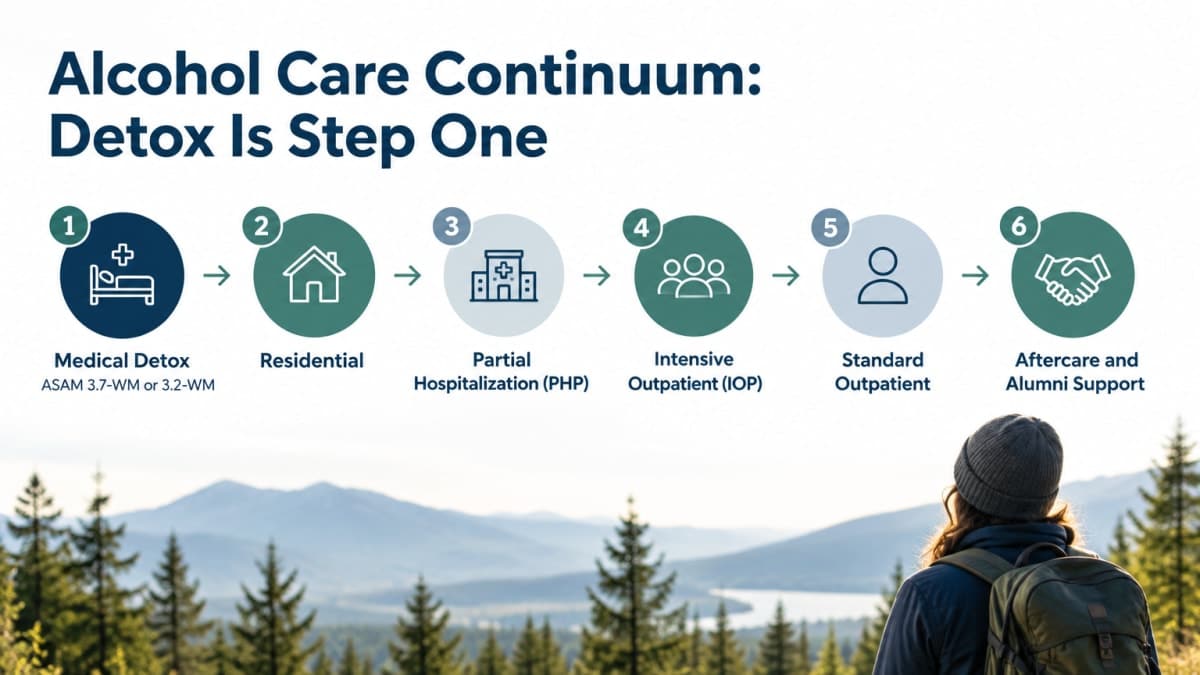
Inpatient alcohol rehab in Oregon is a stack of care levels, not a single 30-day package. It usually starts with medically supervised withdrawal management (what most people call detox), then moves into residential treatment, partial hospitalization (PHP), intensive outpatient (IOP), standard outpatient, and alumni support. The right starting point is matched to how risky your withdrawal looks and what your life around treatment can hold.
If you are reading this at 2 a.m. with a drink next to you, or if you are a spouse scrolling while your person sleeps it off in the other room, you are not the first. You are looking in the right place. Oregon regulates these programs through the Oregon Health Authority, which licenses residential substance-use programs that provide housing and treatment (generally for up to 16 people at a time) and separately licenses withdrawal-management programs at specific American Society of Addiction Medicine (ASAM) levels 1. Those categories matter, because “inpatient rehab” on a billboard can mean very different things in practice.
Here is what you can expect at Pacific Crest Trail Detox, a non-hospital medical detox in Milwaukie: a quiet, home-like setting instead of a sterile ward, registered nurses on site around the clock, a provider rounding seven days a week, home-cooked meals, and daily groups led by staff, many of whom have been through recovery themselves. Detox at PCTD typically runs 8 to 10 days, long enough for your body to clear alcohol safely and for a plan for what comes next to actually get built.
The honest version: detox by itself is not treatment for alcohol use disorder 4. It is step one. Oregon has the full continuum, and this guide walks you through what each piece actually looks like, how to tell which level fits, how people pay for it, and how to make the call when you are ready. Readers in Milwaukie, Portland, Gresham, Beaverton, Salem, Vancouver, Washington, and from out of state are all welcome here.
The real levels of inpatient care, in plain language
Clinically managed residential withdrawal management (ASAM 3.2-WM)
This is the lower-intensity version of residential detox. The Oregon Health Authority licenses it as a residential program where you sleep, eat, and get supported through withdrawal, with clinical staff available and a structured daily routine 1. It is designed for people whose withdrawal is expected to be uncomfortable but not medically dangerous, and whose home environment is not safe or sober enough to detox from.
Think of 3.2-WM as a quiet place to land when your body is coming off alcohol. You get check-ins, monitoring, meals, and a plan being built in the background. You are not hooked up to monitors in a hospital room. If your drinking history is heavy, long-running, or has caused seizures or hallucinations before, this level is usually not enough on its own, and a higher level of care is the honest answer.
Medically monitored inpatient withdrawal management (ASAM 3.7-WM)
This is the level most people picture when they hear “medical detox.” Under Oregon’s Chapter 309 rules, 3.7-WM programs run a full clinical assessment at entry, do nursing assessments and vital-sign checks, keep a registered nurse on duty at the program site at all times, and staff at a minimum of one licensed nurse for every five admitted individuals 2. A provider rounds through the program regularly. Medications to manage withdrawal are available and ordered based on your symptoms, not a template.
In practice, this looks like a home-like residence in the Portland metro, not a hospital floor. At Pacific Crest Trail Detox in Milwaukie, a non-hospital medical detox, RNs are on site around the clock, a provider rounds seven days a week, and the kitchen puts out home-cooked meals. Detox at PCTD typically runs 8 to 10 days, long enough for your body to clear alcohol safely and for you to actually feel human again before the next step.
If you have been drinking heavily every day, mixing alcohol with benzodiazepines, or have a history of seizures, DTs, or serious medical conditions, 3.7-WM is the level that keeps you safe 3.
Residential treatment after detox
Residential treatment is a separate license in Oregon from withdrawal management. These programs provide housing and treatment together, generally for up to 16 people at a time, with daily groups, individual counseling, and skills work 1. You move here after your body is stable and the acute withdrawal is behind you.
Residential is where the deeper work starts: looking at what alcohol has been doing for you, learning tools to not drink when the week gets hard, and starting to build a sober routine. Some people step directly from detox into a residential program for a few more weeks. Others step down to partial hospitalization or intensive outpatient and sleep at home or in sober housing. Which direction fits depends on how safe your housing is, how much structure your days need, and what your clinical team recommends.
A continuum, not a 30-day brochure promise
You will see a lot of Oregon rehab pages promising “30, 60, or 90-day programs.” That framing is a marketing habit, not a clinical standard. The National Institute on Alcohol Abuse and Alcoholism describes alcohol care as a continuum: intensive inpatient, residential, partial hospitalization or intensive outpatient, and standard outpatient, with most alcohol use disorder treatment actually delivered in outpatient settings 4. Detoxification by itself is not treatment for AUD. It is the opening move.
A more honest way to picture inpatient alcohol rehab in Oregon:
Medical Detox (ASAM 3.7-WM or 3.2-WM) → Residential → Partial Hospitalization (PHP) → Intensive Outpatient (IOP) → Standard Outpatient → Aftercare and Alumni Support 4, 1.
You do not have to touch every box. Some people need the full stack. Others need medical detox and then step down into PHP or IOP while living at home in Beaverton, Gresham, Salem, or Vancouver, Washington. The point is that detox is step one, not the finish line, and the plan for what comes after should be built while you are still in the bed, not handed to you at discharge. That is how people actually stay stopped.
Why alcohol withdrawal needs medical supervision
Here is the part most Oregon rehab sites soften, and we are not going to. Alcohol withdrawal can kill you. The National Institute on Alcohol Abuse and Alcoholism is direct about it: stopping suddenly after prolonged heavy drinking can be life-threatening, and some people need intensive inpatient detoxification to get through it safely 3. This is not scare talk. This is why the people who answer the phone at a medical detox ask about your drinking history before anything else.
What makes alcohol different from most other substances is the way your nervous system adapts to it. When you have been drinking heavily every day for months or years, your brain has turned up its own alarm system to balance the sedation. Take the alcohol away without medical support, and that alarm system fires with nothing to quiet it. The result can be tremors, anxiety that will not stop, racing heart, nausea, insomnia, and sweating in the first 24 to 48 hours. In more serious cases, that progresses to seizures or delirium tremens, which is the one that can be fatal.
You cannot predict for sure whose withdrawal will go that way. Risk goes up with:
- heavy daily drinking,
- past withdrawal seizures or DTs,
- older age,
- other medical conditions,
- and especially combining alcohol with benzodiazepines like Xanax, Klonopin, or Ativan.
If any of that describes you or your person, a 3.7-WM medical detox is the honest answer, not a weekend of white-knuckling it at home.
In a medically monitored setting, nurses check your vital signs on a schedule, score your withdrawal symptoms, and give medication when you need it. Benzodiazepines are the standard of care for acute alcohol withdrawal because the evidence shows they reduce symptoms and prevent complications like seizures and DTs 5. The ASAM clinical guideline that providers follow walks through assessment, monitoring, medication, and how to match you to the right level of care 6. None of that happens on your couch.
How to tell which level of care fits you (or your person)
There is no quiz that gives you a perfect answer, but there are honest signals that point to the right starting level. Clinical teams match placement to withdrawal risk, medical and mental-health history, your home environment, and whether you have tried outpatient support before 4. Here is how to read those signals without needing a medical degree.
Medically monitored inpatient detox (3.7-WM) is usually the right call if:
- You drink heavily every day and your hands shake in the morning until you have one.
- You have ever had a withdrawal seizure, delirium tremens, or hallucinations when you cut back.
- You are also taking benzodiazepines (Xanax, Klonopin, Ativan) or other sedatives.
- You have other medical conditions, like heart problems, liver disease, or you are older.
- Previous attempts to stop at home or in a lower-intensity setting have ended in a drink within hours or days.
These are the situations where alcohol withdrawal can turn dangerous fast, and benzodiazepine-based medical management with round-the-clock nursing is the standard of care 5, 6.
A lower-intensity residential setting or outpatient withdrawal management may fit if: your drinking has been lighter or more recent, you have no history of seizures or DTs, you are medically stable, and your home environment is not actively pulling you back toward a drink. Even then, this is a conversation with a clinician, not a decision to make alone at the kitchen table.
If you are the family member making this call, trust what you have seen. Morning drinking, hidden bottles, shaking, missed work, a prior ER visit for withdrawal, these are reasons to ask for the higher level of care and let the admissions clinician talk you down if it is not needed. It is harder to add safety after a seizure than to start with it.
Why inpatient alcohol beds are hard to find in Oregon
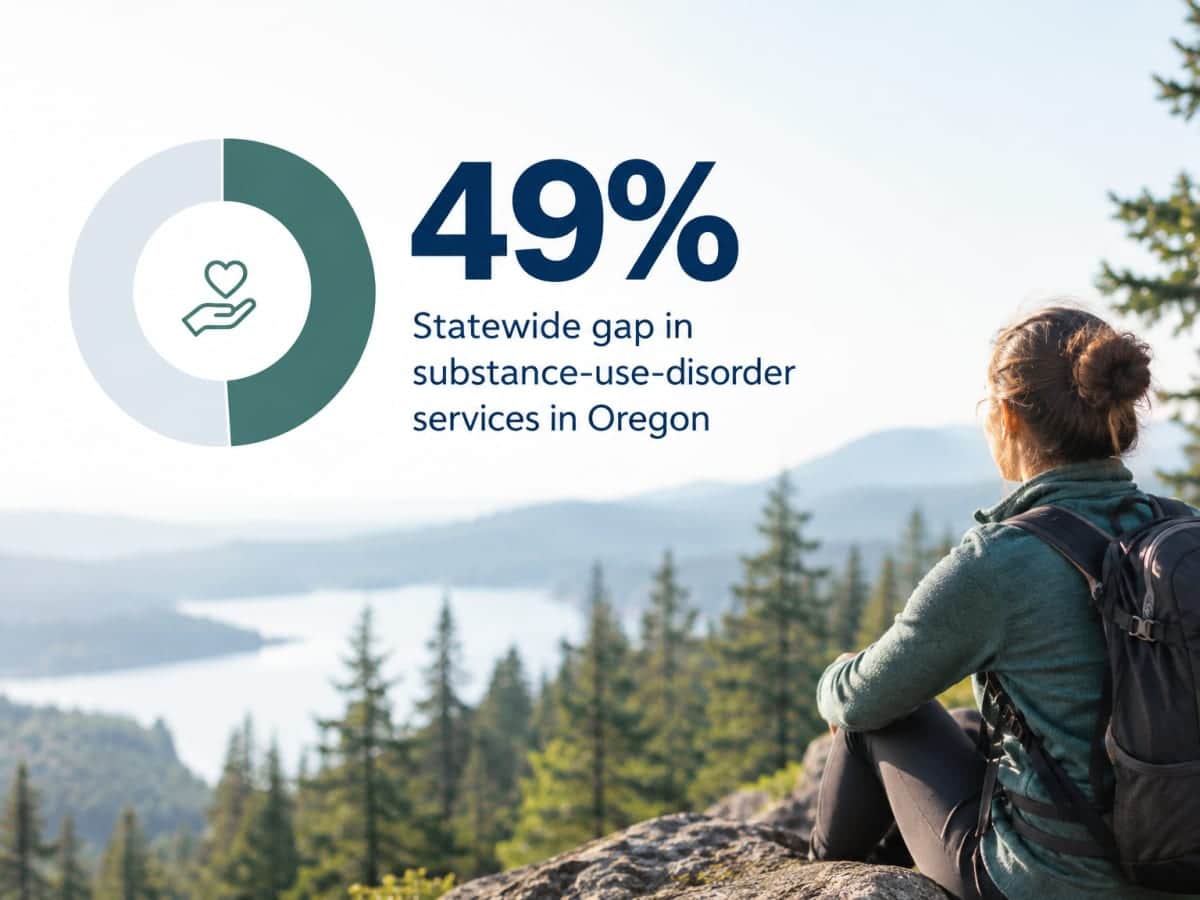
If you have called a few places already and gotten a waitlist, a voicemail, or a “we don’t have a bed until next Tuesday,” you are not imagining it. Oregon has a real supply problem at the exact level of care that keeps people with heavy alcohol use safe. The Oregon Health Authority’s own Substance Use Disorder Services Inventory and Gap Analysis Report identified a 49% statewide gap in SUD services, and among surveyed organizations, 4.5% reported providing residential detoxification and just 1.1% reported providing medically managed intensive inpatient care 11. Those two numbers are the honest answer to “why is this so hard?”
The gap is worse the farther you get from the Portland metro. The Alcohol and Drug Policy Commission has named infrastructure shortages in rural and underserved areas as a top barrier to timely access, which is why someone in a smaller Oregon town often has to drive to Milwaukie, Portland, Salem, or across the river to find an available medical detox bed 17. Even inside the metro, a facility that lists a service is not the same as a facility with an open bed today.
The state is working on it. Oregon’s 2025 legislative session appropriated $65 million to increase adult behavioral-health residential capacity, with an estimated 196 new beds and preservation of more than 100 existing beds through facility upgrades 13. That matters, but new beds take time to come online, and they do not help you tonight.
Medications that help: MAT during and after detox
Medication-assisted treatment (MAT) shows up in two different places in alcohol recovery, and it helps to keep them separate. The first is during acute withdrawal, when your body is clearing alcohol and your nervous system is firing. The standard of care there is benzodiazepines, given by a clinical team that is monitoring you, because the evidence shows they reduce symptoms and prevent complications like seizures and delirium tremens 5. Those medications are started and stopped inside the detox setting. They are not something you take home.
The second place MAT shows up is after detox, as part of continuing care. The FDA has approved three medications specifically for alcohol use disorder: naltrexone, acamprosate, and disulfiram 4. They work in different ways. Naltrexone can quiet the pull of a drink. Acamprosate helps steady a brain that has been through long-term heavy drinking. Disulfiram makes drinking physically unpleasant, which gives some people a useful pause. None of them are a cure, and none of them replace counseling, groups, or the work of building a life that does not revolve around alcohol 4. They are tools that make the first weeks and months after detox easier to hold onto, and a good clinical team will talk with you about which, if any, fit your history and goals 7.
How people pay for inpatient alcohol rehab in Oregon
Money is the second question almost everyone asks after “is there a bed?” The honest answer is that most people pay for inpatient alcohol rehab in Oregon through one of three paths: commercial insurance, the Oregon Health Plan (OHP), or self-pay. Which one applies to you shapes where you can go, not whether you deserve care.
If you have commercial insurance through an employer or the marketplace, most non-hospital medical detoxes in the Portland metro work with the major plans. The cleanest first step is to call the program and let their admissions team verify your benefits directly, instead of trying to decode your own policy at midnight. They can usually tell you same-day what is covered, what your out-of-pocket is likely to look like, and whether you need anything from your plan before you walk in. A non-hospital medical detox in Milwaukie accepts most commercial insurance and will run a confidential insurance check for you over the phone.
If you are on the Oregon Health Plan, you have real coverage for substance-use care. OHP covers screening, assessment, medically monitored withdrawal management, residential and outpatient treatment, counseling, and medication-assisted treatment, and members do not need a primary-care referral or prior authorization for covered behavioral-health services 14, 12. The catch is that not every private facility is in-network with OHP. If OHP is your coverage, call the Oregon Alcohol and Drug Help Line at 1-800-923-4357 or your county or Tribal Behavioral Health Resource Network to find an OHP-contracted program with an open bed 15.
Self-pay is the third path, and it is more common than people expect. Some families use it when insurance has already been maxed, when they want to protect privacy on a shared policy, or when the right bed is at a program that is not in-network. Any reputable program will tell you the self-pay rate up front and work with you on timing. If cost is the thing stopping you from calling, call anyway and ask. Not calling is the expensive choice.
If you are a family member or partner trying to help
Loving someone who is drinking too much is its own kind of exhausting. You are reading rehab pages at work. You are counting bottles in the recycling. You are rehearsing what to say and then saying nothing because last time it ended in a fight. None of that means you are failing. It means you care, and you are tired.
A few things that actually help. Pick a quiet moment, not a drunk one, and say what you have seen in plain words: the morning shaking, the missed pickup, the ER visit, the fear. Skip the labels and the ultimatums you cannot keep. Ask what feels possible today, even if “today” is just a phone call together.
When you call an admissions line, you do not need a diagnosis. Tell them how much your person drinks on a normal day, how long it has been like this, whether there has ever been a withdrawal seizure or DTs, any other medications or health conditions, and what insurance you have. A good intake nurse will take it from there. If your person is in active crisis, call or text 988, or in Oregon the Alcohol and Drug Help Line at 1-800-923-4357 15, 16. You can make the first call for them. That counts.
What happens after detox: PHP, IOP, outpatient, and alumni support
Walking out of detox clean is a real thing to be proud of, and it is also the moment the actual work starts. Your body has cleared the alcohol. Your brain has not caught up yet. The weeks after detox are when cravings sharpen, sleep gets weird, and old triggers (the drive home past your usual bar, Friday at 5 p.m., the fight you have been avoiding) come back online. This is why continuing care matters, and why detox is step one of a continuum, not a graduation ceremony.
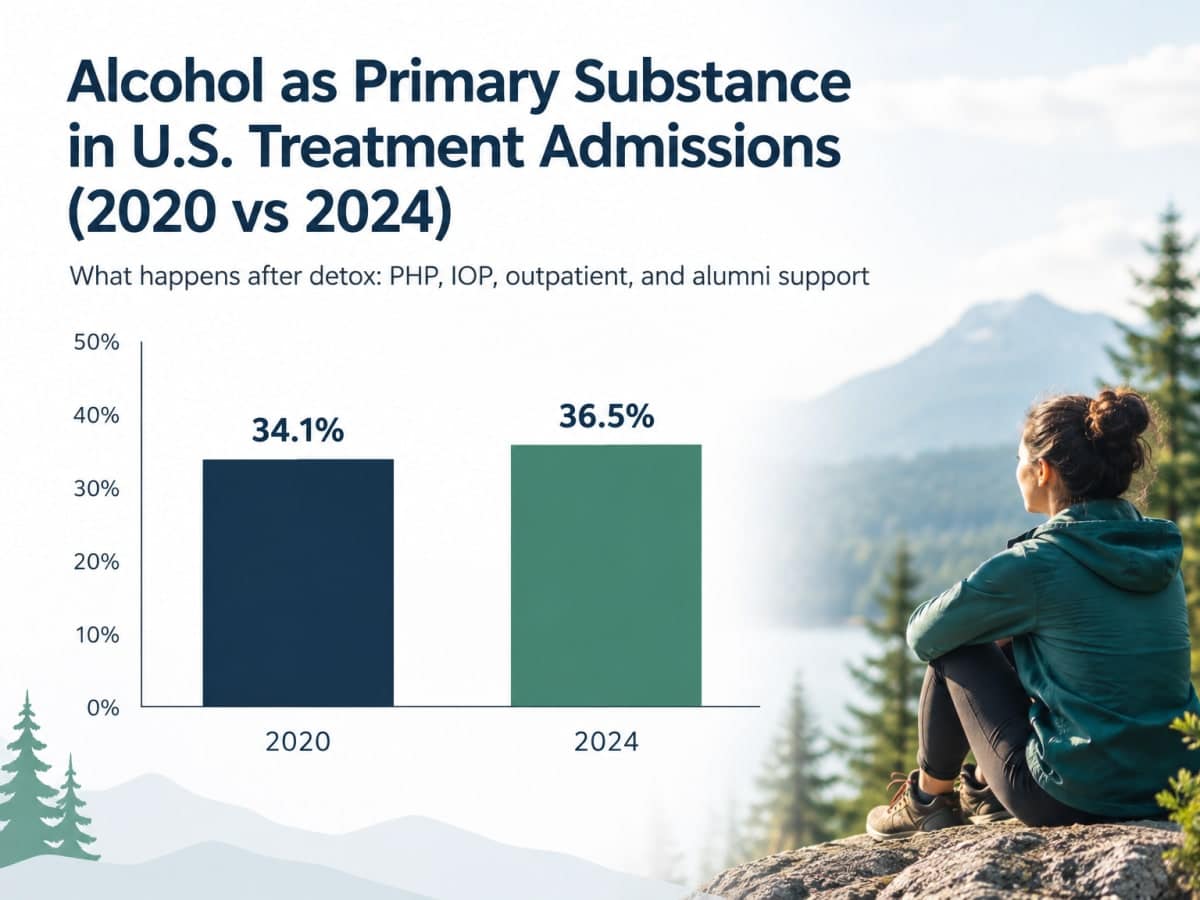
The demand for that continuing care is growing. Alcohol was the primary substance in 36.5% of reported U.S. treatment admissions in 2024, up from 34.1% in 2020, according to SAMHSA’s Treatment Episode Data Set 8. More people are asking for help with alcohol, which means more people are also needing somewhere to go after the detox bed.
Here is what the step-downs actually look like in Oregon:
- Partial hospitalization (PHP): structured treatment most of the day, five or so days a week, while you sleep at home or in sober housing. Groups, individual counseling, medication management, and skills work.
- Intensive outpatient (IOP): fewer hours, usually three days a week in the evenings or mornings, so you can hold a job or care for kids while still being in treatment.
- Standard outpatient: weekly or twice-weekly counseling and group, often with MAT like naltrexone or acamprosate if that fits your plan 7.
- Aftercare and alumni support: ongoing groups, check-ins, and a community of people who have been where you are, including staff who have walked through recovery themselves.
A good Milwaukie detox hands you off directly into PHP, IOP, or outpatient through its own continuum or a trusted partner program, so you are not discharged with a list of phone numbers and a cab ride. That handoff is where people either keep going or quietly slip. Build the next step while you are still in the bed.
Taking the next step: how to call and what to expect
If you have read this far, you already know what you need to do. The hardest part is picking up the phone, and the second-hardest part is believing you are allowed to.
When you call a non-hospital medical detox in Milwaukie, you reach a real person, not a chatbot. The call is confidential and HIPAA-protected. They will ask about your drinking history, any other substances or medications, past withdrawal episodes, medical conditions, and your insurance. Most commercial plans are accepted; benefits can be verified for you over the phone the same day. If the Oregon Health Plan is your coverage, the Alcohol and Drug Help Line at 1-800-923-4357 can point you toward an OHP-contracted bed 15.
You do not need the perfect words. You just need to call. Create your path to recovery, one honest conversation at a time.
Check Coverage for Alcohol Treatment
Find out what your plan may cover for medically supervised alcohol detox and continued care in Oregon.
Frequently Asked Questions
How long does inpatient alcohol detox usually last in Oregon?
At Pacific Crest Trail Detox in Milwaukie, medical detox for alcohol typically runs 8 to 10 days, long enough for your body to clear alcohol safely and for withdrawal symptoms to stabilize under nursing care. The exact length depends on your drinking history, medical conditions, and how your body responds to withdrawal medication. Oregon rules do not set a fixed detox length; placement and duration are based on clinical need 2.
Is medical detox from alcohol really necessary, or can I taper at home?
Alcohol withdrawal can be life-threatening after prolonged heavy drinking, and some people need intensive inpatient detoxification to get through it safely 3. We will not give you an at-home taper. If you shake in the morning, have ever had a withdrawal seizure or DTs, or mix alcohol with benzodiazepines, call a medical detox or, in an emergency, call 988 or go to the nearest ER.
Does insurance cover inpatient alcohol rehab in Oregon?
Yes, in most cases. Most non-hospital medical detoxes in the Portland metro accept commercial insurance and can verify your benefits over the phone the same day. The Oregon Health Plan covers screening, assessment, medically monitored withdrawal management, residential treatment, counseling, and medication-assisted treatment without a referral or prior authorization 14, 12. Call the Milwaukie detox described in this guide to verify your commercial benefits over the phone.
Can someone from Vancouver, WA or out of state come to Pacific Crest Trail Detox?
Yes. People come to Milwaukie from Vancouver, Washington, from smaller Oregon towns, and from out of state. Being outside the immediate Portland metro does not disqualify you. Call admissions, share your drinking history and insurance, and they will walk you through what travel and intake look like. Oregon has a real shortage of medically monitored inpatient beds, so calling early rather than waiting for a cleaner week matters 11.
What happens after detox ends?
Detox is step one, not treatment on its own 4. After your body is stable, you step into continuing care: residential, partial hospitalization (PHP), intensive outpatient (IOP), standard outpatient, and alumni support. FDA-approved medications like naltrexone, acamprosate, or disulfiram may fit your plan as part of ongoing care, alongside counseling and groups 4. A good detox builds the handoff while you are still in the bed.
What should I say when I call for a loved one?
You do not need a diagnosis or the right words. Tell admissions how much your person drinks on a normal day, how long it has been like this, any past withdrawal seizures or DTs, other medications or health conditions, and what insurance they have. A good intake nurse will take it from there. In a crisis, call or text 988 or Oregon’s Alcohol and Drug Help Line at 1-800-923-4357 15, 16.
References
- Licensing and Certification. https://www.oregon.gov/oha/BH/Providers/Pages/Licensing-Certification.aspx
- Health Systems Division: Behavioral Health Services – Chapter 309. https://www.oregon.gov/oha/HSD/RAC/309-018.pdf
- Alcohol Use Disorder: From Risk to Diagnosis to Recovery. https://www.niaaa.nih.gov/health-professionals-communities/core-resource-on-alcohol/alcohol-use-disorder-risk-diagnosis-recovery
- Recommend Evidence-Based Treatment: Know the Options. https://www.niaaa.nih.gov/health-professionals-communities/core-resource-on-alcohol/recommend-evidence-based-treatment-know-options
- Mental Health Issues: Alcohol Use Disorder and Common Co-Occurring Conditions. https://www.niaaa.nih.gov/health-professionals-communities/core-resource-on-alcohol/mental-health-issues-alcohol-use-disorder-and-common-co-occurring-conditions
- The ASAM Clinical Practice Guideline on Alcohol Withdrawal Management. https://www.samhsa.gov/resource/ebp/asam-clinical-practice-guideline-alcohol-withdrawal-management
- Medication for the Treatment of Alcohol Use Disorder: A Brief Guide. https://www.samhsa.gov/resource/recovery/medication-treatment-alcohol-use-disorder-brief-guide
- Treatment Episode Data Set (TEDS) 2024. https://www.samhsa.gov/data/sites/default/files/reports/rpt57179/2024-teds-annual-report.pdf
- 2024 National Substance Use And Mental Health Services Survey (N-SUMHSS) State Profiles. https://www.samhsa.gov/data/report/2024-n-sumhss-state-profiles
- National Substance Use and Mental Health Services Survey 2024: Data on Substance Use and Mental Health Treatment Facilities. https://www.samhsa.gov/data/sites/default/files/reports/rpt56696/2024-nsumhss-annual-report.pdf
- Oregon Substance Use Disorder Services Inventory and Gap Analysis Report. https://www.oregon.gov/oha/HSD/AMH/DataReports/SUD-Gap-Analysis-Inventory-Report.pdf
- Substance Use Disorder Integration Report. https://www.oregon.gov/oha/HSD/AMH/DataReports/SUD-Integration-Report.pdf
- 2025 End-of-Session Legislative Report – Oregon.gov. https://www.oregon.gov/oha/ERD/Documents/OHA-2025-End-of-Session-Legislative-Report.pdf
- Behavioral Health Care. https://www.oregon.gov/oha/HSD/OHP/Pages/Behavioral-Health.aspx
- Substance Use Disorder Services. https://www.oregon.gov/oha/BH/Adults/Pages/Substance-Use.aspx
- Find Substance Use Help. https://www.oregon.gov/adpc/Pages/Find-Help.aspx
- Alcohol and Drug Policy Commission : Treatment : State of Oregon. https://www.oregon.gov/adpc/Pages/Treatment.aspx
- Oregon Health Authority : Home : Excessive Alcohol Use Prevention. https://www.oregon.gov/oha/PH/PREVENTIONWELLNESS/excessivealcoholuse/Pages/index.aspx
- Data on Excessive Alcohol Use. https://www.cdc.gov/alcohol/excessive-drinking-data/index.html