Key Takeaways
- Sort the situation first: 911 for unresponsive or barely breathing, 988 for behavioral crisis, a detox line this week for heavy daily use or failed quit attempts.
- Alcohol and benzodiazepine withdrawal can trigger fatal seizures and delirium tremens, while opioid and stimulant withdrawal is survivable but followed by a dangerous overdose window 1.
- Toughing it out at home rarely works for illicit or polysubstance use — fewer than 10% achieved abstinence in a home opioid detox trial 17.
- Skip the ultimatum. Wait until they’re sober, lead with love and fear, and offer options — the evidence favors calm, CRAFT-style family conversations 10, 11.
- Good medical detox means an individualized intake, 24-hour vital monitoring, comfort and withdrawal medications, and a discharge plan started before day one ends 1, 18.
- FDA-approved medications — buprenorphine, methadone, naltrexone for opioids and naltrexone, acamprosate, disulfiram for alcohol — reduce cravings and overdose risk, and aren’t substitution 2, 9, 18.
- Detox alone isn’t enough: nearly 10% of inpatient detox discharges were followed by an opioid overdose, so ask what happens on the day they leave 15, 16.
- Oregon’s supply is now dominated by fentanyl and polysubstance combinations, so keep naloxone accessible and expect more than one dose may be needed 4, 5.
First, decide which kind of night this is
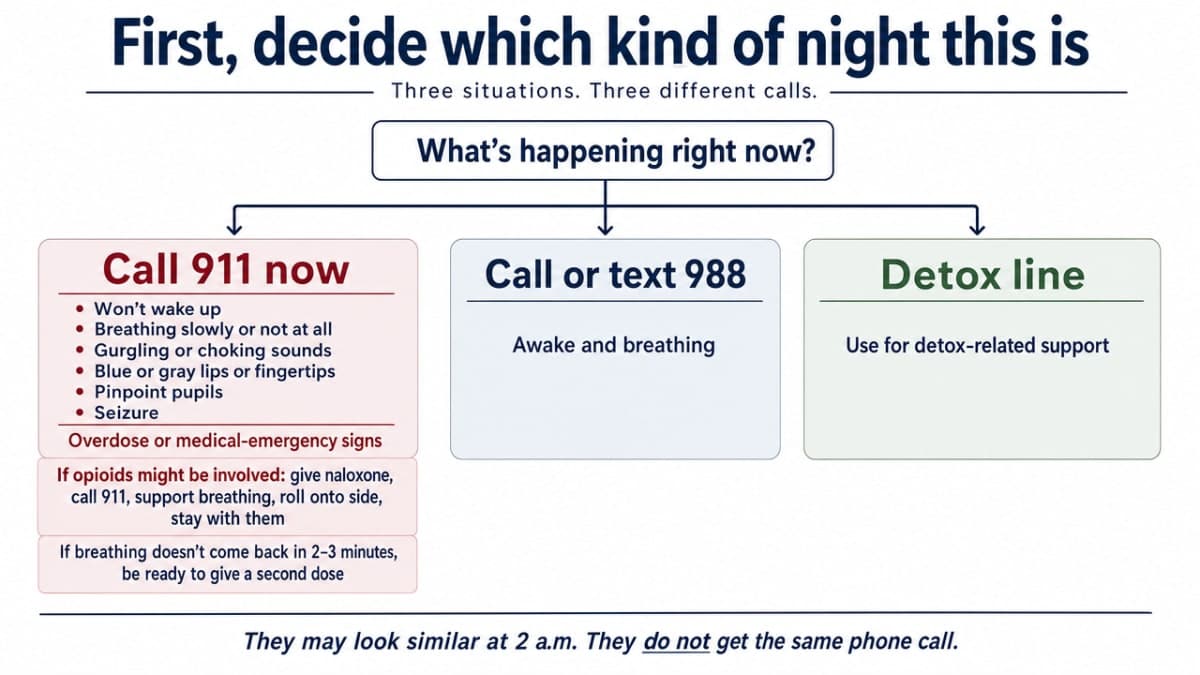
Before you do anything else, figure out which of three situations you’re actually in. They look similar from the kitchen floor at 2 a.m. They are not the same, and they don’t get the same phone call.
Call 911 right now if your adult child won’t wake up, is breathing slowly or not at all, is making gurgling or choking sounds, has blue or gray lips or fingertips, has pinpoint pupils, or is having a seizure. Those are overdose and medical-emergency signs. If you have naloxone (Narcan) in the house and opioids might be involved, give it, call 911, support their breathing, roll them onto their side, and stay with them until help arrives. One dose may not be enough, especially if fentanyl is in the mix, so be ready to give a second dose if breathing doesn’t come back in two to three minutes 3, 4.
Call or text 988 if they’re awake and breathing but in a behavioral-health crisis, talking about suicide, panicking, or coming unglued in a way that scares you but isn’t a medical emergency. 988 is Oregon’s 24/7 line, and family members are allowed to call about someone else 8.
Call a detox line this week, not tonight’s ambulance, if they’re using heavily every day, shaking in the morning, have tried to quit and couldn’t, or are asking for help in a quiet moment. In Oregon, you can start with the Alcohol and Drug Help Line at 1-800-923-4357 or the Oregon Hopeline at 1-833-975-0505 7.
Write those three numbers on something you can see. You will not remember them when you need them.
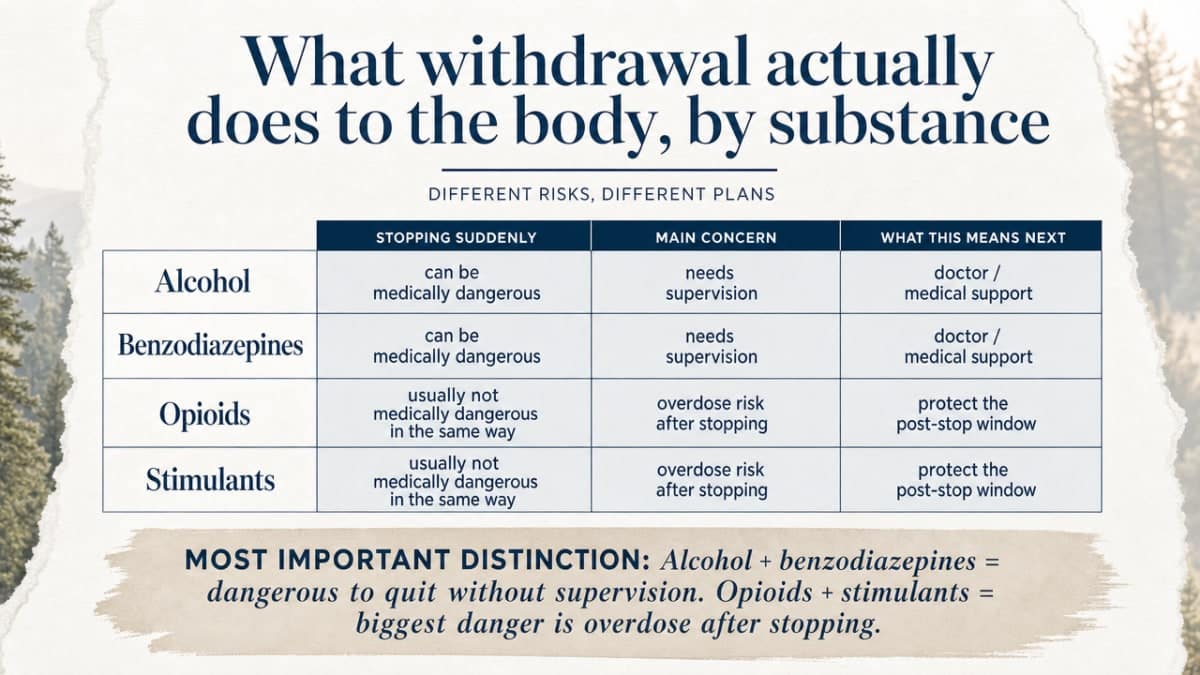
What withdrawal actually does to the body, by substance
Here’s the part no one explains clearly enough to parents, and it matters because it changes what you do next. Withdrawal isn’t one thing. The substance your adult child has been using decides whether their body can safely stop on its own, whether it needs a doctor in the room, or whether the real danger is what comes after they stop.
Alcohol and benzodiazepines: the ones that can kill them
If your adult child has been drinking heavily every day for weeks or months, or has been on daily benzodiazepines like Xanax, Klonopin, or Ativan, their nervous system has adapted to the substance. Taking it away suddenly can send the body into a dangerous overcorrection.
NIAAA lists the symptoms of alcohol withdrawal plainly: tremors, sweating, elevated pulse and blood pressure, insomnia, anxiety, nausea, seizures, and delirium tremens. That last one — the DTs — can be fatal. Alcohol withdrawal can be life-threatening when someone who chronically drinks heavily stops suddenly 1. Benzodiazepine withdrawal behaves the same way and carries the same seizure risk.
What that means for you: if your son is shaking at 7 a.m., sweating through his shirt, saying he feels like he’s crawling out of his skin, or has had a seizure before when he’s tried to stop — this is not a willpower situation. This is a medical one. He needs someone watching his vitals and, often, medication to bring his nervous system down safely. That’s what medical detox is for.
Opioids, meth, and polysubstance use: miserable, and dangerous in a different way
Opioid withdrawal looks terrifying. The sweating, the cramps, the vomiting, the restless legs, the look on their face. It is one of the worst things you’ll ever watch. But by itself, in an otherwise healthy adult, it usually isn’t the thing that kills them.
What kills people is what happens next. Tolerance drops fast during withdrawal. If your daughter uses again at the dose she was taking last week, her body can’t handle it anymore — and in Oregon that dose almost certainly contains fentanyl. This is why medication matters. The FDA has approved buprenorphine, methadone, and naltrexone for opioid-use disorder, and NIDA considers medication the first line of treatment, not a last resort 2, 18.
Meth and cocaine withdrawal is mostly psychological — crushing fatigue, depression, cravings, sometimes suicidal thinking. That’s a 988 situation, not usually a seizure one 8. Polysubstance use, which is where most Oregon cases actually land, means you can’t assume anything. You need an assessment.
Why ‘just detox at home and tough it out’ is the plan parents regret
A lot of parents quietly plan this one. You’ve got a spare bedroom, Gatorade, Imodium, a thermometer, and the thought that if you can just get them through a bad weekend, you’ll be on the other side of it by Monday. You are not a bad parent for thinking this. You are a tired parent trying to protect your kid from a system that scares them.
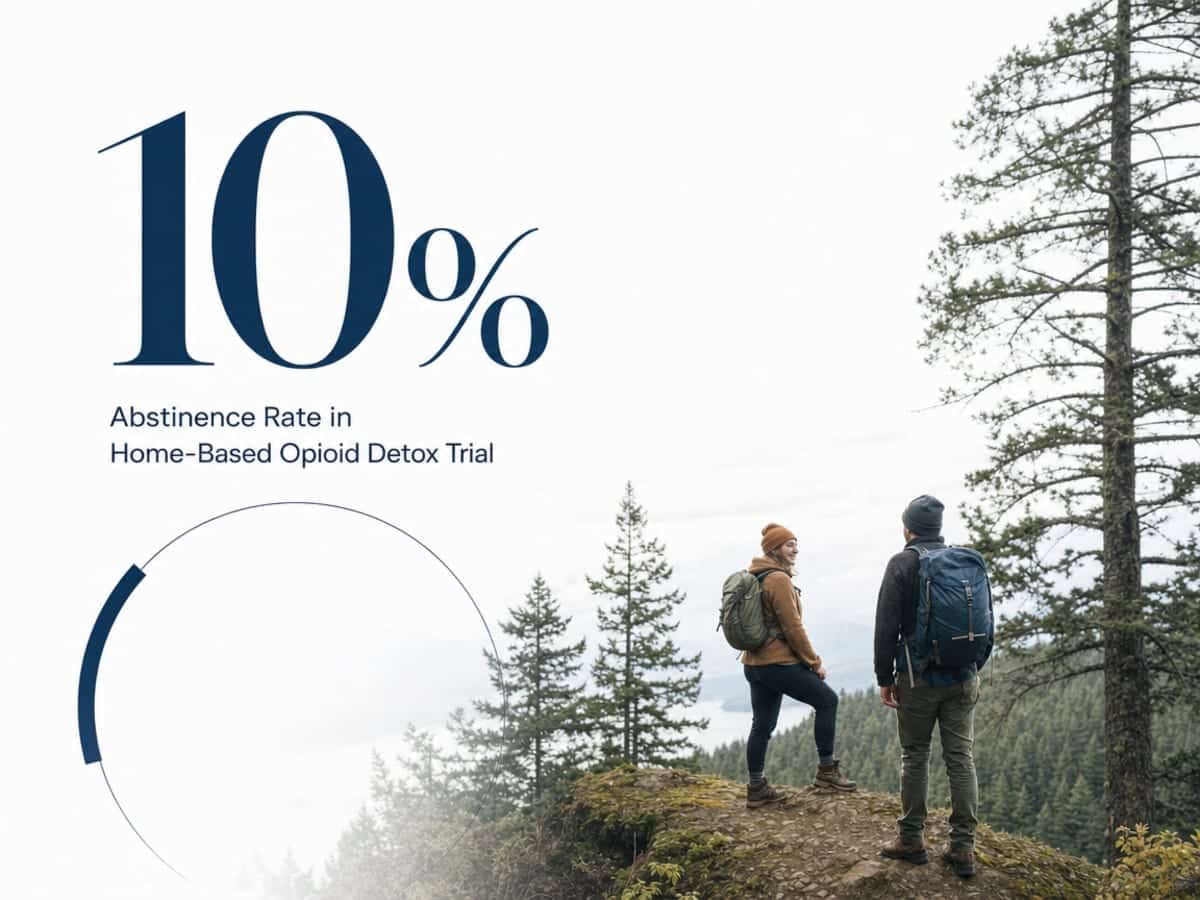
Here’s what the evidence actually says. A 2024 systematic review of home-based detoxification found that for carefully selected people with non-severe alcohol dependence, supervised home withdrawal can be reasonable — but the evidence is thin for illicit drugs and polysubstance use, which is where most Oregon families actually are. In a high-quality trial of home-based opioid detox, fewer than 10% of participants achieved abstinence 17. That means more than nine out of ten walked out the other end still using, often at a lower tolerance than when they started.
For alcohol and benzodiazepines, the risk is more immediate. If your adult child has been drinking heavily every day or taking daily Xanax or Klonopin, home withdrawal can trigger seizures and delirium tremens. NIAAA is explicit that alcohol withdrawal can be life-threatening in people who stop suddenly after chronic heavy use 1. You are not equipped to manage a seizure in a hallway at 3 a.m. Nobody’s parents are.
And there’s the quieter cost. If the weekend goes badly — if they bolt, if they use again, if you end up yelling — you’ve burned the trust you were going to need for the next conversation. Medical detox exists so you don’t have to be the one holding the washcloth and the thermometer and the Narcan box all at once 4. Letting other people do the medical part is how you stay the parent.
Having the conversation without blowing up the relationship
You’ve probably rehearsed this conversation in your head a hundred times. In the shower. In the car. Lying awake at 3 a.m. staring at the ceiling. And every version ends the same way — with them walking out, or shutting down, or saying the thing that cuts the deepest. So you don’t say anything, and another week goes by.
Here’s what the research actually supports, and it’s probably the opposite of what the movies taught you. The confrontation-and-ultimatum approach — the one where you fill the living room with family members and read letters — isn’t what the evidence favors. NIAAA’s family-support guidance leans toward non-confrontational conversations that offer options rather than demands 10. The Community Reinforcement and Family Training approach, known as CRAFT, is designed specifically to help families encourage treatment without the big dramatic standoff, and family-based support is associated with better outcomes than individual counseling alone 11. Family-centered interventions, including the ones studied in young adults, are linked to reduced substance use and better family functioning across 41 studies 13.
Translated: your calm, honest, two-minute conversation at the kitchen table is doing more work than the dramatic one you’ve been dreading. You don’t have to be a therapist. You have to be their parent, in a steady voice, with a short list of options and a phone number.
When to talk, where to sit, and what not to lead with
Wait until they’re sober. Not sleeping it off, not coming down — actually sober, fed, and relatively calm. NIAAA is direct about this: don’t try to have a treatment conversation while someone is intoxicated, and wait until the person is safe and stable 10. Morning coffee is better than Friday night. The passenger seat of a car on a short drive is better than a face-to-face across the dining table, because nobody has to hold eye contact.
Don’t lead with the thing you’re most afraid of. Don’t lead with the voicemail you didn’t answer, the money that’s missing, or what their sister said last Thanksgiving. Lead with the fact that you love them and you’re scared. Then stop talking long enough for them to answer.
A short script you can actually say out loud
Keep it to three beats.
- What you’ve noticed, without a case file. “I’ve seen you shaking in the mornings and I know you haven’t been sleeping.”
- What you’re feeling, not what they’re doing wrong. “I’m scared, and I don’t want to lose you.”
- One concrete, low-stakes ask. “Will you let me make a phone call with you — just a call, not a commitment — to a detox place in Milwaukie that handles this?”
Offer options, not an ultimatum. NIAAA recommends discussing several treatment paths and asking what kind of help they’d be willing to try 10. If they say no, you haven’t lost. You’ve opened a door. Say, “Okay. The offer stands. I’ll be here when you’re ready.” Then don’t bring it up again for a few days. The research on family involvement supports patience over pressure 11, 14.
What medical detox looks like when it’s done right
If you’ve never seen the inside of a medical detox, the word probably conjures something between a hospital ward and a jail. That’s not what good non-hospital detox looks like. At a place like Pacific Crest Trail Detox in Milwaukie, it looks closer to a house — beds, couches, a kitchen, people walking around in sweatpants — with a clinical team on site around the clock. The medical work is real. The setting is not designed to feel like punishment.
Here’s what a parent should expect a well-run detox to actually do:
- An intake assessment that asks about everything your adult child has been using, how much, how often, and when they last used — plus medical history, mental-health history, and any prior withdrawal episodes. That assessment is what decides the plan. NIAAA and NIDA both stress that placement and treatment should be matched to the individual, not applied as a one-size protocol 1, 18.
- 24-hour monitoring of vital signs during the window when withdrawal symptoms peak, with medications on hand to treat them.
- A conversation — before discharge, not after — about what comes next. A good program treats detox as the start of care, not the end of it, and will talk with you about medication, outpatient therapy, family counseling, and the handoff to ongoing treatment 14, 18.
What happens in the first 24 to 72 hours
The first day is mostly about safety. For alcohol or benzodiazepines, that means watching for tremors, blood pressure spikes, and seizure risk, and using medication to settle the nervous system down gradually instead of letting it crash 1. For opioids, it means managing the misery — the sweating, cramping, vomiting, insomnia — with comfort medications and, often, starting buprenorphine once withdrawal symptoms reach a certain threshold 2.
By day two or three, the worst of the physical storm usually eases. Your adult child will probably sleep hard, eat something, and start to look like themselves again. That is the window when a counselor sits down with them, not to lecture, but to ask what they want to try next.
Medications that reduce cravings and lower overdose risk
Nobody has to white-knuckle their way through this anymore, and nobody should. For opioid-use disorder, the FDA has approved three medications: buprenorphine, methadone, and naltrexone. NIDA considers medication the first line of treatment, usually combined with counseling 2, 18. These medicines reduce cravings and, in the case of buprenorphine and methadone, substantially lower the risk of fatal overdose.
For alcohol-use disorder, NIAAA lists three FDA-approved options: naltrexone, acamprosate, and disulfiram, which work in different ways and can be started during or after detox 9. If someone tells you medication is “just trading one drug for another,” they are repeating a myth that costs lives. Ask the detox program which medications they offer and how they’ll continue them after discharge.
Detox is step one, not the finish line
Here’s the thing nobody told you when you started making phone calls: getting your adult child through withdrawal is the easy part. Not easy in the sense of pleasant — easy in the sense of medically solvable. There’s a protocol. There are medications. There are nurses who’ve done this a thousand times. What happens on day eight is the harder problem, and it’s the part that decides whether this detox is the one that sticks or the one you’ll be remembering a year from now.
A study of 81,519 inpatient detox discharges found that nearly 10% were followed by an opioid overdose at some point, and the overdose rate was highest in the days right after discharge — especially for people who walked out without moving into further care 16. That isn’t a scare statistic. It’s the shape of the risk. Tolerance drops during detox. The street supply in Oregon is overwhelmingly fentanyl. If your son uses on day four at the amount he was using on day one, his body genuinely can’t handle it anymore.
The flip side is where the hope lives. A separate study of 30,681 people who went through opioid detox found that those who continued into medication treatment, residential care, or both after discharge had substantially lower mortality than those who got detox alone 15. NIDA puts it plainly: detox by itself is generally followed by resumed use, and medications should be the first line of treatment for opioid addiction, usually paired with counseling 18.
What’s actually happening in Oregon right now
You are not imagining it, and you are not overreacting. The drug supply your adult child is using today is not the drug supply you were worried about five years ago, and that changes what help looks like.
Oregon recorded 1,544 drug-overdose deaths in 2024, down from 1,833 in 2023 — a 16% decline and the first statewide year-over-year drop since 2016. More than 90% of those fatal overdoses involved fentanyl, methamphetamine, or both, and 62.2% involved more than one substance 5. The decline is real and worth holding onto. The composition of the risk is what should shape your next phone call.
What that means in a kitchen, not a report: if your adult child is using opioids in Oregon in 2025, assume fentanyl is in it, even if they say it isn’t. If they’re using meth, assume it may be cut with fentanyl too. Polysubstance use — alcohol plus benzos, opioids plus stimulants — is the norm now, not the exception, and it’s the reason a detox program has to actually assess what’s in their system before writing a plan. A protocol built for heroin in 2010 will not keep your daughter safe in 2025.
Keep naloxone in the house and in your car, and make sure someone besides you knows where it is. CDC guidance for families is clear that more than one dose may be needed when fentanyl is involved 4. The overall numbers are moving in the right direction. The individual window is still narrow.
How to vet a detox program in one phone call
You don’t need a clinical background to ask good questions. You need a short list and the willingness to keep asking until the answers land. The first call to a detox program should take fifteen or twenty minutes, and it should leave you with a clearer picture of whether this is the right place or whether you keep dialing.
Start with the medical basics. Ask whether the program is licensed by the Oregon Health Authority for residential withdrawal management — that’s a yes-or-no question, and a real program will answer it in one sentence 6. Ask who is on site overnight, how often vitals are checked during the first 72 hours, and what happens if your adult child becomes too medically unstable for the setting. For alcohol or benzodiazepine withdrawal especially, you want to hear a specific protocol, not vague reassurance 1.
Then ask about medication. For opioids: do they start buprenorphine or methadone during detox, and will they continue it after discharge or hand it off to someone who will 2, 18? For alcohol: do they offer naltrexone, acamprosate, or disulfiram as options to discuss with a clinician 9? If the answer to either question is some version of “we prefer abstinence,” that’s a program selling you willpower.
Finally, ask about the day they leave. What does discharge planning look like? Do they have their own outpatient program, or a specific warm handoff? Will they include you in the plan? A program that can’t answer those questions in plain language on a first call is a program that treats detox as the whole story — and the evidence on what happens after discharge is clear enough that you can’t afford that gap 15, 16.
Taking care of yourself while you do this
You’re not going to be any good to your adult child if you fall apart. That’s not a motivational line. It’s the practical truth of a situation that could stretch across months, not days.
Eat something today. Sleep when you can, even if it’s broken. Tell one person outside the family what’s going on — a friend, a pastor, a therapist, somebody who won’t try to fix it. If you’re the one holding the Narcan box and the phone and the worry, you need a second adult who knows the plan.
Family counseling isn’t just for your adult child. The clinical guidance on involving families in treatment is clear that parents and siblings benefit from their own support, and that family-based care is linked to better engagement and outcomes than individual counseling alone 11, 14. Ask the detox program whether they offer family sessions. If they do, go.
And give yourself permission to not have the right answer tonight. The parent who’s still standing in six months is the one your adult child needs.
Calling Pacific Crest Trail Detox
You don’t have to figure this out tonight by yourself. If you’re sitting with a phone in your hand and a list of questions you don’t quite know how to ask, that’s reason enough to call. Pacific Crest Trail Detox has been doing medical detox in a home-like setting in Milwaukie since 2017 — alcohol, opioids, benzodiazepines, meth, polysubstance — with medication support when it fits and a continuum through partial hospitalization, intensive outpatient, and alumni care so the day your adult child leaves isn’t a cliff 15, 18. PCTD accepts most insurance (not OHP), and the first call is a conversation, not an admission.
Tell us what’s happening. We’ll help you think through whether tonight is a 911 call, a 988 call, or a Tuesday-morning intake 8. You’ve carried this far enough alone. Pick up the phone and talk it through with someone who’s done this a thousand times.
Check Your Insurance for Immediate Detox Options
See if your insurance can help cover safe, professional detox for your adult child starting today.
Frequently Asked Questions
Can my adult child die from alcohol or benzodiazepine withdrawal?
Yes, and this is the part most parents don’t know. If your adult child has been drinking heavily every day or taking daily benzodiazepines like Xanax, Klonopin, or Ativan, stopping suddenly can trigger seizures and delirium tremens, which can be fatal. NIAAA is explicit that alcohol withdrawal can be life-threatening after chronic heavy use 1. This is the clearest reason to get a medical assessment before anyone tries to quit at home.
My adult child refuses to go to detox. What can I actually do?
Keep the door open and stay patient. NIAAA recommends non-confrontational conversations when your adult child is sober and stable, offering several options instead of one ultimatum 10. CRAFT-style family support and family counseling are associated with better engagement and outcomes than individual counseling alone 11, 14. A refusal today isn’t a no forever. Keep naloxone close, keep your own support in place, and keep offering a specific next step.
Is medication like buprenorphine or naltrexone just trading one drug for another?
No. That’s a myth, and it costs lives. The FDA has approved buprenorphine, methadone, and naltrexone for opioid-use disorder, and NIDA considers medication the first line of treatment, usually paired with counseling 2, 18. For alcohol-use disorder, NIAAA lists naltrexone, acamprosate, and disulfiram as approved options 9. These medicines reduce cravings and, for opioids, substantially lower the risk of fatal overdose. That isn’t substitution — it’s medical care.
Why is the risk of overdose so high right after detox?
Tolerance drops fast during withdrawal. If your adult child uses afterward at the dose they were taking before, their body can’t handle it anymore — especially with fentanyl in the supply. A study of 81,519 inpatient detox discharges found that nearly 10% were followed by an opioid overdose, with risk concentrated in the days right after discharge 16. That’s why continuing medication and ongoing care after detox matters so much 15.
Should I call 911, 988, or a detox line?
Call 911 if they won’t wake up, are breathing slowly or not at all, are making gurgling sounds, or are seizing — give naloxone if opioids might be involved 3, 4. Call or text 988 if they’re awake and breathing but in a behavioral-health crisis or talking about suicide 8. Call a detox line this week — Oregon’s Alcohol and Drug Help Line is 1-800-923-4357 — for heavy daily use or failed quit attempts 7.
What should I ask when I call a detox program for the first time?
Ask four things. Is the program licensed by the Oregon Health Authority for residential withdrawal management 6? What medical monitoring happens in the first 72 hours, especially for alcohol or benzodiazepines 1? Which FDA-approved medications do you offer, and will you continue them after discharge 2, 9? And what does the day they leave look like — your own outpatient program, or a specific warm handoff to one 15, 18?
References
- Alcohol Use Disorder: From Risk to Diagnosis to Recovery. https://www.niaaa.nih.gov/health-professionals-communities/core-resource-on-alcohol/alcohol-use-disorder-risk-diagnosis-recovery
- Information about Medications for Opioid Use Disorder (MOUD). https://www.fda.gov/drugs/food-and-drug-administration-overdose-prevention-framework/information-about-medications-opioid-use-disorder-moud
- 4. Naloxone Is One Important Tool to Reverse Opioid Overdose. https://www.cdc.gov/overdose-prevention/reversing-overdose/about-naloxone.html
- How and When to Use Naloxone for an Opioid Overdose. https://www.cdc.gov/overdose-prevention/media/pdfs/Naloxone_FactSheet_Family_and_Caregivers_How_and_When_to_use_Naloxone.pdf
- 2025 – Opioids and the Ongoing Drug Overdose Crisis in Oregon. https://www.oregon.gov/oha/PH/PREVENTIONWELLNESS/SUBSTANCEUSE/OPIOIDS/SiteAssets/Lists/feature/EditForm/2025%20Oregon%20Opioid%20Overdose%20Report.pdf
- Residential Treatment Facilities: Licensing and Certification. https://www.oregon.gov/oha/hsd/amh-lc/pages/rt.aspx
- Oregon Health Authority: Addiction Services. https://www.oregon.gov/oha/BH/Adults/Pages/Substance-Use.aspx
- About 988. https://www.oregon.gov/oha/HSD/AMH/Pages/About-988.aspx?utm_name=holding-hope080125
- Treatment for Alcohol Problems: Finding and Getting Help. https://www.niaaa.nih.gov/publications/brochures-and-fact-sheets/treatment-alcohol-problems-finding-and-getting-help
- Starting The Conversation. https://alcoholtreatment.niaaa.nih.gov/support-through-the-process/starting-the-conversation
- Frequently Asked Questions: Searching for Alcohol Treatment. https://alcoholtreatment.niaaa.nih.gov/FAQs-searching-alcohol-treatment
- Family-centred interventions for people with substance use disorders: a systematic review and meta-analysis. https://pmc.ncbi.nlm.nih.gov/articles/PMC11367307/
- Family Intervention Models for Young Adults with Substance Use Disorders: A Systematic Review. https://pubmed.ncbi.nlm.nih.gov/39564277/
- Chapter 3—Family Counseling Approaches. https://www.ncbi.nlm.nih.gov/books/NBK571088/
- Association between mortality rates and medication treatment after opioid detoxification. https://pmc.ncbi.nlm.nih.gov/articles/PMC7854020/
- Opioid overdose and inpatient care for substance use disorder. https://pmc.ncbi.nlm.nih.gov/articles/PMC7928069/
- Home‐based detoxification for individuals with alcohol or drug use disorders: a systematic review. https://pmc.ncbi.nlm.nih.gov/articles/PMC11814356/
- Treatment and Recovery. https://nida.nih.gov/publications/drugs-brains-behavior-science-addiction/treatment-recovery