


Key Takeaways
- Delirium tremens happens when the nervous system revolts after heavy, sustained drinking stops suddenly, and it typically appears 48 to 72 hours after the last drink.1
- Home remedies like thiamine, fluids, and a quiet room cannot replace the IV access, titrated benzodiazepines, and minute-by-minute vital monitoring a hospital team provides during DT.5
- If confusion, hallucinations, seizures, fever, or unstable vitals appear, call 911 first; a medically supervised detox can take the handoff once the person is stable.2
- Detox is a starting point, not the finish line, so plan for the handoff into PHP, IOP, outpatient, and alumni support to protect the gains made in the first 72 hours.1
The Honest Answer Before You Scroll Any Further
No. Delirium tremens is not something you treat at home. If you or someone you love is already confused, shaking hard, seeing things that aren’t there, or burning up with fever after cutting back on alcohol, this is a medical emergency. Call 911. The honest answer is that short, and we’re going to spend the rest of this article explaining why, because you deserve more than a one-word reply when you’re scared.
You’re probably here for a reason that makes sense to you. Maybe you’ve been through a bad ER visit before. Maybe there are kids at home, a job on the line, or shame that feels heavier than the symptoms. Maybe you’re the partner or parent watching this unfold on the couch, trying to decide if it’s bad enough to act. Those feelings are real, and we’re not going to shame you for them.
What we will do is tell you the truth. Alcohol withdrawal can be life-threatening when heavy drinking stops suddenly without medical support, and delirium tremens is the dangerous end of that spectrum.1 A hospital stay is needed when DT appears.2 After the crisis passes, a medically supervised detox like Pacific Crest Trail Detox in Milwaukie, Oregon can take it from there, warmly and confidentially.
What Delirium Tremens Actually Is (And Why It’s Different From a Bad Hangover)
The Timeline: When DT Shows Up After the Last Drink
A hangover is your body processing a rough night. Delirium tremens is your nervous system in revolt because the alcohol it has been leaning on for months or years is suddenly gone. Those are not the same event, and the clock on them looks nothing alike.
For a person who has been drinking heavily and daily, the first signs of withdrawal usually show up 6 to 12 hours after the last drink. You might notice shaky hands, sweating, a jumpy stomach, a headache that will not quit, trouble sleeping, and a kind of anxiety that feels bigger than the room. Between hours 12 and 24, some people start seeing or hearing things that are not there, though they often still know those things are not real.
Withdrawal seizures tend to cluster in the first 24 to 48 hours. Delirium tremens itself typically arrives later, between about 48 and 72 hours after the last drink, and can stretch past that. By the time DT is in the room, you are no longer dealing with a hangover timeline. You are dealing with a condition that can be fatal without medical care.1
The Signs That Mean You’re Past Home Territory
Here is the honest line between “rough morning” and “get help right now.” A bad hangover does not include confusion about where you are, who people are, or what day it is. DT does.
Watch for a cluster of these:
- Deep confusion or disorientation
- Severe agitation
- Hallucinations that feel completely real (bugs on the skin, voices, shadowy figures in the hallway)
- A racing heart
- Fever
- Drenching sweats
- Blood pressure that will not settle
- Whole-body tremors that make a cup of water impossible to hold
A seizure, even one, puts you in emergency territory immediately.
Those are the exact things a hospital team tracks minute by minute during DT: electrolytes, fluid status, temperature, pulse, breathing, blood pressure, seizure activity, and how a person is responding to medication.2 If you are reading those words from a couch and recognizing them in yourself or someone you love, that is the signal. This has moved past anything a quiet room and a glass of water can hold. Call 911, or get to the nearest emergency department. The detox conversation can happen the moment the crisis is stable.
Why Delirium Tremens Treatment at Home Fails, Even With a Devoted Family
What a Kitchen Can’t Do That a Medical Team Can
Love is not a substitute for an IV line. We say that gently, because the people who try to ride DT out at home are almost always surrounded by someone who cares deeply. A spouse checking in every hour. A grown kid sleeping on the floor next to the couch. A best friend who took the week off work. That matters. It just does not reach what delirium tremens actually requires.
Here is the gap, in plain terms. During DT, clinicians have to monitor temperature, pulse, breathing, blood pressure, electrolytes, fluid status, seizure activity, and how a person is reacting to medication, moment by moment.2 They need the ability to start an IV when someone can no longer keep water down, replace electrolytes that have swung dangerously, and respond to a seizure in seconds, not minutes.
The medicine itself is a problem for home care. Benzodiazepines are the main treatment for DT, and the doses have to be titrated to the person’s response, with a trained set of eyes watching for over-sedation and breathing changes.5 Severe or treatment-resistant cases often need intensive-care-level support.5 The treatment goals a clinical team is working toward, preventing seizures, calming severe agitation, protecting the heart and brain, and preventing death, depend on close vital-sign and lab monitoring that a kitchen simply cannot provide.6 That is not a failure of your family. That is the condition.
The Hidden Risks: Seizures, Aspiration, and Autonomic Crashes
Three things make DT especially dangerous outside a hospital, and most families only hear about them after the fact.
- The first is a seizure. Withdrawal seizures can arrive with almost no warning, and a single one can cause a head injury, a bitten tongue that bleeds into the airway, or a fall down a staircase.
- The second is aspiration. A person deep in confusion, vomiting, or barely conscious can inhale stomach contents into their lungs. That turns into pneumonia fast, and sometimes into respiratory failure.
- The third is autonomic instability, which is a clinical way of saying the body’s automatic controls stop working together. Heart rate spikes. Blood pressure swings high, then crashes. Temperature climbs into fever range. Breathing speeds up and then stutters.
These shifts can tip into cardiac events or circulatory collapse, which is a major reason the lethal risk of DT is tied to the need for inpatient or intensive-care-level monitoring.6 At home, by the time you notice the color of someone’s lips changing, you are already behind. In a medical setting, that same change triggers a response within seconds.
Why ‘B Vitamins, Fluids, and a Quiet Room’ Won’t Hold the Line
You have probably read the list. Thiamine. A banana for potassium. Gatorade. Dim the lights. Keep it quiet. Someone sits with them. Those suggestions are not evil, and some of them show up in real hospital care. The problem is the setting, not the ingredients.
Thiamine given by mouth is not absorbed well in a person who has been drinking heavily for years. Oral fluids are useless when someone cannot stop vomiting or has drifted past the point of safely swallowing. A quiet room does not treat a seizure or a 140 heart rate.
And here is the catch. Nearly every piece of modern evidence about which medications work for alcohol withdrawal, including comparisons of benzodiazepines, phenobarbital, and gabapentin, comes from studies of hospitalized adults with trained staff watching the response.7 Those findings do not translate to a bedroom with a pill bottle on the nightstand. The home version of DT care is not a lighter version of hospital care. It is a different, much more dangerous thing.
How Often People End Up in the ER for Alcohol Withdrawal
If you’re wondering whether you’re overreacting by thinking about the ER, you’re not. Alcohol withdrawal sends a lot of people through emergency department doors, and it sends a lot of them straight to a hospital bed afterward.
A few things to hold onto about that number. It comes from U.S. emergency departments only, so it captures the people who made it in, not the ones who stayed home and rode something out alone. It’s retrospective, meaning researchers looked back at records rather than following patients forward. And it tells you something plain: when alcohol withdrawal gets serious enough to show up at an ER, more than half the time, clinicians decide the person cannot safely leave. That is not a failure on the patient’s part. It’s what severe withdrawal actually asks for.
Three Scenarios Most Articles Blur Together
Mild Uncomplicated Withdrawal: When Outpatient Care Can Fit
Not every person who stops drinking lands in the same place. If you’ve been drinking heavily but your symptoms stay in the mild lane, meaning some shakiness, poor sleep, anxiety, mild sweating, and a fast pulse without confusion, hallucinations, seizures, or a history of either, a clinician may decide outpatient care is reasonable. That decision is theirs to make, not yours alone on a laptop at 2 a.m.
The NIAAA is clear that treatment setting should be individualized, and outpatient detox can fit some lower-risk people when they’re under medical oversight.1 That is not the same as toughing it out solo. It means a provider has examined you, screened for the risk factors that push care inpatient, and built a plan with check-ins and medication. Start by calling a detox center or your doctor for an honest assessment before you decide where to ride this out.
Moderate Withdrawal: Why Supervised Detox Is the Right Door
Moderate withdrawal is the middle ground where a lot of people get hurt by waiting. You’re sweating through your shirt, your heart feels like it’s running laps, your hands won’t settle, you’ve thrown up more than once, and sleep is gone. You’re still oriented. You still know what day it is. But the symptoms are climbing, not plateauing.
This is where supervised medical detox earns its keep. The VA/DoD clinical guideline supports inpatient medically supervised withdrawal when symptoms are severe, when a person has a history of DT or withdrawal seizures, when oral medication won’t stay down, or when there are co-occurring medical conditions that make unsupervised withdrawal unsafe.3 A home-like detox in Milwaukie, Oregon, with RNs on site around the clock, is built for exactly this stretch. You get medicine titrated to how your body is actually responding, not a guess from a pill bottle on the nightstand. Call before the symptoms climb another notch.
DT or Suspected DT: Call 911 First, Detox Second
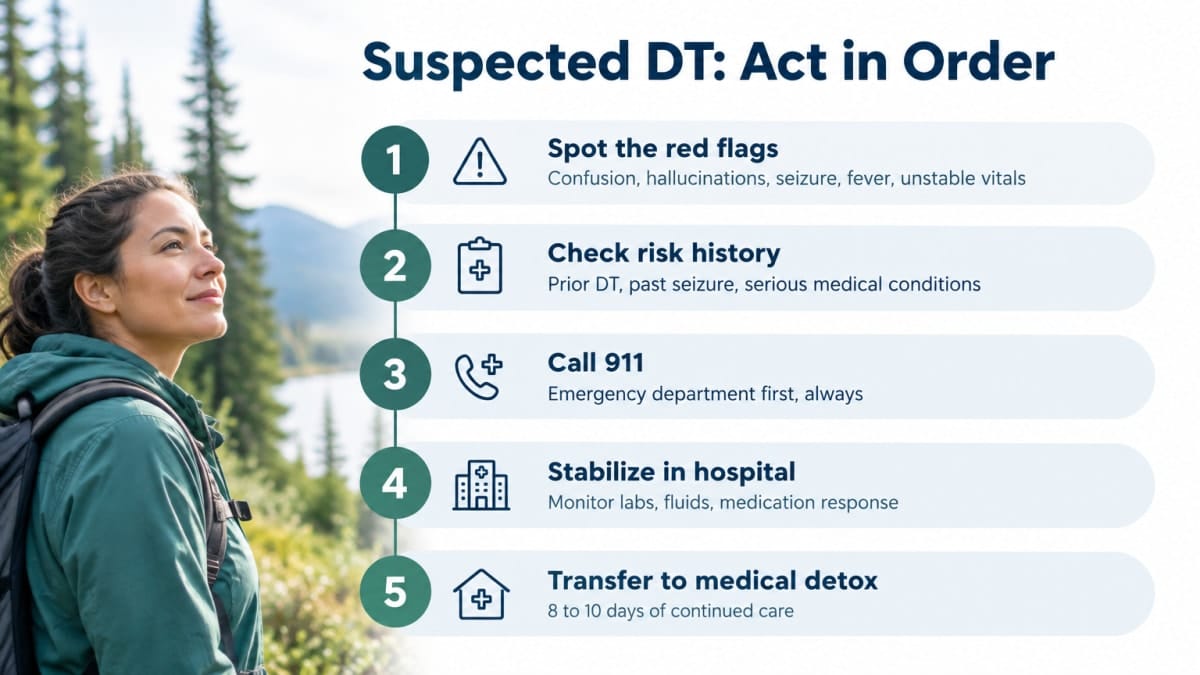
If confusion is in the room, call 911. That is the whole decision tree. Hallucinations that feel real, deep disorientation, a seizure, drenching fevers, blood pressure that swings, or a heart rate that will not come down, those symptoms mean the window for “let me drive them to detox” has closed. Delirium tremens requires a hospital stay, where clinicians can monitor electrolytes, fluids, temperature, pulse, breathing, blood pressure, seizure activity, and medication response in real time.2
The risk factors that push a person into this category are not subtle:
- A past episode of DT
- A prior withdrawal seizure
- Inability to keep oral medication down
- Serious medical conditions on top of heavy drinking3
If any of those are in the picture, the emergency department is the first stop, period. Once the crisis is stable, a medical detox like the one in Milwaukie can take the handoff and start the next 8 to 10 days of care. Order matters here. Hospital first. Detox second. Both are safer than the couch.
What Medically Supervised Detox Actually Feels Like
A Home-Like Setting Instead of a Hospital Gown
If the word “detox” brings up images of fluorescent lights, a thin hospital gown, and a stranger in scrubs asking the same intake questions every four hours, you are not wrong to flinch. That picture keeps a lot of people on the couch longer than they should stay.
A non-hospital medical detox looks and feels different. Picture a residential house in Milwaukie, Oregon, not far from Portland, with real bedrooms, couches, a kitchen where someone is actually cooking dinner, and quiet corners where you can sit outside and breathe. You wear your own clothes. You eat home-cooked meals at a table with other people who understand exactly where you are, because many of the staff have been there themselves. Daily groups give you somewhere to put the fear and the shame. The setting is calmer than a hospital on purpose, so the first days of getting well do not feel like a punishment for being sick.
The Medicine, Monitoring, and People Behind the Door
Home-like does not mean low-care. Behind that front door, registered nurses are on site around the clock, and medical providers round seven days a week. Vital signs get checked on a schedule, not when someone remembers. Withdrawal symptoms are scored, and medication is adjusted to how your body is actually responding, which matters because benzodiazepines, the main medicines used for serious alcohol withdrawal, have to be titrated by someone trained to watch for both under-treatment and over-sedation.5
A typical alcohol detox runs about 8 to 10 days. During that stretch, the team is tracking the same things a hospital would during a crisis, including vital signs and electrolyte shifts, so small problems get caught before they turn into big ones.6 You are not alone with a pill bottle. You are not guessing. And when those days are done, the plan does not stop at the door, because detox is a starting point, not a complete treatment.1
If You’re the Spouse, Parent, or Friend Watching This Happen
What to Say When You Call 911
If you’re the one making the call, you don’t need perfect words. You need the right ones in the first thirty seconds. Dispatchers triage by what they hear, so lead with the facts that move someone up the queue.
Say it like this: “My [husband/mom/friend] has been drinking heavily every day and stopped. He’s confused, seeing things that aren’t there, shaking, sweating, and his heart is racing. I think this is delirium tremens.” Give the address. Say whether a seizure has happened, whether he’s breathing normally, and whether he’s responsive to you. Mention any medications, past DT episodes, or past withdrawal seizures, because those details push the response level up.3
Stay on the line. Unlock the front door. Move pets and anything sharp out of the way. You’re not overreacting. You’re giving the paramedics a running start.
What to Tell a Detox Intake Line
Once the medical crisis is stable, or if symptoms are climbing but DT isn’t in the room yet, the next call is to a medical detox. Intake nurses are not there to judge you. They’re trying to decide, quickly, what level of care fits.
Give them a clear picture:
- How much and how often the person has been drinking
- When the last drink was
- What symptoms you’re seeing right now, including any shakiness, sweating, vomiting, confusion, or hallucinations
- Any history of DT, withdrawal seizures, or past detox stays
- Current medications and major health conditions
- Insurance information if you have it in hand, so they can start verifying benefits
Ask what the next hour looks like. A good intake team will tell you plainly.
Staying Safe During Agitation or Hallucinations
While you’re waiting for help, your job is to keep both of you safe, not to argue with what the person is seeing. Hallucinations during DT feel completely real. Telling someone the spiders aren’t there usually makes the fear worse.
Keep your voice low and even. Use short sentences. Say their name. Dim the lights if bright ones are making things worse. Clear a path to the door. Move knives, car keys, and firearms out of reach. If they’re pacing or swinging, back up and give them space; don’t try to hold them down. If a seizure happens, don’t put anything in their mouth, turn them gently onto their side, and time it.
Then stay close enough to see them, and let the paramedics take it from there.
After the First 72 Hours: What Real Recovery Looks Like
Getting through the first three days is a huge deal. It is also not the end of the story. Detox is a starting point, not a complete treatment, and the evidence is clear that pairing it with longer-term care gives you a real shot at staying well.1 The 72-hour mark is where a lot of people quietly relapse, because the acute danger is gone and the deeper work has not started yet.
Here is what the next 90 days can look like when the handoff is done right. After an 8 to 10 day medical detox in Milwaukie, Oregon, the next step is usually a partial hospitalization program, where you spend most of the day in structured groups and individual therapy and sleep in supportive housing. From there, an intensive outpatient program lets you start rebuilding work and family life while still showing up for several hours of treatment a week. Standard outpatient and alumni support carry the load after that, with people who have been through recovery themselves walking alongside you.
Outcomes get tracked through ERPHealth so the plan keeps adjusting to you, not the other way around. Create your path to recovery one honest step at a time.
A Confidential Next Step for Oregon, SW Washington, and Beyond
If you’ve read this far, you’re already doing the hard part, which is being honest about what’s happening. The next step does not have to be dramatic. It can be a phone call.
Pacific Crest Trail Detox is a non-hospital medical detox in Milwaukie, Oregon, just outside Portland, and we welcome people from Gresham, Beaverton, Salem, Vancouver, Washington, and from out of state when travel is the right call. The intake line is answered by people who understand what you’re feeling because many of them have been where you are. The conversation is confidential and HIPAA-protected. You can ask what detox would look like for your situation, verify your insurance benefits without naming a carrier publicly, and get a straight answer about what the next hour, the next day, and the next 8 to 10 days could hold.
If delirium tremens is already in the room, call 911 first. Once you’re stable, call us. We want to be your last treatment experience, whether we’re your first detox or your fifth.
Check Coverage for Medically Supervised Detox
See whether your plan may help cover care when delirium tremens makes home detox unsafe.
Frequently Asked Questions
Can delirium tremens ever be safely treated at home?
No. Once delirium tremens is in the picture, meaning confusion, hallucinations, severe agitation, or unstable vital signs after heavy drinking stops, a hospital stay is needed.2Mild uncomplicated withdrawal is a different conversation and sometimes fits outpatient care after a clinical assessment, but DT itself is not a condition any family can safely manage at home.
How do I know if what I’m seeing is delirium tremens or regular alcohol withdrawal?
Regular withdrawal is shaky, sweaty, anxious, and miserable, but the person still knows who and where they are. DT adds deep confusion, hallucinations that feel real, a racing heart, fever, and blood pressure that will not settle. A seizure also pushes it into emergency territory. If any of those are present, call 911 instead of waiting to see.
Should I call 911 or drive to a detox center first?
If delirium tremens or a seizure is happening right now, call 911. Paramedics can stabilize breathing, start an IV, and respond to a seizure in seconds. Driving someone in active DT across town is dangerous for both of you. Once they are medically stable in the emergency department, a medical detox can take the handoff and keep the care going.
What happens at a medically supervised detox like Pacific Crest Trail Detox?
You stay in a home-like residential setting in Milwaukie, Oregon, with registered nurses on site around the clock and providers rounding seven days a week. Vital signs and withdrawal symptoms are scored on a schedule, medications are adjusted to how your body responds, and you eat home-cooked meals between daily groups. Detox typically lasts 8 to 10 days.1
How long does alcohol detox usually take, and what comes after?
Medical alcohol detox usually runs about 8 to 10 days. After that, detox is a starting point, not a finished treatment, so the next steps are typically a partial hospitalization program, intensive outpatient, standard outpatient, and alumni support.1That continuum is where the deeper work happens, and it gives you a stronger shot at staying well past the first 72 hours.
Is the call to verify insurance or ask questions actually confidential?
Yes. Calls to Pacific Crest Trail Detox are confidential and HIPAA-protected. You can describe what is happening, ask what detox would look like for your situation, and have your benefits verified without naming a carrier publicly. Nothing you share gets passed to an employer, a family member, or anyone else without your written permission. Ask questions, then decide.
References
- Alcohol Use Disorder: From Risk to Diagnosis to Recovery. https://www.niaaa.nih.gov/health-professionals-communities/core-resource-on-alcohol/alcohol-use-disorder-risk-diagnosis-recovery
- Delirium tremens: MedlinePlus Medical Encyclopedia. https://medlineplus.awsqa.nlm.nih.gov/ency/article/000766.htm
- VA/DoD Clinical Practice Guideline for the Management of Substance Use Disorders Pocket Card. https://healthquality.va.gov/HEALTHQUALITY/guidelines/MH/sud/VADoDSUDCPGPocketCard.pdf
- Alcohol withdrawal syndrome presentations to emergency departments in the United States from 2015 to 2023. https://pubmed.ncbi.nlm.nih.gov/39815821/
- Delirium Tremens: Assessment and Management. https://pmc.ncbi.nlm.nih.gov/articles/PMC6286444/
- Delirium Tremens: A Review of Clinical Studies. https://pmc.ncbi.nlm.nih.gov/articles/PMC11069634/
- Pharmacological Interventions for Alcohol Withdrawal Syndrome Among Hospitalized Adults: A Multicenter Cohort Study. https://pmc.ncbi.nlm.nih.gov/articles/PMC12683996/