


Key Takeaways
- Salem has opioid treatment programs, outpatient counseling, and the 24/7 Marion County Behavioral Health Crisis Center, but residential medical detox beds with round-the-clock staff are scarce locally 3.
- Seizures, confusion, chest pain, or trouble breathing during alcohol or benzo withdrawal are 911 emergencies; 988 and the county crisis center handle non-life-threatening crises regardless of insurance 3.
- Driving an hour north trades convenience for 24/7 medical supervision and a built-in handoff to continuing care, which matters because detox alone carries high return-to-use rates 5.
- Before committing, verify Oregon Health Authority licensing, ask about 24/7 medical staffing, withdrawal medications, day-eight planning, and insurance — including whether OHP is accepted, since not every facility takes it 6, 7.
If You’re Reading This at 2 a.m., Start Here
If you found this page in the middle of the night, you’re already doing something hard. Maybe you’re sitting on the bathroom floor. Maybe you’re watching someone you love shake under a blanket on the couch. Maybe your hands are cold and you don’t know what to type next. Whatever brought you here — take a breath. You’re in the right place to figure out the next step.
Here’s what you need to know up front, before anything else:
If you’re in crisis but not in immediate medical danger, call or text 988. The Marion County Behavioral Health Crisis Center in Salem is also open 24/7 and takes people regardless of insurance or ability to pay 3.
The rest of this guide is for the next decision — the planned one. What Salem has, what sits an hour north in Milwaukie, and how to tell which kind of help fits what you’re facing. You don’t have to figure it all out tonight. Just keep reading.
Crisis Right Now vs. Planned Detox: Knowing Which Door to Walk Through
Signs This Is a Medical Emergency
Some withdrawal symptoms are miserable but survivable. Others can kill a person. You deserve to know the difference.
Call 911 right now if you or the person you’re with has any of these:
- A seizure, or shaking that won’t stop
- Chest pain, a racing heart that won’t slow down, or trouble breathing
- Confusion so deep they don’t know where they are, who you are, or what year it is
- A fever with heavy sweating and a pounding pulse
- Hallucinations — seeing bugs, hearing voices, grabbing at things that aren’t there
- Can’t be woken up, or breathing is slow and shallow (possible overdose)
Alcohol withdrawal and benzodiazepine withdrawal — Xanax, Klonopin, Ativan, Valium — can be life-threatening. This is not something to ride out on the couch with a bucket. If any of these signs show up, hospital first, planning second. The detox decision can wait an hour. Breathing cannot.
Where to Go in Salem Tonight: 988 and the Marion County Behavioral Health Crisis Center
If the situation is scary but not a 911 emergency — overwhelming cravings, suicidal thoughts, panic, early withdrawal that hasn’t turned dangerous yet — you have two solid options tonight, both in Salem, both free to use.
Call or text 988. That’s the national Suicide and Crisis Lifeline. A trained person picks up. You can talk about drugs, alcohol, suicide, or just the fact that you’re falling apart. They won’t send police as a first move for most calls.
The Marion County Behavioral Health Crisis Center is open 24 hours a day, seven days a week, and takes walk-ins regardless of insurance or ability to pay 3. The center provides crisis assessment and stabilization, substance-use support, mobile crisis response if you can’t get there, and peer mentors who have lived what you’re living 3. They can also help connect you to continuing care once the immediate fire is out.
Crisis stabilization is not the same thing as a full medical detox. But tonight, it might be exactly the door you need.
What ‘Planned Medical Detox’ Actually Means
Planned medical detox is a different kind of help. It’s not a 911 call. It’s not a crisis walk-in. It’s a bed, a doctor, and a team waiting for you — scheduled a day or a few days out — in a place built for exactly this.
Here’s what it actually involves: a nurse or doctor checking you over, medication to ease withdrawal symptoms so your body isn’t fighting itself, 24/7 monitoring through the hardest stretch (usually days two through four), and a plan for what happens after your body is stable 4. For opioid use, that often means starting medication like buprenorphine or methadone that keeps cravings and withdrawal manageable 4.
The federal guidance is clear on one thing: short-term supervised withdrawal by itself is not recommended, because the return-to-use rate is high when nothing comes next 5. A real detox program isn’t just the first week — it’s the bridge to what happens in weeks two, four, and twelve. That’s the version worth driving for.
What Salem Actually Has — Honestly
Opioid Treatment Programs, Outpatient Care, and Crisis Stabilization in Marion County
Salem isn’t a treatment desert. You have real options locally, and you should know what they are before anyone talks you into a drive.
Marion County hosts opioid treatment programs (OTPs) — the clinics that dispense methadone and buprenorphine for people diagnosed with opioid use disorder 2. If you’re using heroin, fentanyl, or prescription opioids, these programs can be lifesaving. You go in, you get your medication, you come home. Many offer counseling alongside the medication dose. For someone with stable housing, a supportive person at home, and the ability to show up daily at first, an OTP can be the right level of care.
You’ll also find outpatient counseling and group programs across the Salem area — the kind you attend a few hours a week while you keep living your life. These work well when withdrawal isn’t medically dangerous and you have a safe place to sleep.
And for the hours when things get scary, the Marion County Behavioral Health Crisis Center is open 24/7 and takes anyone regardless of insurance or ability to pay, with assessment, stabilization, mobile response, and peer mentors who’ve been where you are 3.
What Salem is thinner on: residential beds with round-the-clock medical staff watching you through the dangerous days of alcohol or benzo withdrawal, then handing you straight into partial hospitalization and outpatient care without a gap. That’s where the picture changes.
Why Salem Searchers Often Can’t Get the Bed They Need Locally
Here’s the honest part. You might call every number in Salem and still not find an open bed at the level of care you actually need. That’s not your fault, and it’s not because you’re not trying hard enough.
So when you call around and hear “we’re full,” “we have a waitlist,” “we don’t take your insurance,” or “we don’t do medical detox here, we only do outpatient” — you’re bumping into a capacity problem the whole state is working on. The question stops being “what’s closest” and becomes “what’s open, right now, that can actually keep me safe through withdrawal and hand me off to what comes next.” Sometimes the answer is an hour north on I-5. That’s not a failure. That’s the map as it is.
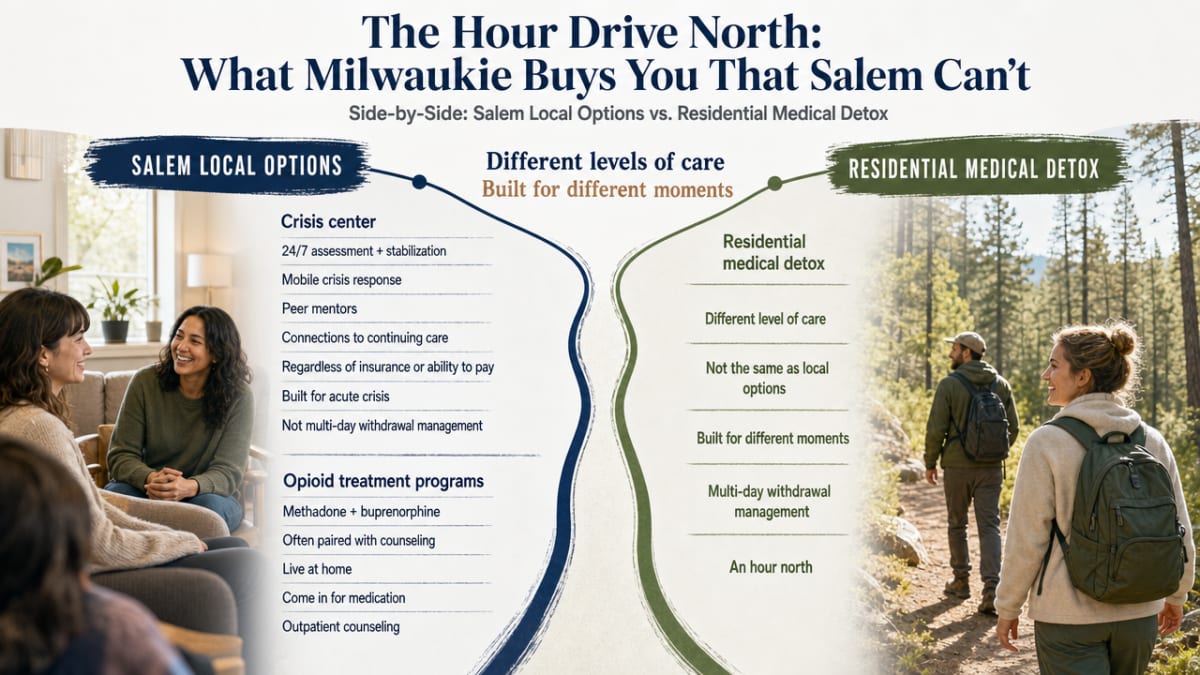
The Hour Drive North: What Milwaukie Buys You That Salem Can’t
Side-by-Side: Salem Local Options vs. Residential Medical Detox
Here’s the clearest way to think about it. Salem’s local options and a residential medical detox program aren’t the same thing wearing different hats — they’re different levels of care, built for different moments.
What Salem offers close to home:
- Marion County Behavioral Health Crisis Center — 24/7 assessment and stabilization, mobile crisis response, peer mentors, and connections to continuing care, regardless of insurance or ability to pay 3. Built for acute crisis, not multi-day withdrawal management.
- Local opioid treatment programs — Marion County clinics that dispense methadone and buprenorphine for people diagnosed with opioid use disorder, often paired with counseling 2. You live at home and come in for your medication.
- Outpatient counseling and groups — a few hours a week while you stay in your own bed and keep your routine.
What a residential medical detox an hour north adds:
- A bed in a home-like setting — not a hospital hallway — with a nurse on shift through the night
- 24/7 medical supervision through the hardest days of alcohol, benzo, or opioid withdrawal
- Medication to ease withdrawal symptoms as your body resets 4
- A built-in handoff to partial hospitalization, intensive outpatient, and alumni support — so day eight doesn’t leave you alone
Neither column is better in the abstract. One is better for your situation. If you’re stable enough to sleep at home and show up to a clinic, local works. If withdrawal is medically risky or everything at home is pulling you back, the drive buys you a container.
Naming the Fear of the Drive: Gas, Kids, Work, Feeling Far From Home
Let’s say it out loud. An hour on I-5 feels like a wall when you’re already exhausted. Who watches the kids. Who tells your boss. How much gas. What if something goes wrong and you’re a county away from everyone who loves you. These aren’t small worries. They’re the reason a lot of people stay stuck in the same loop for another year.
So here’s the honest math. The drive happens once on the way in, and once on the way out. That’s it. Your family can visit. Phones work. Most people take a leave of absence under FMLA, which protects your job for medical care — and withdrawal management counts.
On the kids: a lot of parents put this off because leaving feels like abandonment. It isn’t. A week away so you come home actually present is a gift to them, not a loss. On the gas and the time: a tank of fuel and an hour of road is a smaller price than another ER visit, another lost job, another year.
You’re not weak for being scared of the drive. You’re being honest. Now you get to decide.
Why Detox Alone Isn’t Enough — and What a Real Bridge Looks Like
Here’s the hard truth nobody wants on a brochure: finishing detox is a beginning, not a finish line. Your body stops shaking. Your head clears. And then day eight shows up, and if nothing is built for day eight, the risk doesn’t go away — it changes shape.
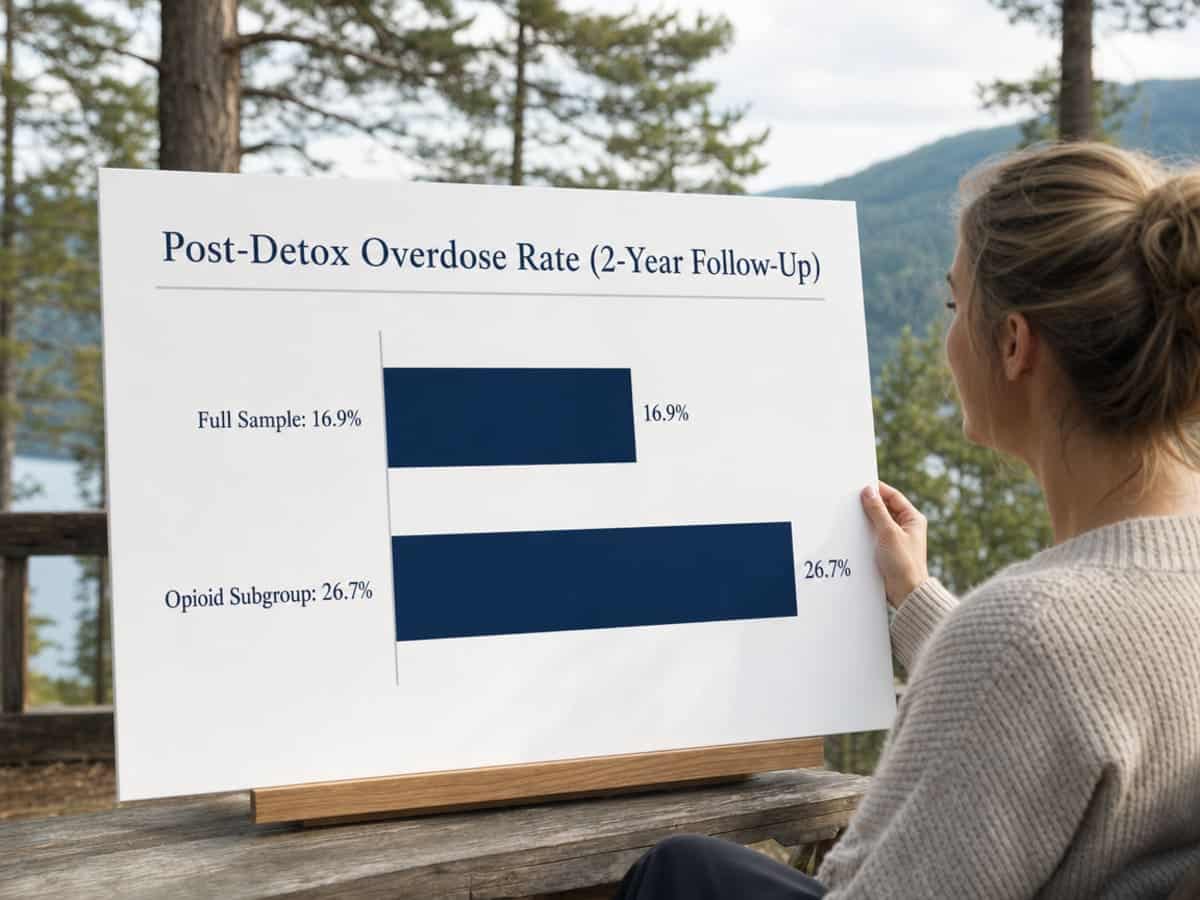
A prospective study that followed 470 adults for two years after detoxification estimated that 16.9% of the full sample experienced a later overdose, and 26.7% of the subgroup with opioid problems did 9. That study is older, it was conducted in Boston, and it looked at multiple substances — so don’t read those numbers as a Salem forecast. Read them as a warning about what happens when detox stands alone. When tolerance drops but nothing is in place for the weeks that follow, people get hurt.
The good news is that the picture changes when a bridge is built. Research on people after medically managed opioid withdrawal found that medication treatment, residential treatment, or the combination of the two was associated with substantially reduced mortality compared to no further care 10. Federal guidance says the same thing plainly: short-term supervised withdrawal by itself isn’t recommended, because return-to-use rates are high 5.
So a real bridge looks like this — detox flows directly into partial hospitalization or intensive outpatient, medication for opioid use continues when it’s the right call, counseling starts while you’re still in the house, and someone has a plan for your first weekend home. That’s the version of help that holds.
How to Tell If a Detox Facility Is Actually Safe and Real
Oregon Licensing: What to Verify Before You Pack a Bag
Before you give anyone your credit card or get in a car, make sure the place is real. In Oregon, residential substance-use programs — including detox — are supposed to be licensed and inspected by the state 7. That’s your first and easiest check.
Ask directly: “Are you licensed by the Oregon Health Authority as a residential substance-use treatment facility?” A real program will answer yes without hesitation and can tell you their license number. If the person on the phone dodges, changes the subject, or doesn’t know what you’re asking about, that’s your answer — keep looking.
You can also cross-check through the Oregon Health Authority’s provider directory and your own health plan’s network list 7. Licensing doesn’t tell you everything — it won’t tell you if the staff is kind or if the beds are comfortable — but it tells you the state has eyes on the place. That’s the floor you don’t want to go below.
Questions to Ask on the First Phone Call
You’re going to be tired when you make this call. Write these down ahead of time so you don’t have to think.
- “Do you have a doctor or nurse on-site 24/7 during detox?” For alcohol and benzo withdrawal, this isn’t optional.
- “Do you offer medication to ease withdrawal — like buprenorphine or methadone for opioids?” Federal guidance supports medication as a core part of opioid care 4.
- “What happens on day eight? Do you connect me to partial hospitalization, outpatient, or aftercare — or do I figure that out alone?” Short-term withdrawal management by itself isn’t recommended because return-to-use rates are high 5.
- “Do you take my insurance? What will I actually owe?”
- “Is the setting home-like or hospital-style?” Both can work. You deserve to know which you’re walking into.
- “Can my family visit or call?”
If the answers feel honest and specific, that’s a good sign. If they feel rehearsed or vague, trust that feeling. You’re allowed to call somewhere else.
Paying for It: Insurance, OHP, and Parity Rules That Protect You
Money is the question nobody wants to ask out loud when someone is sick. Ask it anyway. Knowing the number before you commit saves you a different kind of pain later.
Start with what you have. If you have the Oregon Health Plan (OHP), the good news is that OHP covers behavioral-health services, including medication-assisted treatment, detoxification, residential treatment, and counseling, and you don’t need a primary-care referral to get help for alcohol or drug use 6. The honest part: not every facility accepts OHP. Pacific Crest Trail Detox does not. If OHP is your only coverage, your path points toward Salem-area and other Oregon providers that take it — call OHP’s behavioral-health line or your coordinated care organization to find an open bed.
If you have commercial insurance — through your job, a spouse, the marketplace, or Medicare — call the member services number on your card and ask three plain questions: Is this facility in-network? What’s my deductible and what will I actually owe out of pocket? Does this level of care need prior authorization?
If an insurer makes you jump through more hoops for detox than for a surgery, that’s where parity comes in. Federal and Oregon parity rules require health plans to treat behavioral-health benefits comparably to medical ones — similar copays, similar treatment limits, and prior authorization that’s no more restrictive than for physical health care 8. If something feels wrong, the Oregon Division of Financial Regulation can help you push back. You’re allowed to appeal. You’re allowed to ask twice.
What the First 72 Hours Actually Look Like
Not knowing what’s about to happen to your body is its own kind of fear. Here’s a plain-language picture of the first three days inside a medical detox, so your brain has something to hold onto.
Day one. You check in. Someone takes your vitals, asks what you’ve been using, how much, how often, and when you last used. A nurse or doctor builds a plan tailored to you. If you’re withdrawing from opioids, medication like buprenorphine or methadone may start that same day to ease symptoms 4. For alcohol or benzos, medications are used to prevent seizures and keep your heart rate and blood pressure safe. You’ll likely sleep badly. That’s normal.
Day two and three. This is usually the hardest stretch — sweats, chills, body aches, anxiety, stomach trouble. Staff check on you around the clock, adjusting medication so you’re not white-knuckling it 4. You eat when you can. You rest. Someone sits with you if you need it.
By the end of 72 hours, the worst of the physical storm is often behind you — and a counselor is already talking with you about what comes next, so day eight isn’t a cliff.
For Families: What to Do When the Person You Love Can’t Research This Themselves
If you’re the one making calls because your person can’t — because they’re sick on the couch, or in denial, or too ashamed to pick up the phone — this part is for you.
First, breathe. You don’t have to solve everything today. Your job right now is small and specific: find a safe place for the next few days. That’s it. The rest can come after.
Here’s a short list of what actually helps:
- Make the call yourself. You can gather information on someone else’s behalf. Ask about open beds, insurance, what withdrawal risks they handle, and how someone gets admitted.
- Know the crisis door. If things turn dangerous tonight — seizures, confusion, suicidal talk — the Marion County Behavioral Health Crisis Center is open 24/7 and takes people regardless of insurance 3. 988 works too.
- Have the insurance card ready. Facility, member ID, group number. If it’s OHP, know that not every program accepts it 6.
- Pack a small bag ahead of time. Comfortable clothes, phone charger, ID, medication list.
- Protect yourself. You can’t pour from an empty cup. Loving someone through this is its own kind of marathon.
Making the call is already a win. You’re doing hard, loving work.
Check if your detox stay is covered now
Quickly confirm your insurance coverage before making the drive for detox help.
Frequently Asked Questions
Is there a medical detox center in Salem, Oregon?
Salem has outpatient counseling, opioid treatment programs that dispense methadone and buprenorphine, and the Marion County Behavioral Health Crisis Center for 24/7 crisis stabilization regardless of insurance 2, 3. What’s thinner locally are residential beds with round-the-clock medical staff for alcohol or benzo withdrawal. If that’s what you need, you may have to look beyond city limits — including an hour north in Milwaukie.
What should I do if someone is in acute withdrawal in Salem right now?
If you see seizures, confusion, chest pain, trouble breathing, or someone can’t be woken up, call 911. Alcohol and benzo withdrawal can kill. For a scary but non-emergency moment — cravings, suicidal thoughts, early withdrawal — call or text 988, or go to the Marion County Behavioral Health Crisis Center, open 24/7 and free regardless of insurance 3. Planning for detox can happen once the person is safe.
Is the drive from Salem to Milwaukie worth it for detox?
It depends on what you need. If local outpatient or an opioid treatment program fits your situation, stay close. If withdrawal is medically risky, or if home keeps pulling you back, the hour on I-5 buys 24/7 medical supervision in a home-like setting with a built-in bridge to partial hospitalization, outpatient care, and alumni support — because detox alone isn’t recommended as the whole plan 5.
Does Pacific Crest Trail Detox accept the Oregon Health Plan (OHP)?
No. Pacific Crest Trail Detox does not accept OHP. If OHP is your only coverage, that’s okay — OHP does cover behavioral-health services, including detox, residential treatment, medication-assisted treatment, and counseling, and no primary-care referral is required to ask for help 6. Call OHP’s behavioral-health line or your coordinated care organization to find an in-network bed in Salem or elsewhere in Oregon.
How long does medical detox take, and what happens after?
Most medical detox stays run three to seven days, depending on the substance and your health. Opioid withdrawal often starts easing when medication like buprenorphine or methadone begins; alcohol and benzo withdrawal need careful medical management 4. After detox, a real program hands you into partial hospitalization or intensive outpatient care — because medication and continuing treatment after withdrawal are tied to substantially lower mortality than no further care 10.
How can I tell if a detox facility is licensed and safe?
Ask the facility if they’re licensed by the Oregon Health Authority as a residential substance-use treatment program — real programs will tell you yes and can share their license number 7. Cross-check through OHA’s provider directory or your insurance network list. Then ask whether a nurse or doctor is on-site 24/7 during detox, what medications they use, and how they connect you to care after day seven.
References
- Programmatic and Fiscal Inventory of Primary. https://www.oregon.gov/adpc/Documents/HB3321%20Report%2009.15_FULL%20REPORT%20WITH%20APPENDICES.pdf
- Overdose-Related Services and Projects Summary by Oregon County. https://www.oregon.gov/oha/PH/PREVENTIONWELLNESS/SUBSTANCEUSE/OPIOIDS/Documents/CountyServiceSummary.pdf
- Marion County opens expanded Behavioral Health Crisis Center. https://www.oregon.gov/oha/erd/pages/marion-county-opens-expanded-behavioral-health-crisis-center.aspx
- TIP 63: Medications for Opioid Use Disorder. https://www.samhsa.gov/sites/default/files/pep21-02-01-002.pdf
- Federal Guidelines for Opioid Treatment Programs. https://library.samhsa.gov/sites/default/files/federal-guidelines-opioid-treatment-pep24-02-011.pdf
- Oregon Health Plan (OHP) Behavioral Health Coverage. https://www.oregon.gov/oha/hsd/ohp/pages/behavioral-health.aspx
- Oregon Health Authority: Residential Treatment Facilities. https://www.oregon.gov/oha/hsd/amh-lc/pages/rt.aspx
- Mental health parity – Oregon Division of Financial Regulation. https://dfr.oregon.gov/insure/health/understand/coverage/pages/mental-health-parity.aspx
- Overdose after detoxification: a prospective study. https://pubmed.ncbi.nlm.nih.gov/17280803/
- Association between mortality rates and medication treatment after opioid withdrawal. https://pmc.ncbi.nlm.nih.gov/articles/PMC7854020/